
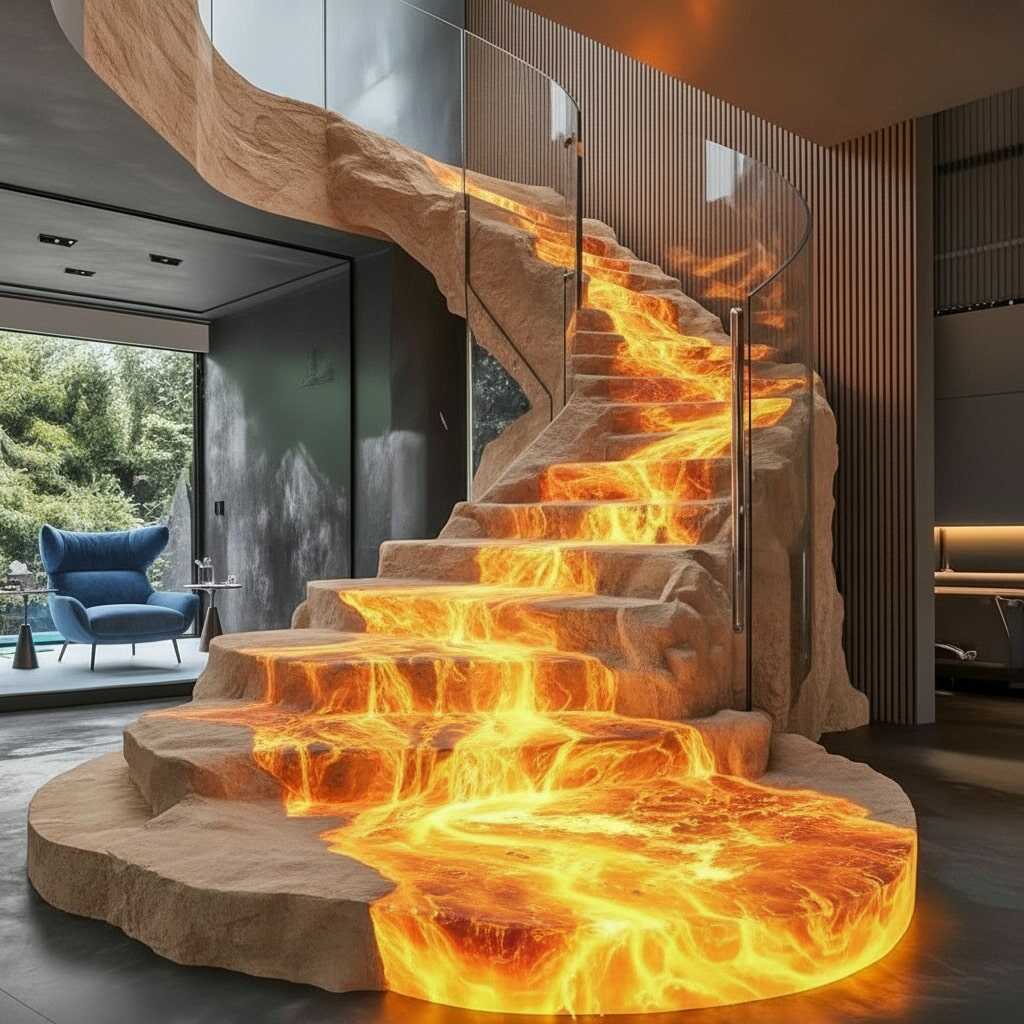
In the evolving lexicon of contemporary interior design, spaces are no longer mere containers for function—they are dynamic canvases for emotional resonance, narrative depth, and elemental symbolism. Among the most arresting manifestations of this paradigm shift is the Lava Themed Staircase: a sculptural, experiential centerpiece that transcends utilitarian purpose to become a visceral, almost mythic presence within the home or public building. This design archetype does not whisper—it erupts. It draws from the raw, primal energy of volcanic phenomena—not as a literal reproduction of molten rock, but as a poetic interpretation of its movement, texture, chromatic intensity, and transformative power.
A Lava Themed Staircase is not defined solely by color (though deep crimsons, obsidian blacks, molten oranges, and glowing amber accents are common). Rather, it is an orchestration of materiality, form, light, and spatial choreography. It evokes the slow, viscous flow of basaltic lava down a mountainside; the sudden, fissured violence of a pyroclastic surge; the cooling crust that hardens into glassy obsidian or porous pumice. It is architecture in flux—arrested mid-motion—giving occupants the sensation of ascending or descending through the very pulse of the Earth.
This article explores the Lava Themed Staircase as more than a decorative flourish. It is an ontological statement—a declaration that interiors can embody natural forces, that design can channel geology and cosmology, and that the act of moving between levels can be a ritual of transformation. In three parts, we will excavate the conceptual foundations, dissect its material and formal expressions, and reflect on its symbolic resonance within modern spatial consciousness.
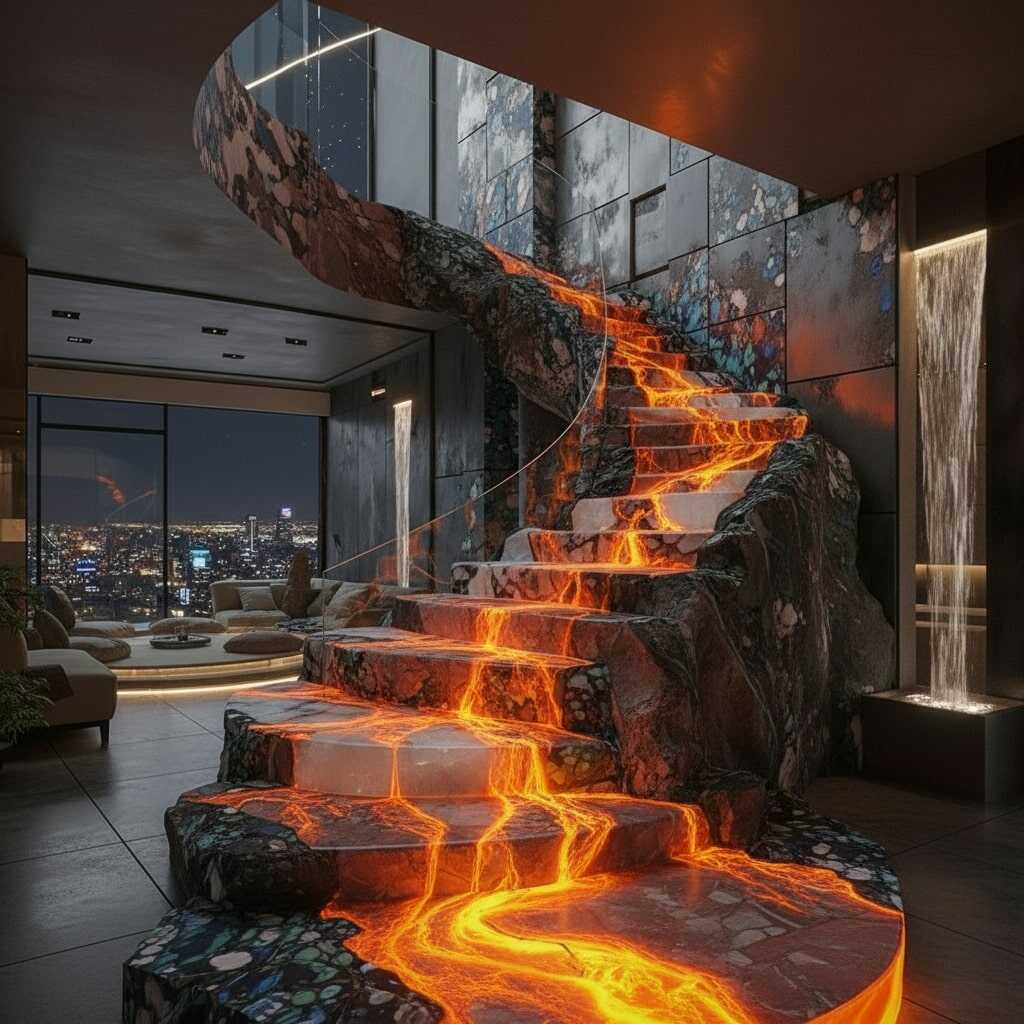
Part I: Conceptual Foundations — Geology as Metaphor, Heat as Narrative
The Lava Themed Staircase arises not from trends, but from a deep cultural re-engagement with the Earth’s elemental forces. In an age increasingly marked by climate anxiety and ecological awareness, designers are turning to geologic time—and its most dramatic processes—as a source of grounding and meaning. Volcanism, in particular, embodies paradox: destruction and creation, chaos and order, danger and fertility. Lava flows obliterate landscapes, yet over millennia, they give rise to the richest soils and most biodiverse ecosystems. This duality mirrors the modern human condition: striving for stability while acknowledging inevitable flux.
Within this context, the staircase—traditionally a passive connector—becomes a narrative conduit. In architecture, vertical circulation is symbolic. Stairs represent ascent: aspiration, revelation, transcendence. A Lava Themed Staircase reinterprets this ascent as emergence—as rising through layers of the Earth’s crust, as participation in a slow, planetary metamorphosis. Each step is not merely a tread, but a stratum; each landing, a cooling plateau.
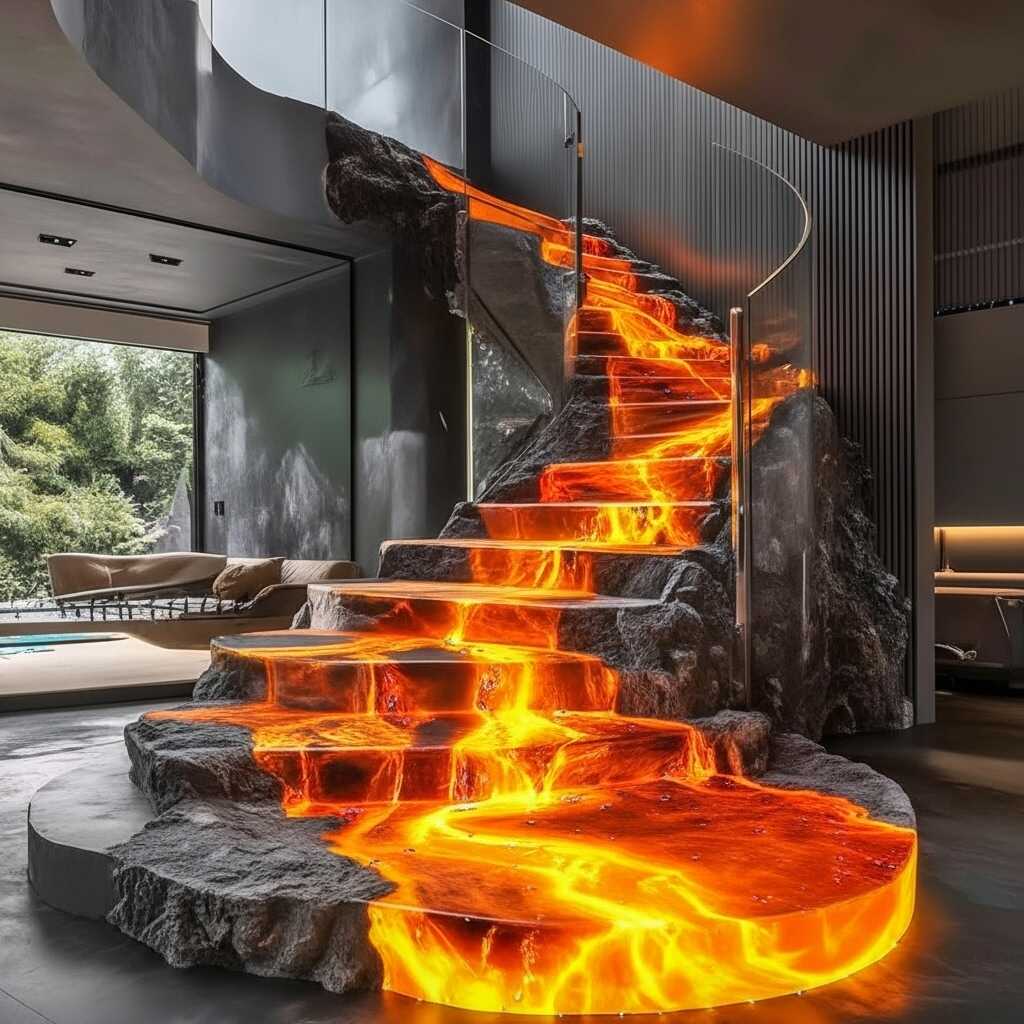
Consider the psychological impact. Unlike the cool neutrality of minimalist staircases or the ornate predictability of classical spirals, a lava-inspired design elicits embodied cognition. The eye follows the undulating handrail—perhaps forged in blackened steel with a rippled, ropy pāhoehoe-like surface. The underlighting casts a subterranean glow, shifting from deep magmatic red at the base to golden incandescence near the summit—mimicking the thermal gradient of rising magma. One does not simply use this staircase; one experiences it somatically. The pulse quickens. The ambient temperature may not change, but the mind perceives heat, pressure, movement.
This conceptual layer is crucial: the Lava Themed Staircase is not kitsch. It avoids the literal—no plastic “lava lamps” embedded in risers, no cartoonish bubbling effects. Instead, it operates through abstraction and allusion. A Japanese concept, yūgen—profound grace and subtlety—guides its execution. The theme is suggested, not shouted. A single vein of amber resin tracing a crack in a basalt-textured concrete step; a shadow gap that glows like a fissure at dusk; a handrail that tapers and fractures like cooling scoria—all these micro-gestures accumulate into an immersive geopoetic environment.
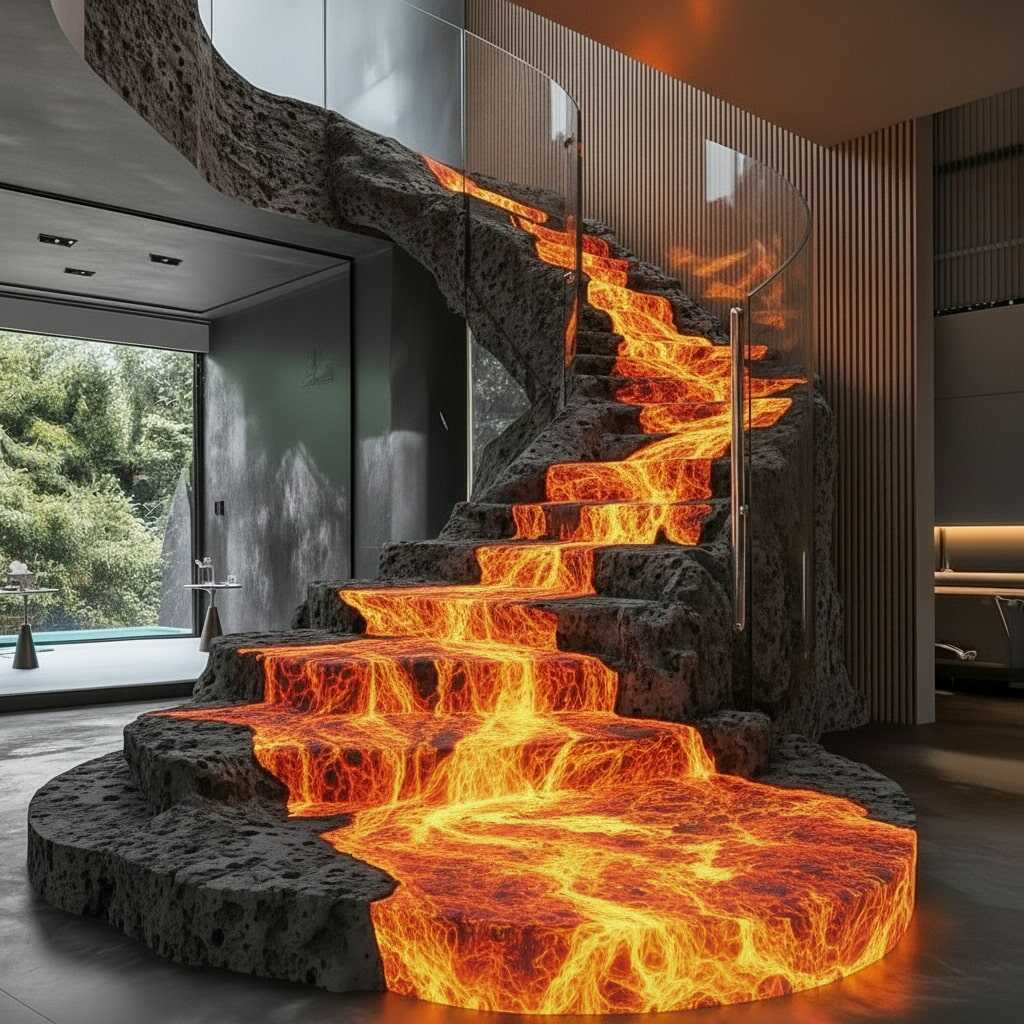
Part II: Material Alchemy and Formal Expression — Sculpting the Unsolid
To manifest the Lava Themed Staircase authentically, designers engage in a form of material alchemy—transforming inert substances into evocations of living fire. This requires deep collaboration between architects, material scientists, artisans, and lighting designers. The result is a hybrid object that straddles sculpture, engineering, and geological homage.
1. The Chromatic Spectrum: Beyond Red
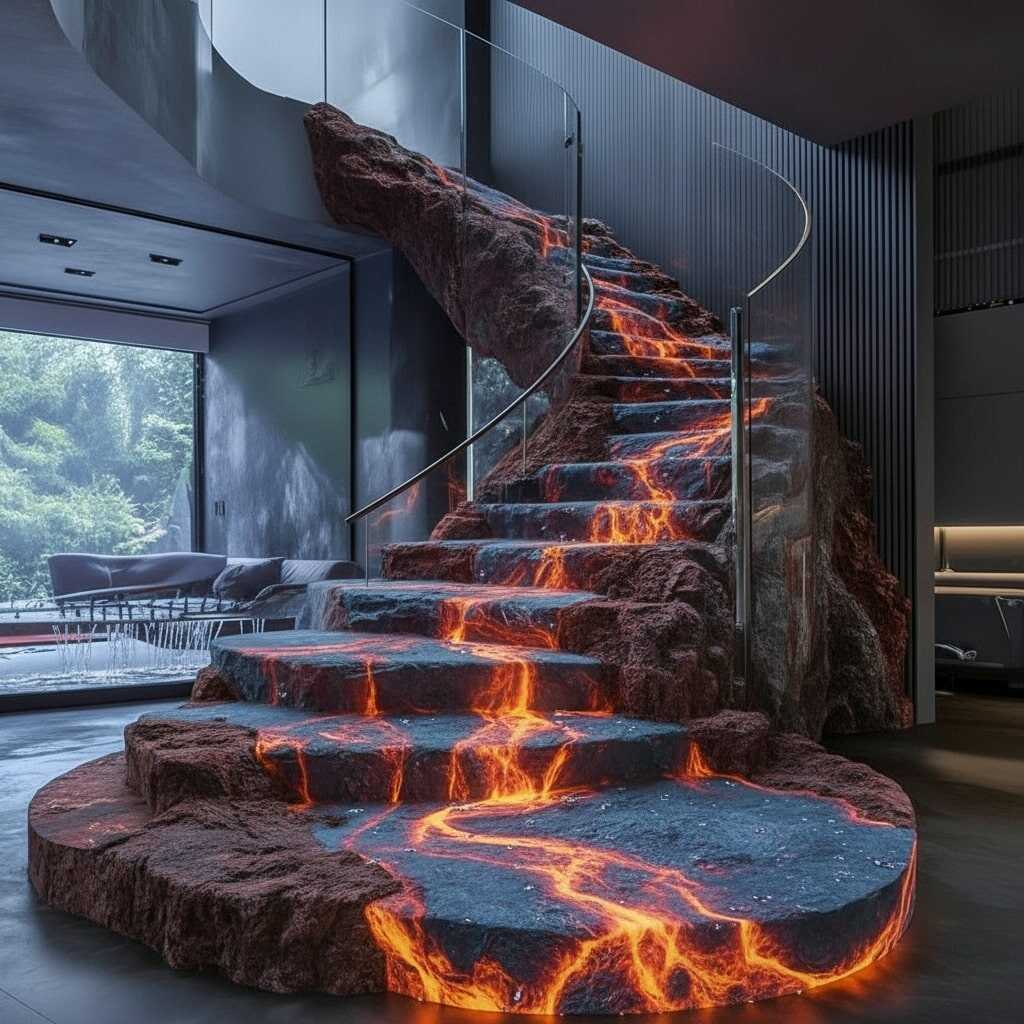
While crimson dominates the popular imagination of lava, real volcanic flows exhibit a far richer palette. Basaltic lavas glow in hues ranging from near-white (1,200°C) to cherry red (800°C) to dull maroon (600°C). As they cool, surface oxidation creates iridescent blues, purples, and metallic sheens. A sophisticated Lava Themed Staircase harnesses this complexity.
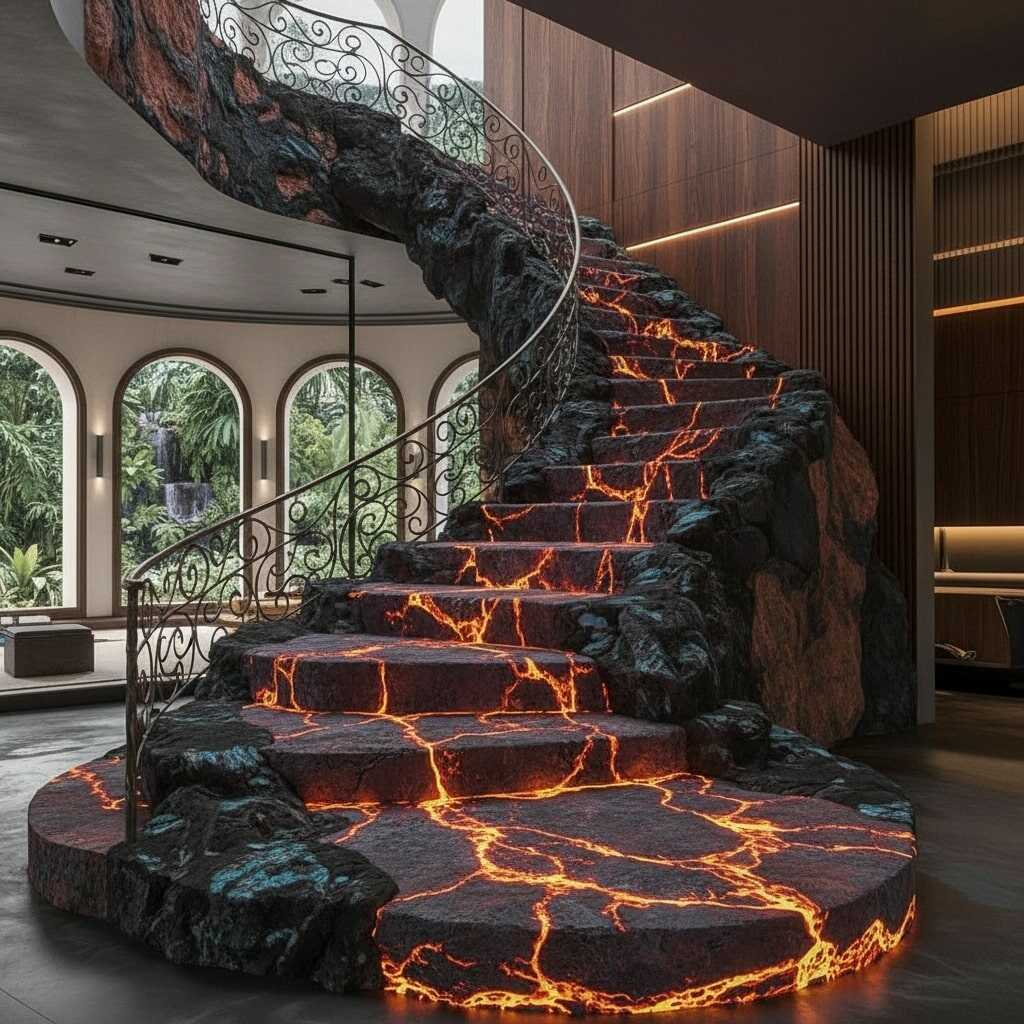
- Primary Structure: Often composed of board-formed concrete stained with iron oxide pigments, achieving a deep, earthen rust that suggests weathered igneous rock. Alternatively, blackened steel—treated with heat patinas—creates surfaces that shimmer with undertones of violet and bronze, echoing the iridescence of magnetite-rich flows.
- Accents and Inlays: Thin veins of resin, backlit with programmable LEDs, simulate active fissures. The resin may be tinted with dichroic pigments: shifting from molten gold at one angle to blood-crimson at another. Some designers embed fragments of real obsidian or volcanic glass (sourced ethically), polished to mirror-like finishes that reflect and fracture the ambient light—like cooled lava lakes under moonlight.
- Thermal Illusion: Advanced radiant heating systems are sometimes integrated—not for warmth, but for perception. Subtle warmth radiating from the treads enhances the psychological realism, blurring the line between visual metaphor and sensory truth. This is not discomfort; it is atmospheric verisimilitude.
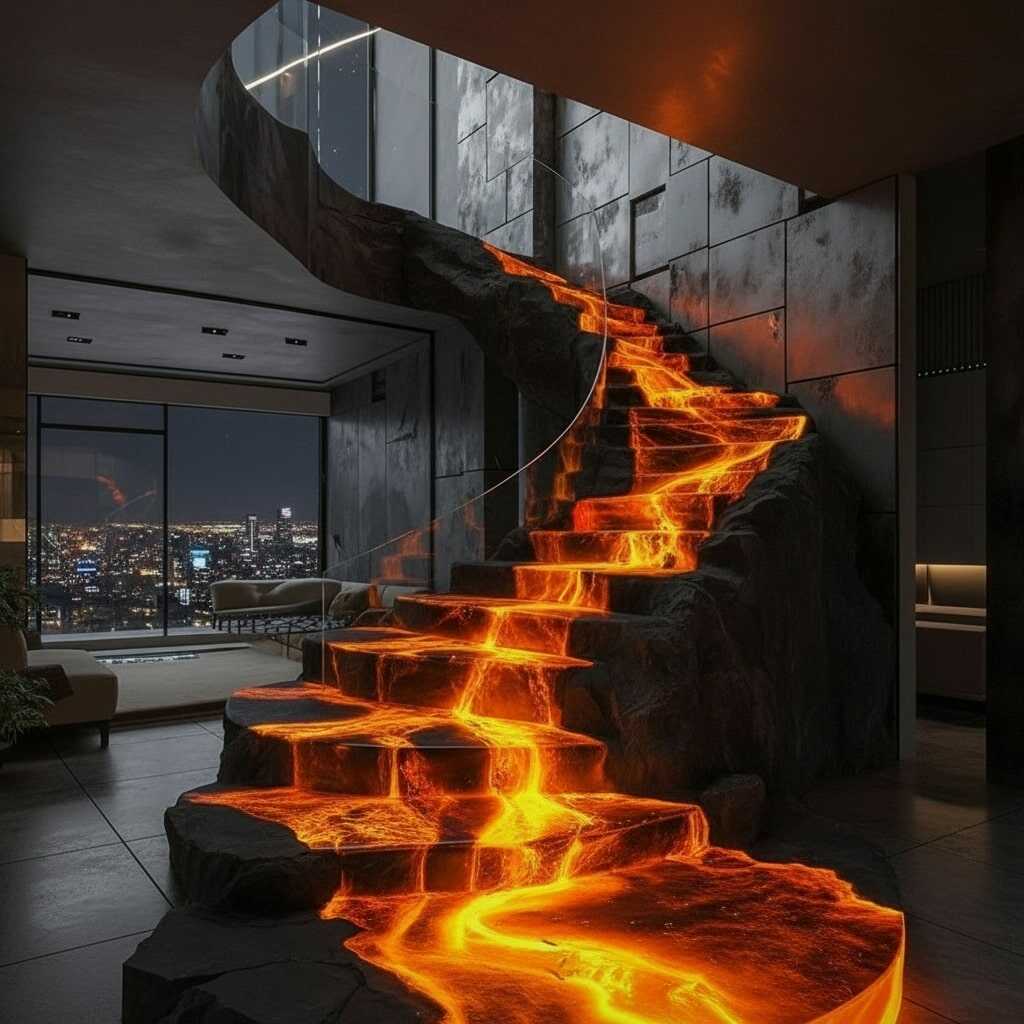
2. Morphology: Flow, Fracture, and Stratification
Formally, the Lava Themed Staircase rejects rigid orthogonality. Instead, it embraces the fluid dynamics of real lava:
- Pāhoehoe Inspired Flow: Smooth, ropy surfaces—achieved through custom CNC-milled molds or hand-sculpted plaster overlays—define handrails and soffits. These undulations mimic the ropy texture formed when viscous lava advances and its surface skin wrinkles. The effect is both organic and alien, familiar yet disquieting.
- ʻAʻā Fragmentation: In contrast, certain sections may adopt the rough, clinker-like texture of ʻaʻā flows—jagged, fragmented, and chaotic. This is realized through exposed aggregate concrete with sharp basalt chips, or laser-cut steel panels assembled in fractured tessellations. Such textures appear at landings or transitional zones, suggesting turbulence or sudden cooling.
- Columnar Jointing: Some avant-garde iterations reference the hexagonal cooling columns of places like Giant’s Causeway or Devils Postpile. Steel or concrete supports are cast in polygonal modules, stacked or cantilevered to suggest natural fracture patterns—geometry born not of human logic, but of thermal contraction.
3. Light as Magma: The Subterranean Glow
Lighting is not an accessory—it is the lifeblood of the Lava Themed Staircase. Traditional overhead fixtures are abandoned in favor of integrated, low-temperature LED systems that emulate geothermal luminescence:
- Underside Illumination: Hidden channels along the stringers or beneath floating treads emit a soft, directional glow upward, casting long, dramatic shadows that animate the textures. Color temperature shifts gradually: 2200K (deep amber) at the base, rising to 3000K (warm white-gold) at the top—mirroring the ascent from mantle to surface.
- Fissure Lighting: Thin linear LEDs trace intentional cracks in the material, pulsing imperceptibly in randomized, slow cycles—like distant magma movement sensed rather than seen. Some systems respond to motion, brightening subtly as one approaches, as if the Earth itself awakens to human presence.
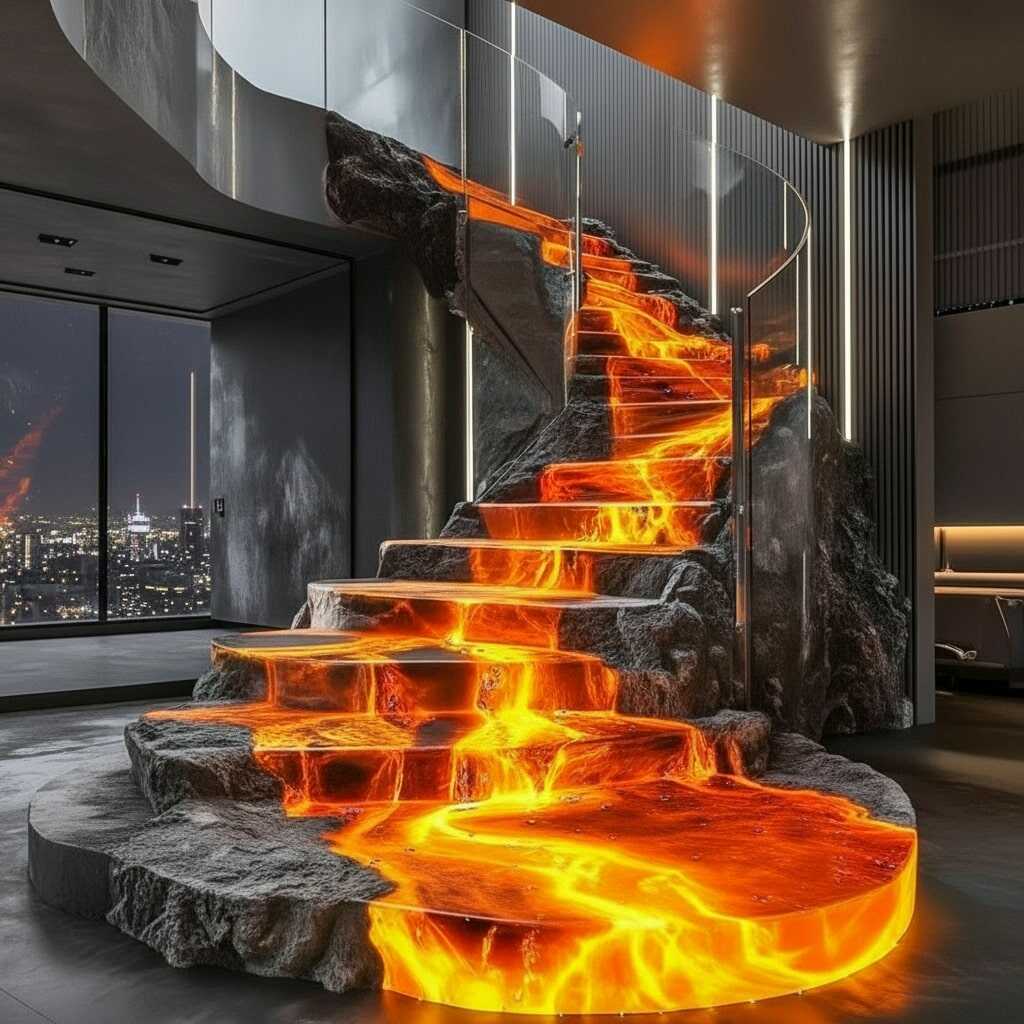
- Reflective Surfaces: Mirrored or polished obsidian panels on adjacent walls multiply the glow, creating infinite regressions of light—suggesting depth, cavernous voids, or the reflective surface of a lava lake.
This interplay of material, form, and light ensures that the Lava Themed Staircase is never static. It changes with the time of day, the season, the weather outside. At dawn, it glows like cooling embers; at midnight, it pulses like a dormant volcano holding latent fire.
Part III: Symbolic Resonance — The Staircase as Threshold of Transformation
What, ultimately, does the Lava Themed Staircase signify in the broader discourse of modern interior design? It is more than aesthetic innovation—it is a philosophical stance.
In a world saturated with digital interfaces and ephemeral experiences, this design asserts the power of material presence. It roots the inhabitant in deep time and planetary processes. To walk its path is to be reminded: we dwell on a dynamic, breathing planet. Our structures are temporary; the Earth’s rhythms are eternal.
Moreover, the staircase becomes a liminal threshold—a space between states. In myth and ritual, thresholds are charged with potential. They are where transformation occurs: the hero descends into the underworld; the initiate crosses into new knowledge. The Lava Themed Staircase literalizes this. Descending, one moves toward heat, pressure, the unconscious, the generative core. Ascending, one emerges—reforged, like new land born from eruption.
This symbolism resonates deeply in contemporary life. We navigate constant personal and societal “eruptions”: upheavals in identity, technology, ecology. The Lava Themed Staircase does not deny this turbulence; it aestheticizes it, dignifies it, integrates it into the architecture of daily life. It says: instability is not failure—it is the condition of becoming.
Architects like Tadao Ando have long used concrete and light to evoke serenity and introspection. The Lava Themed Staircase extends this legacy into a more volatile, vital register. It is Ando’s tranquility ignited—Zen contemplation meeting Hesiod’s Theogony, where fire is the spark of creation.
Further, it challenges the sterility of late-modern minimalism. Where white-box interiors erase history and geography, the Lava Themed Staircase re-inscribes them. It is site-specific in spirit, even when not geographically tied to a volcano. It asks: What forces shaped this place? What energies lie beneath? How do we honor the violence and beauty of our origins?
In public buildings—a museum atrium, a university research center, a civic hall—the Lava Themed Staircase becomes a communal symbol. It invites collective pause, shared wonder. Children press their palms to its warm surfaces; elders recall stories of ancient eruptions; scientists see in its forms a familiar, beloved geology. It democratizes awe.
And in the home—a private sanctuary—it personalizes the epic. A homeowner ascending to their study does not merely change floors; they enact a micro-myth of resilience and renewal. Each morning, the ritual reaffirms: Emergence is possible. From pressure, form. From heat, light.
Conclusion: The Enduring Glow — Design as Geological Witness
The Lava Themed Staircase is not a passing fad. It is a symptom of a deeper recalibration in how we inhabit space—a return to elemental consciousness, to narrative depth, to the sublime in the everyday. It exemplifies what philosopher Timothy Morton calls “ambient poetics”: an awareness of the vast, interconnected systems in which human life is embedded—and an attempt to give those systems architectural expression.
Unlike fireplaces—once the literal and symbolic hearth of the home—the Lava Themed Staircase does not contain fire; it is fire, transmuted. It is safe, yet never tame. It is controlled, yet alive with the memory of eruption. It invites reverence without religiosity, awe without fear.
As climate change renders Earth’s geologic volatility more visible—melting permafrost, rising seas, intensifying wildfires—the Lava Themed Staircase offers a paradoxical comfort: the acknowledgment of impermanence as a source of meaning. It does not promise stasis. Instead, it celebrates process—the slow, magnificent, sometimes terrifying process by which worlds are made and remade.
In the end, the most successful Lava Themed Staircase is one that does not merely catch the eye but alters perception. It lingers in memory like the afterimage of staring into flame. It transforms transit into pilgrimage. And in doing so, it fulfills the highest ambition of interior design: not to decorate space, but to deepen time.
For in every step taken upon its glowing path, we are reminded—not of where we are going, but of where we come from: the molten heart of a living planet, still cooling, still creating, still rising.