
In an era of escalating urban density, rising real estate costs, and the growing appeal of minimalist, intentional living, the boundaries between personal, social, and functional spaces are dissolving. Studio apartments—often no more than 300 to 500 square feet—are no longer just temporary arrangements for students or young professionals; they are chosen habitats for creatives, remote workers, couples, and even families embracing compact living. Simultaneously, shared living environments—from communal housing collectives to multi-generational homes—demand innovative solutions that respect individual privacy while nurturing collective harmony. Amidst this landscape, architecture no longer speaks solely in square footage or ceiling heights. It whispers through clever elevation, vertical stratification, and spatial choreography—principles embodied, perhaps most accessibly, in a single, transformative piece of furniture: the elevated loft bed.
Far from a mere dormitory relic or a child’s novelty, the elevated loft bed represents a quiet revolution in spatial philosophy. It is not simply a sleeping platform raised off the ground; it is a catalyst for rethinking how we inhabit, divide, and experience interior space. When we lift the bed—a zone traditionally dominant in footprint and static in function—we do more than reclaim floor area. We create layers: a vertical zonation where rest, work, socialization, and storage can coexist without competing. In doing so, the elevated loft bed becomes an instrument of autonomy in shared dwellings and a generator of possibility in constrained studios. This article explores how this seemingly straightforward adaptation fundamentally reshapes the experience of cohabitation and compact living—not by adding space, but by redefining it.

Part I: Vertical Zoning—Liberating the Ground Plane
At its core, the power of the elevated loft bed lies in its ability to decouple function from footprint. In conventional layouts, the bed occupies a central, immovable quadrant of the room—a horizontal anchor that dictates circulation, limits furniture placement, and often renders corners underutilized. By lifting the sleep zone—typically between 5.5 and 7.5 feet high—the entire floor plane beneath is released, fluid and unobstructed.
This liberated ground becomes a canvas for intention. In a studio apartment, the space beneath the loft can evolve into a fully equipped home office: desk aligned with natural light, bookshelves flanking the work surface, a rolling chair gliding freely across hardwood. Or it might become a compact living room: a low-slung sofa, a round coffee table, a floor lamp casting a warm pool of light—an intimate gathering nook that feels distinct, even sacred, despite occupying the same footprint as the bed above. The visual and psychological separation is reinforced not by walls, but by elevation: looking up to sleep, looking out to engage.

Crucially, this vertical zoning introduces temporal rhythm into spatial design. During the day, the loft recedes visually—the bed, perhaps adorned with a simple curtain or integrated cabinetry—becomes background. Life unfolds below: cooking, reading, yoga, hosting friends. At night, ascending the ladder or stairs becomes a ritual of transition, a physical and mental ascent into rest. This separation of waking and sleeping spheres, rare in studios, fosters healthier circadian alignment and emotional decompression.
In shared living—whether with roommates, partners, or family—this stratification fosters autonomy without isolation. Consider two roommates in a one-bedroom unit. One loft bed over a dedicated desk and pinboard; the other, perhaps at standard height, paired with a daybed in the communal zone. Each individual claims a vertical territory: sleep, work, and personal storage vertically integrated. Noise, movement, and light disturbances are minimized not by distance (impossible in tight quarters), but by vertical displacement. A late-night reader below need not wake the sleeper above, just as early risers can prepare coffee without tiptoeing past a ground-level bed.
The elevated loft bed, then, is not about maximizing utility alone—it’s about cultivating spatial dignity. It allows each function to breathe, each occupant to inhabit their domain with intentionality. The floor is no longer a contested resource; it becomes a shared commons, thoughtfully curated rather than chaotically negotiated.

Part II: Psychological Architecture—Privacy, Identity, and Ritual in Compact Environments
Beyond square footage, the elevated loft bed operates on a profound psychological level. In constrained or shared spaces, the erosion of personal boundaries can lead to chronic low-grade stress, a sense of exposure, or the feeling of perpetually “performing” domesticity. The loft bed reintroduces thresholds—not physical doors, but perceptual ones—that signal transition and containment.
The ascent to the sleeping platform is inherently ritualistic. Whether via a minimalist ladder, floating stairs, or integrated shelving steps, the act of climbing is a somatic cue: you are leaving the active world behind. At the summit, even without walls, the loft enclosure—a low railing, a partial canopy, draped fabric—creates an intimate envelope. This is not confinement; it is nesting. The body feels protected from above and sides; sightlines to the room below narrow, reducing visual stimuli. Studies in environmental psychology affirm that partial enclosures, especially overhead ones, trigger parasympathetic responses—the body registers safety, facilitating deeper rest.
Moreover, the elevated sleeping loft becomes a site of personal curation. Here, individuals layer identity in ways impossible in ground-level arrangements dominated by circulation paths. A string of fairy lights, a small framed print, a folded textile at the foot of the mattress—these are not mere decorations; they are territorial markers, affirmations of self in a shared or minimal environment. The loft becomes a private gallery, a sanctuary scaled to the body. For young adults in transitional housing, artists in live-work spaces, or elders in multi-generational homes, this vertical privacy is not indulgence—it is essential infrastructure for mental well-being.

In shared studios—say, partners navigating work-from-home life—the loft enables asynchronous living. One partner can sleep soundly above while the other quietly reads or works below, bathed in a focused pool of light that doesn’t spill upward. The loft acts as an acoustic buffer, softening footsteps, keyboard taps, or the murmur of a podcast. This isn’t about silence; it’s about selective permeability. The space permits coexistence without constant synchronization—a radical kindness in intimate cohabitation.
Even lighting becomes an expressive tool. Under-bed zones can be brightly lit for productivity, while the loft remains dimmed with warm, indirect sources—perhaps LED strips beneath the frame or a small pendant within the sleeping nook. This micro-climate of light reinforces functional separation and supports circadian health: cool, bright light below for alertness; warm, low light above for melatonin production.
The elevated loft bed, therefore, transcends ergonomics. It is architecture in miniature—a vessel for psychological sovereignty. It acknowledges that in small or shared spaces, feeling private is as vital as being private.

Part III: Social Fluidity and Spatial Storytelling
Perhaps the most unexpected transformation wrought by the elevated loft bed is its impact on social dynamics and spatial narrative. In traditional layouts, furniture dictates behavior: a bed in the center makes conversation awkward; a sofa pushed against a wall limits gathering. The loft bed, by contrast, invites reconfiguration. With the bed removed from floor-level dominance, the ground plane becomes inherently more social, more democratic.
A studio with an elevated loft bed naturally encourages communal postures. The open floor invites a circular rug, floor cushions, a low table—configurations that promote face-to-face interaction, not passive TV-watching from parallel sofas. Dinner guests can sit cross-legged on the floor, sharing a meal beneath the loft, the sleeper above a gentle, non-intrusive presence. The space feels generous, even if its dimensions are modest, because sightlines remain open, circulation is intuitive, and no single object commands the room.
In co-living houses or communal studios, multiple loft beds can create a subtle hierarchy of intimacy. A sleeping loft facing a window might belong to the early riser who welcomes dawn light; another tucked behind a screen might house the night owl. These micro-variations—orientation, height, enclosure—allow residents to self-select their ideal balance of exposure and retreat, fostering a sense of belonging on their own terms. Shared spaces remain vibrant below, while individual lofts become quiet chapters in a collective story.
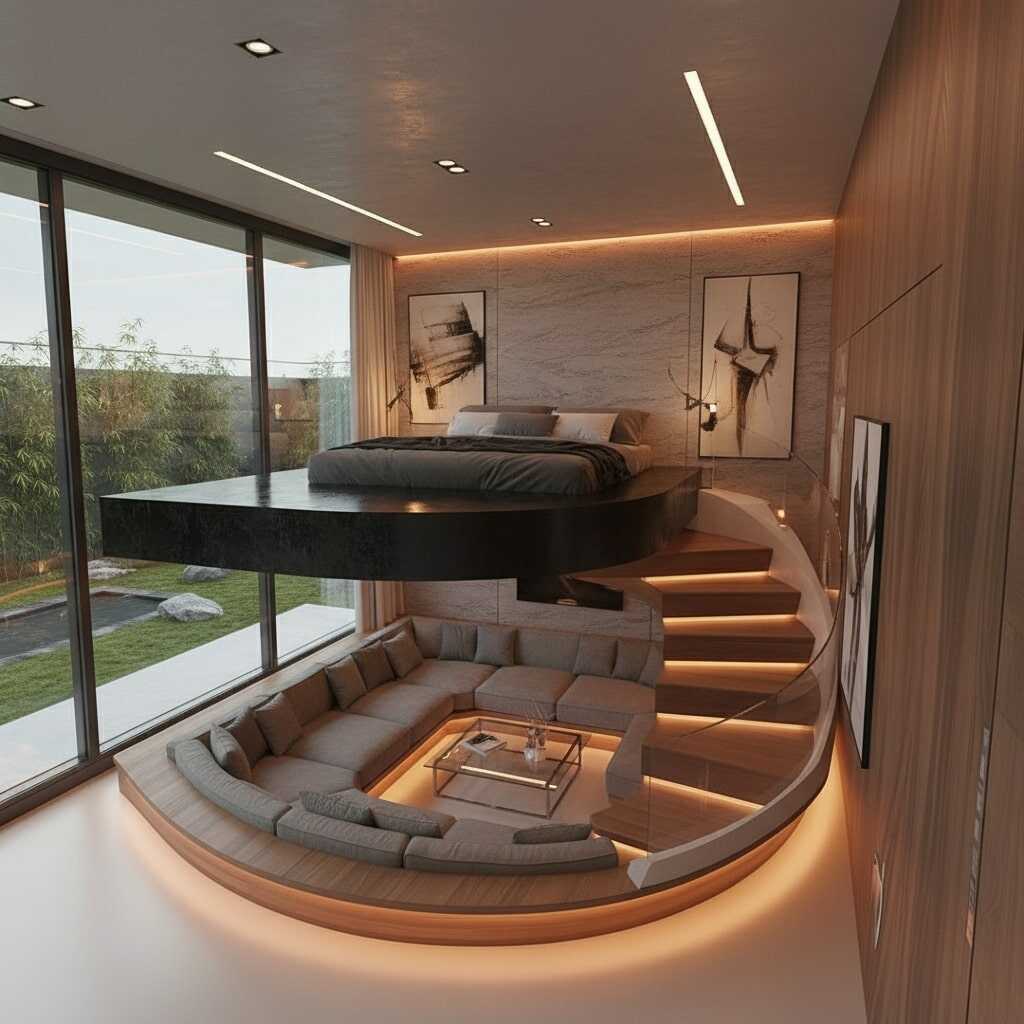
Indeed, the loft bed encourages spatial storytelling. A carefully designed loft—perhaps with integrated shelving that displays books and ceramics, a small plant suspended from the frame, a textile that cascades partway down—becomes a visual focal point, a testament to its occupant’s aesthetic and values. It is not hidden; it is celebrated. In this way, the loft bed resists the anonymity of minimalism. It insists that even in small spaces, personality has room to rise.
Furthermore, the verticality it introduces fosters kinesthetic engagement. Climbing, reaching, adjusting—these small physical acts reconnect us to our bodies and our environment. In an age of sedentary screen life, the simple act of ascending to bed becomes a micro-movement practice, a reminder that living well is not just about efficiency, but about embodied presence.
The loft also blurs the line between domestic and imaginative space. For children in shared family studios, a loft bed becomes a castle turret, a spaceship cockpit, a reading perch above the world. For adults, it evokes childhood treehouses or monk’s cells—spaces of retreat that are both practical and poetic. This resonance with archetypal sanctuaries deepens the emotional resonance of the home.

Conclusion: Elevation as Empowerment
The elevated loft bed is far more than a clever space-saving hack. It is a quiet manifesto for living differently in the 21st century—a rejection of the flat, partitioned, functionally segregated home in favor of fluid, layered, human-scaled environments. It acknowledges that space is not just physical—it is psychological, social, and deeply personal.
In studios, it transforms constraint into creativity, turning square footage limitations into opportunities for vertical expression and functional harmony. In shared living, it fosters respect—not through distance, but through thoughtful stratification, allowing autonomy to flourish within interdependence. It restores ritual to daily life, privacy to openness, and dignity to density.
Ultimately, the elevated loft bed speaks to a deeper yearning: not just to fit into our spaces, but to thrive within them. It invites us to look up—not out of necessity, but out of possibility. To climb, to nest, to descend renewed. In a world where so much feels compressed and compromised, the act of lifting the bed becomes an act of elevation—not just of furniture, but of living itself.
The future of housing may lie in micro-units and co-living experiments, but its soul will be shaped by gestures like this—simple, human, and profoundly transformative. The elevated loft bed does not solve the housing crisis. But it does something perhaps more vital: it reclaims the home as a site of agency, imagination, and grace—even when the walls are close, and the ceiling is shared.