
In the quiet corridors of design history, functionality has long reigned supreme—especially in utilitarian spaces such as the bathroom. Toilets, in particular, have been steadfast symbols of hygiene and necessity, their forms honed over centuries for efficiency, durability, and minimal aesthetic intrusion. Yet in recent years, a quiet revolution has blossomed from the most unexpected of places: a toilet shaped like a pineapple, a watermelon, a lemon, or even a cluster of grapes. This is not kitsch for kitsch’s sake. This is the Fruit Themed Toilet—a bold declaration that even the most private and pragmatic of objects can be a canvas for imagination, joy, and artistic reinvention. In this convergence of the botanical and the bathroom, we witness a rare alignment: where whimsy meets functional art, and the ordinary is transfigured into the extraordinary.

The Fruit Themed Toilet is not merely a novelty object. It is a cultural artifact, a philosophical gesture, and a design paradox made tangible. It challenges the assumption that serious design must be austere, that utility cannot coexist with delight. By embedding the organic vibrancy of fruit—nature’s most generous and sensuous offerings—into the architecture of sanitation, designers engage in a profound act of subversion. They remind us that cleanliness need not be sterile; that privacy need not be somber; that even in our most vulnerable moments, beauty can reside.
This article explores the Fruit Themed Toilet not as a product, but as a concept—a poetic rupture in the fabric of domestic routine. Through three interwoven lenses—The Anatomy of Playful Subversion, Botanical Symbolism and the Ritual of Renewal, and The Toilet as Sculptural Sanctuary—we will delve into what this object means, how it reshapes our relationship with space and self, and why such playful seriousness matters in an increasingly homogenized world.
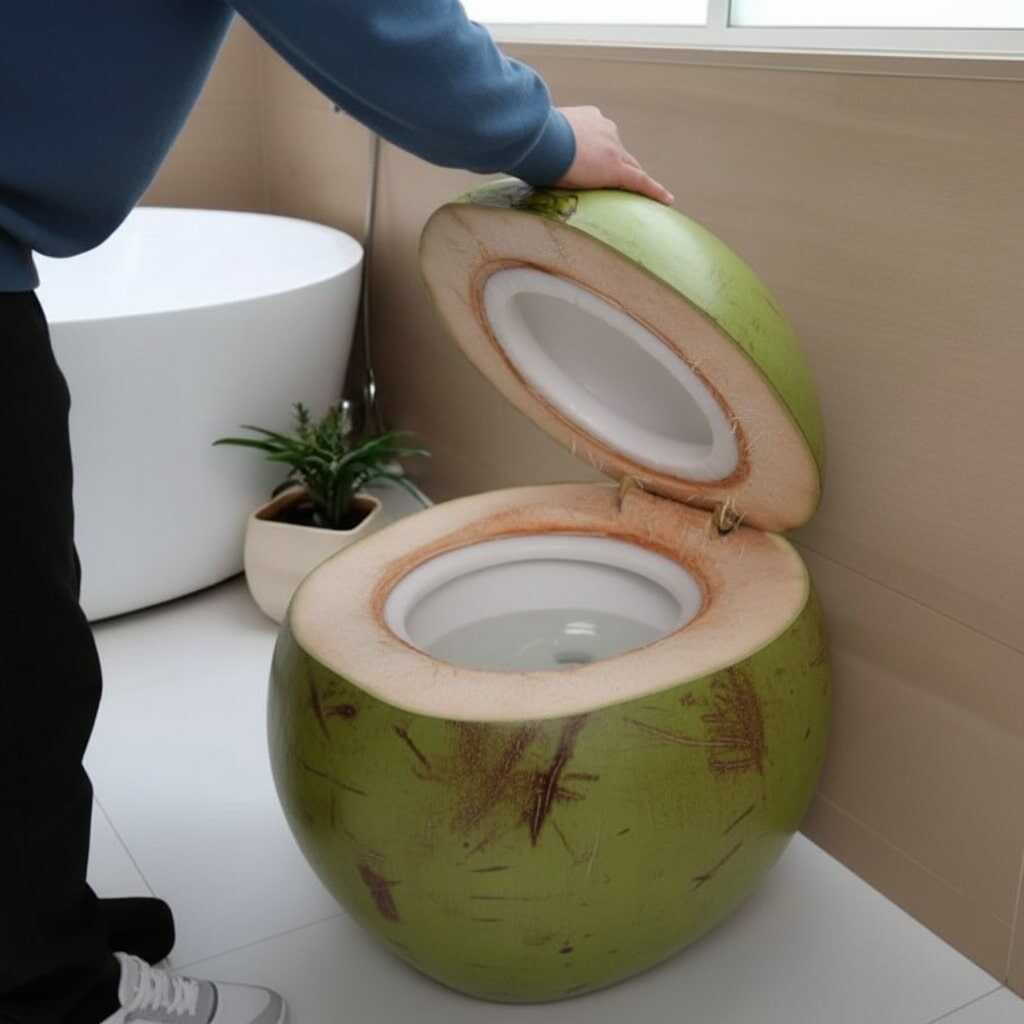
The Anatomy of Playful Subversion
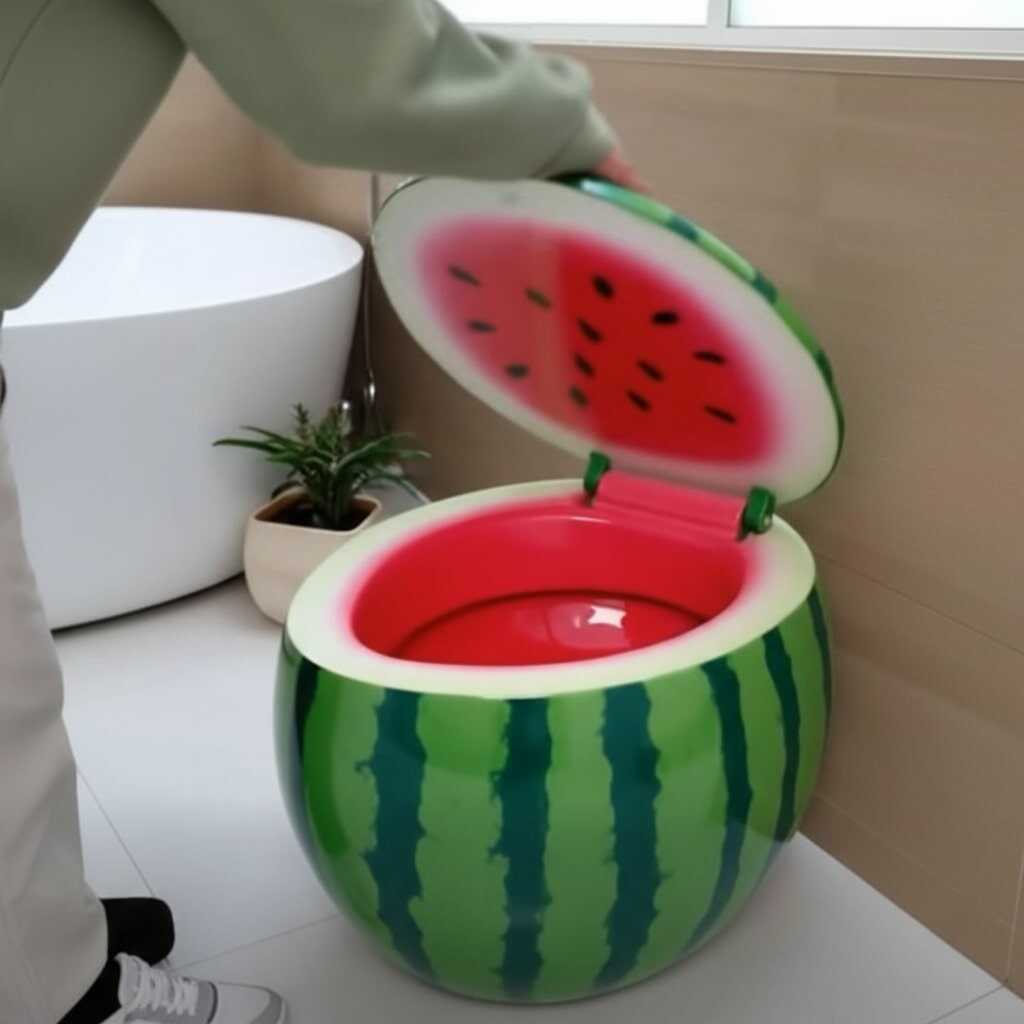
To call the Fruit Themed Toilet “whimsical” is accurate—but incomplete. Whimsy implies caprice, lightness, a fleeting spark of fancy. While it certainly possesses these qualities, its deeper resonance lies in subversion: the gentle but deliberate unsettling of expectations. Consider the cognitive dissonance produced by encountering a watermelon-slice toilet seat—the rind rendered in glossy green enamel, the flesh in blushing pink ceramic, the seeds as matte black inlays. One expects clinical white porcelain; one receives summer’s sweetness, sliced open and offered without irony.
This dissonance is intentional and meaningful. Functional objects, particularly those associated with bodily elimination, are culturally coded as unseen—to be hidden behind closed doors, scrubbed free of personality, stripped of narrative. The Fruit Themed Toilet, by contrast, insists on visibility, on personality, on narrative. It dares to ask: Why must this object be invisible? Why must it refuse its own presence?
The subversion operates on multiple levels. First, materially: fruit is soft, perishable, juicy, and abundant; porcelain is hard, enduring, cool, and refined. The fusion of these material identities—rendering the ephemeral in the eternal—creates a tactile paradox. A lemon-shaped cistern does not just look like a lemon; it becomes one, immortalized in ceramic, its zest forever suspended in glaze. This act of preservation echoes ancient traditions—think of Roman mosaics depicting bountiful harvests in bathhouses, or Renaissance frescoes of bacchanalian feasts adorning monastic refectories—where abundance was celebrated even in spaces of discipline and purification.
Second, semantically: fruit carries rich linguistic and symbolic baggage. It is associated with temptation (the apple in Eden), knowledge (the pomegranate in Persephone’s myth), fertility (the fig), hospitality (the pineapple), and vitality (the orange). To introduce these associations into the bathroom—an arena typically linked to waste, shame, or clinical detachment—is to reframe the entire experience. The act of elimination is no longer merely biological; it becomes part of a larger cycle: ingestion, digestion, release, renewal. The Fruit Themed Toilet becomes an altar to this cycle—small, personal, and profoundly human.
Finally, spatially: bathrooms are often the smallest, most neglected rooms in the home. Yet a Fruit Themed Toilet demands attention. It reclaims the bathroom as a site of aesthetic intention, transforming it from a utilitarian pitstop into a curated chamber of reflection. A pineapple toilet, with its spiky crown and textured shell, evokes tropical escapism; a cluster-of-grapes model suggests Dionysian joy. In each case, the toilet ceases to be background noise and becomes the room’s centerpiece—a functional sculpture that invites pause, even reverence.
This playfulness is not trivial. As psychologist D.W. Winnicott argued, play is the foundation of creativity, empathy, and authentic selfhood. A Fruit Themed Toilet invites play—not in the sense of childishness, but in the radical openness to reimagining the given. It whispers: What if? What if necessity could sing? What if utility could bloom?
Botanical Symbolism and the Ritual of Renewal
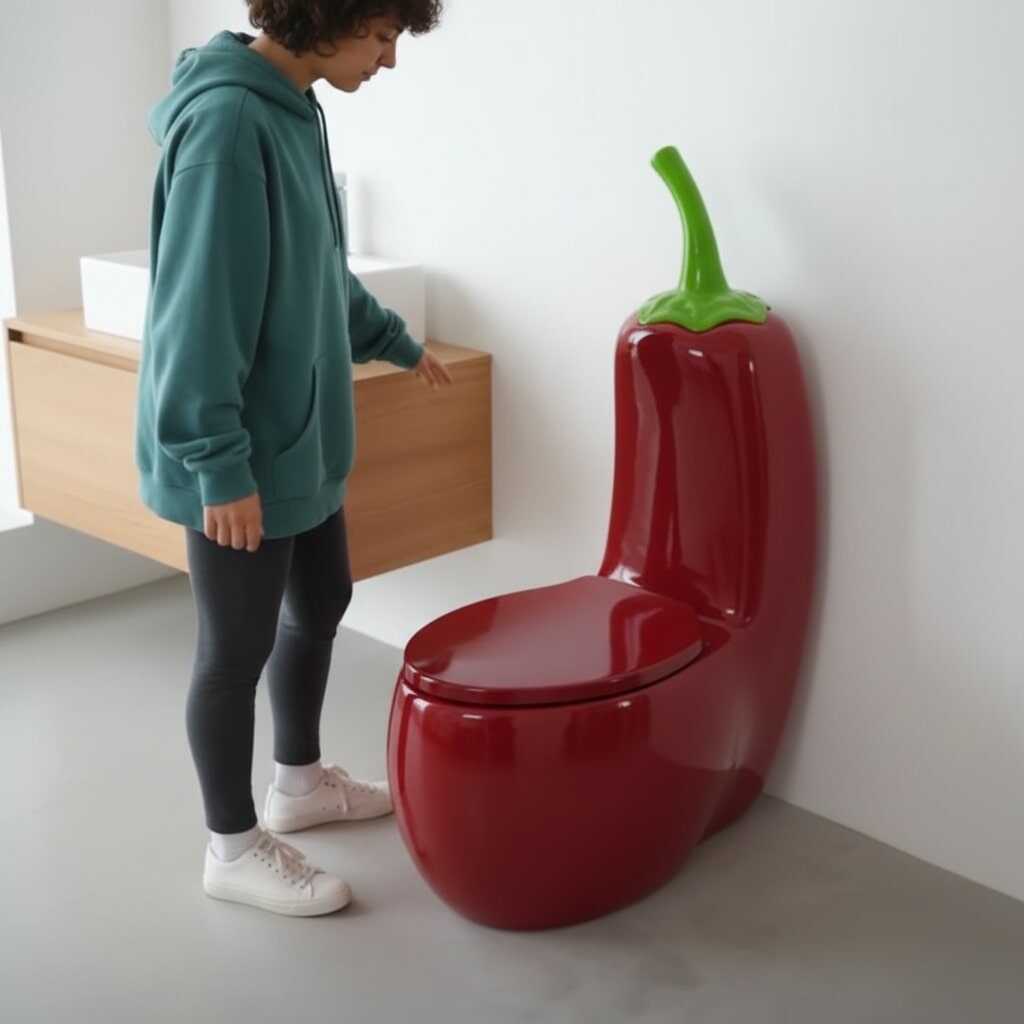
At its core, the Fruit Themed Toilet engages in a quiet dialogue between two primal forces: decay and regeneration. Fruit, in its natural state, is a perfect emblem of this tension. It ripens, it overflows, it falls, it rots—and from that rot, new life springs. This cyclical truth is mirrored in the very function of the toilet: a vessel for release, for cleansing, for making space for what comes next.
The symbolism deepens when we consider specific fruits and their mythological, cultural, and sensory associations.
Take the pineapple, historically a symbol of welcome, luxury, and hospitality. In colonial America, hosting a pineapple at a banquet signified the host’s generosity and social standing—a rare, imported treasure offered to honored guests. To shape a toilet after this fruit is to extend hospitality not to others, but to oneself. It says: You, too, deserve welcome. You, too, merit ceremony—even here, in the quiet chamber of release. The pineapple’s crown—a ring of sharp, leafy spikes—becomes a regal flourish atop the cistern, transforming the flush into a coronation of self-care.
Or consider the pomegranate, revered across Mediterranean and Middle Eastern traditions as a symbol of life, death, and rebirth. In the Greek myth of Persephone, her consumption of six pomegranate seeds binds her to the underworld for six months each year—the origin of winter. Yet this descent is not an end; it is a necessary phase in the agricultural cycle. A pomegranate-themed toilet, then, evokes this mythic return: the descent into the bowl as a seasonal retreat, the flush as Persephone’s ascent, heralding spring. Here, elimination is not loss—it is participation in a sacred rhythm.
The watermelon, with its vivid dichotomy of green rind and crimson interior, speaks to duality: protection and vulnerability, restraint and abundance. Its high water content—over 90%—links it intrinsically to hydration, purification, and refreshment. A watermelon toilet, then, becomes an icon of rehydration—not just of the body, but of the spirit. After the release, one is rinsed, reset, rebalanced. In hot climates, where watermelon is both sustenance and relief, such a toilet resonates as a microcosm of environmental harmony.
Even the humble lemon, with its sharp acidity and bright hue, carries layered meaning. In many cultures, lemons ward off evil and purify spaces—their scent cleanses, their juice disinfects. A lemon toilet, gleaming in citron-yellow glaze, becomes an apotropaic object: a guardian against stagnation, a beacon of clarity. Its very presence suggests that cleansing is not only physical, but energetic—clearing not just waste, but psychic residue.
This botanical symbolism transforms the bathroom into a secular temple of renewal. The ritual of using the toilet—often rushed, mechanical, even shameful—is reframed as a mindful act of participation in natural cycles. One does not merely dispose; one returns. One does not merely flush; one releases with intention. The Fruit Themed Toilet becomes a silent teacher, reminding us that decay feeds growth, that emptiness makes room for fullness, and that even our most private acts are part of a vast, interconnected ecology.
The Toilet as Sculptural Sanctuary
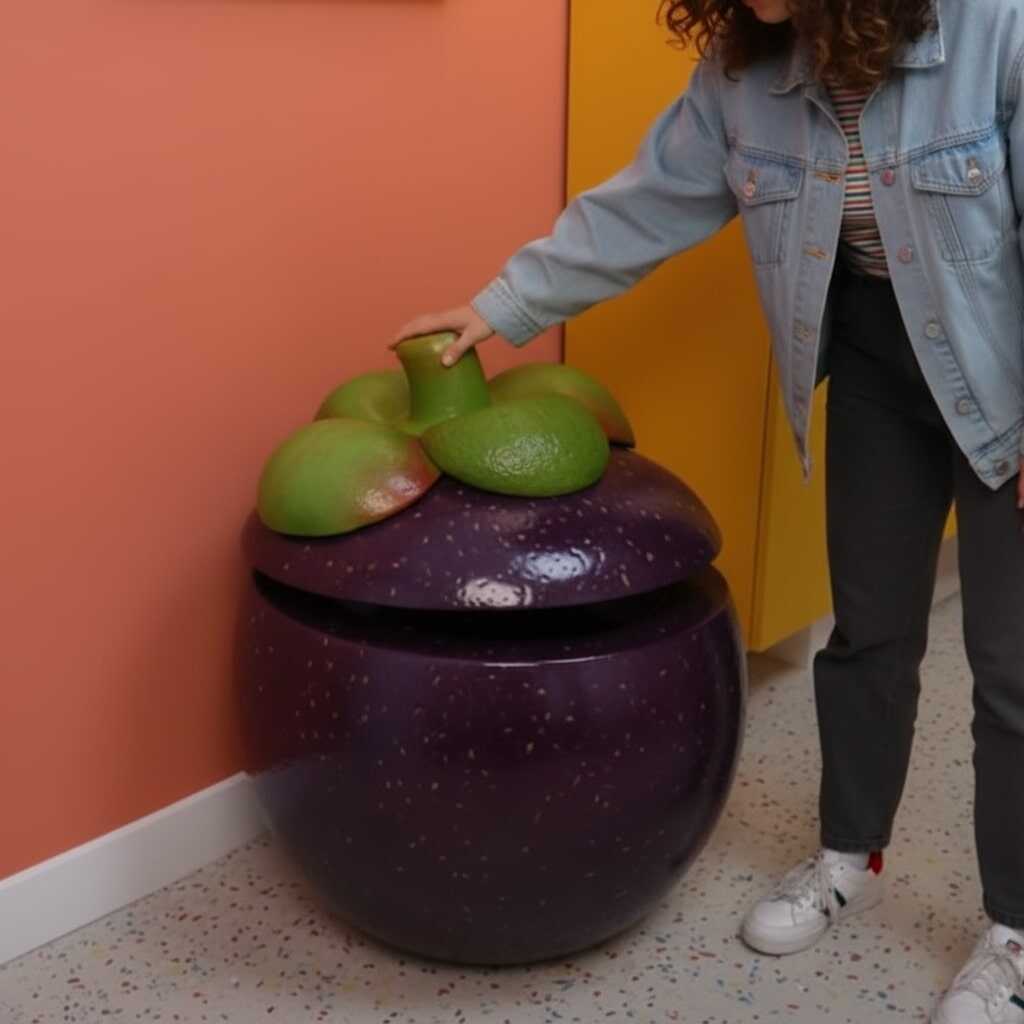
Beyond symbolism and subversion, the Fruit Themed Toilet stakes a claim in the realm of sculpture. It is not mass-produced anonymity; it is singular expression. Each curve, each glaze variation, each textural detail—the dimpled skin of an orange, the velvety nap of a peach, the segmented geometry of a kumquat—is a decision, a gesture, a brushstroke in three-dimensional space.
Consider the craftsmanship involved. To sculpt a functional toilet in the likeness of a fig requires more than superficial decoration. The bowl must still conform to ergonomic and hydraulic principles: the trapway must function, the seat must support, the flush must be efficient. Yet within those constraints, the artist must capture the fig’s delicate teardrop form, its subtle asymmetry, the faint blush at its base where it ripened in the sun. This is applied art at its most demanding—where engineering and poetry share the same mold.
In this sense, the Fruit Themed Toilet belongs to a lineage of artist-designed sanitaryware. Think of Salvador Dalí’s Mae West Lips Sofa—where furniture becomes body, where function becomes fantasy. Or the Memphis Group’s postmodern bathrooms of the 1980s, with their clashing colors and geometric absurdity, rejecting minimalism in favor of exuberant individuality. The Fruit Themed Toilet continues this tradition, but with a gentler, more organic sensibility. It is surrealism rooted in nature, not dream logic alone.
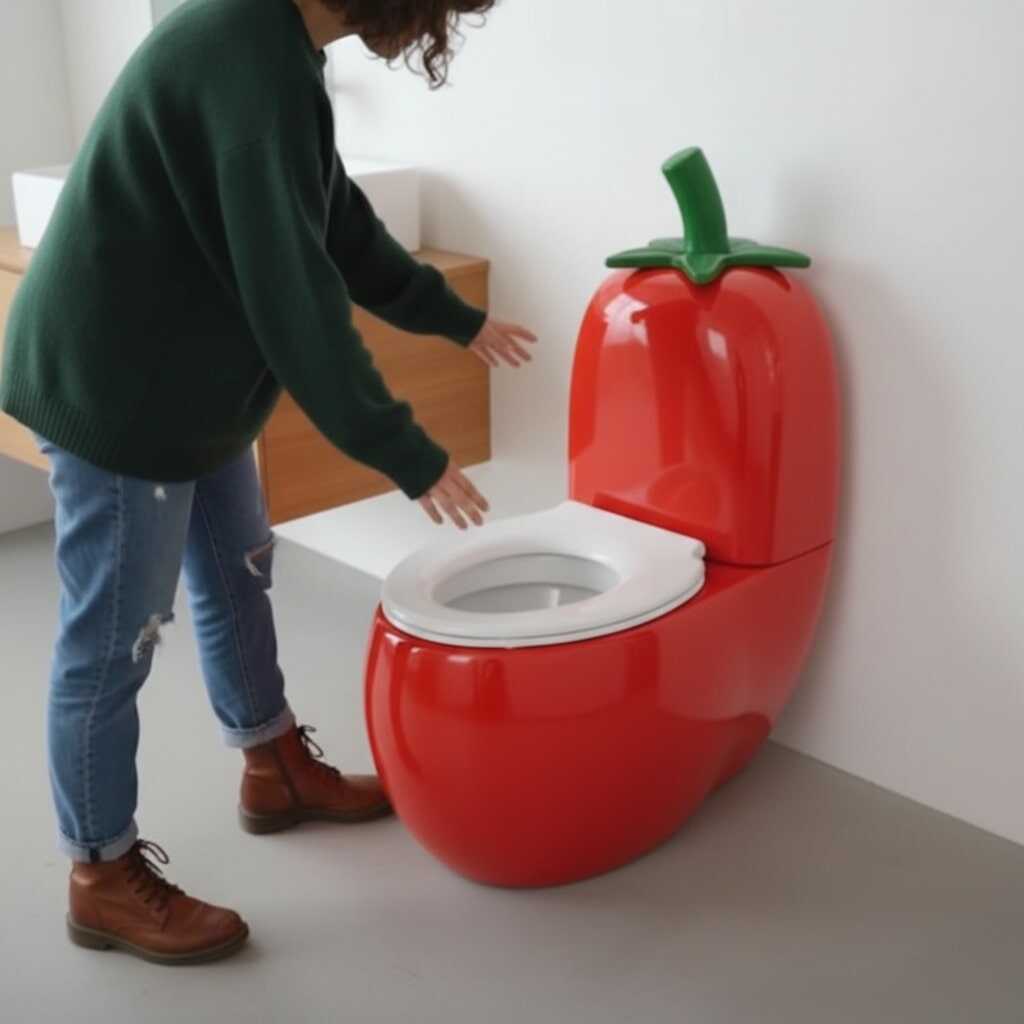
Moreover, it redefines the concept of sanctuary. A sanctuary need not be grand or solemn. It can be small, personal, even humorous. The bathroom, when inhabited by a Fruit Themed Toilet, becomes a pocket of respite—a place where one can retreat not just physically, but sensorially and emotionally. The tactile pleasure of a ceramic lime’s pebbled surface beneath one’s fingertips; the psychological lift of a tangerine’s warm orange glow in muted lighting; the quiet humor of sitting upon a banana peel (rendered, of course, in non-slip matte finish)—these are micro-moments of grace.
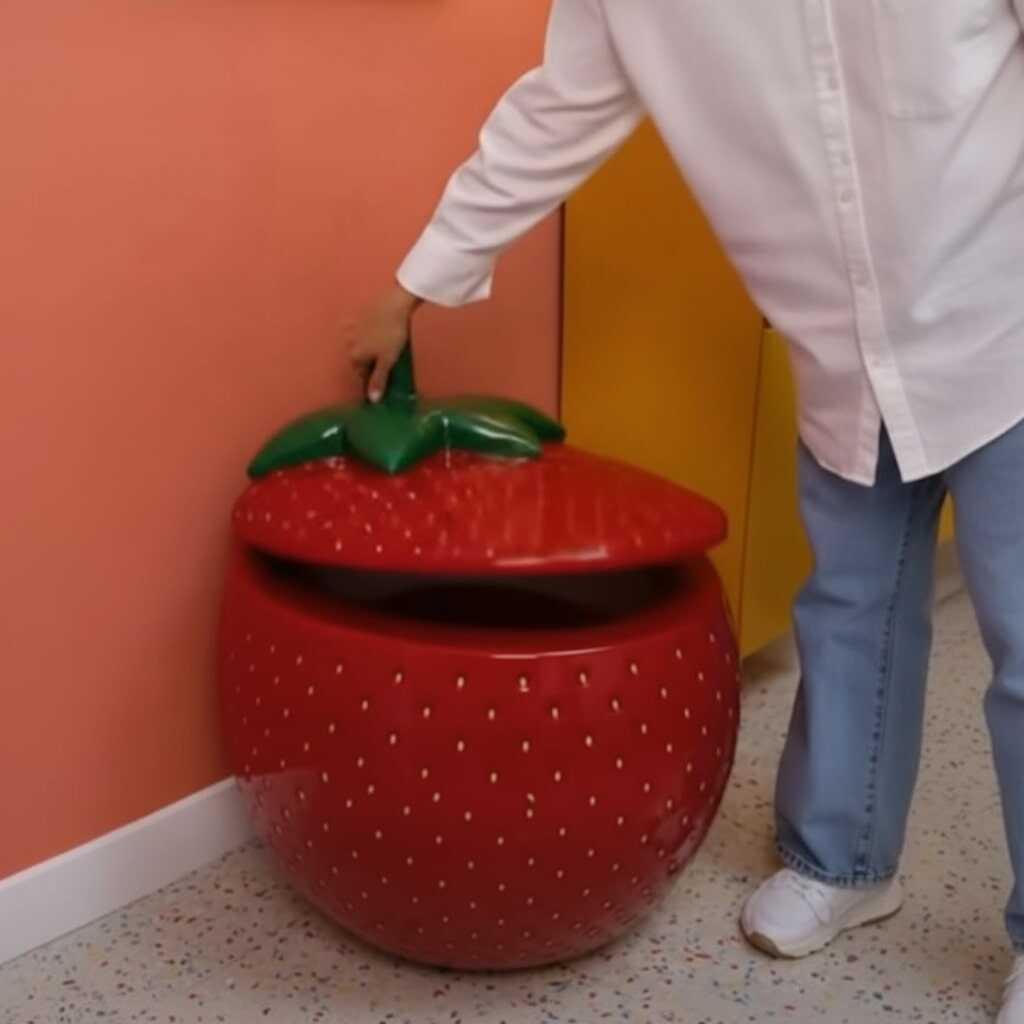
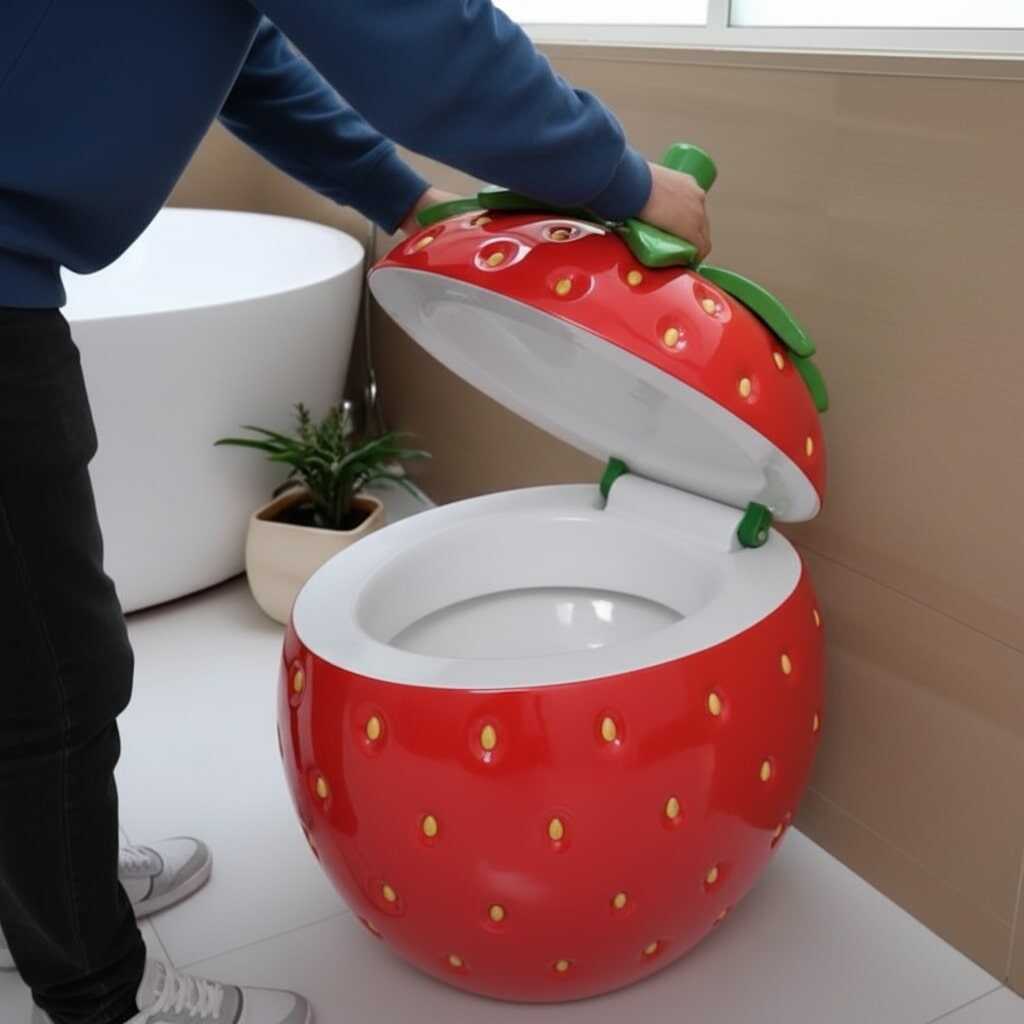
Crucially, this sanctuary is inclusive in its whimsy. Unlike high-art installations that demand art-historical literacy, the Fruit Themed Toilet communicates through universal language: the language of taste, memory, and sensation. Who has not held a strawberry, felt its seeds, smelled its perfume? Who has not shared a slice of melon on a summer day? The fruit theme is instantly legible across cultures, ages, and backgrounds. Its artistry does not exclude; it embraces.
It also challenges the hierarchy of art spaces. Why must sculpture reside only in galleries or plazas? Why not in the home’s most intimate room? By situating art where the body is most unguarded—knees bent, breath held, muscles relaxed—the Fruit Themed Toilet democratizes aesthetic experience. Art is not something we visit; it is something we live with, even in our most vulnerable postures.
Conclusion: The Serious Joy of the Unserious
To encounter a Fruit Themed Toilet is to experience a moment of cognitive recalibration. It is to laugh—not at absurdity, but at recognition. Recognition that life, even in its most mundane operations, is threaded with potential for wonder. Recognition that beauty need not be reserved for special occasions or elite spaces. Recognition that function and fantasy are not opposites, but partners in the dance of human making.
The Fruit Themed Toilet is whimsical, yes—but its whimsy is deeply serious. It is a protest against austerity, a hymn to embodiment, a manifesto written in ceramic and glaze. In a world increasingly dominated by digital interfaces and algorithmic efficiency, it reasserts the value of the tactile, the local, the idiosyncratic. It reminds us that to be human is to crave not just utility, but meaning—and that meaning can bloom in the most unexpected soils.
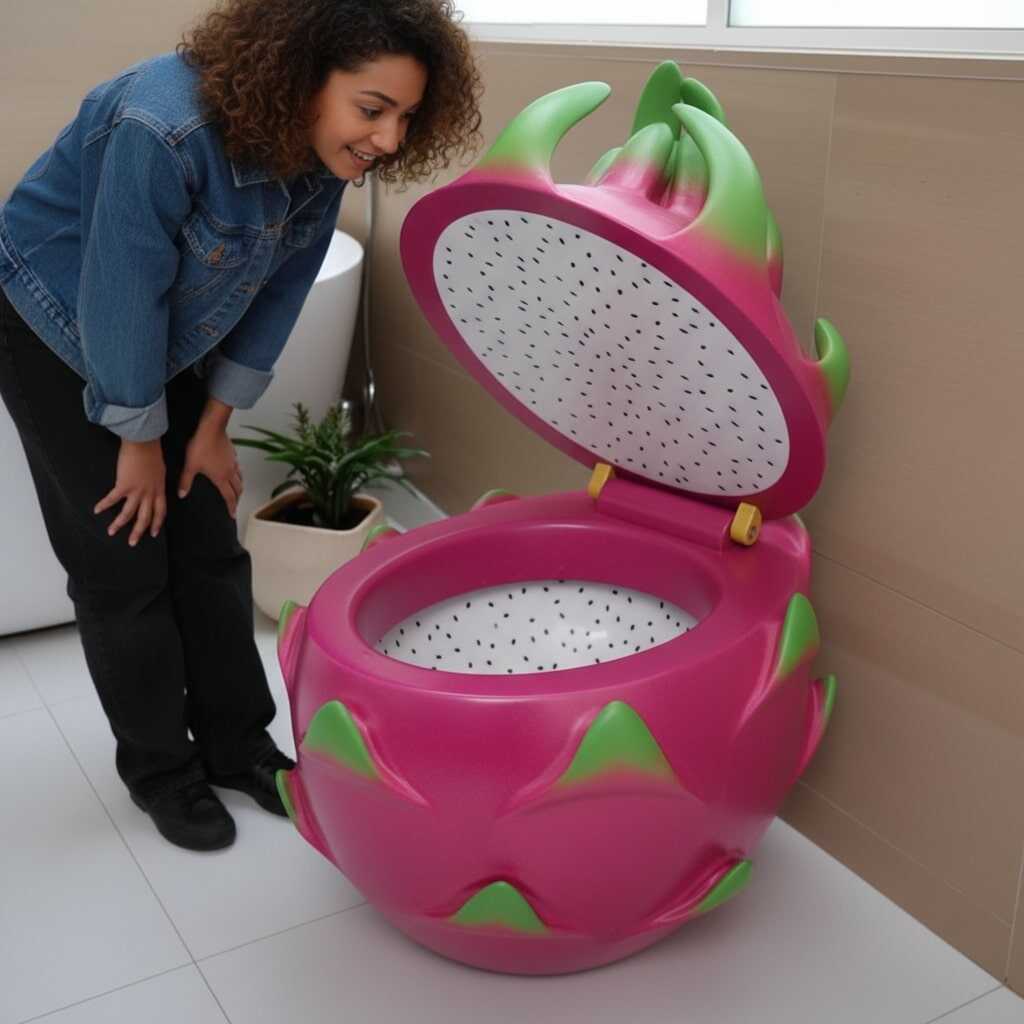
This object does not solve global crises. It does not purify water or reduce carbon emissions. And yet, in its own quiet way, it performs a vital kind of work: it re-enchants the everyday. It invites us to pause before the flush, to smile in the stall, to remember that even in release, there is abundance. Fruit falls from the tree not as failure, but as fulfillment—its seeds carried forward by wind, by water, by creature. Likewise, the Fruit Themed Toilet offers us a vision of wholeness: where what is expelled is not erased, but transformed; where what is functional is also joyful; where what is private is also, beautifully, alive.
In the end, the Fruit Themed Toilet is more than a design object. It is an invitation—to play, to reflect, to remember that we, too, are part of nature’s generous, cyclical feast. And sometimes, the most radical thing we can do is sit down, take a breath, and appreciate the pineapple beneath us—not as a joke, but as a blessing.