
In the evolving landscape of children’s interior design, the bedroom has transcended its traditional role as a mere place for rest. More than ever, it serves as a sanctuary for storytelling, self-expression, and imaginative exploration. At the heart of this transformation lies a singular design element—both functional and fantastical—the Tree Bunk Bed. More than just furniture, a Tree Bunk Bed is a narrative anchor: a sculptural centerpiece that invites the natural world indoors, weaving woodland wonder into the fabric of daily life. Its branches stretch toward the ceiling, its trunk stands firm as structural backbone, and its layered bunks become hollows, nests, and hideaways—each imbued with possibility.
The Tree Bunk Bed is not defined solely by its form—though its organic curves, textured bark-like finishes, and canopy-inspired upper levels are undeniably arresting—but rather by the experience it cultivates. It asks: What if sleep were an act of climbing into a treetop? What if waking meant emerging from a hollow like a woodland creature greeting the dawn? These questions spark a design philosophy rooted in thematic intentionality: rooms conceived not as collections of objects, but as immersive worlds. When a Tree Bunk Bed enters a space, it doesn’t simply occupy square footage—it redefines it. Walls become forest edges, floors become forest floors, and ceiling lights become dappled sunlight filtering through leaves.
This article explores how designers, parents, and creative minds can harness the symbolic and spatial power of the Tree Bunk Bed to craft deeply resonant, thematically rich bedroom environments. We’ll journey through three distinct approaches—Narrative Cohesion, Spatial Poetry, and Multi-Sensory Immersion—each revealing how thoughtful layout, materiality, and detail work in concert with the bed’s inherent storytelling to create spaces where dreams take root, grow, and branch outward.
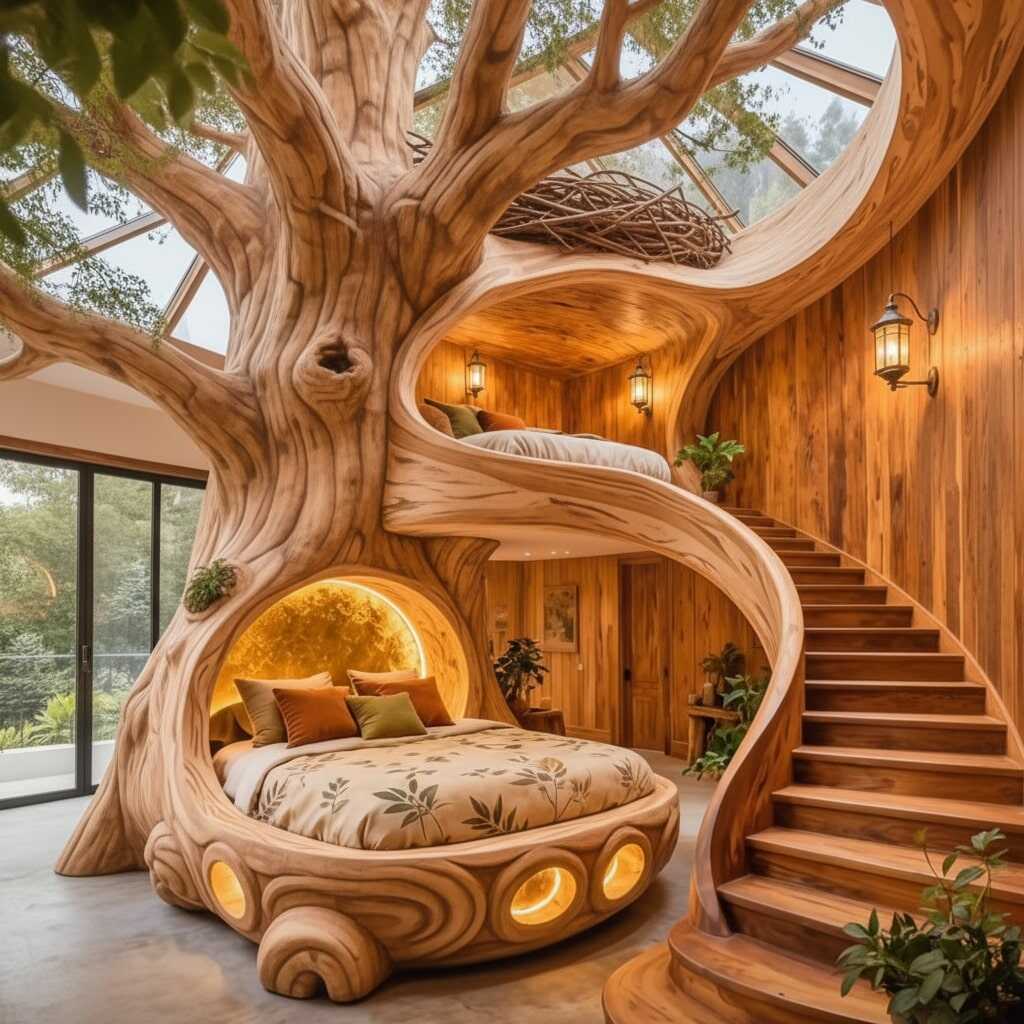
Part I: Narrative Cohesion — Building a World That Makes Sense
A Tree Bunk Bed is, at its core, a story-starter. Its form begs for context: Whose tree is this? What creatures dwell within it? What season does it inhabit? Thematic bedrooms that succeed do so because every element participates in a unified narrative. The Tree Bunk Bed isn’t a prop dropped into a scene; it is the scene’s protagonist—and the room becomes its ecosystem.
The Forest Canopy Theme: Elevation as Escape
In this layout, the upper bunk is not merely “the top bed”—it is the treetop lookout, a private aerie suspended above the forest floor. The ceiling above is painted with soft gradients of dawn sky—pale gold melting into cerulean—or adorned with removable paper lanterns shaped like oversized fireflies or bioluminescent mushrooms. Suspended from the upper frame, sheer voile drapes cascade like morning mist, offering privacy while preserving the sensation of being enveloped by foliage.
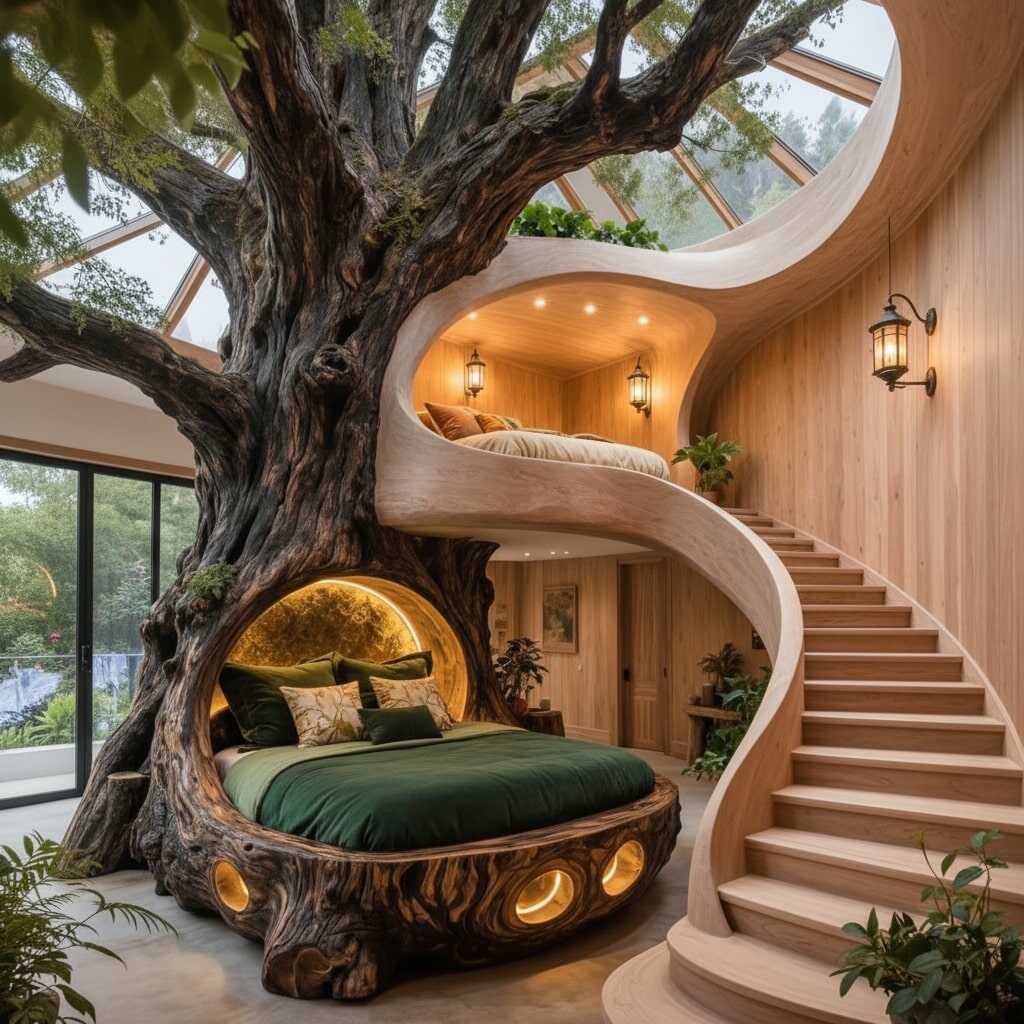
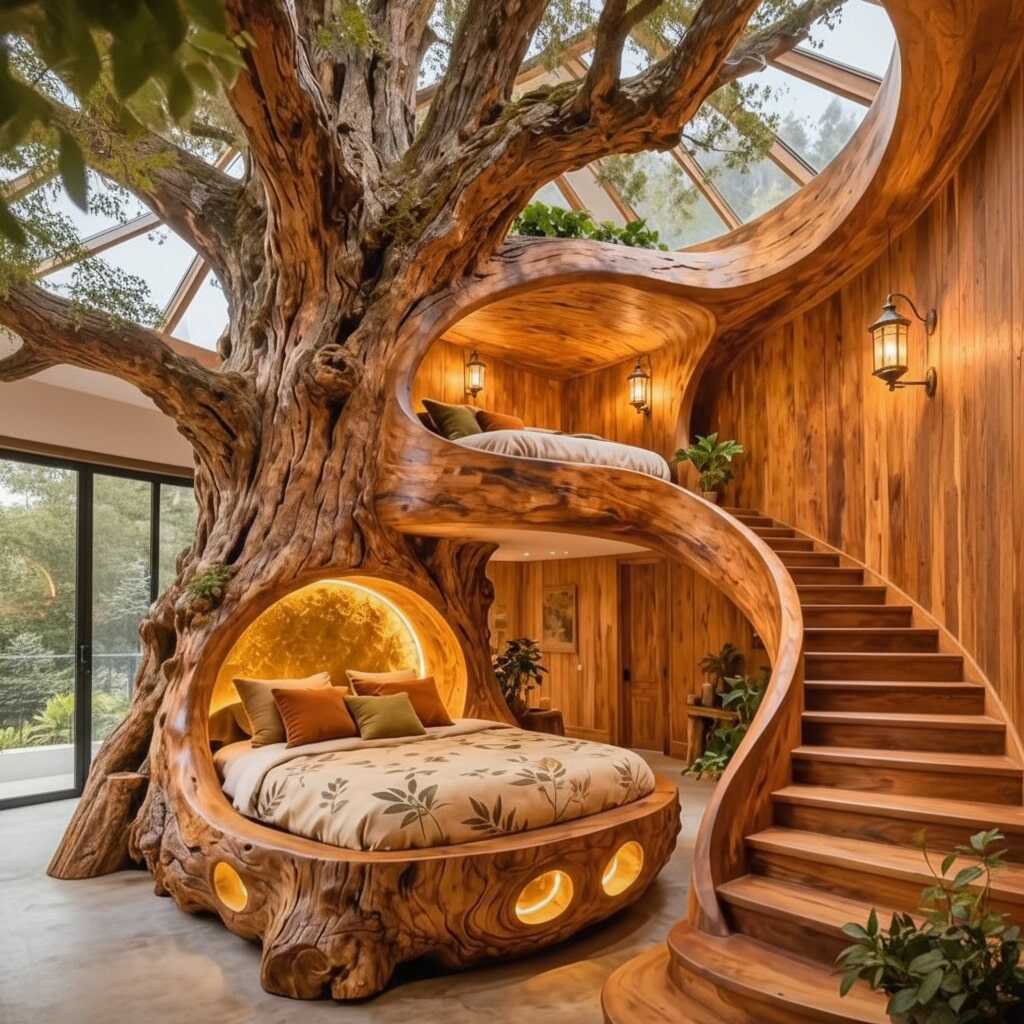
The lower bunk, conversely, becomes the woodland hollow—a sheltered space where one might curl up with a book or imagine hibernating like a bear. Here, the walls adjacent to the bed curve inward slightly (using flexible wood slats or sculpted plaster) to suggest the rounded interior of a massive trunk. Embedded LED strips, set to warm amber, glow faintly from within faux “knot holes,” mimicking the gentle pulse of fireflies. A low, wide windowsill—dressed with mossy cushions and miniature potted ferns—extends the illusion outward, blurring the boundary between interior and imagined exterior.
Crucially, circulation supports the narrative. Rather than a straight-line path to the ladder, the floor features a winding “forest path” of interlocking cork tiles in varying earth tones, bordered by low, cushioned “mossy” benches. This encourages movement as exploration: every step is part of the journey into the woods.
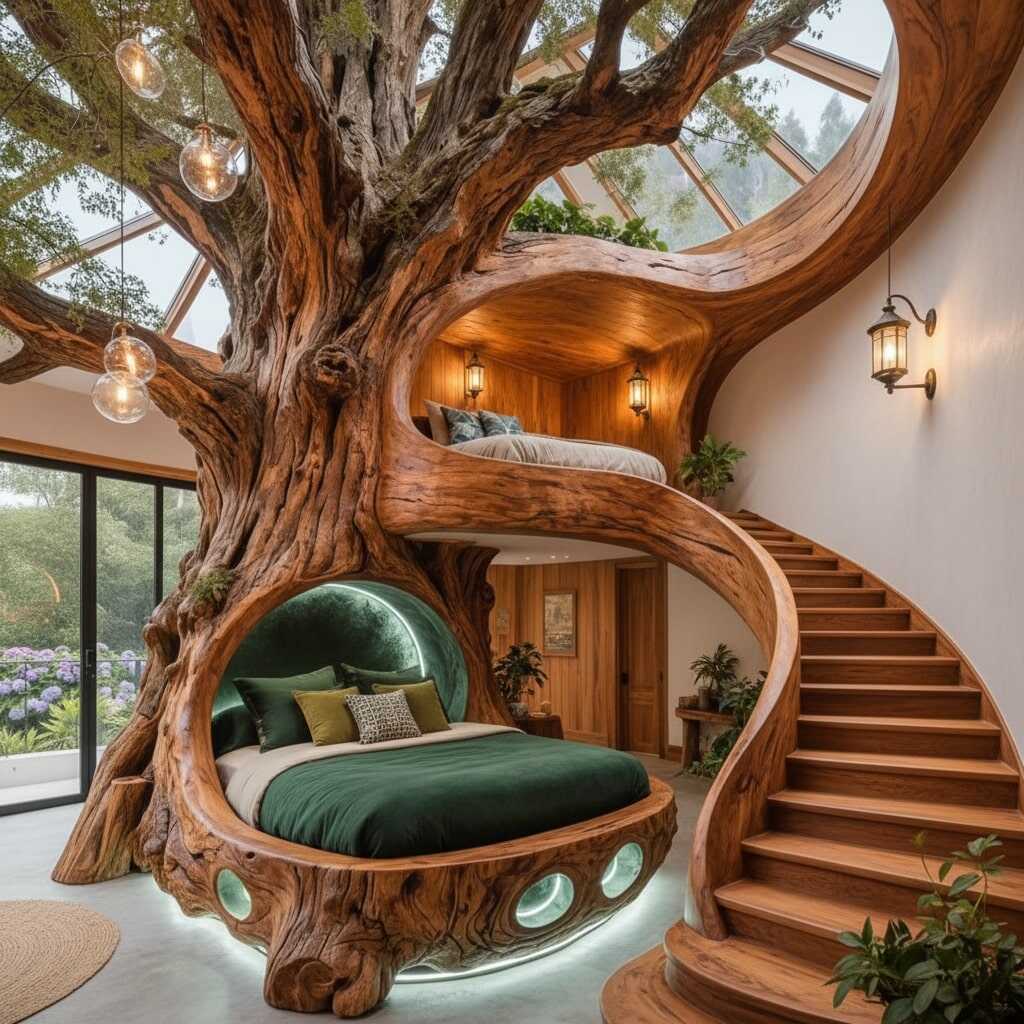
The Enchanted Grove Theme: Magic in the Details
Here, the Tree Bunk Bed transforms into an ancient sentinel—part tree, part artifact—guarding secrets and housing gentle magic. The trunk is not smooth but textured with carved glyphs, faux vines, and embedded crystal-like resin “geodes” that catch and refract light. The ladder becomes a spiraling vine, winding upward instead of ascending linearly, its rungs shaped like oversized acorns or smooth river stones.
The layout emphasizes discovery zones. A nook beneath the lower bunk is curtained with beaded strands that chime softly when parted—a threshold into a reading grotto lined with deep-green velvet and scattered with oversized floor pillows shaped like toadstools. Opposite, a wall-mounted “magical map” (a corkboard overlaid with hand-painted parchment) charts imaginary realms, with pushpins marking story milestones—perhaps where the bed’s “tree” stands in the center of Whisperwood.
Lighting plays a pivotal role: instead of overhead fixtures, illumination comes from source-appropriate placements—a cluster of brass “lantern” pendants dangling from upper branches, a cluster of fiber-optic “star vines” creeping along the headboard, and a rotating projector casting slow-drifting constellations across the ceiling at night. Every light source feels found, not installed—as if magic itself has pooled in corners and pooled along surfaces.
The Seasons Cycle Theme: A Bed That Breathes with Time
This ambitious layout embraces change: the Tree Bunk Bed is designed to transform with the calendar, reflecting the cyclical rhythm of nature. The trunk features modular panels—interchangeable bark segments that can be swapped seasonally. In spring, panels bloom with laser-cut cherry blossoms and embedded silk buds; in summer, dense leaf clusters (made of layered felt or recycled PET fabric) unfurl along the upper branches; autumn brings panels of warm-toned wood veneers with copper-leaf “falling leaves” suspended on nearly invisible thread; winter strips the tree bare, revealing silvery branches dusted with removable glitter-flecked “frost.”
The room layout accommodates this fluidity. A rotating “seasonal station” sits near the window—a low cabinet with four labeled drawers (Spring, Summer, Autumn, Winter), each containing thematic textiles, small decor items, and activity prompts (e.g., “plant a seedling” in spring, “collect pinecones” in autumn). The floor rug is a large circular design depicting a year-wheel, with the Tree Bunk Bed at its center; children can literally stand in the current season.
This approach teaches temporal awareness and ecological literacy through design—not didactically, but experientially. The tree doesn’t just represent nature; it participates in its rhythms.
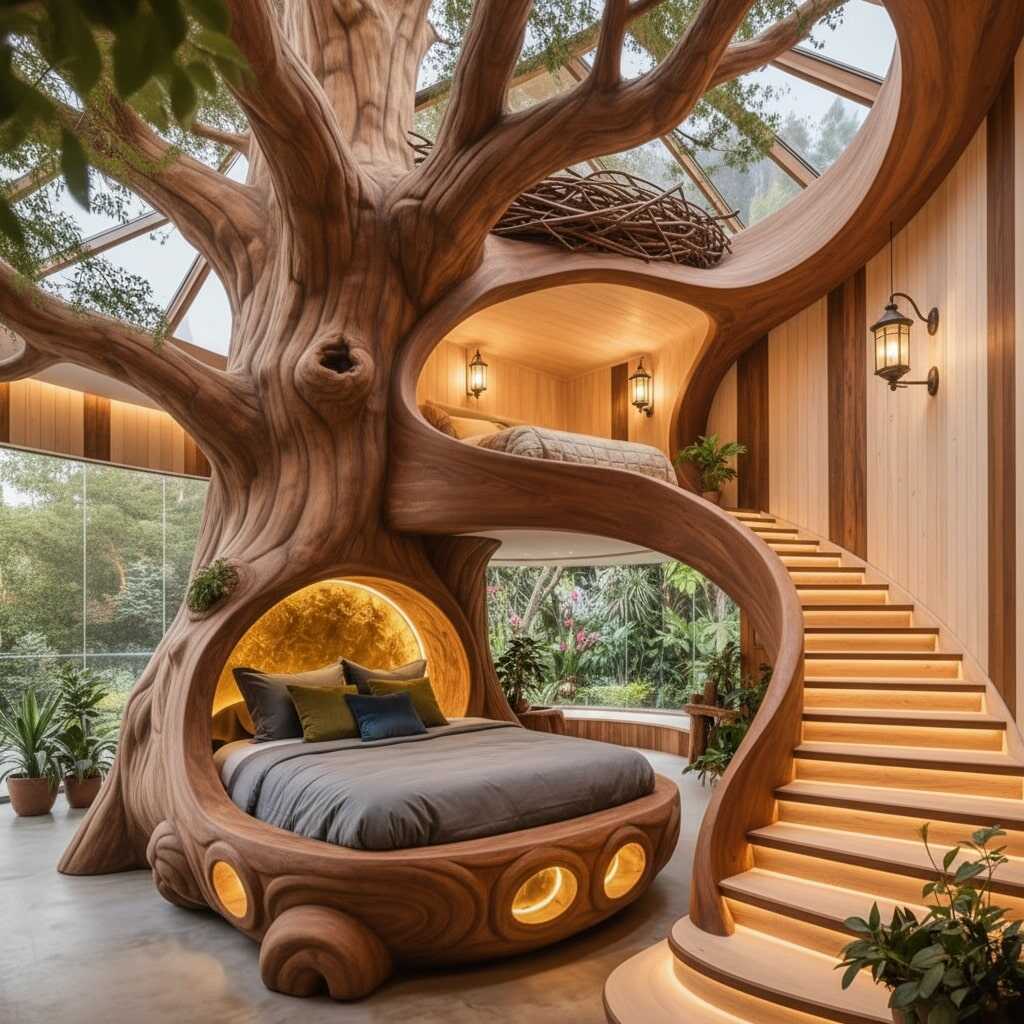
Part II: Spatial Poetry — Architecture as Emotion
Beyond narrative, the Tree Bunk Bed challenges conventional room planning. Its irregular silhouette demands a rethinking of circulation, zoning, and verticality. Successful layouts don’t fight the bed’s organic form—they dance with it, using asymmetry, layering, and negative space to create emotional resonance.
Vertical Layering: The Skyward Dimension
Unlike rectilinear bunk beds that stack vertically in a utilitarian column, the Tree Bunk Bed branches. Its upper level may cantilever slightly, or its access ladder may angle outward, creating pockets of space beneath and around it that beg for purposeful occupation. Designers can amplify this by introducing tiered platforms—not just for the beds, but for the entire room.
Imagine: the lower bunk sits on the main floor level; a half-step up (4 inches) lies a “mossy clearing” reading zone with built-in cushioned benches; another step up (now 8 inches total) hosts a small desk nook tucked into the angle formed by the trunk and wall. This terraced approach mimics a forest’s natural topography—gentle rises and plateaus—and encourages mindful movement. Climbing isn’t just about reaching the top bunk; it’s about ascending through environments, each with its own mood and function.
Ceiling height is leveraged poetically. In rooms with generous clearance, the Tree Bunk Bed’s upper frame can nearly kiss the ceiling—transforming the space above into a hidden sky chamber. A removable panel in the ceiling (painted to match the trunk interior) allows access to a crawl-space attic lined with soft felt and strung with fairy lights—a secret observatory reachable only by the boldest climbers.
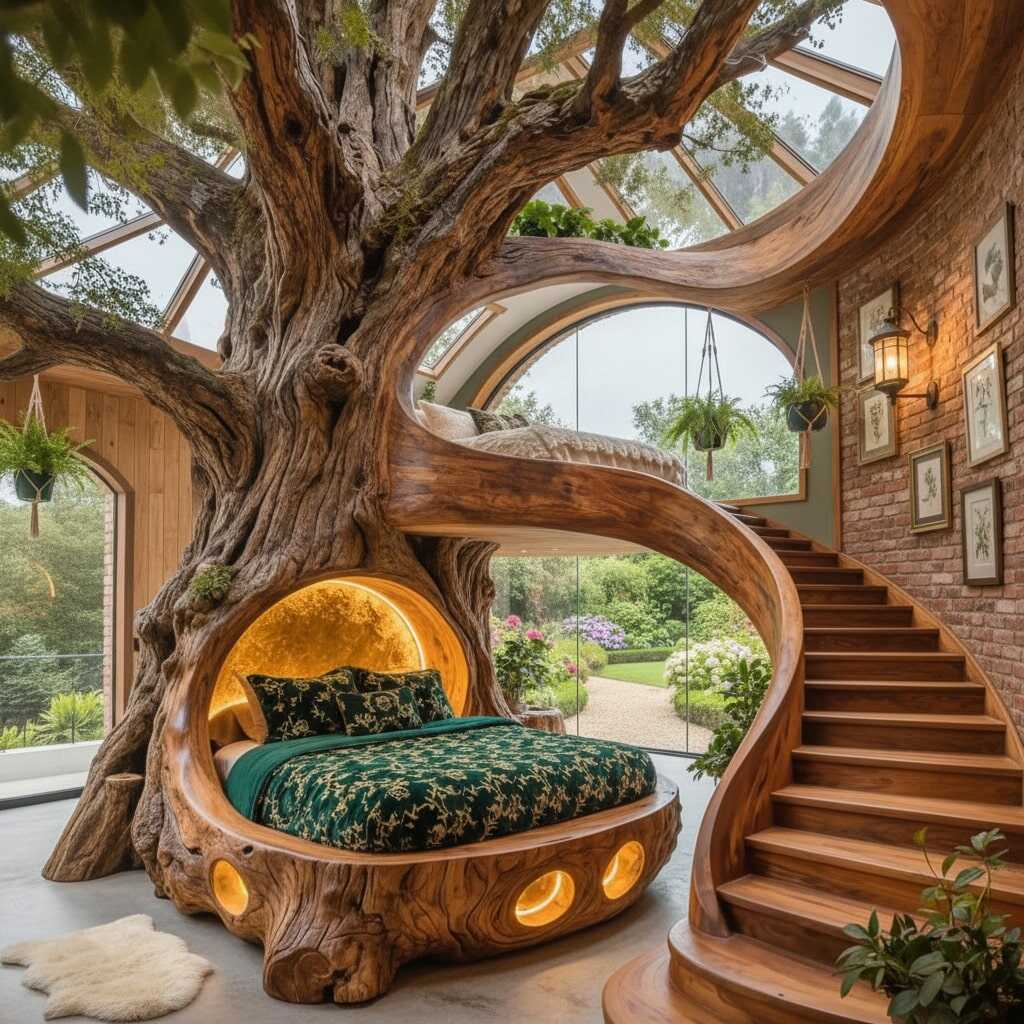
Asymmetrical Balance: Embracing the Wild
Symmetry feels orderly—but forests are gloriously asymmetric. A Tree Bunk Bed layout should honor that truth. Place the bed off-center, angled toward a window, as if growing toward the light. Let one branch extend over a low bookshelf, another curve around a corner to frame a play corner.
This asymmetry creates dynamic sightlines. From the doorway, the room reveals itself in layers—the trunk partially obscuring the lower bunk, the upper bunk visible only as a silhouette against the window. From the desk, the bed forms a protective canopy. From the upper bunk, the entire room unfolds like a landscape viewed from a ridge.
Furniture echoes this irregularity: a kidney-shaped rug, a freeform cork pinboard, a cluster of mismatched stools gathered like mushrooms after rain. Nothing is rigidly aligned; everything belongs.
Negative Space as Sanctuary
The most powerful element in any Tree Bunk Bed layout may be what’s not there: the voids, the gaps between branches, the hollow beneath the roots. These negative spaces are invitations—to pause, to hide, to daydream.
A deep recess beneath the lower bunk—wide enough for a child to sit cross-legged—becomes a “root cellar” nook. Lined with cork for sound absorption and warmth, it houses a small battery-powered lantern and a basket of story stones. The space beneath the ladder? Not wasted, but transformed into a miniature “stream bed”—a shallow tray of polished river stones with a tiny water feature (recirculating, silent pump) that glints in the light.
Even the air feels different here. Because the Tree Bunk Bed is not a solid mass but an open lattice of form and void, light filters through it, casting moving shadows that shift with the sun. Sound is softened; voices echo less. The room breathes.
Part III: Multi-Sensory Immersion — Beyond the Visual
A truly immersive themed bedroom engages more than sight—it awakens touch, sound, even scent. The Tree Bunk Bed, with its tactile surfaces and evocative form, is the perfect catalyst for this deeper engagement.
Tactile Topography: Surfaces That Speak
The trunk isn’t smooth laminate—it’s grooved, knotted, and textured. Hand-rubbed finishes mimic birch bark’s papery peel or oak’s rugged furrows. Rungs on the ladder vary: some cool and smooth (sanded hardwood), others wrapped in soft rope or padded with cork. The guardrails on the upper bunk might be woven willow branches (sealed for safety), offering both visual delicacy and gentle resistance to a resting hand.
Bedding continues the language: quilts with appliquéd leaves in velvet and linen, pillowcases printed with macro-photographs of lichen, duvet covers with subtle topographic embroidery. Even the floor contributes—cork tiles for warmth underfoot, a wool rug with a raised “root system” pattern that can be traced with bare toes.
Soundscape: The Whisper of Leaves
Sound design is often overlooked. In a Tree Bunk Bed room, it’s essential. A discreet white-noise machine, programmed with layered forest audio—distant birdsong, rustling leaves, a gentle brook—creates an ambient backdrop. But the interactive sounds matter more: the soft creak of a rope-wrapped ladder rung (engineered for safety, not instability), the chime of wind-catcher beads strung along a branch, the thump-whisper of a felt-covered door closing on the root nook.
At bedtime, a parent might activate a “night chorus” setting: crickets, an owl’s distant call, the sigh of wind in high branches—calming, not startling, frequencies calibrated for rest.
Olfactory Anchoring: The Scent of Place
Smell is the most evocative sense—and the most neglected in design. A Tree Bunk Bed room can incorporate subtle, natural scent layers: a diffuser with a blend of cedarwood, vetiver, and a hint of damp earth (non-toxic, child-safe); sachets of dried lavender and pine needles tucked into the hollow nook; a small terrarium on the desk releasing the green tang of moss and soil.
These scents aren’t overpowering—they’re background notes, like the faint perfume of a forest after rain. Over time, they become associated with safety, with storytime, with sleep. The room doesn’t just look like a tree—it smells like one.
Conclusion: Growing Into the Story
To design with a Tree Bunk Bed is to engage in an act of co-creation—not just between designer and client, but between imagination and reality, between child and environment. It asks us to move beyond decoration and into world-building, where every choice—how a branch arches, where light pools, what sound rises at dusk—serves a larger emotional and narrative truth.
A Tree Bunk Bed is more than a solution to space constraints or a whimsical aesthetic choice. It is a pedagogy of wonder: teaching spatial empathy (how does this hollow feel to inhabit?), ecological awareness (how does a tree live, change, shelter?), and narrative agency (what story do you bring to this space?). As children grow, the themes may evolve—the enchanted grove becomes a study of mycology; the seasonal tree becomes a journal of phenology—but the foundational sense of place remains.
In an age of digital saturation, such rooms offer irreplaceable grounding. They are places where the body is engaged—not scrolling, but climbing, touching, hiding, watching light move across a wall like sun through leaves. They remind us that design, at its most meaningful, is not about objects in a room—but about experiences rooted in place.
The Tree Bunk Bed stands, quite literally, as a testament to this belief: that childhood deserves spaces of depth, mystery, and quiet magic. It asks little—only that we be willing to imagine deeply, design generously, and leave room for the wild, whispering branches of possibility to grow.
And in that growth, we find not just a bedroom—but a world.