
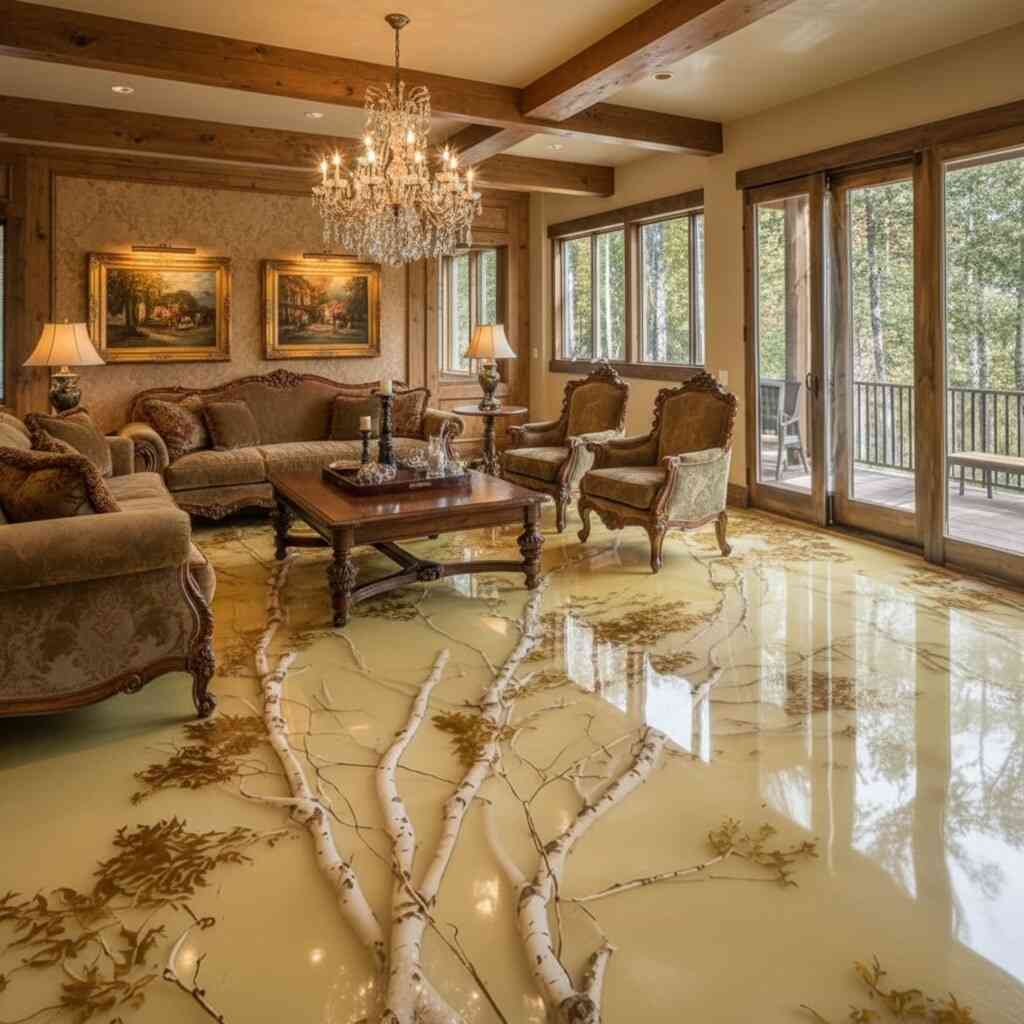
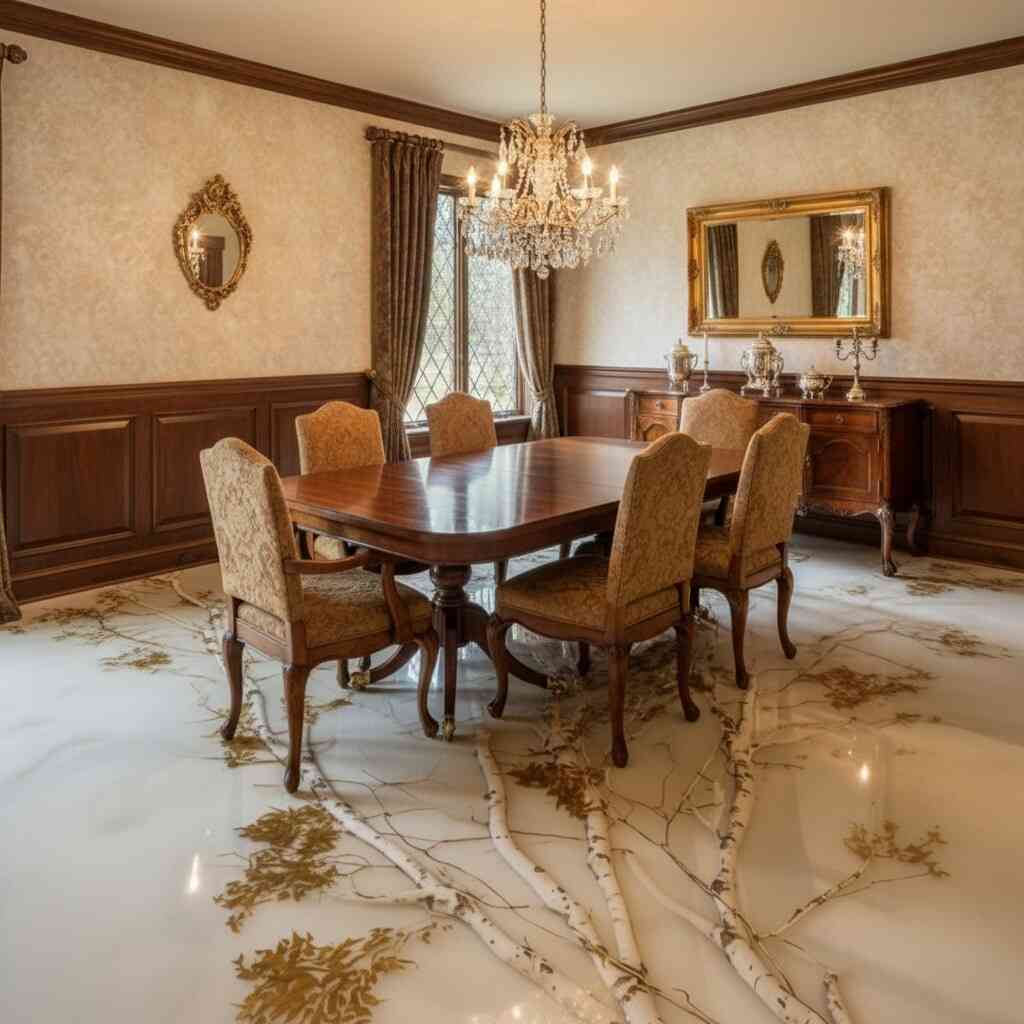
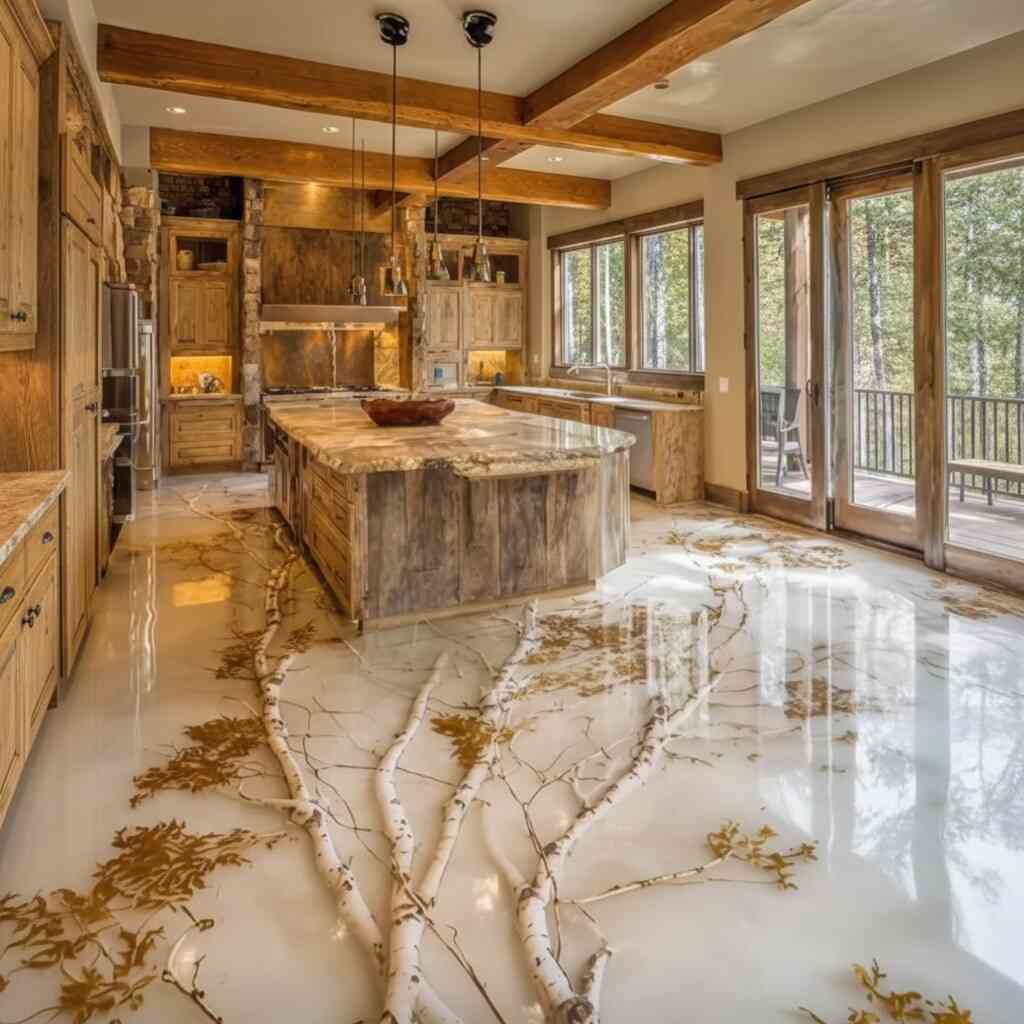
Imagine stepping into a space where the quiet elegance of a northern woodland is not merely evoked through décor or imagery, but embedded—quite literally—into the very foundation beneath your feet. Birch Tree Epoxy Flooring is not simply a surface treatment; it is an experiential gesture, a deliberate convergence of organic authenticity and architectural innovation. In an era where interior design increasingly seeks balance between technological sophistication and biophilic resonance, this flooring modality emerges as a poetic synthesis: a grounded homage to nature rendered in resilient, luminous resin.
At first glance, the term Birch Tree Epoxy Flooring may seem paradoxical—how can something as delicate and transient as birch bark be translated into the permanence of a high-performance floor? Yet this apparent contradiction is precisely where its power lies. The birch tree—slender, resilient, luminous in winter light—has long held symbolic resonance across cultures: renewal, purification, adaptability. In Scandinavian folklore, it is the first tree to colonize barren land, a harbinger of regeneration. Among Indigenous peoples of North America, birch bark is revered not only for its utility but for its spiritual integrity—light yet unyielding, humble yet enduring.
Epoxy, conversely, speaks the language of modernity: industrial strength, seamless continuity, chemical resistance. To marry these two—birch and epoxy—is to engage in a form of material alchemy. The result is more than decorative. It is a spatial narrative, a tactile invocation of forest memory. This article explores how Birch Tree Epoxy Flooring transcends utilitarian function to become a medium of environmental storytelling, psychological grounding, and aesthetic re-enchantment in contemporary interior spaces.

The Aesthetic Language of Birch: Translating Nature into Surface
The Visual Grammar of Birch Bark
To understand Birch Tree Epoxy Flooring is to first immerse oneself in the visual syntax of the birch itself. Its bark—peeling in papery, horizontal layers—is not uniform white, as often simplistically depicted. Rather, it shifts in tone: cool ivory in shadow, warm pearl in morning sun, faintly blushed with ochre or gray where lichen clings. The fissures run in rhythmic, irregular bands—some tight and whisper-thin, others wide enough to reveal the deep amber underbark. Each tree bears its own topography; no two trunks share the same pattern.
In crafting Birch Tree Epoxy Flooring, artisans do not replicate birch bark literally. Rather, they interpret it—distilling its essence into a layered interplay of pigment, texture, and translucency. This is achieved through a multi-stage pour process, where translucent epoxy is tinted with mineral-based pigments to achieve the nuanced gradations of natural bark. Fine aggregates or mica flakes may be suspended to mimic the subtle shimmer of dew on bark at dawn. Hand-scribed lines—etched before the resin cures—reproduce the organic fracture patterns, not as rigid imitations but as gestural traces, preserving the irregularity essential to authenticity.
Crucially, high-fidelity Birch Tree Epoxy Flooring avoids the pitfalls of photorealistic vinyl or printed laminate. There is no repeating motif, no machine-perfect symmetry. Instead, the floor unfolds like a slow scroll of landscape—each section subtly different, inviting prolonged observation. This non-repetitive variation is not an accident; it is a philosophical stance. In mimicking nature’s refusal to conform to grids, the floor quietly critiques the sterility of mass-produced environments.
Light, Depth, and the Illusion of Stratification
One of the most compelling attributes of Birch Tree Epoxy Flooring lies in its interaction with light. Unlike opaque surfaces, epoxy’s inherent translucency allows for stratified depth. Designers often employ a “layer-pour” technique: a base coat in soft taupe or pale ochre (suggesting the living cambium layer), followed by a mid-layer of off-white with suspended fiber-like strands (evoking cellulose structure), capped with a nearly clear topcoat embedded with micro-fissure detailing. When daylight streams across the surface, the floor doesn’t just reflect—it reveals, as if one could peer beneath the bark.
This depth has profound psychological implications. Studies in environmental psychology suggest that surfaces with micro-variation and depth reduce cognitive fatigue—our eyes are not strained by flatness, but soothed by gentle complexity. The birch-inspired floor, then, functions as a low-grade meditative object: unobtrusive, yet rich enough to reward attention. In minimalist interiors—where walls may be monochrome and furniture restrained—the floor becomes the primary site of sensory engagement.
Seasonal Resonance and Temporal Layering
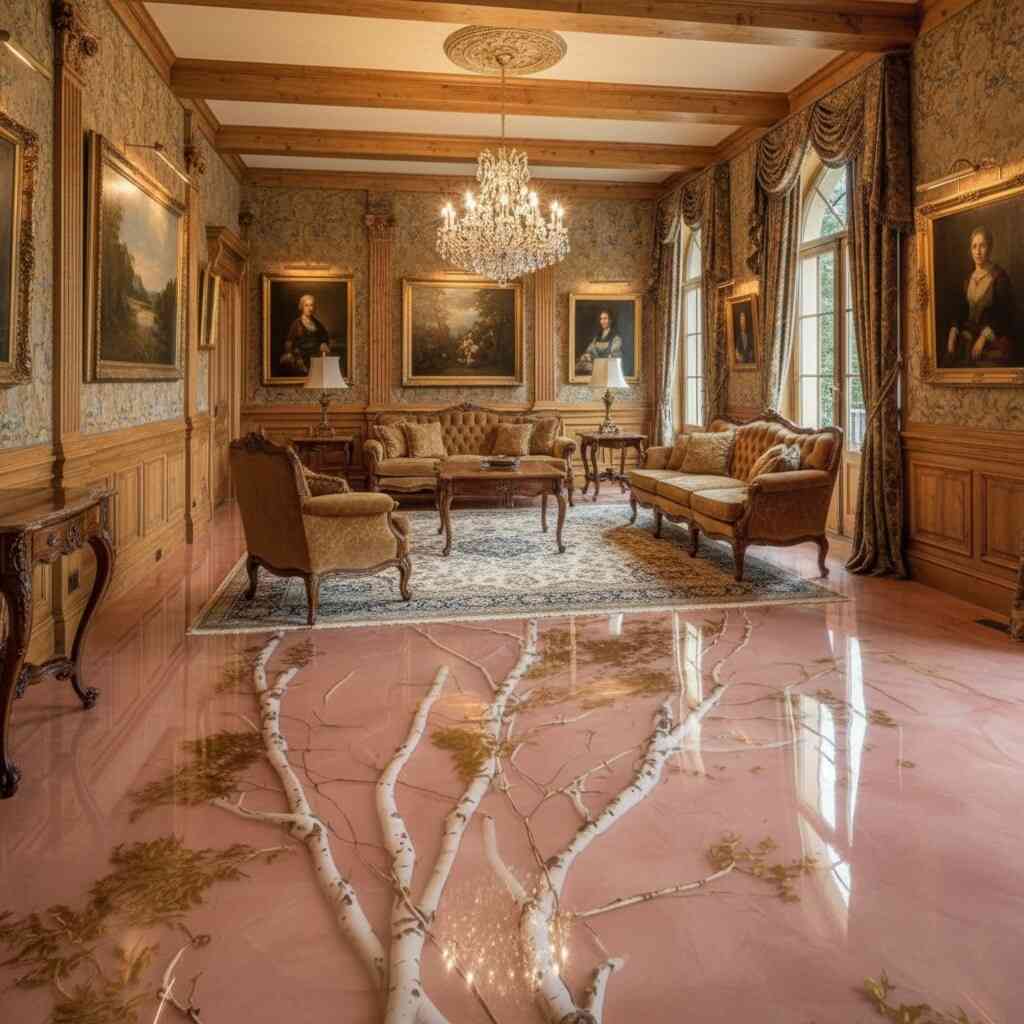
A sophisticated Birch Tree Epoxy installation may subtly encode seasonal shifts. In colder climates, birch bark appears starkly luminous against snow—a high-contrast study in value. In summer, it softens into the green canopy, its whiteness muted by humidity and moss. Advanced designs incorporate this temporal dimension through gradient transitions: cooler, brighter tones near windows (evoking winter light), warmer, more textured zones in interior alcoves (suggesting summer shade). Some installations even embed minute, biodegradable cellulose filaments that shift hue under UV exposure—imperceptibly deepening over years, like bark aging on a living tree.
This attention to temporal nuance transforms the floor from static object to dynamic participant in the life of the space. It does not shout; it breathes. And in doing so, it aligns interior rhythm with ecological cadence—a quiet act of resistance against the atemporal, always-on glow of digital environments.
Material Philosophy: Epoxy as a Conduit, Not a Cover
Beyond Surface Decoration: The Ethics of Material Honesty
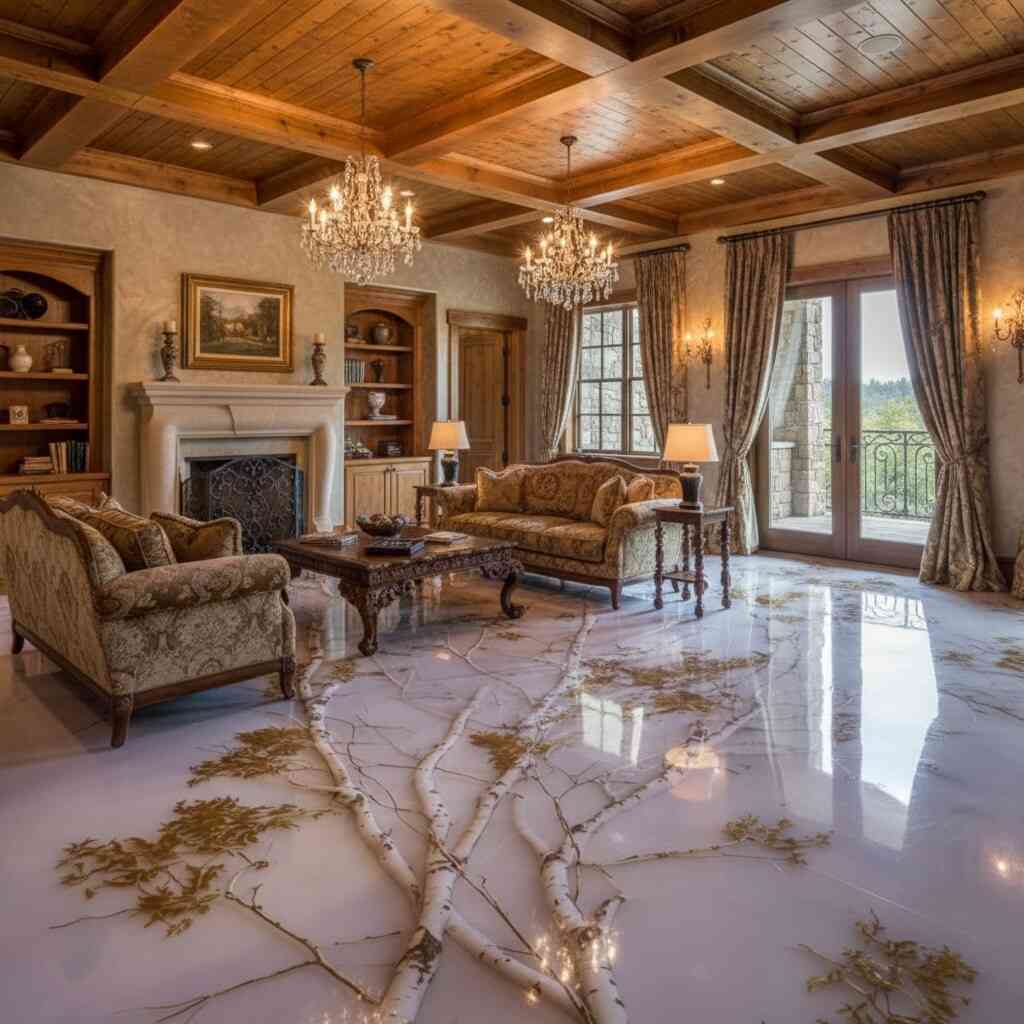
It would be tempting to dismiss Birch Tree Epoxy Flooring as mere aesthetic veneer—a decorative trick to “bring the outside in.” But such a reading misses its deeper intentionality. This approach does not simulate nature in the way plastic plants simulate foliage. Rather, it translates it—acknowledging the gap between forest and foyer, and working within that space of metaphor.
Epoxy, as a medium, is inherently candid about its artificiality. It gleams. It reflects. Its seams (if any) are deliberate, not hidden. There is no pretense of being wood—it does not creak, warp, or scent the air with terpenes. And in that transparency lies integrity. Birch Tree Epoxy Flooring does not deceive; it invites reflection on the relationship between human habitats and wild systems. It asks: How do we dwell with nature when we cannot dwell in it? How do we honor ecological memory without romanticizing extraction?
This ethical layer separates it from superficial “biomimicry.” It is not biomimicry for efficiency (like termite-mound ventilation), nor biomimicry for novelty (like leaf-vein patterning on phone cases). It is biomimicry as reverence—a slow, deliberate study of form, pattern, and process, rendered with material honesty.
The Tactile Dimension: Coolness, Smoothness, and the Absence of Grain
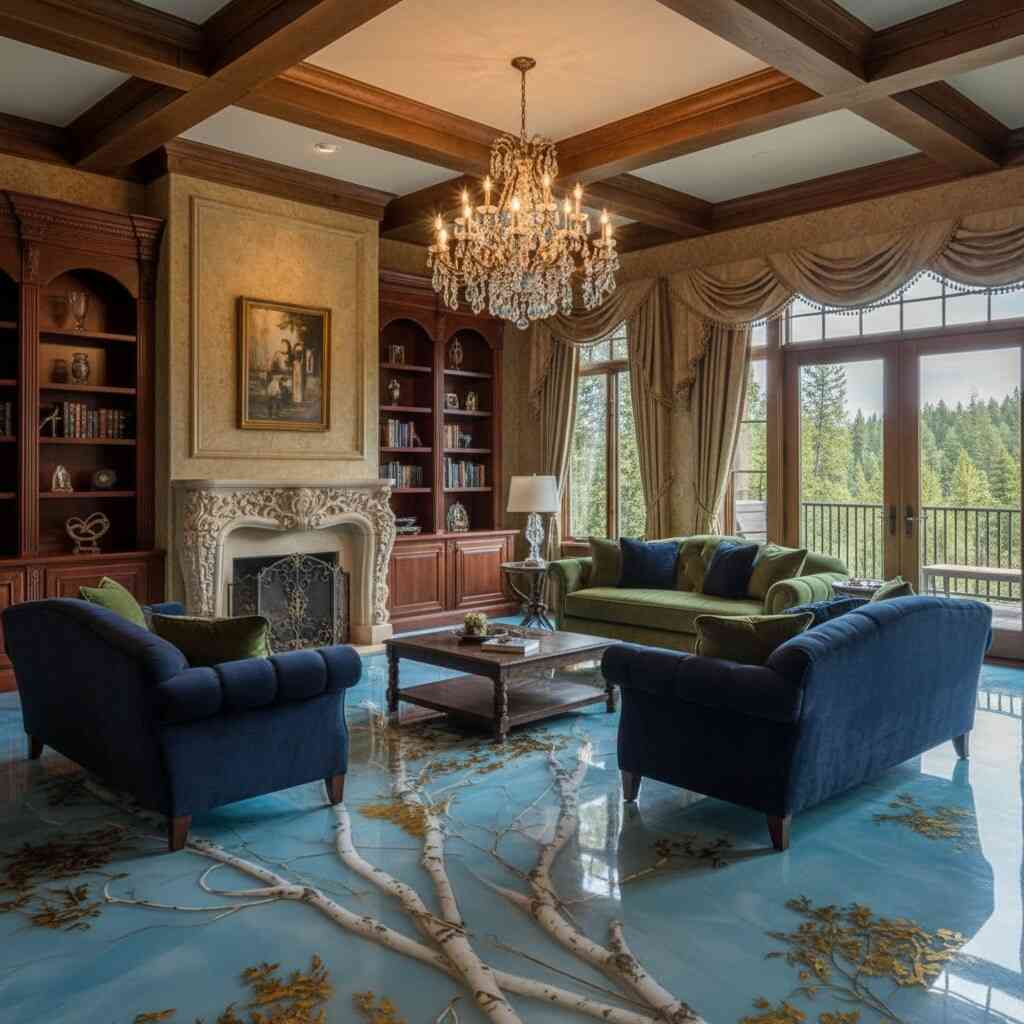
Touch is integral to our spatial understanding, yet often neglected in flooring discourse. Birch Tree Epoxy Flooring engages the haptic sense in nuanced ways. Unlike real wood—warm, porous, subtly yielding—epoxy is cool, non-porous, and firm. This contrast is not a flaw but a conceptual counterpoint. Where birch bark in nature is tactilely inviting (soft to the touch, easy to peel), the epoxy version offers a different kind of intimacy: one of visual proximity without physical mimesis.
Walking barefoot on such a floor produces a gentle thermal feedback—cool in summer, neutral in heated interiors. The seamless surface eliminates grout lines or plank edges, encouraging a fluid, uninterrupted movement through space. This physical continuity mirrors the visual continuity of the design: no borders, no interruptions, just the quiet unfoldment of pattern.
Some installations integrate micro-texturing—sub-millimeter undulations that catch light like ripples on bark after rain—adding a barely perceptible friction that grounds the experience without disrupting smoothness. This attention to haptic subtlety reinforces the philosophy: nature is not only seen but felt, even if abstractly.
Sustainability Reconsidered: Durability as Stewardship
Sustainability in architecture is often framed in terms of carbon footprint, recyclability, or renewability. While these metrics matter, Birch Tree Epoxy Flooring proposes an expanded definition: durability as ecological responsibility. A well-installed epoxy floor can last 20–30 years with minimal maintenance—far outpacing engineered wood, luxury vinyl, or even some hardwoods in high-traffic zones.
This longevity reduces the need for replacement, minimizing material consumption over time. Moreover, modern epoxy formulations increasingly use bio-based resins (derived from soy or linseed oil) and low-VOC hardeners, lessening environmental impact without compromising performance. The pigments employed—iron oxides, natural clays, mica—are geologically stable and non-toxic.
Importantly, the birch motif itself carries a conservationist undertone. Birch is a pioneer species—fast-growing, soil-stabilizing, essential to forest succession. To choose its image for a long-lasting floor is to align with values of resilience and regeneration. It is a subtle reminder: sustainability is not only about reducing harm, but about participating in cycles of renewal.
Psychological and Spatial Impact: Grounding in an Age of Dislocation
Biophilia Reimagined: Beyond Potted Plants and Green Walls
The biophilic design movement—anchored in E.O. Wilson’s hypothesis that humans possess an innate affinity for life and lifelike processes—has often manifested in literal ways: living walls, aquariums, nature sounds. Birch Tree Epoxy Flooring represents a more integrated, less theatrical expression of biophilia. It does not add nature to the space; it embeds its logic into the architecture’s substrate.
Research by the Human Spaces Global Report (2015) found that interiors incorporating natural elements increased well-being by 15% and creativity by 6%. But crucially, the type of natural element matters. Abstract, pattern-based nature references (such as fractal branching or bark textures) can produce similar psychological benefits as literal representations—sometimes more so, because they engage the imagination rather than prescribe interpretation.
A floor patterned after birch bark does not tell the viewer, “This is a tree.” It suggests: This is a rhythm. This is resilience. This is light on surface. The mind completes the metaphor—a quiet act of co-creation between space and occupant.
Creating Calm in High-Stimulation Environments
Modern interiors—especially in urban lofts, tech offices, or minimalist homes—often prioritize openness, light, and clean lines. While visually striking, such spaces can inadvertently heighten sensory exposure: reflective surfaces, hard acoustics, unbroken sightlines. Birch Tree Epoxy Flooring acts as a visual dampener. Its soft tonal shifts and organic patterning disrupt glare without sacrificing luminosity. The irregular lines break up large expanses, reducing the “void effect” that can make minimalist spaces feel alienating.
In therapeutic settings—clinics, wellness studios, quiet reading rooms—this quality is especially valuable. The floor becomes a non-intrusive anchor, a place for the eye to rest without demanding focus. Unlike bold geometric tiling or high-contrast wood planks, birch-inspired epoxy supports mental decompression. It does not compete; it holds space.
Cultural Memory and Place-Making
For those with roots in boreal or temperate forests—Scandinavia, Canada, Northern Japan, Siberia—the sight of birch patterning can evoke deep somatic memory: the sound of wind in slender trunks, the scent of damp bark in spring, the sight of golden leaves against snow. Even for those without direct experience, the motif carries archetypal resonance. Birch appears in myth as a threshold tree—the liminal guardian between worlds (e.g., Norse bjǫrk, Slavic bereza). Its presence in flooring subtly re-sacralizes the domestic: the threshold is not just a doorway, but the entire plane of dwelling.
In this way, Birch Tree Epoxy Flooring contributes to place-making—the transformation of generic space into meaningful place. It whispers continuity: you are not floating in a neutral container; you are standing on a stratum of story, light, and time.
Conclusion: The Floor as a Living Palimpsest
Birch Tree Epoxy Flooring is ultimately an act of translation—not from forest to floor, but from perception to presence. It does not seek to transplant nature indoors, nor to dominate it with technology. Instead, it occupies the fertile middle ground: where material innovation serves ecological imagination, and where surface becomes scripture.
In an age of climate anxiety and digital saturation, such floors offer quiet resistance. They remind us that beauty need not be fragile to be tender; that strength need not be harsh to be enduring. The birch—pioneer, survivor, luminous in winter—becomes more than motif. It becomes mentor.
To walk across a Birch Tree Epoxy floor is to tread lightly on time: the time of tree growth, the time of resin cure, the time of human pause. It invites slowness. It rewards attention. And in its seamless expanse, it holds space—for memory, for breath, for the quiet certainty that even in the most modern of interiors, we can remain rooted.