
There are kitchens—and then there are Beach Island Kitchens. This is not a place defined by stainless steel appliances or minimalist cabinetry, though those may be present. Nor is it simply a culinary space adjacent to sand and surf. A Beach Island Kitchen is a living paradox: a sanctuary of sensory harmony where the untamed rhythm of the ocean converges with the intimate choreography of cooking. It is where salt air—carrying whispers of distant horizons—dances with the sizzle of garlic hitting hot oil, where seafoam serenity isn’t just a poetic turn of phrase but a palpable mood settled over counters and cutting boards like morning mist.
The phrase Beach Island Kitchen evokes more than architecture or geography. It suggests a philosophy—a way of being that embraces impermanence, celebrates raw elements, and finds nourishment not only in food but in the very act of preparing it within liminal spaces: between land and sea, between solitude and gathering, between wildness and domestic comfort. To step into such a kitchen is to surrender to a different tempo of time: one paced by tides rather than clocks, measured in the curl of steam rising from a pot of chowder, or the slow caramelization of onions beside an open window cracked just enough to admit the cry of gulls.
This article is not a guide to decor or a catalog of recipes. It is an invitation—to dwell deeply in the essence of what a Beach Island Kitchen means. It explores how environment reshapes ritual, how elemental forces influence flavor and feeling, and how the act of cooking becomes a form of communion when the ocean is your nearest neighbor. We move through three interwoven dimensions: the Sensory Tapestry of the space, the Temporal Rhythm that governs its daily life, and the Emotional Resonance that lingers long after the dishes are washed and the tide has turned.

Part I: The Sensory Tapestry — Salt, Smoke, and the Whisper of Wind
A Beach Island Kitchen speaks first—and most insistently—through the senses. Its language is tactile, olfactory, auditory. Before a single ingredient is measured, the environment has already laid down its terms.
Salt as Seasoning—Invisible and Inevitable
Salt is not merely an ingredient here; it is a cohabitant. It drifts in on the breeze, settles in microscopic crystals on wooden countertops, clings to copper pots, and subtly alters the chemistry of everything it touches. A cast-iron skillet, left uncovered for a day, may develop a faint patina of corrosion—not decay, but testimony. The salt air permeates linens, infuses dried herbs with a faint brininess, and even changes the way butter browns in a pan: slightly faster, with a more complex, almost mineral depth. This isn’t contamination—it’s collaboration. The ocean insists on its presence, insisting that no flavor exists in isolation. Freshly shucked oysters need little adornment because the sea has already seasoned them; a simple grilled fish carries not just lemon and thyme, but the memory of the current that carried it to shore.
Sound: The Counterpoint of Sizzle and Surge
Close your eyes in a Beach Island Kitchen at dusk. What do you hear? The hiss-pop of shrimp searing in olive oil. The rhythmic clack of a wooden spoon against ceramic. And beneath it all—the ceaseless, breathing cadence of the surf: a low, resonant whoosh followed by the delicate collapse of foam. This is not background noise; it is counterpoint. The kitchen’s sounds are human, intentional—making. The ocean’s are elemental, eternal—being. Together, they form a duet that calms the nervous system even as hands move with purpose. A pot of clams steaming open releases not just vapor but a percussive click-click as shells part—echoing, eerily, the pebbles tumbling in the shore break just beyond the dunes.
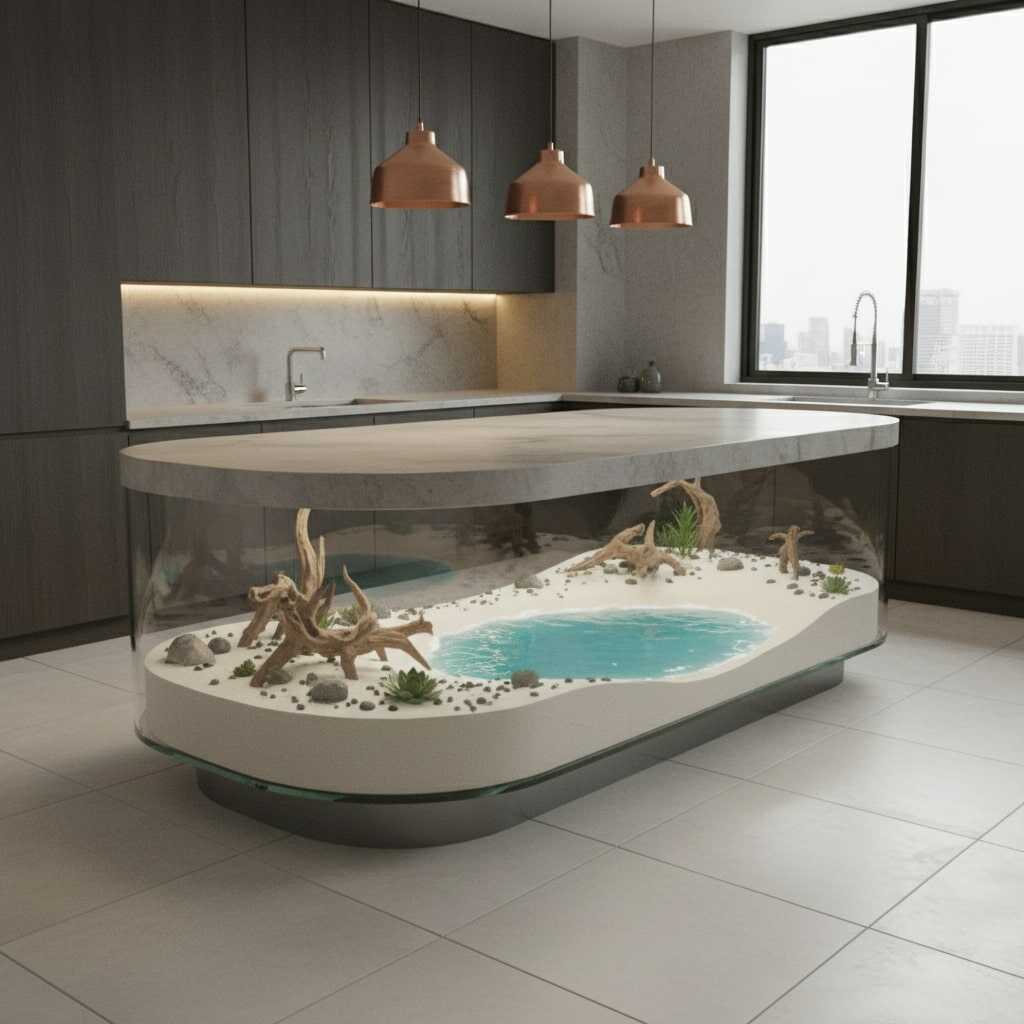
Light as a Living Ingredient
Here, light is never static. In the early hours, it arrives obliquely—thin, silver, and cool—casting long, lean shadows across butcher-block islands. By noon, it bleaches everything: white cabinets glow, linoleum reflects like wet sand, and citrus halves on the counter seem to ignite from within. But it is the late afternoon light—the golden hour, stretched long by the flat horizon—that transforms the space. It slants in through salt-fogged windows, gilding dust motes and the fine mist rising from a pot of simmering broth. It turns the kitchen into a lantern. This light doesn’t just illuminate; it sanctifies. It turns chopping parsley into a ritual, stirring risotto into meditation. You cook with the light, not just in it—adjusting the angle of your knife to catch its clarity, timing the finish of a sauce to coincide with its fading warmth.
Texture: The Grain of Place
Nothing is perfectly smooth in a Beach Island Kitchen. The teakettle bears faint water spots that no polishing fully erases. The cutting board, made from reclaimed driftwood or gnarled olive wood, holds knife scars like tide lines. Wicker baskets sag softly with use, their fibers slightly frayed. Even the floor—whether wide-plank pine, sea-washed tile, or concrete stained with decades of coffee spills—carries the imprint of passage: sandy footprints tracked in at dawn, damp towel rings left by afternoon swimmers, the ghost of a barefoot dance during last summer’s impromptu gathering. These textures are not flaws. They are evidence of life lived openly—of a space that refuses sterility in favor of authenticity.
And then there is the smell—a layered, evolving fragrance unlike any other kitchen. At sunrise: coffee, toast, and the faint ozone tang of retreating tide. Midday: coconut oil, lime zest, and the sweet-savory perfume of tomatoes roasting with anchovies and thyme. Evening: woodsmoke (from a driftwood fire pit just outside), garlic confit, and the subtle iodine note of steamed mussels. These aromas do not compete. They layer, like sediment in coastal strata—each stratum holding a moment, a mood, a memory.

Part II: The Temporal Rhythm — Cooking by Tide, Not Clock
Time in a Beach Island Kitchen does not march forward in measured ticks. It ebbs and flows. It is governed less by the microwave’s digital countdown and more by the slow arc of the sun, the wax and wane of the moon, the turning of seasons marked not by calendars but by the arrival of certain fish, the bloom of sea grapes, the first cold nor’easter that sends sand skittering across the deck.
The Ritual of Provisioning
Shopping here is not a weekly errand; it is an act of attunement. You walk the morning fish auction—not for the best deal, but for the freshest story. The cod came in at 4 a.m., hauled from 60 fathoms where the water is still cold as spring rain. The scallops were dredged just beyond the shoal, their roe still pink and glistening. You know the fishmonger—not by name alone, but by the way he tilts his head when assessing ice melt, or how he saves the smallest, sweetest shrimp for the old widow who lives in the blue cottage. Vegetables come from the dune-side garden, where tomatoes grow stunted but intense, their skins thickened by wind and salt spray. Herbs are snipped just before use: rosemary bent low by coastal gales, its oils concentrated; basil grown in sheltered pots, still trembling with volatile perfume.
There is no “meal prep” in the corporate sense. Instead, there is anticipation—a quiet assessment of what the day has offered. Will the fog lift by noon, making it worth grilling outside? Has the wind shifted, bringing in bluefish known for their rich, almost buttery flesh? The menu is written in real time, on a chalkboard smudged by damp fingers, revised as the afternoon light deepens.

The Pace of Preparation
Tasks unfold with a patient cadence. Shucking oysters is not rushed; it is a seated act, elbows on the counter, the blade finding the hinge with practiced intuition. Peeling shrimp is done over a bowl placed in the sink to catch the brine, the shells destined for stock—not waste, but future depth. Even the simplest act—salting pasta water—feels ceremonial: the coarse sea salt poured slowly, the pot set to boil not while you scroll on a phone, but while you watch the waves beyond the window, noticing how the light catches the crest just before it breaks.
Fire, when used, is elemental. A charcoal grill lit with crumpled newspaper and dry sea grass. A wood-fired oven, its bricks holding heat like sun-warmed stone. There is no “preheat to 375°.” You learn the language of flame: the white ash signaling readiness, the gentle crackle of applewood, the moment when the heat lifts just enough to sear without charring. Cooking becomes responsive, improvisational—adjusting the grate height by hand, turning fish with a spatula made of driftwood, trusting instinct over instruction.

The Unhurried Table
Meals here are not consumed; they are inhabited. The table—if there is one—is often outdoors: a salvaged door on sawhorses, draped with a faded oilcloth. Plates are mismatched: one with a hairline crack repaired with gold (kintsugi, though no one calls it that), another glazed in cobalt blue, chipped at the rim. Wine is poured into jelly jars. No one checks their phone. Conversation lulls and swells like the surf. Someone tells a story about the time the nor’easter flooded the lower pantry and how they salvaged the jars of pickled ramps by floating them out on a surfboard. Laughter rises, then subsides into comfortable silence, filled only by the clink of forks and the distant cry of a loon.
Dessert is often simple: peaches macerated in local honey and a splash of rum, served warm from the sun. Or shortbread, its butter notes deepened by a pinch of smoked sea salt. There is no rush to clear the table. Crumbs remain. Coffee is poured a second time. Someone refills the bird feeder hanging from the eave. The meal doesn’t end—it dissipates, like mist at sunrise.
This is time reclaimed—not “quality time” as a commodity, but time as a medium, as rich and layered as a well-reduced stock.

Part III: Emotional Resonance — Sanctuary, Memory, and the Sea’s Embrace
Beyond sensory pleasure and temporal rhythm, the Beach Island Kitchen holds emotional gravity. It is a vessel for memory, a site of solace, a place where identity is both shaped and softened by proximity to the sea.
A Sanctuary of Impermanence
Unlike the fortress-like kitchens of urban apartments—sealed against noise, weather, and the outside world—the Beach Island Kitchen is porous. Windows stay open. Screens sag slightly. Sand accumulates in the corners, not because of neglect, but because to sweep it all away would be to deny the place’s truth. This permeability is not vulnerability; it is trust. The kitchen does not seek to control the environment. It negotiates with it. A sudden squall sends everyone scrambling to close shutters—but there is laughter in the scramble, camaraderie in the shared effort. When the rain stops, the air is washed clean, heavy with petrichor and brine. You open the doors again. The space breathes.
In this acceptance of flux, there is profound peace. The kitchen becomes a metaphor for how to live: with open windows, with salt on your skin, with the understanding that some things—like the tide, like grief, like joy—cannot be held, only witnessed, only moved through.
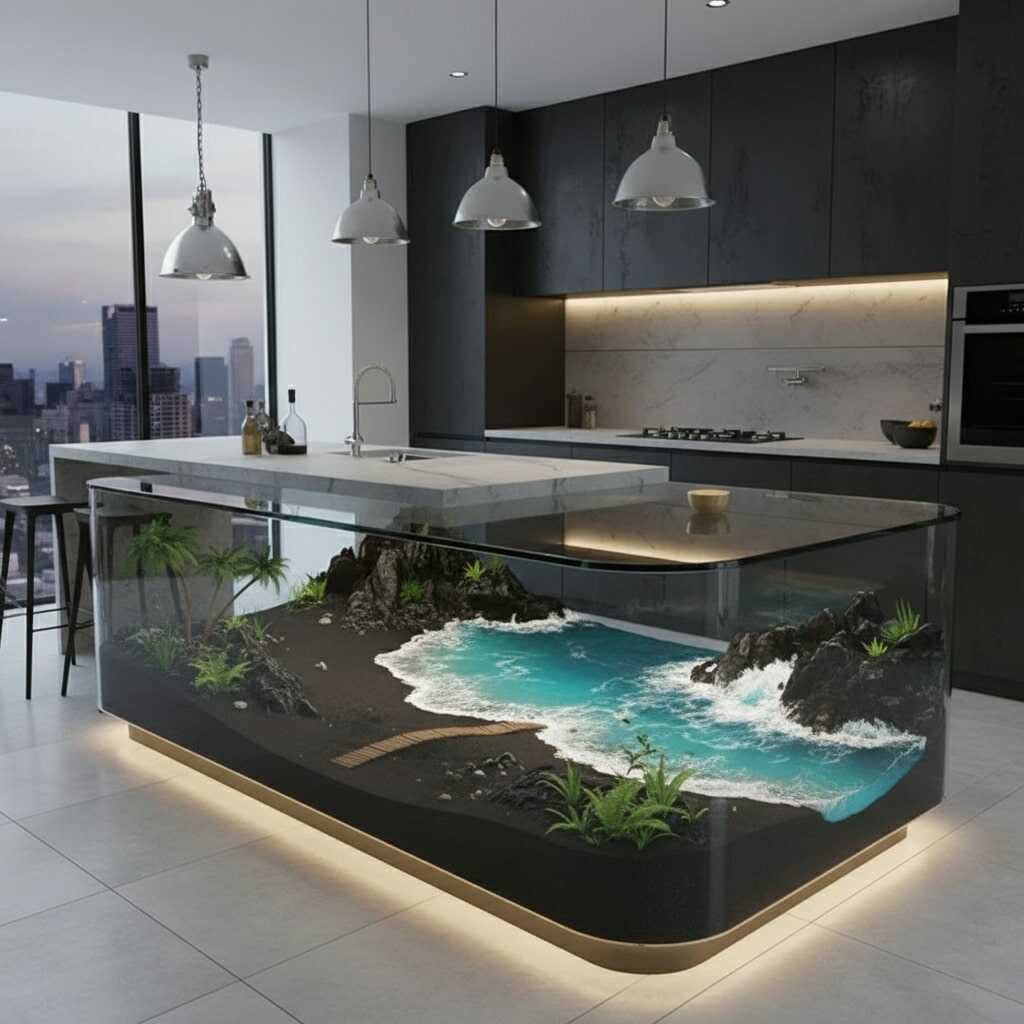
The Keeper of Stories
Every object here holds narrative weight. The dented colander was used by your grandmother to rinse beach peas during summers in the 1950s. The cast-iron Dutch oven—blackened, heavy, unbreakable—was salvaged from a cottage fire decades ago, its lid still bearing a faint soot stain shaped like a gull in flight. The recipe card for corn chowder, written in fading blue ink, includes marginalia: “Add extra bacon if Ed’s coming—he’ll pretend he’s watching his cholesterol but he’s lying.”
Cooking becomes archaeology. To make the chowder is to summon Ed, his laugh, the way he’d tap his spoon against the rim of his bowl before the first bite. To roll out pie dough on the same marble slab your mother used is to feel her hands over yours, guiding the pressure, the turn, the fold. The kitchen doesn’t just store memories; it activates them—through scent, through touch, through the repetition of gesture.
Seafoam Serenity: The Quiet Within the Surge
The phrase seafoam serenity is not an oxymoron here. It is an observed truth. Seafoam is born of turbulence—the churning of wind and wave, the collision of air and water. Yet when it washes ashore, it rests in delicate, ephemeral piles: fragile, luminous, transient. Serenity, in this context, is not the absence of chaos, but the calm that arises within it.
The Beach Island Kitchen embodies this paradox. It is where storms are weathered—not just meteorological ones, but emotional ones. Where a broken heart finds solace in the rhythmic task of deveining shrimp. Where grief is held gently while stirring a pot of soup, the steam rising like a whispered prayer. The ocean outside does not offer platitudes. It offers perspective: its vastness humbles, its constancy reassures, its indifference—strangely—comforts. You are small, yes. But you are here, stirring this pot, watching this light, tasting this salt on your lips. That is enough.
In moments of quiet—early morning, before the others wake—you might stand at the sink, rinsing the previous night’s glasses, looking out at the gray-green water. The only sound is the drip of the faucet and the distant thud of a wave. Your hands are wet, your shoulders relaxed. There is no agenda. No to-do list. Just presence. Just being. This is seafoam serenity: the luminous calm that forms at the edge of all that churns.

Conclusion: The Kitchen as Compass
A Beach Island Kitchen is never just a room. It is a compass—not pointing north, but pointing inward. It recalibrates our sense of what matters: not efficiency, but resonance; not perfection, but authenticity; not accumulation, but attention.
It teaches us that nourishment is multidimensional. That to feed the body is to also feed the senses, the memory, the spirit. That salt is both preservative and catalyst. That sizzle is the sound of transformation—of raw becoming cooked, of solitary becoming shared. That serenity is not escape, but integration: the ability to stand on shifting sand and still find your footing.
Perhaps the deepest truth the Beach Island Kitchen offers is this: We are all, in some way, islands. Separate, yes—but never truly cut off. Connected by unseen currents: of memory, of love, of shared meals and salty air drawn deeply into the lungs. To cook in such a place is to remember that connection. To wash a bowl as the tide turns is to participate in an ancient rhythm older than words.
So when you next find yourself in a kitchen—even one far from any shore—ask: Where is my salt air? Where is my sizzle? Where is my seafoam serenity? The answers may not lie in geography, but in intention. In opening a window. In lighting a candle that smells of driftwood and sage. In pausing—just once—to stir the pot slowly, and listen for the ocean in your own breath.