
The mid-twentieth century birthed some of the most iconic industrial designs in history, but few vehicles capture the essence of freedom, counterculture, and retro charm quite like the classic Type 2 Volkswagen camper van. Decades after its debut, this beloved aesthetic is transitioning from the open highway to the open water through a remarkable feat of leisure engineering: the inflatable Volkswagen bus boat. This specific design concept masterfully translates the blocky, endearing silhouette of a vintage land vehicle into a buoyant, functional watercraft.
By marrying mid-century automotive nostalgia with contemporary inflatable technology, designers have created a highly distinct water vehicle. This article explores the precise design language, physical appearance, structural materials, and color compositions that define this unique inflatable bus boat, showing how a 1960s road icon transforms into a modern lakeside marvel.
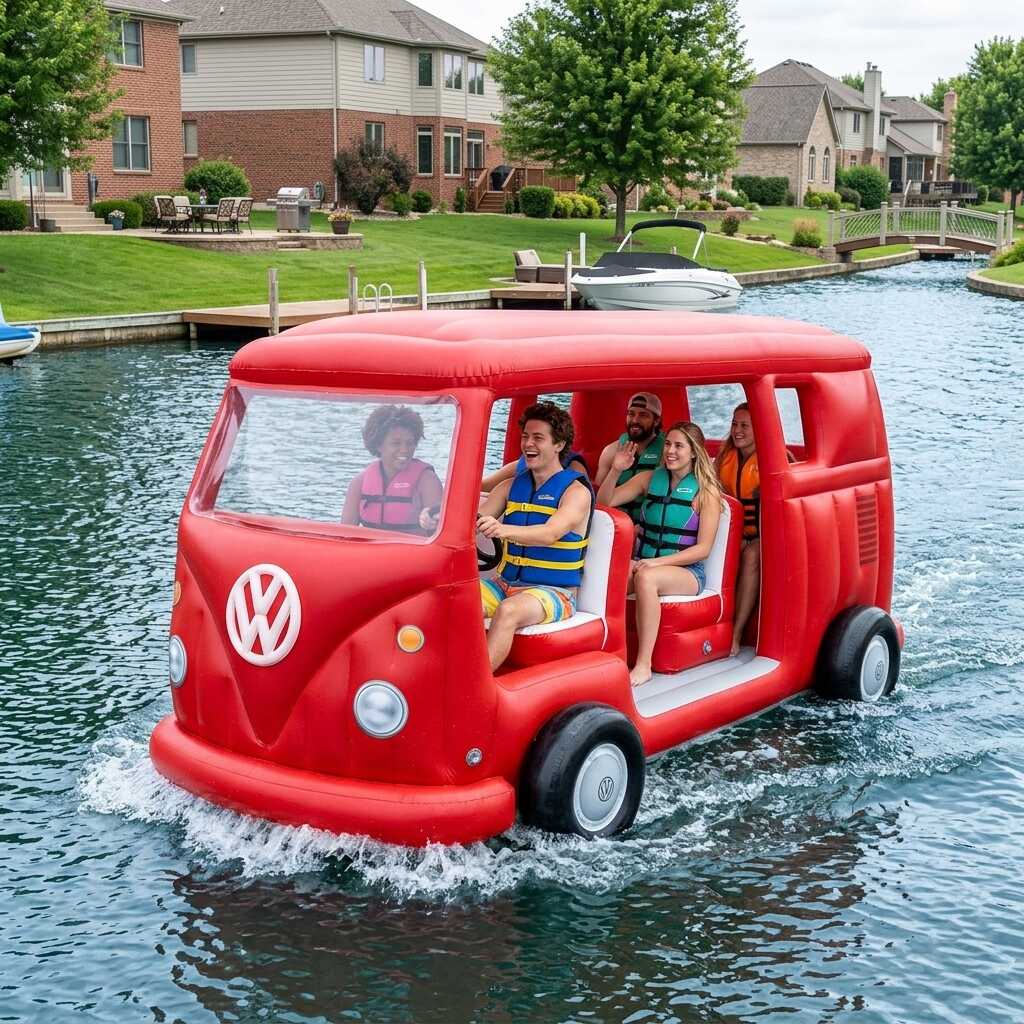
Part I: Architectural Silhouette and Spatial Design
Translating a boxy, land-bound vehicle into a stable watercraft requires a careful balance between aerodynamic automotive styling and hydrodynamic stability. The inflatable Volkswagen bus boat achieves this by mimicking the classic “forward control” cabin structure of the original Type 2 van while optimizing the lower hull for aquatic balance.
The Front-End Facia and V-Shape Nose
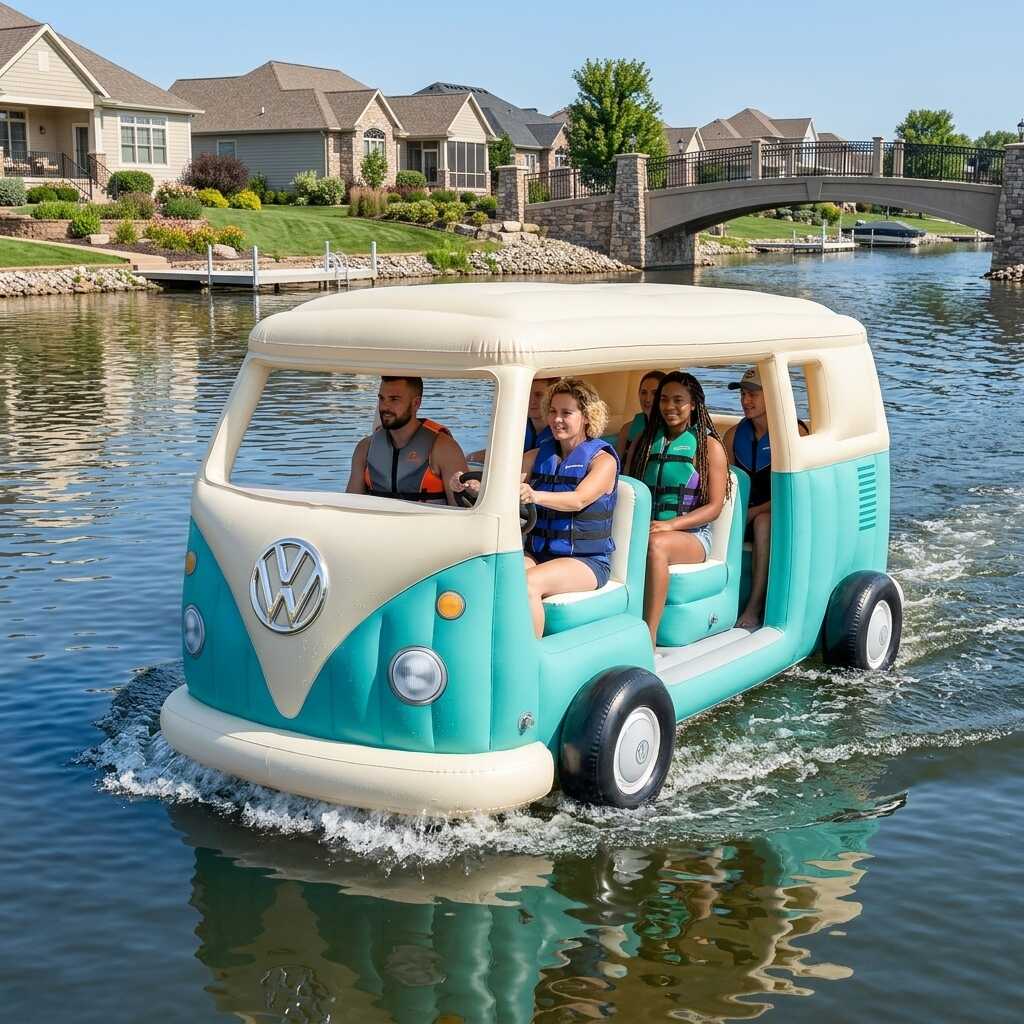
The defining characteristic of the classic VW bus is its flat, slightly curved front end. In the inflatable boat design, this flat vertical plane is maintained to preserve the iconic look, but the lower section gently curves backward to meet the waterline. This subtle modification prevents the front from acting as a massive wall against the water, allowing it to glide smoothly over small ripples. The signature split-windshield design is replicated using contrasting structural panels, giving the front of the boat its unmistakable, expressive “face.”
Side Profile and Geometric Proportions
From a side view, the boat retains the familiar rectangular, elongated silhouette of the classic camper van. The length-to-width ratio is carefully engineered to ensure that the inflatable structure feels spacious without becoming unwieldy on the water. Instead of sharp, rigid corners, the edges are rounded out by thick, pressurized air chambers. These cylindrical chambers frame the perimeter, softening the overall look while mirroring the gentle, non-aggressive curves of original 1960s automotive manufacturing.
Open-Top Cockpit Configuration
While the exterior mimics a fully enclosed van, the upper architecture is modified into an open-top or semi-convertible layout to suit its purpose as a water vessel. The “roof” section is strategically hollowed out to create a recessed, secure seating cockpit. This design choice maintains the high exterior side walls—replicating the van’s side panels and window cutouts—while ensuring the interior floor sits lower than the outer tubes to maximize stability and prevent tipping.
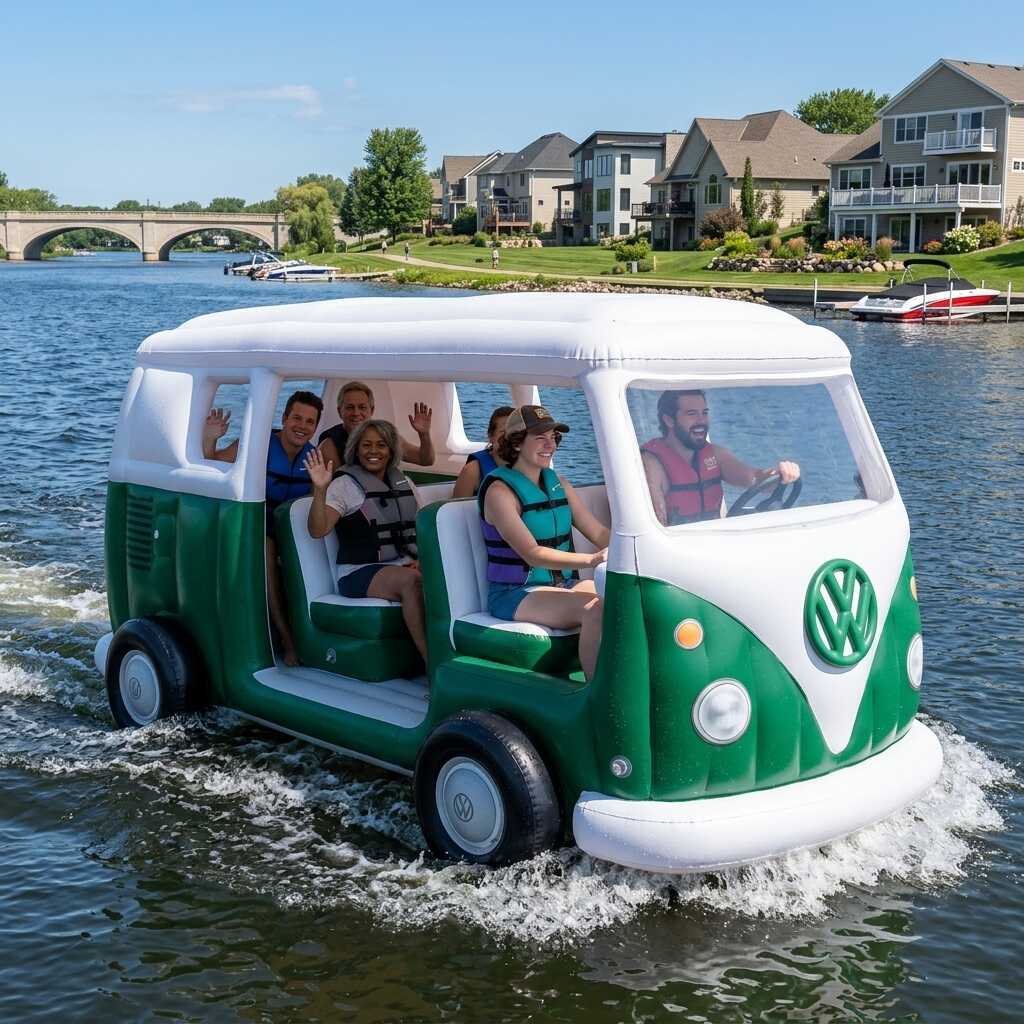
Part II: Exterior Visual Elements and Retro Detailing
The success of the inflatable Volkswagen bus boat design lies entirely in the details. Without precise visual markers, a large inflatable can easily look like a generic floating block. The design utilizes smart layering, printed graphics, and structural overlays to ensure instant recognition.
Lighter-Than-Air Detailing: The Oversized Emblem and Grille
At the absolute center of the front facia sits the crowning jewel of the design: an oversized, circular emblem mimicking the classic VW logo. In high-quality inflatable designs, this is not merely a flat print; it is a separate, slightly raised layer of material that adds physical depth to the bow. Flanking the lower section of the nose is a printed faux-chrome bumper and a series of horizontal lines that replicate the original air-intake grilles, completing the illusion of a vintage engine cooling system.
Split-Window Aesthetics and Faux Pillars
The original “Splittie” camper vans are legendary for their dual-pane front windshields. The inflatable boat honors this by utilizing darkened, glossy PVC panels on the front to simulate glass. A central vertical seam or colored fabric strip divides these panels, perfectly capturing the split-screen look. Along the sides, a series of rectangular dark panels mimic the iconic passenger windows, separated by vertical “pillars” printed directly onto the main body material to maintain the structural illusion of a multi-windowed transport vehicle.
Wheel Well Integration
One of the most creative aspects of this aquatic design is the treatment of the wheels. Because a boat requires a smooth, uninterrupted hull to minimize drag, functional wheels are absent. Instead, designers incorporate recessed wheel wells into the lower side panels. Inside these semi-circular cutouts, lifelike 2D or semi-3D inflatable “whitewall tires” with chrome-finished hubcaps are printed or attached. When the boat is resting on the water, these wheels sit just above the waterline, making it appear as though the vintage bus is magically driving across the surface of the lake.
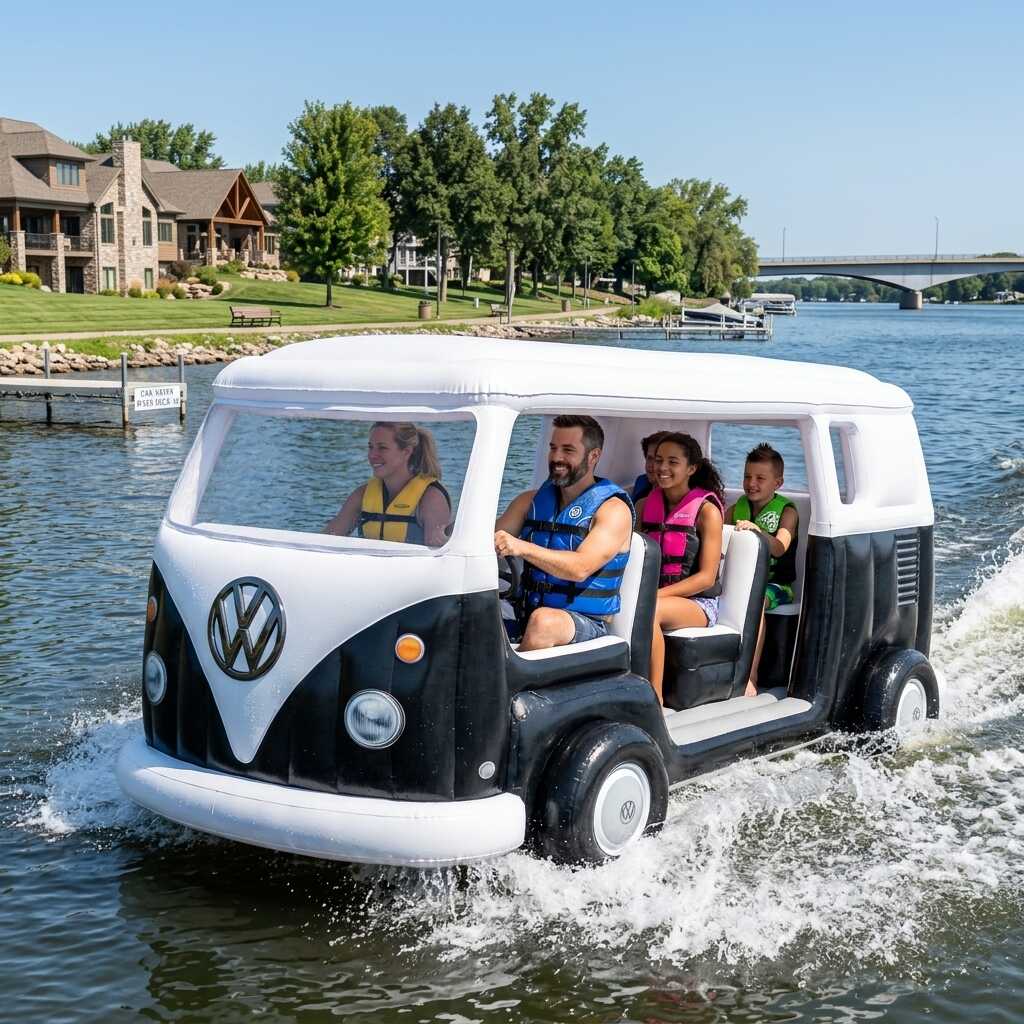
Part III: Materials, Textures, and Structural Integrity
An inflatable structure of this size demands heavy-duty engineering to maintain its complex, boxy shape under pressure. Without advanced material selection, the flat sides of a bus design would naturally bow outward and turn into an unshaped cylinder.
Heavy-Duty Drop-Stitch and Reinforced PVC
To achieve the flat, rigid side walls and straight lines characteristic of a vintage van, the interior construction relies heavily on drop-stitch technology. This process involves joining two parallel pieces of polyester fabric with thousands of tiny, nylon threads. When inflated to a high pressure, these threads pull tight, creating an incredibly rigid surface that remains perfectly flat rather than ballooning outward. The outer skin is composed of multi-layered, commercial-grade Polyvinyl Chloride (PVC), measuring between 0.9mm and 1.2mm in thickness, which provides a smooth, puncture-resistant matte or semi-gloss finish.
Thermo-Welded Seams and Multi-Chamber Safety
The geometric complexity of the bus design means there are numerous intersecting panels. These joints are secured using high-frequency thermo-welding, fusing the PVC layers into a single, unbreakable bond that resists stretching. Furthermore, the boat is engineered with a multi-chamber internal architecture. The front nose, the left and right side walls, and the floor bed are all isolated inflation zones. This division ensures that each section maintains its specific pressure, preserving the crisp angles of the van silhouette even during temperature fluctuations on the water.
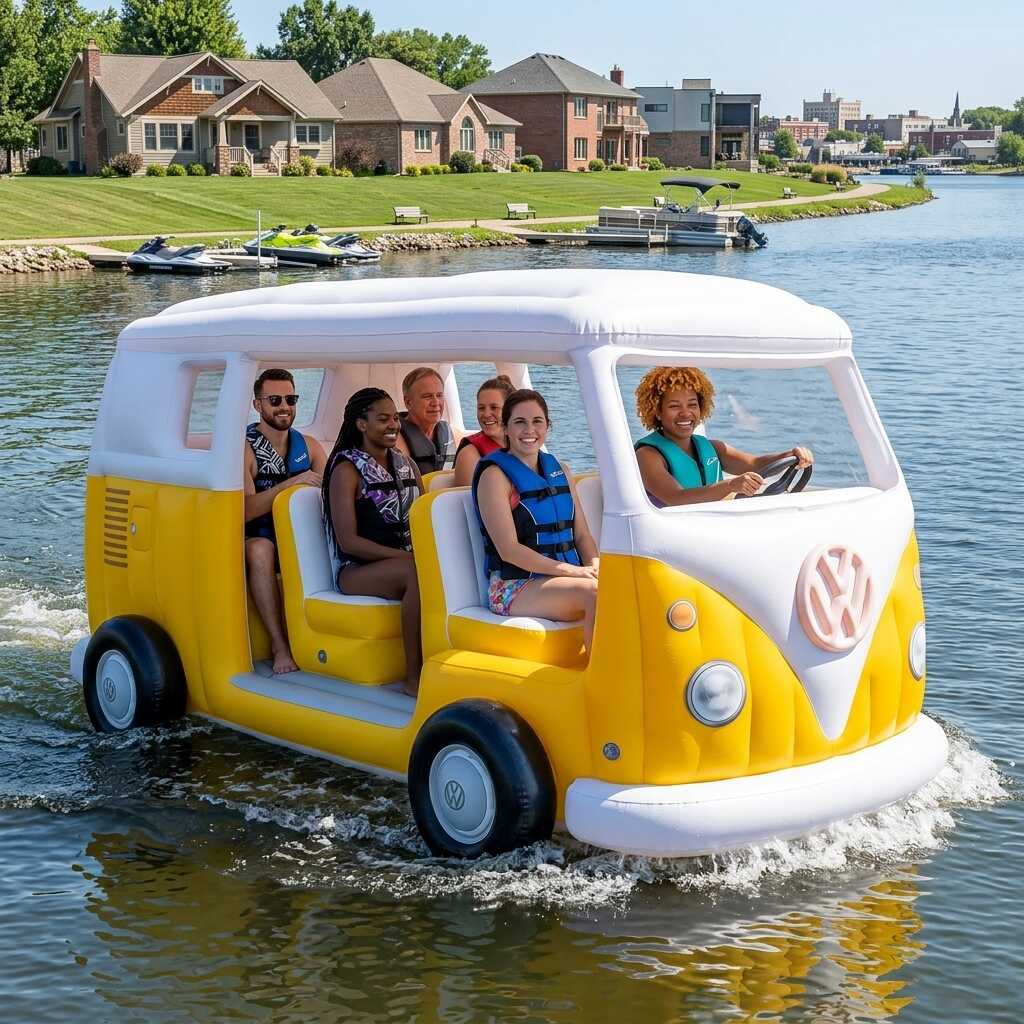
Part IV: Color Theory and Authentic Retro Palettes
Color plays a vital role in triggering immediate historical recognition. The inflatable Volkswagen bus boat design bypasses modern, neon water-toy colors in favor of authentic, period-correct automotive paint schemes from the 1960s and 1970s.
The Classic Two-Tone Division
The definitive color layout for a vintage camper is the two-tone split, and this translation is executed flawlessly on the watercraft. Typically, the upper half of the boat—including the window frames, front pillars, and interior cockpit rim—is finished in a crisp, clean cream or pastel white. The lower half features a bold, solid block of color. The dividing line runs horizontally around the entire perimeter of the vessel, dipping into a distinctive “V” shape at the front bow, exactly matching the paint lines of the original land vehicles.
Period-Correct Pastel Hues
The primary color choices celebrate the palette of the hippie era. The most common variations include:
-
Seaside Turquoise: A soft, greenish-blue that blends naturally with tropical or lake waters.
-
Matte Ochre or Mustard Yellow: A warm, earthy tone that radiates a sunny, late-60s beach vibe.
-
Heritage Crimson: A deep, muted red that provides high visibility on the water while maintaining a classic look.
These colors are formulated with UV-resistant pigments embedded directly within the PVC matrix, ensuring that the retro hues do not fade into washed-out shades after prolonged exposure to sunlight.
Conclusion: A Masterclass in Trans-Medium Design
The inflatable Volkswagen bus boat represents a brilliant execution of cross-industry design translation. By treating the iconic Type 2 camper van not just as a vehicle, but as a specific geometric and visual language, designers have successfully moved a land legend into an entirely new medium. Through the strategic use of flat drop-stitch panels, precise retro color blocking, and meticulously placed visual details like the split windshield and printed whitewall tires, this floating craft maintains absolute aesthetic fidelity to its historical inspiration. It stands as a striking example of how classic mid-century lines can be seamlessly preserved through modern marine materials and inflatable engineering.