
The boundary between avant-garde fashion and functional industrial design has always been fluid, but few creations capture this convergence as radically as the modern inflatable body suit boat. Born from the rebellious spirit of mid-twentieth-century wearable art, this anomalous object functions simultaneously as a sculptural garment and an amphibious vessel. While traditional maritime design prioritizes rigid hull mechanics and standard naval architecture, the development of the inflatable body suit boat flips the script, asking a fundamentally artistic question: How can the human form, wrapped in pneumatic geometry, become its own vehicle?
To understand this design phenomenon, one must look past the practical world of standard watersports and examine the history of wearable art, soft sculpture, and kinetic fashion. The trajectory from theatrical runway performance to a functional, water-buoyant personal craft relies on a meticulous balance of form, material science, and color theory. This article traces that precise evolution, analyzing how the silhouettes of inflatable art transformed into the highly specialized structural anatomy of the modern inflatable body suit boat.
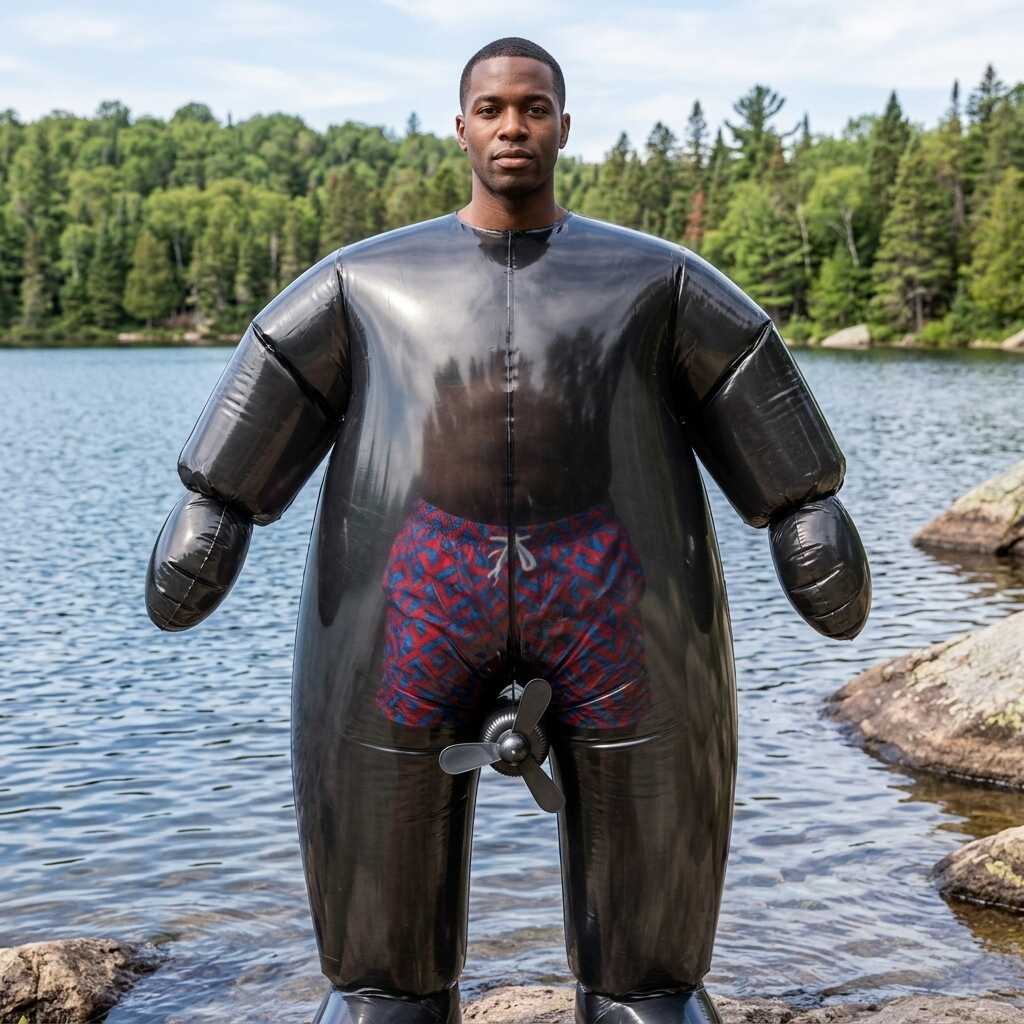
The Genesis: Wearable Art and Kinetic Silhouettes
The aesthetic blueprint of the inflatable body suit boat was not drafted in a shipyard; it was conceived in the experimental studios of 20th-century artists and radical fashion designers. In the 1960s and 1970s, avant-garde movements sought to extend the human body into space through wearable architecture. Artists like the collective Ant Farm, Coop Himmelb(l)au, and fashion icons such as Issey Miyake and Rei Kawakubo experimented with volume, air pressure, and exaggerated forms that challenged standard human outlines.
These early wearable art pieces utilized air as a structural medium, turning flat fabrics into bulbous, dramatic 3D shapes. The primary visual language relied on altering the scale of the wearer. When translated years later into a water-bound vessel, these artistic silhouettes provided the foundational volume required for hydrostatic buoyancy. The modern inflatable body suit boat inherits this exact artistic DNA: it features exaggerated, bulbous pontoons integrated directly into the torso, limbs, and posterior of a wearable suit, creating a radical, organic silhouette that looks like a living sculpture both on land and in the water.
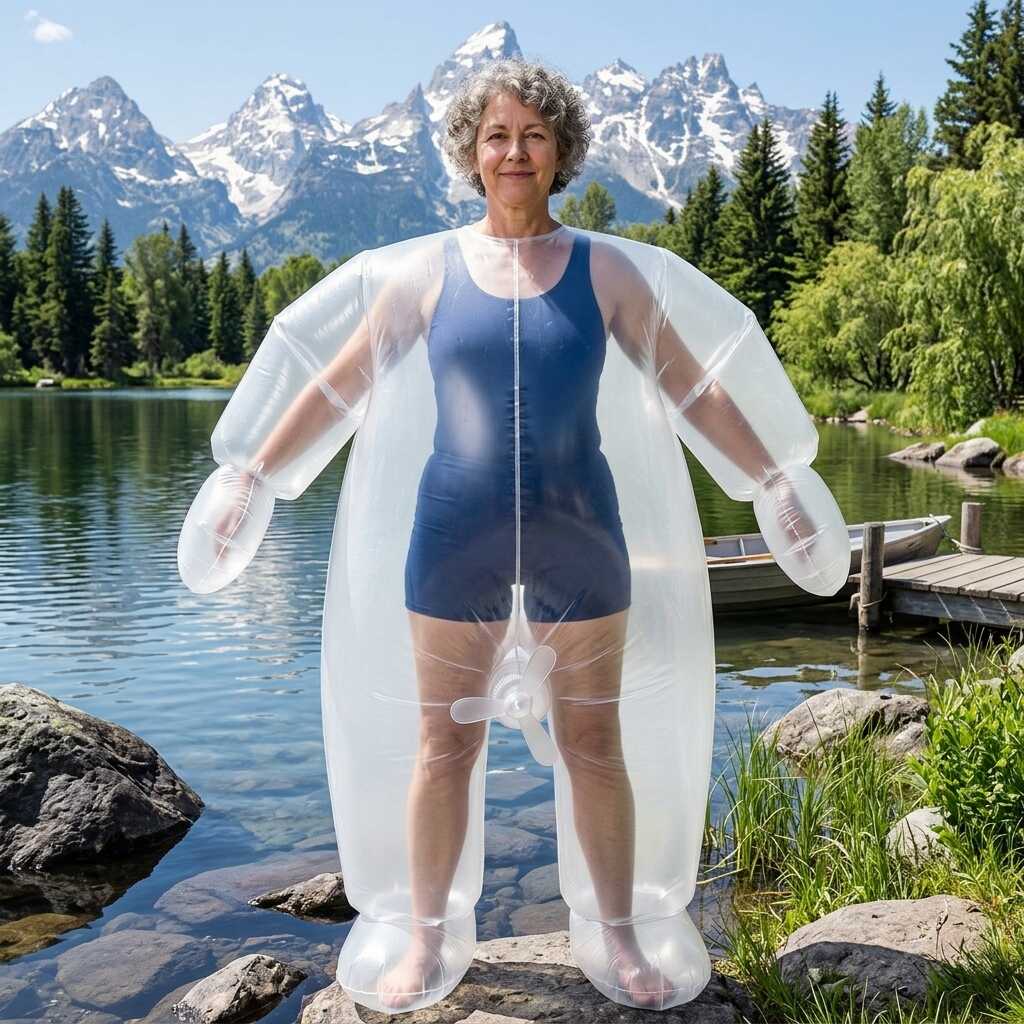
Structural Design and Aerodynamic Anatomy
The design of a functional inflatable body suit boat requires a complex translation of human anatomy into nautical engineering. Unlike a standard kayak or inflatable raft where the user sits inside a hollow chamber, this product wraps the user directly in the buoyant chambers themselves.
The Torso Hull and Pontoons
The core of the structure centers around a heavily reinforced torso unit. This section mimics the layout of a traditional catamaran or trimaran hull but is shaped to conform to the human chest and back. Thick, cylindrical chambers extend outward from the hips and ribs, acting as outriggers or integrated pontoons. When the wearer lies prone or sits back in the water, these chambers displace enough water to keep the human body completely afloat without tipping.
Limb Integration and Articulation
A major design hurdle inherited from wearable art is articulation. How do you keep an inflated structure flexible enough for movement? The suit addresses this through pleated or segmented air cells along the shoulders, elbows, and knees. These accordion-like baffles compress and expand, allowing the wearer to use arms and legs for propulsion while maintaining an airtight, high-pressure state throughout the rest of the suit. The lower legs often flare out into wide, flat, air-filled fins, eliminating the need for separate paddles by turning the wearer’s own limbs into high-surface-area oars.

Material Science: From PVC Film to Drop-Stitch Polyurethane
The transition from fragile gallery art to a rugged, river-ready vessel required a massive revolution in materials. Early pneumatic wearable art relied heavily on thin polyvinyl chloride (PVC) sheets or treated nylon, which were highly prone to punctures and lacked the structural rigidity needed to withstand water currents.
Modern inflatable body suit boats utilize military-grade composite materials engineered to hold high internal pressure without warping.
Double-Wall Drop-Stitch Fabrics
To achieve flat, stable surfaces on the bottom of the suit (allowing the wearer to skim across water or even stand on water surfaces), designers employ drop-stitch technology. This material consists of two layers of polyester base fabric joined together by thousands of tiny, microscopic nylon threads. When inflated, these threads pull tight, allowing the suit to be pumped to incredibly high pressures (up to 15 PSI), turning flexible fabric into a rigid, board-like surface that behaves like a solid hull.
TPU and Hypalon Outer Layers
The outer skin of the suit is typically coated in Thermoplastic Polyurethane (TPU) or Hypalon. TPU offers excellent resistance to ultraviolet (UV) degradation, abrasion, and punctures while remaining highly flexible when deflated for storage. The seams are not merely glued; they are welded using radio-frequency (RF) or thermal energy, fusing the molecular structures of the fabric panels together to form a single, continuous, airtight bond that can handle the dynamic twisting forces applied by human movement in water.

Color Theory and Visual Aesthetics
The color palette of the inflatable body suit boat is a direct bridge between its dual identities: the high-visibility world of maritime safety and the bold, color-blocked world of pop art and retro-futurism.
-
Retro-Futuristic Neons: Drawing inspiration from the 1980s inflatable art scene, many designs favor vibrant neon yellows, electric pinks, and cyan blues. These colors create a stark, high-contrast silhouette against the natural dark blues and greens of open water bodies.
-
Geometric Color-Blocking: Rather than uniform, solid colors, the panels of the suit are often organized in aggressive geometric patterns. Darker, high-abrasion zones (like the underside hull components along the back and thighs) are rendered in matte blacks or deep charcoals to hide scuffs. Meanwhile, upper chambers utilize high-gloss finishes to catch the light, emphasizing the dramatic, rounded curves of the pressurized air cells.
-
Theatrical Monochromes: For pieces that lean further toward the artistic spectrum, matte white or stark monochromatic metallic silver skins are utilized. This choice gives the wearer the appearance of an organic, floating chrome sculpture or an astronaut drifting across a liquid landscape, heavily emphasizing the product’s wearable art roots.

Conclusion
The modern inflatable body suit boat stands as a testament to what happens when creative fashion theory breaks free from the runway and enters the physical elements of nature. By taking the inflated silhouettes, soft sculptural techniques, and avant-garde philosophies of early wearable art and fusing them with cutting-edge drop-stitch fabrics, RF welding, and hydrodynamic design, creators have built an entirely new category of personal watercraft.
It strips away the traditional separation between passenger and vessel, transforming the human body itself into the hull, the pontoon, and the propulsion system. Ultimately, the product proves that functional engineering does not have to be rigid, and wearable art does not have to remain confined to galleries—it can simply float away into entirely new horizons of design.