
In a world increasingly defined by mass production and digital abstraction, the yearning for tangible connection—to material, to process, to place—has deepened. It is within this quiet cultural renaissance of making—of returning to hand, eye, and intuition—that the Epoxy Nature Scene Sofa emerges not as mere furniture, but as a philosophical statement in three dimensions. This piece is neither simply a seat nor a sculpture; it is a dialogue between human intention and natural memory, a confluence where landscape is not represented, but reconstituted. Its making is a ritual of translation: from forest floor to workshop bench, from riverbed stone to poured resin, from geological time to domestic intimacy.
The Epoxy Nature Scene Sofa does not mimic nature. It does not apply a motif like wallpaper onto form. Rather, it embodies landscape—through contour, stratification, texture, and light—inviting the inhabitant not to sit upon nature, but to dwell within its recollected essence. Its creation demands an unusual synthesis: the patience of a geologist, the sensitivity of a painter, the precision of an engineer, and the reverence of a poet. It is, at its core, an act of material storytelling, where epoxy resin ceases to be a synthetic compound and becomes a medium of preservation, revelation, and metamorphosis.
This article traces that journey—not as a technical manual, but as a contemplative exploration of process as meaning. We will move through three interwoven phases: Conception and Cartography—the gathering of place and idea; Material Alchemy and Embodiment—the physical realization of form and scene; and Contemplative Integration—the quiet resonance that arises when landscape is welcomed into the interior as presence, not decoration. In each stage, the Epoxy Nature Scene Sofa reveals itself as more than object: it becomes a threshold.
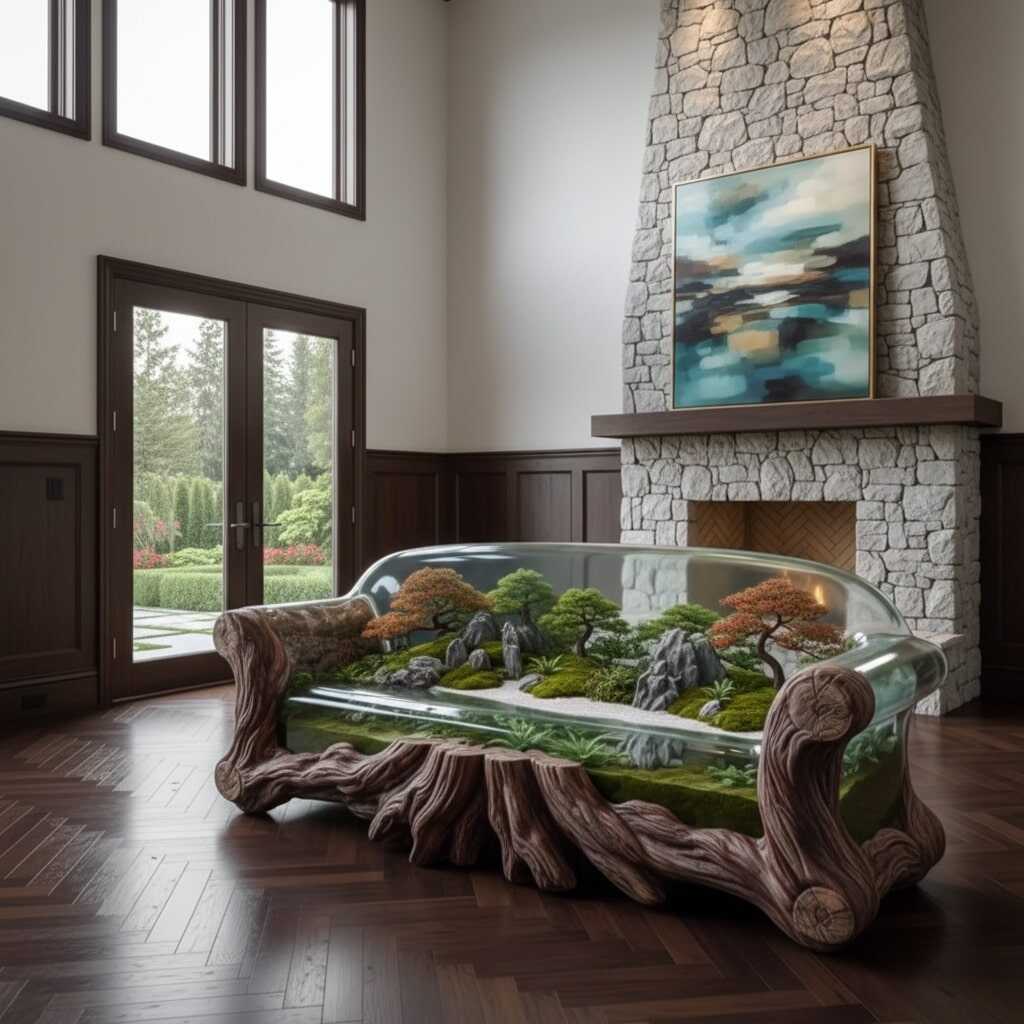
Part I: Conception and Cartography — Listening to the Land Before the Pour
Before the first drop of epoxy is mixed, the Epoxy Nature Scene Sofa begins not in the studio, but in the field. Its genesis is rooted in place-specific attunement. The maker does not arrive with a pre-formed design, but with openness—a readiness to be addressed by terrain. This phase is less about sketching and more about listening: to the slope of a moss-covered ravine, the fractal branching of a lightning-struck oak, the sedimentary layers exposed in a roadside cut, the way light pools in a forest clearing at dusk.
This is cartography of the intimate kind. The maker may spend days, even weeks, returning to a single site—not to extract, but to absorb. Photographs are taken, yes, but more importantly, field notes are kept: the cool dampness of lichen under fingertips, the sound of wind moving through dried reeds, the weight and grain of a water-worn stone held in the palm. Samples are collected—not as trophies, but as emissaries: a fragment of shale, a cluster of pine cones still resinous, a handful of ochre-rich soil, a fallen branch with bark still clinging in spiraled patterns. These are not raw materials for replication, but references for resonance. They carry the grammar of a place—the syntax of erosion, growth, decay, and resilience.
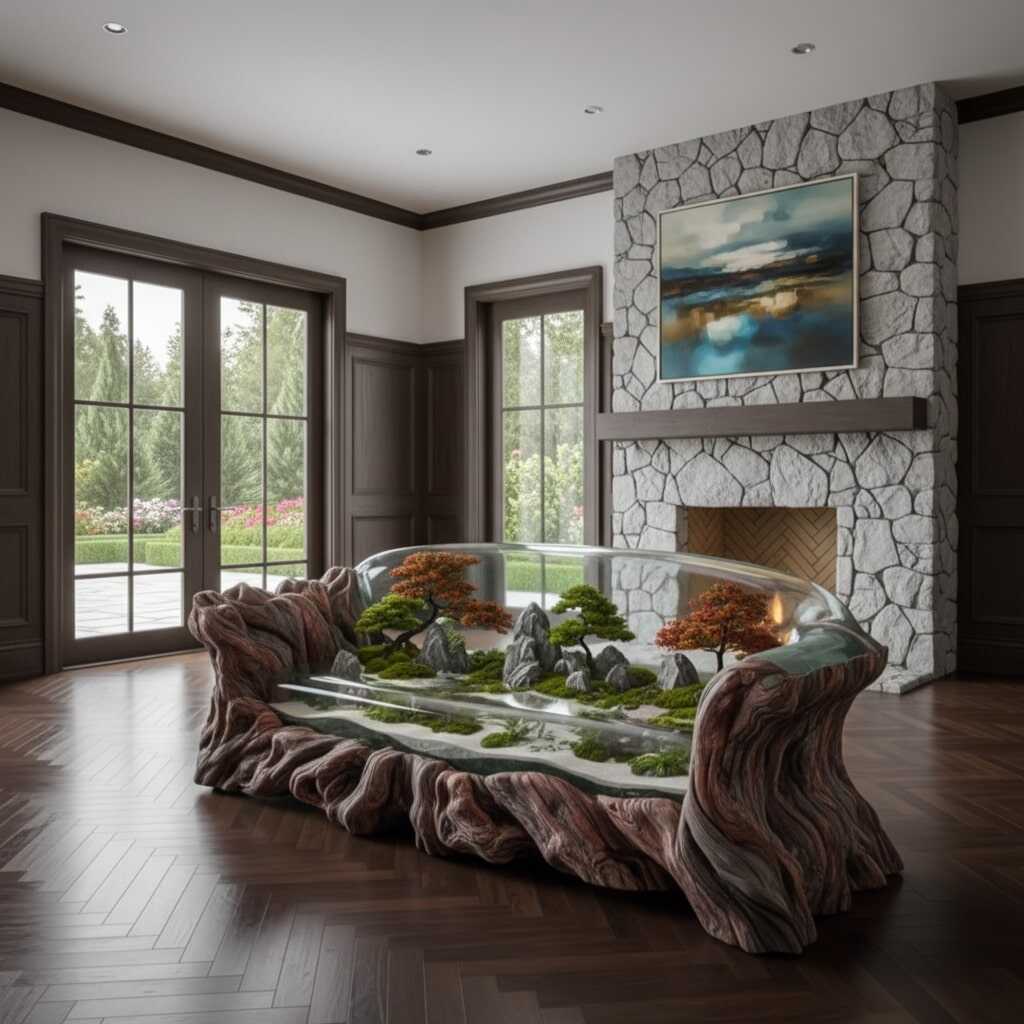
Back in the studio, these fragments become the first tactile anchors of design. The sofa’s silhouette is not drafted on paper first; it is felt through manipulation. Clay is shaped over armatures, not to impose geometry, but to echo the undulating rise of a dune or the sheltering curve of a riverbank. The seat depth is determined not by ergonomic charts alone, but by the memory of sitting on a sun-warmed granite outcrop—how the body nestles into its slight depression, how the back finds purchase against its gentle rise. The armrests may swell and taper like the roots of a banyan, or taper to a fine point like the tip of a fern frond unfurling.
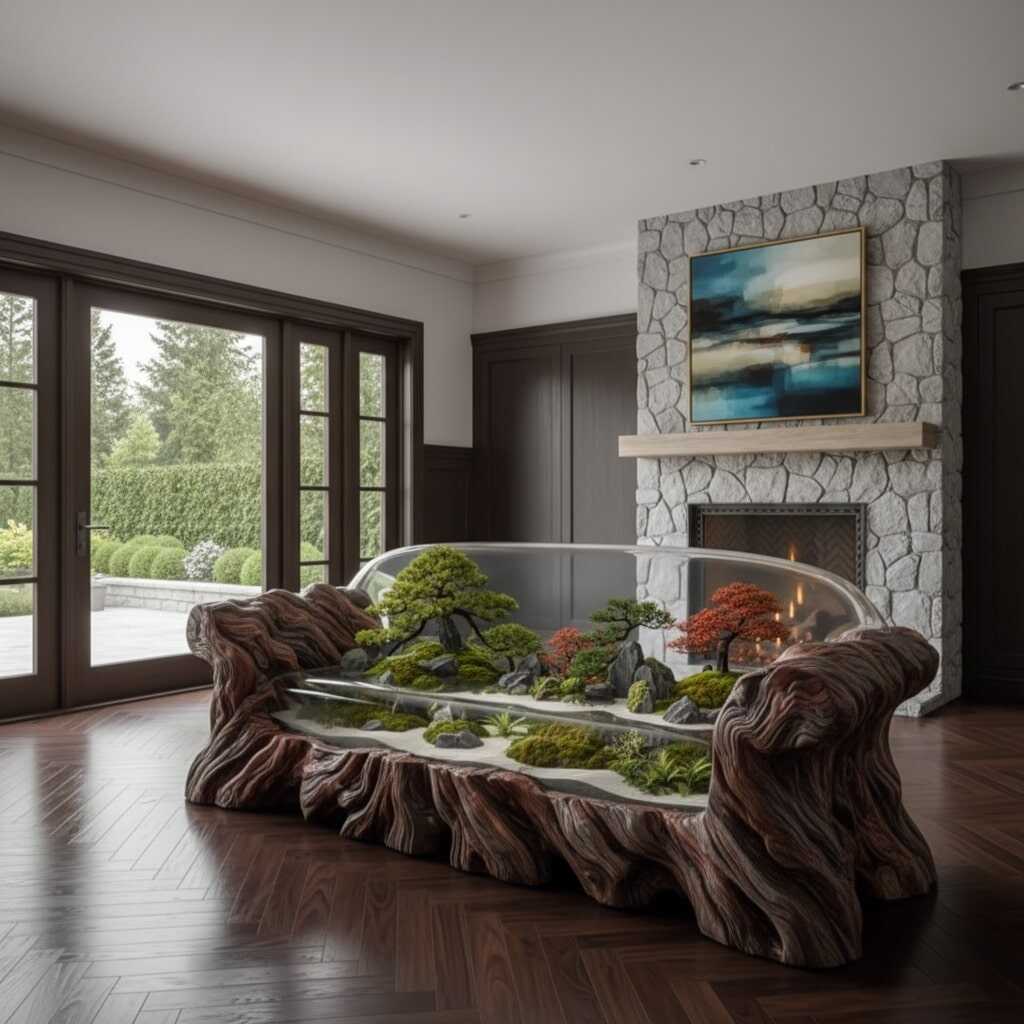
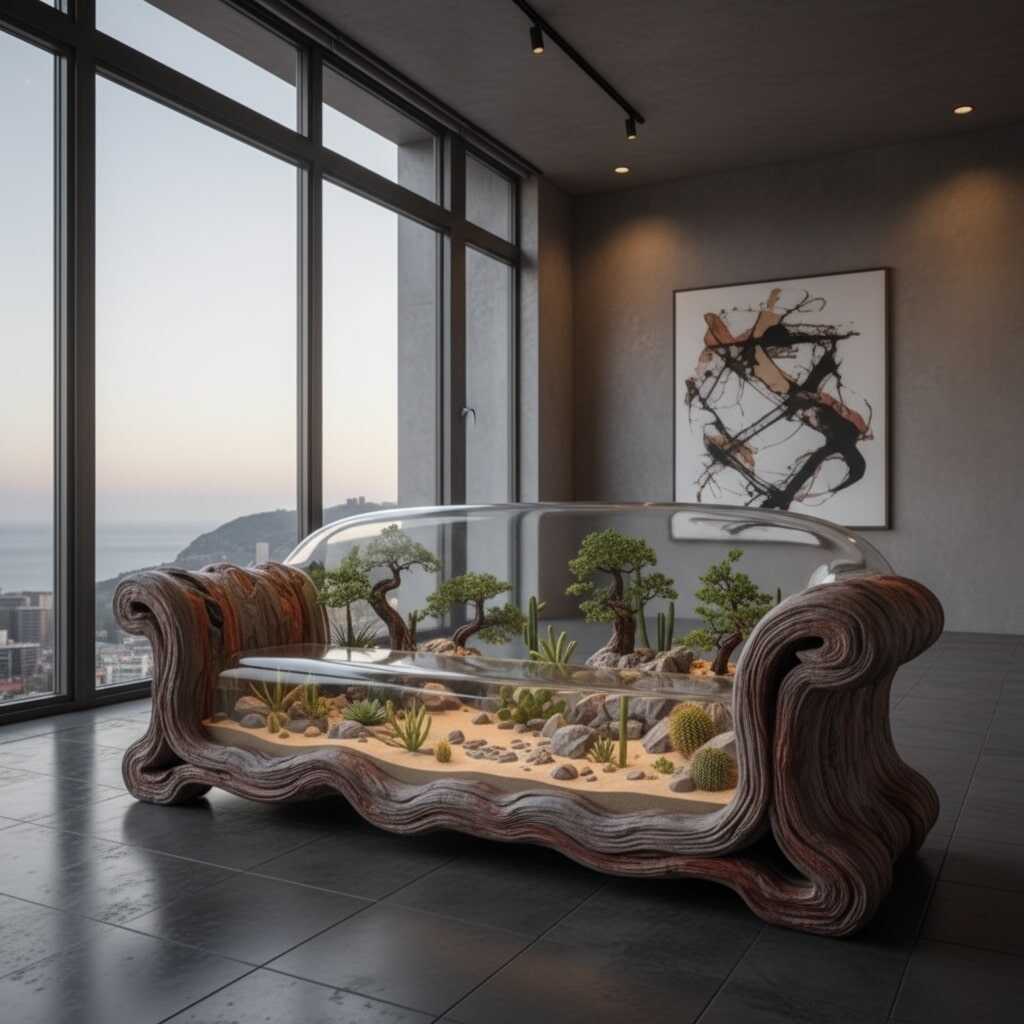
Crucially, the nature scene is not a pictorial insert. It is structural. The landscape does not sit on the sofa; it is the sofa. A ravine becomes the recess between seat and backrest. A cluster of boulders informs the modular grouping of cushions—or their absence, where hard, polished surfaces invite bare skin to meet cool, river-smoothed form. The “scene” is three-dimensional architecture, not two-dimensional illustration. In this way, the Epoxy Nature Scene Sofa rejects the decorative veneer. It commits to topography as function.
This phase concludes not with a finalized blueprint, but with a material map—a layered collage of sketches, soil samples in labeled vials, pressed leaves, annotated photographs, and small maquettes in wood and clay. It is a palimpsest: the land’s voice, filtered through memory, translated into intention. Only when this map feels true—not accurate, but authentic—does the maker turn to epoxy.
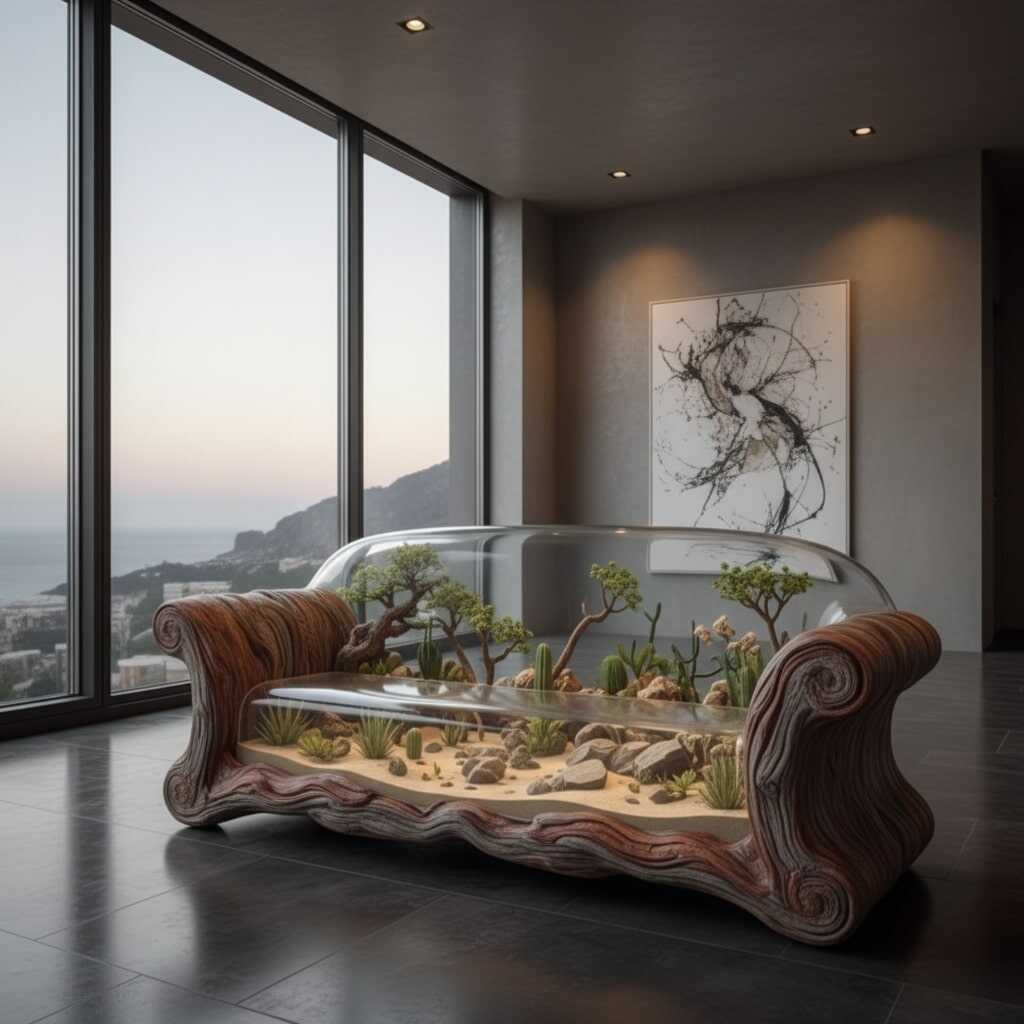
Part II: Material Alchemy and Embodiment — Pouring Time, Capturing Light
Epoxy resin is often misunderstood as a static, glossy shell—a sealant, a finish. In the creation of the Epoxy Nature Scene Sofa, it becomes something far more dynamic: a medium of suspended time, a liquid lens through which landscape is both preserved and reimagined. Its transformation—from viscous, honeyed fluid to solid, glass-like clarity—is not merely chemical; it is alchemical. It is here that craft meets geology, and the maker becomes a collaborator with molecular processes.
The substrate—the structural skeleton of the sofa—is typically built from sustainably sourced hardwoods or reclaimed timber, shaped to mirror the contours established in the cartographic phase. But it is rarely left bare. Instead, the wood is prepared as terrain. Gouges are carved to mimic erosion channels; depressions are hollowed to suggest pools or animal burrows; surfaces are charred (via shou sugi ban or similar techniques) to evoke fire-scoured landscapes or ancient petrified wood. These interventions are not random; they are informed by the specific ecological narratives gathered in the field. A charred section may recall a lightning-caused forest fire that cleared the way for new growth; a deep channel may echo the path of a seasonal creek.
Then begins the pouring.
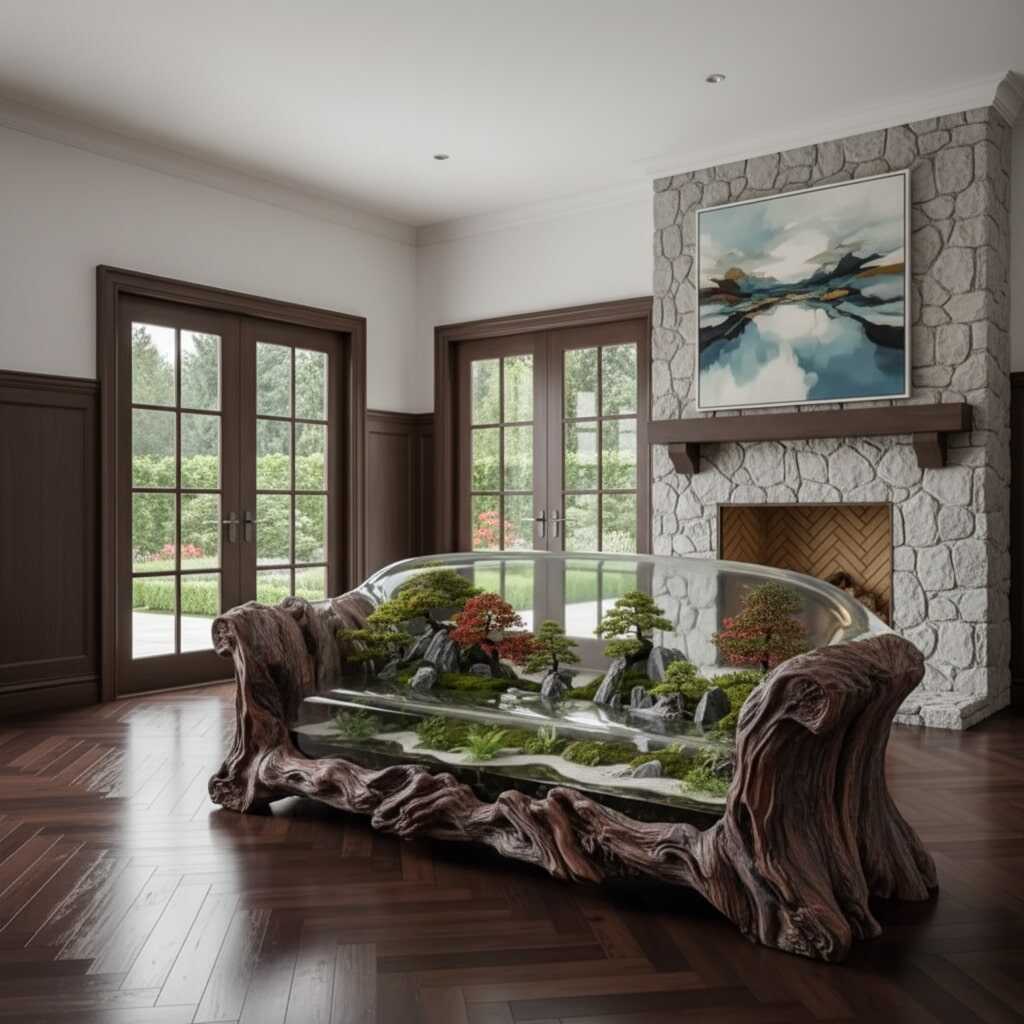
This is where the nature scene is literally embedded. The maker does not pour a single, uniform layer. Instead, the process is stratigraphic—layer upon layer, each with its own intention, its own temporality.
The base pour may be tinted with iron oxides, ground stone, or botanical inks to replicate the mineral strata of a specific cliff face—ochres, umbers, deep violets of shale. Into this semi-fluid matrix, actual fragments are placed: tiny pebbles smoothed by centuries of current, shards of slate, mica flakes that will catch light like distant stars in rock. The resin is poured shallowly, allowed to partially cure, then sanded—creating a “fossil bed” that will be visible in cross-section at the sofa’s edges.
The middle layers are where life emerges. Here, the maker introduces organic inclusions, each chosen for its integrity and meaning: a perfect maple samara (helicopter seed), suspended mid-spiral descent; a cross-section of a branch revealing its concentric growth rings, like a captured moment of time; clusters of dried moss, preserved in mid-flourish; delicate fern fronds, their fractal geometry intact. These are not glued on top—they are submerged, encapsulated. To do this requires immense care: air bubbles must be coaxed out with heat guns and torches, not burst; the viscosity of the resin must be calibrated so that inclusions neither sink nor float uncontrollably. It is a dance of gravity and suspension.
Most profound is the light layer—the final, clearest pour. Often several centimeters thick, this cap is pure, UV-stable epoxy, sometimes with a subtle blue or amber cast to mimic the quality of light at dawn or late afternoon. When cured, it becomes a lens. Viewed from above, the embedded scene is slightly magnified, softened—like seeing a forest floor through a ripple on a pond’s surface. Viewed from the side, the stratigraphy is revealed: the mineral base, the organic stratum, the crystalline light-capture above. This transparency is not emptiness; it is atmosphere made solid. It holds the memory of air, of sky, of the space between things.
The curing process is slow—days, sometimes weeks. Temperature and humidity are monitored not for efficiency, but for fidelity. A too-rapid cure can cause internal stress fractures, cloudiness, or ambering—distortions that break the illusion of natural clarity. The maker waits. In this waiting, there is humility: the material has its own timeline. The Epoxy Nature Scene Sofa cannot be rushed any more than a mountain can be grown in a day.
Once fully cured, the surface is polished—not to a high-gloss perfection, but to a luminous matte or soft satin that diffuses light like water over stone. Sharp edges are eased, not removed—preserving the sense of natural formation, not industrial finish. Any imperfections—tiny bubbles near an inclusion, a subtle wave in the surface—are not sanded away, but honored as traces of the process, as evidence of the hand and the material’s will.
At this stage, the sofa exists. But it is still inert. Its final activation comes not in the workshop, but in its encounter with human presence.
Part III: Contemplative Integration — Furniture as Threshold, Not Object
The Epoxy Nature Scene Sofa resists categorization. It is not “statement furniture” in the sense of张扬 (zhāng yáng)—ostentatious display. Nor is it purely functional. It exists in the liminal space between artifact and environment, inviting a different mode of engagement: contemplative inhabitation.
To sit on it is not merely to be supported. The body registers subtle messages: the coolness of the resin surface, reminiscent of stone in morning shade; the gentle undulation of the backrest, guiding posture not through ergonomics alone, but through an echo of natural repose—the way one leans into a tree’s embrace. The embedded scene is not “viewed” as a picture on a wall; it is experienced peripherally—a flicker of light on mica as one shifts, the slow recognition of a seed form beneath the knee. Perception deepens over time. What first appears as abstract pattern reveals itself, with familiarity, as a specific lichen species, a familiar leaf shape, the grain of a local hardwood.
This sofa does not dominate a room. It modulates it. In a minimalist interior, it becomes a concentrated node of complexity—a micro-landscape that draws the eye and stills the mind. In a lush, plant-filled space, it converses with living greenery, not as competition, but as kin—offering the permanence of geology to the ephemerality of growth. At night, under low light, the clear epoxy captures and refracts ambient glow, turning the embedded scene into a faint internal luminescence, like bioluminescence in deep water or fireflies in tall grass.
Critically, the Epoxy Nature Scene Sofa does not idealize nature. It does not present a pristine wilderness. The inclusions may include signs of decay: a leaf with insect nibbles, wood with spalting (fungal patterning), stones worn smooth through attrition. This is not flaw—it is truth. It acknowledges nature as process: growth and decomposition, resilience and fragility, continuity and interruption. In doing so, it offers a more honest, more profound connection than any idealized pastoral could.
Its presence fosters a quiet recalibration. In sitting, one is not merely resting the body, but reorienting perception—remembering that we, too, are shaped by forces larger than ourselves: gravity, time, elemental change. The sofa becomes a threshold between the domestic and the wild, not by bringing the wild in, but by reminding us that the wild was never out there—it is in the grain of our bones, the rhythm of our breath, the memory held in stone and seed.
This is the deepest meaning of fusion: not the blending of materials (wood and resin), nor even of disciplines (craft and geology), but the reconciliation of being. The Epoxy Nature Scene Sofa is an invitation to dwell not as dominion, but as participant—to sit, and in sitting, remember that we, too, are landscape.
Conclusion: The Enduring Whisper of Embodied Place
The making of an Epoxy Nature Scene Sofa is, ultimately, an act of re-membering—a piecing back together of what modern life has fragmented: the separation of hand from material, of inhabitant from environment, of time from attention. It is born from hours of silent observation, from the careful calibration of chemical reactions, from the acceptance of material agency, and from a profound respect for the narratives held in soil, stone, and stem.
It does not solve problems. It does not optimize. It resonates.
In its stratified depths, it holds compressed time: the slow accretion of sediment, the swift fall of a seed, the patient curing of resin. In its form, it carries the memory of contour—the dip of a valley, the rise of a dune, the curve of a river’s bend. In its surface, it captures light—not as reflection, but as inhabitation.
The Epoxy Nature Scene Sofa is not a replica of nature. It is a translation—a distillation of place into presence, rendered in a language of wood, stone, organic fragment, and luminous resin. Its power lies not in spectacle, but in subtlety; not in novelty, but in depth. It asks for time: time to make, time to cure, time to sit, time to see.
And in that asking, it offers a rare gift in our accelerated age: the possibility of slowness as communion. To sit before it, upon it, with it, is to re-enter a conversation older than language—one written in erosion and growth, in light and shadow, in the quiet persistence of form emerging from chaos.
In the end, the Epoxy Nature Scene Sofa is less an object to be owned, and more a threshold to be crossed—back into the enduring, whispering truth that we are not apart from the world, but of it. And sometimes, the most profound journeys begin not with departure, but with the simple, sacred act of sitting down—and remembering where we stand.