
There is a quiet poetry in the way cherry blossoms fall—soft, deliberate, suspended in mid-air as if time itself hesitates to carry them downward. For centuries, sakura—the Japanese cherry blossom—has served as a profound cultural metaphor: a symbol of impermanence, renewal, and the delicate beauty inherent in fleeting moments. To witness a cherry blossom season is to confront the sublime paradox of life: that what is most beautiful is often most ephemeral.
Now, imagine capturing that poetic moment—not in a photograph, nor in a brushstroke of ink on rice paper, but beneath your feet, embedded within the very foundation of your living space. Enter the Cherry Blossom Epoxy Floor: a breathtaking synthesis of organic inspiration and cutting-edge material innovation. This is not merely a decorative surface; it is a philosophical statement rendered in resin and pigment, a meditation on nature’s cycles translated into architectural form.
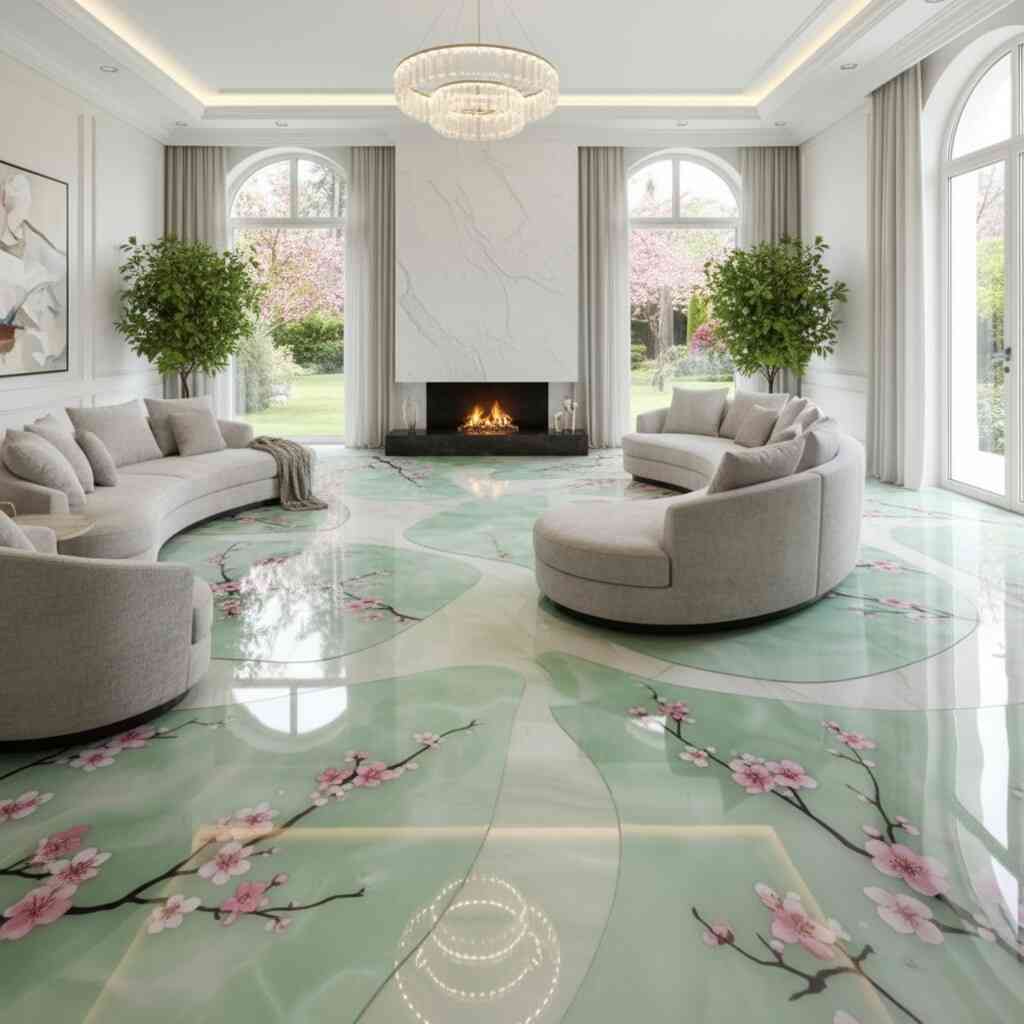
Unlike traditional flooring options that prioritize function over feeling, the Cherry Blossom Epoxy Floor transcends utility. It invites contemplation. It transforms the floor—the most overlooked plane in interior design—into a canvas where art, atmosphere, and architecture converge. In an era increasingly dominated by sterile minimalism and digital saturation, this floor offers something radical: presence. It slows us down. It reminds us to look down—not in haste, but in reverence.
This article explores how the Cherry Blossom Epoxy Floor embodies a deeper dialogue between the natural world and human habitation—how it serves as both aesthetic marvel and existential anchor. We will journey through its visual language, its symbolic resonance, and its evolving role in contemporary spatial narratives—always returning to the core idea that true design does not imitate nature; it converses with it.
Part I: The Visual Alchemy – How Nature Is Captured in Resin
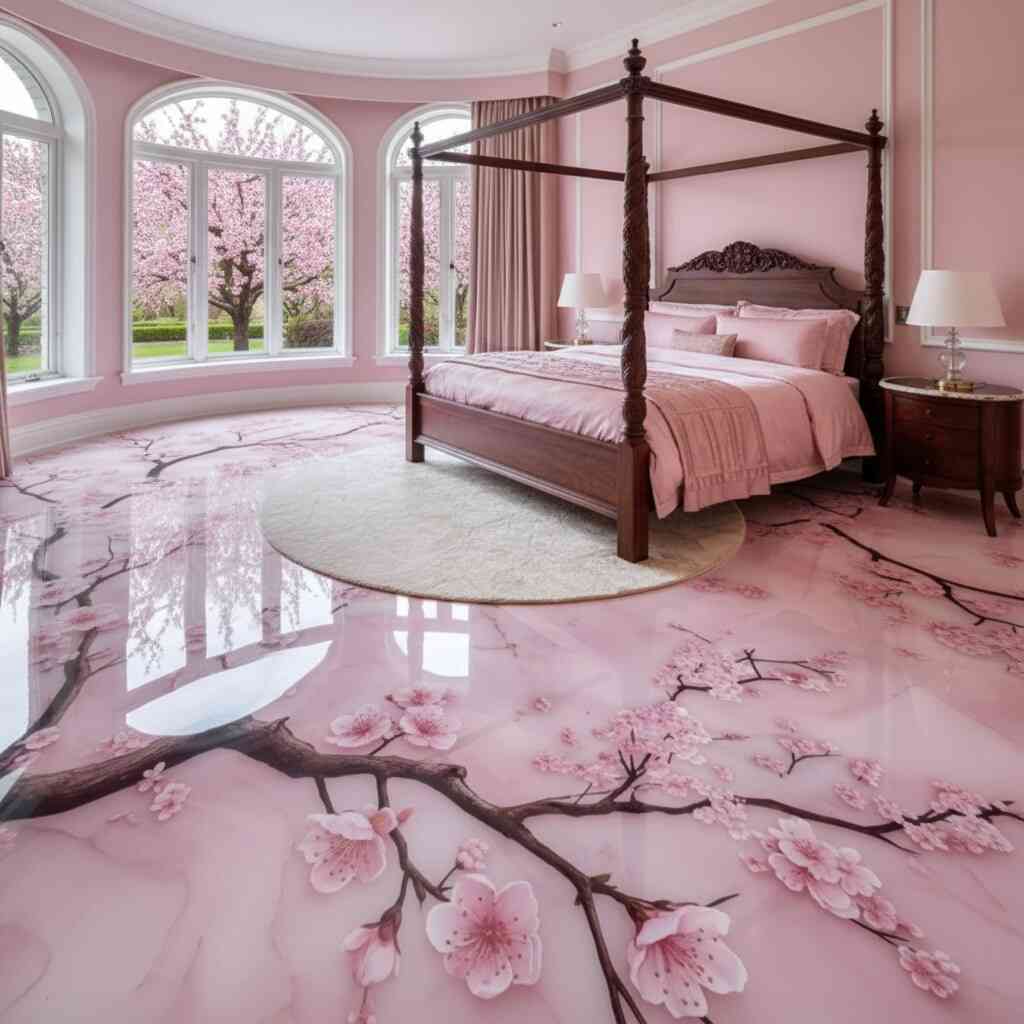
At first glance, a Cherry Blossom Epoxy Floor appears almost impossible: how can something so soft, so fleeting—the fragile petal of a sakura—be immortalized in glossy, industrial resin? The answer lies not in replication, but in interpretation.
Epoxy, by nature, is a paradoxical medium: chemically robust, yet optically fluid. When expertly applied, it behaves like liquid glass—capable of holding suspended particles, pigments, and delicate inclusions without distortion. Artisans crafting a Cherry Blossom Epoxy Floor do not simply stamp a floral pattern onto a surface. Instead, they engage in a multi-layered choreography of material and light.
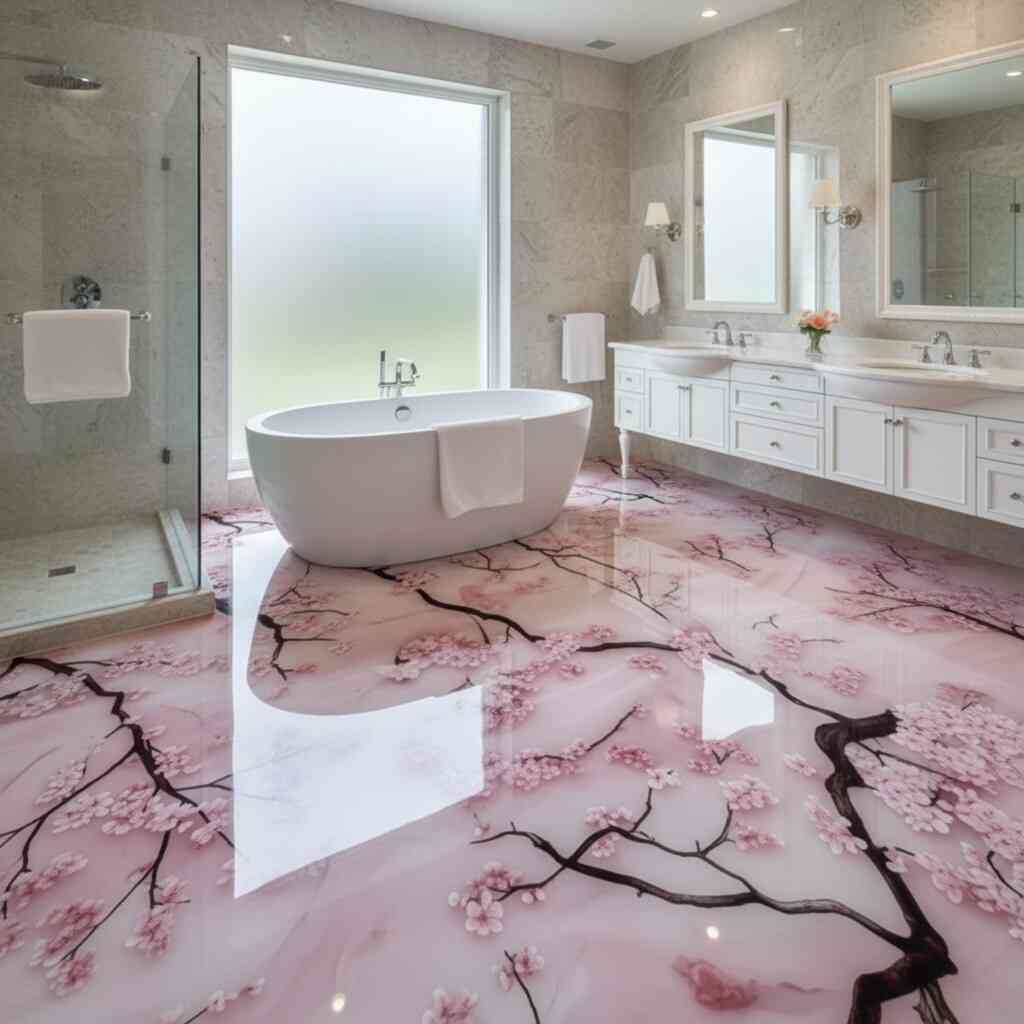
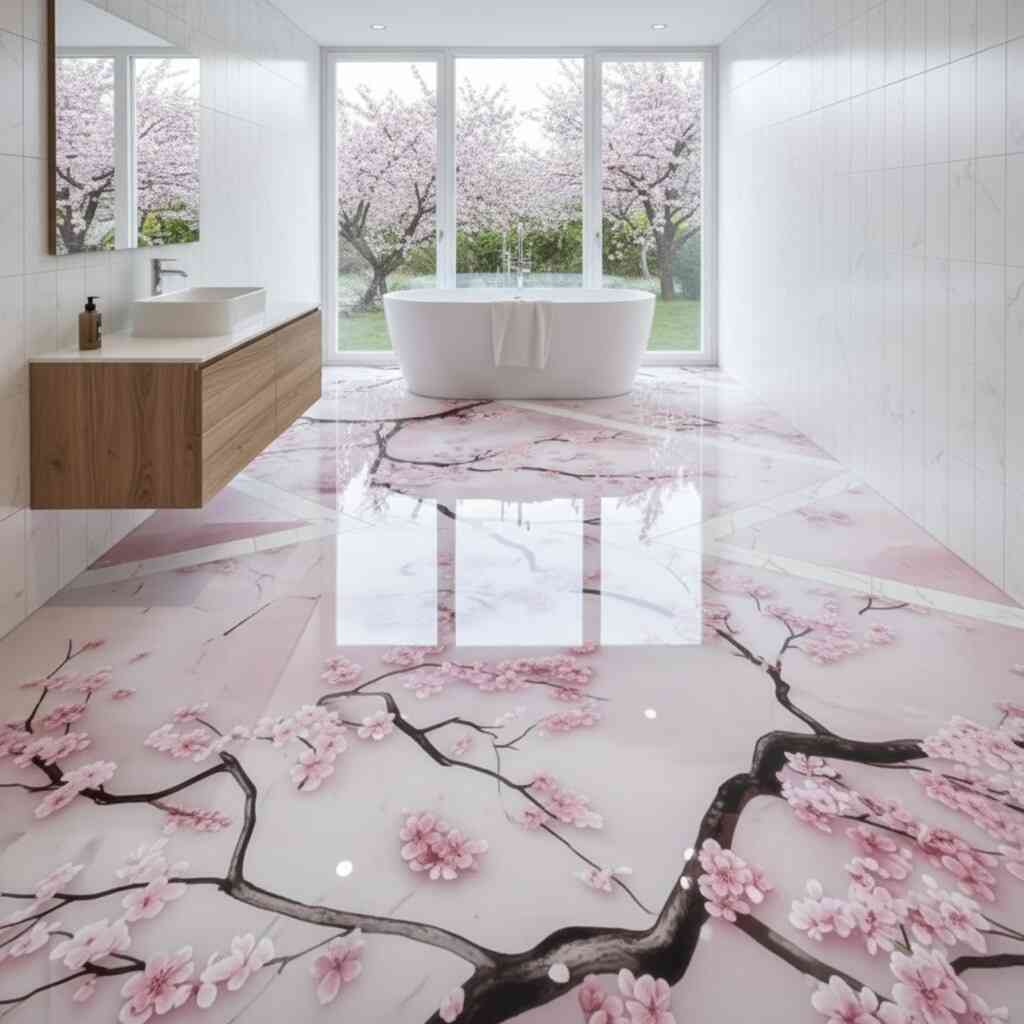
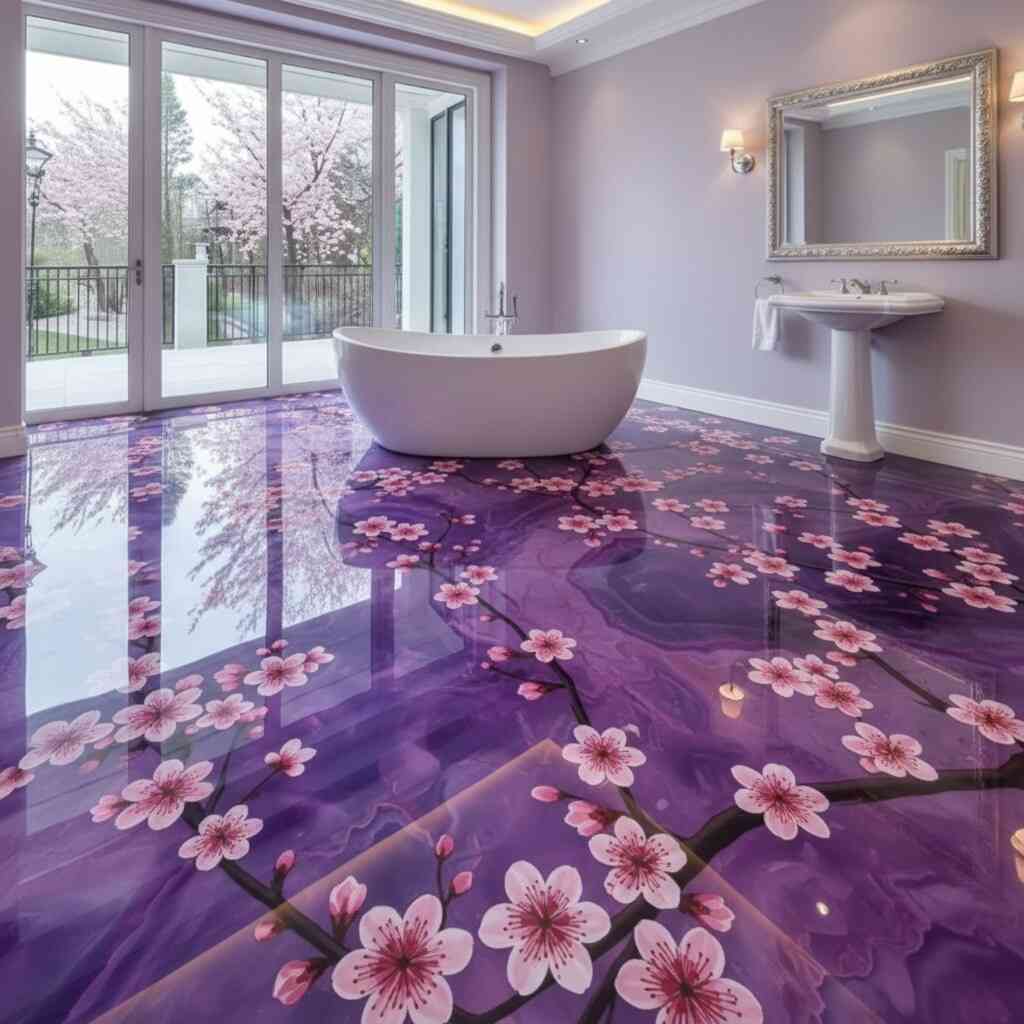
The process typically begins with a base layer—often a soft ivory, pale grey, or warm cream—evoking the muted tones of early spring skies or weathered wood. Onto this, hand-placed elements come into play: translucent resin petals, some cast from actual dried blossoms (preserved through vacuum sealing or silica embedding), others meticulously hand-painted in gradients of blush pink, petal white, and faint lavender. These are not uniform; irregularity is essential. A true sakura bloom is asymmetrical, slightly crinkled at the edges, veined with subtle imperfections—signs of life, not flaws to be erased.
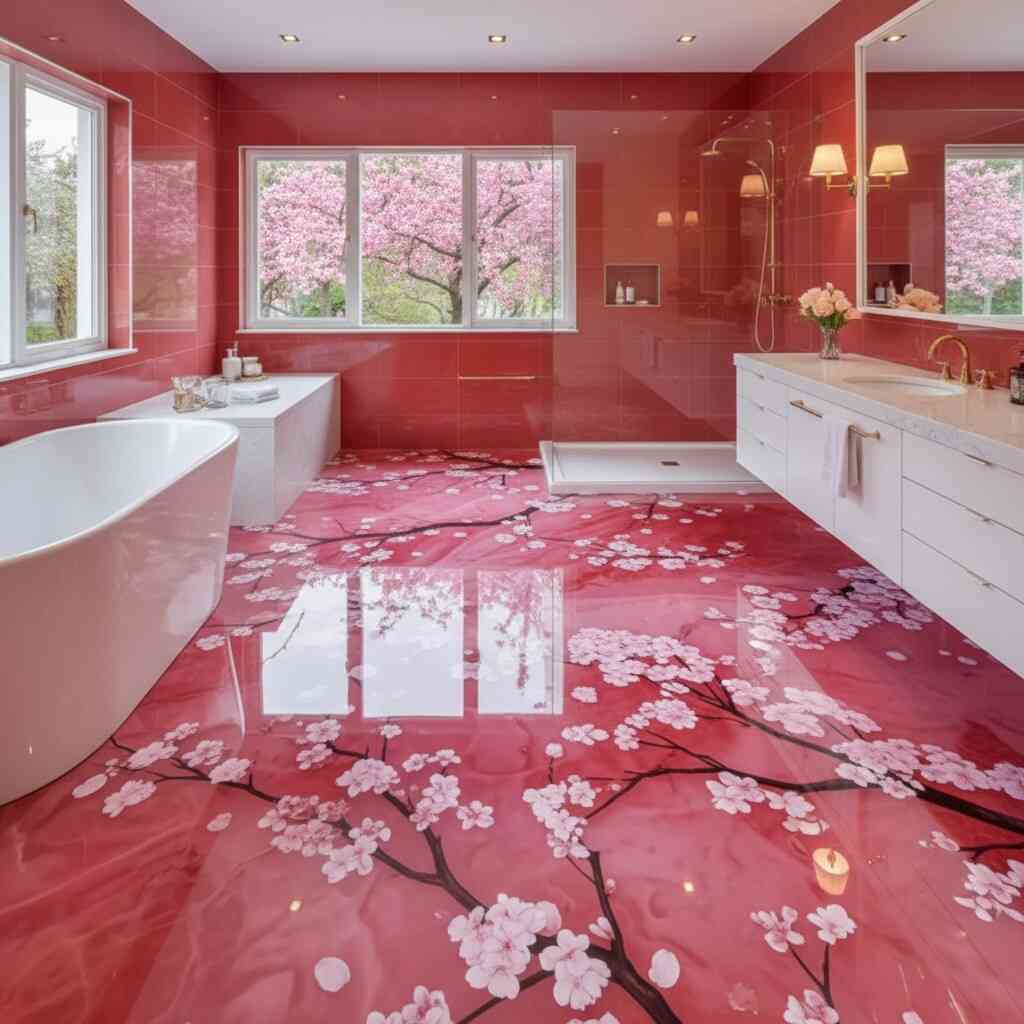
Then comes the flow. Artisans pour successive, pigmented epoxy layers in a controlled cascade—mimicking the natural drift of falling blossoms caught in a breeze. Some designs incorporate gentle swirls or faint ripples, suggestive of water or wind currents beneath the surface. The final topcoat is poured with optical clarity in mind: high-gloss finishes reflect ambient light like a morning-dew-kissed grove, while satin or matte variants evoke the hazy softness of a mist-covered hillside at dawn.
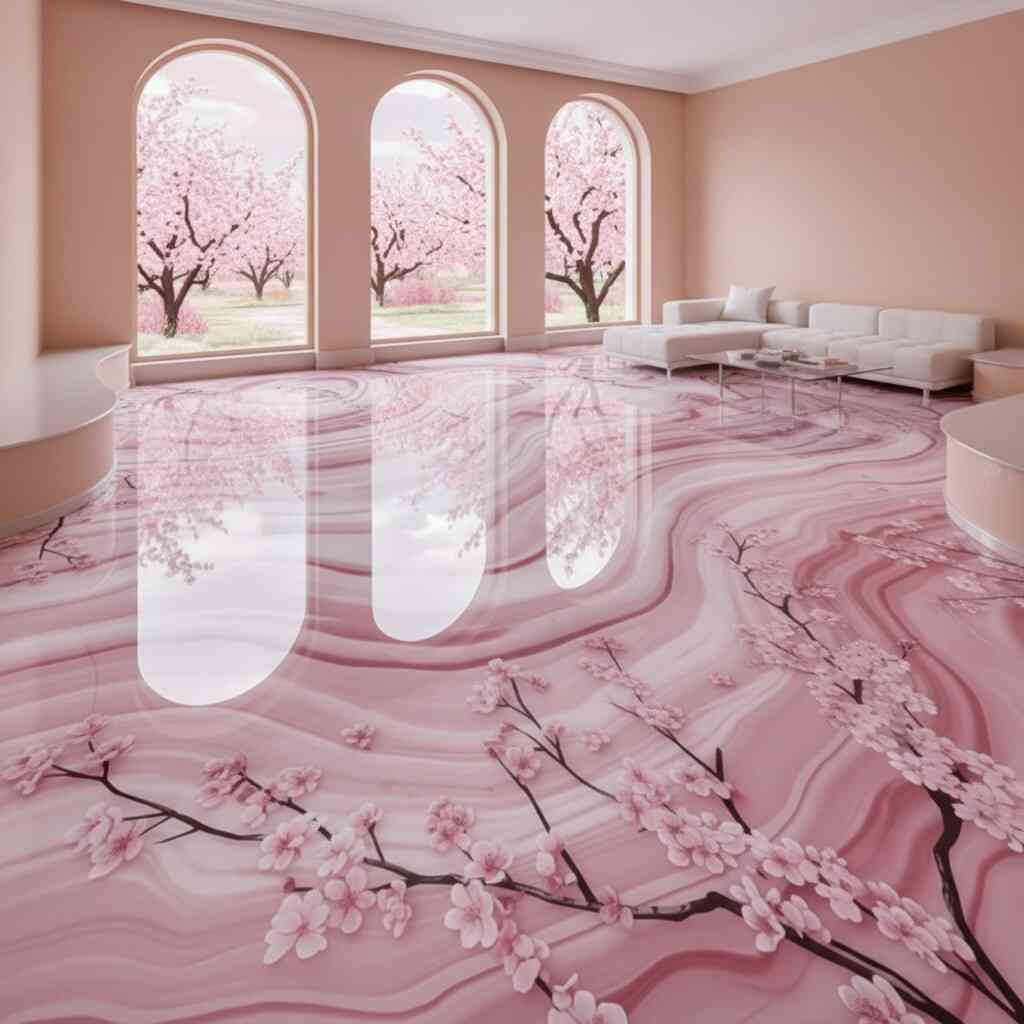
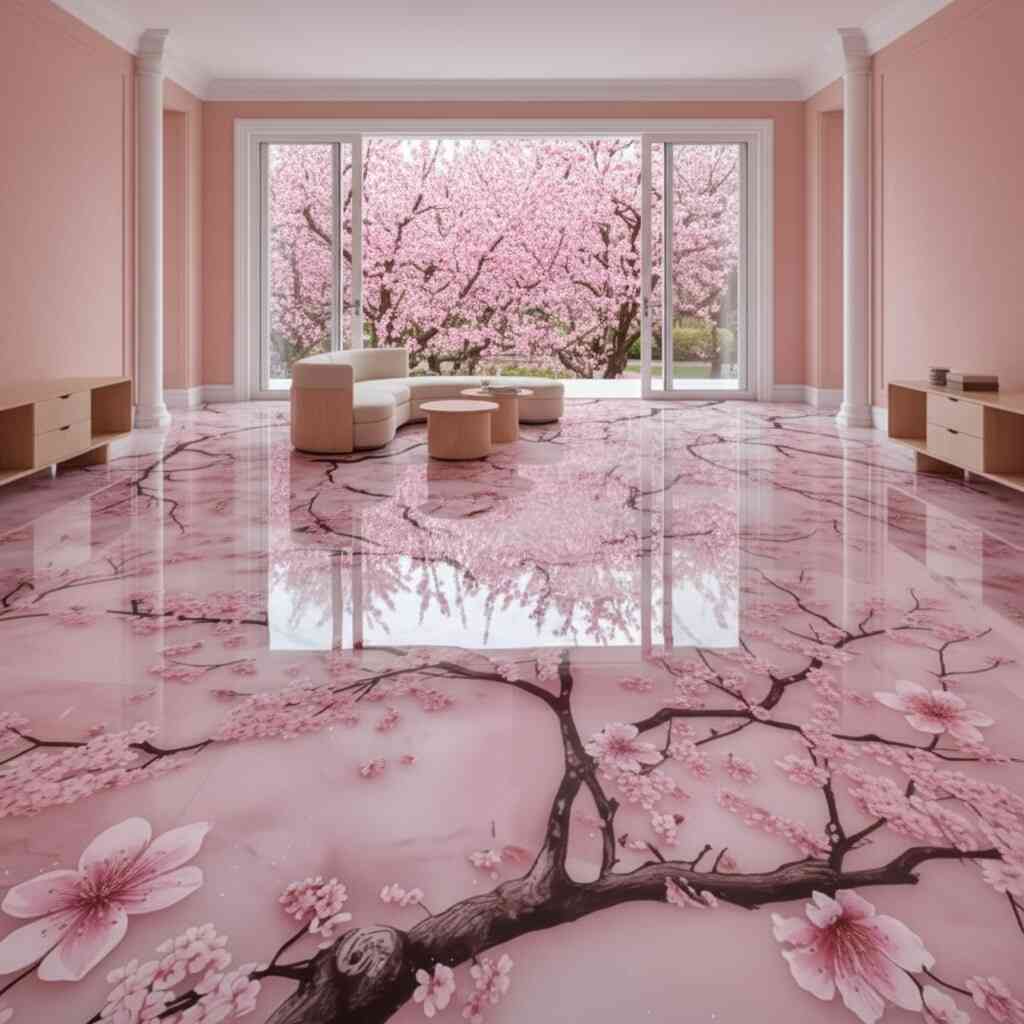
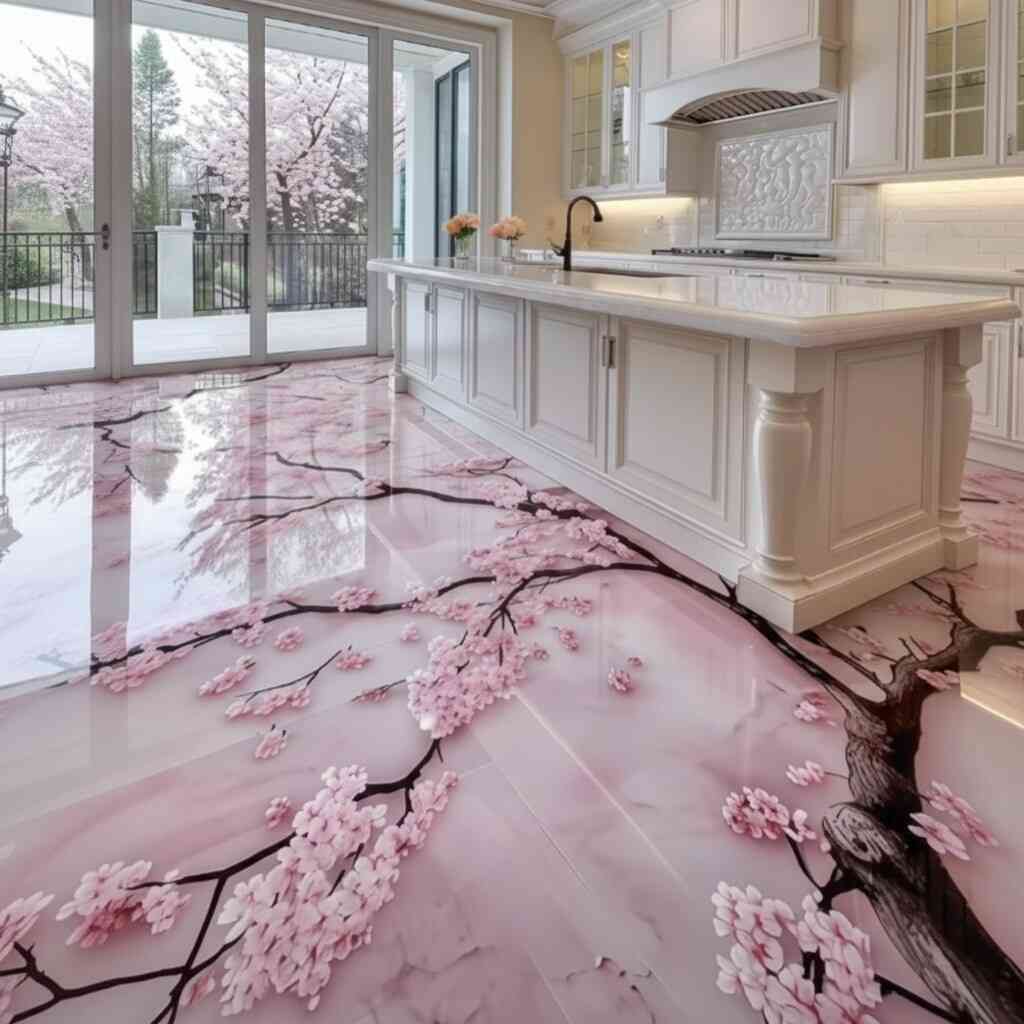
What emerges is not a literal depiction, but an impression—a visual haiku in three dimensions. From a distance, the floor reads as a serene field of blossoms; up close, individual petals reveal depth, translucency, and variation. Light interacts dynamically: under noon sun, the pink tones deepen and glow; beneath artificial lighting, the surface holds a quiet luminescence, like moonlight on petals.
This alchemy—of chemistry, craftsmanship, and poetic sensibility—is what makes the Cherry Blossom Epoxy Floor unique. It refuses flatness. It denies the two-dimensional. Instead, it offers stratigraphy: layers of meaning, memory, and material stacked like geological time—all visible in a single glance downward.
Part II: Symbolism Beneath Our Feet – The Philosophy of the Sakura Floor
To install a Cherry Blossom Epoxy Floor is to make an intentional philosophical choice about how we inhabit space. In Japanese aesthetics, the concept of mono no aware—the pathos of things—refers to a heightened awareness of the impermanence of all phenomena, and a gentle sadness at their passing, coupled with a deeper appreciation for their beauty because they do not last. The cherry blossom is its quintessential emblem.
A floor bearing this motif, then, does not merely decorate—it instructs. It situates the dweller within a temporal and spiritual framework. Every step becomes a gesture of mindfulness. You walk across spring, yet you know—viscerally—that spring is not static. The blossoms are frozen in mid-fall, suspended not in death, but in the act of transition. This suspension is key: the floor does not depict blossoms in full bloom (a moment of peak, soon to decline), nor fallen and brown (decay); it captures them in passage—the liminal, the in-between.
This aligns powerfully with contemporary design movements that seek to reintroduce ritual and reflection into daily life. In an age of hyper-connectivity and accelerated time, interiors are increasingly asked to serve as sanctuaries—not just of comfort, but of cognition. A Cherry Blossom Epoxy Floor functions as a grounding artifact. It invites pause. A guest might stop mid-stride, drawn by the play of light on a petal’s edge. A child might kneel, tracing the curve of a bloom with a fingertip, sensing depth beneath the smooth surface.
Moreover, the floor challenges the traditional hierarchy of architectural elements. Walls carry art; ceilings frame light; furniture supports the body. The floor? It is walked upon, scuffed, ignored. But in elevating the floor to the status of primary narrative surface, the Cherry Blossom Epoxy Floor inverts this assumption. It declares: What is beneath you matters as much as what surrounds you. In doing so, it echoes ancient traditions—think of the intricate mosaic floors of Roman villas, the mandala-like rangoli patterns drawn at Indian thresholds, or the tatami-aligned spatial rhythms of traditional Japanese homes—where the ground plane was never neutral, but sacred, directional, and symbolic.
Even the choice of resin—synthetic, yet luminous and durable—adds a layer of modern allegory. Here, nature is not preserved in amber (a fossilized past), but reanimated in polymer (a living present). The sakura is not dead; it is recontextualized. This speaks to an ecological ethos not of preservation through isolation, but of integration—of finding ways to carry natural consciousness into human-made environments without romanticizing or exploiting the source.
The floor, then, becomes a site of embodied philosophy. You do not read about mono no aware; you experience it with every footfall. You do not study transience from afar; you live atop its quiet testament.
Part III: Spatial Harmony – Integrating the Sakura Floor into Modern Interiors
A Cherry Blossom Epoxy Floor is not an isolated feature; it is a compositional keystone. Its success lies not in standing out, but in resonating—in creating a spatial harmony that feels inevitable, as though the floor had always belonged to the architecture that houses it.
This requires thoughtful integration with other design elements. Because of its inherent softness—both chromatically and thematically—the floor pairs exquisitely with clean, unadorned lines and natural materials. Consider a minimalist living room with pale oak joinery, linen drapes in oat or stone, and furniture in muted charcoal or blackened steel. Against such austerity, the floor does not compete; it breathes. It adds warmth without clutter, emotion without sentimentality.
In contrast, placing the same floor within a space rich with texture—rough-hewn plaster walls, hand-thrown ceramic vessels, woven fiber rugs in neutral tones—creates a dialogue between refinement and rawness. The glossy surface reflects the tactile imperfections of surrounding elements, multiplying visual interest while maintaining serenity.
Lighting, too, becomes a co-creator. Recessed LED strips along the perimeter can graze the floor at a low angle, casting elongated shadows from raised petal inclusions, transforming the surface into a kinetic installation as the day progresses. Pendant lights with paper or rice-paper shades diffuse light softly, enhancing the floor’s ethereal quality—especially in the evening, when the resin seems to hold residual daylight, glowing faintly like bioluminescent petals.
One of the most compelling applications is in transitional spaces: hallways, entryways, stair landings. These are zones of movement, of in-betweenness—and thus, perfect metaphors for the sakura’s liminal state. A hallway floored in cherry blossom epoxy becomes a processional, a gentle reminder that every passage is part of a cycle. An entryway invites guests to arrive not just physically, but sensorially and spiritually. Here, the floor sets the tone for the entire home: one of grace, intention, and quiet reverence.
Even in commercial or institutional settings—studios, wellness centers, boutique hotels—the Cherry Blossom Epoxy Floor redefines atmosphere. A yoga studio, for instance, benefits profoundly: practitioners reclining in savasana gaze downward at drifting blossoms, their breath syncing with the imagined rhythm of falling petals. No didactic sign is needed to cue mindfulness; the floor itself is the instructor.
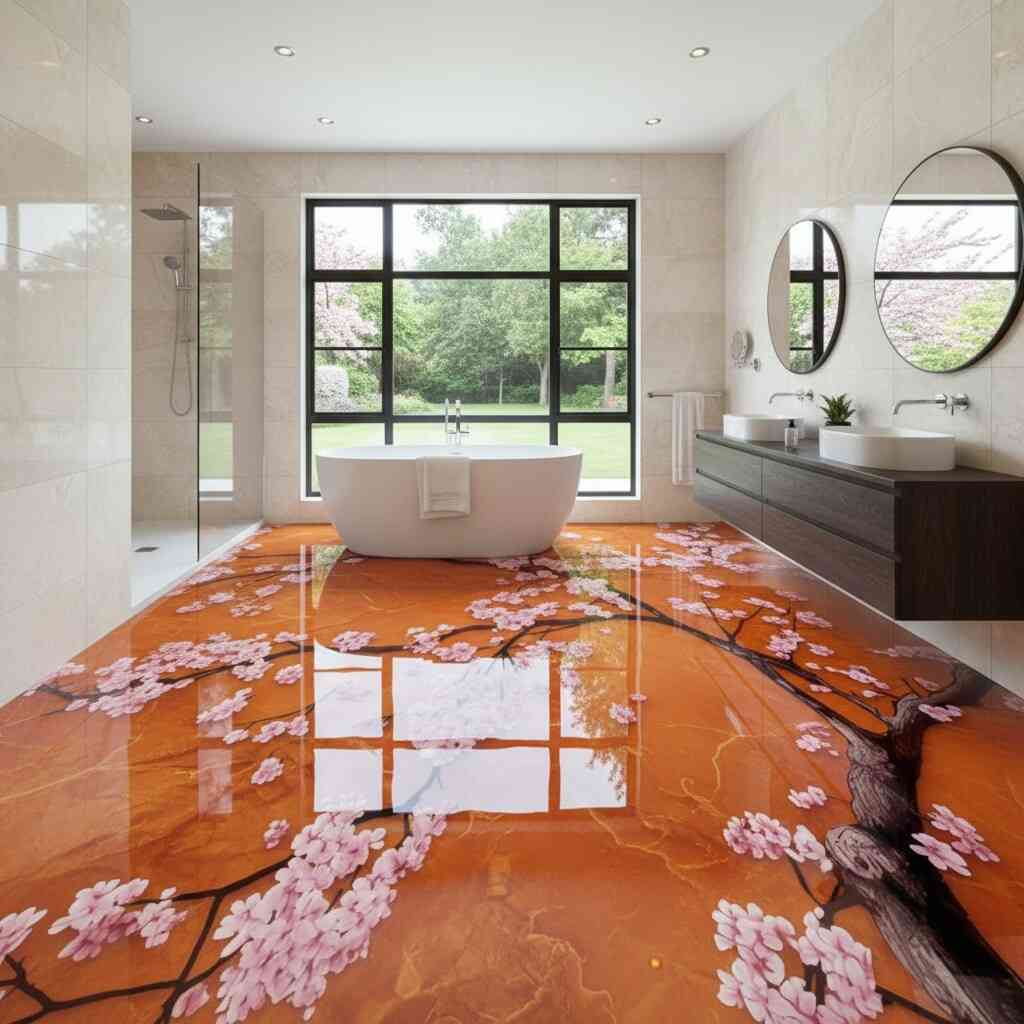
Critically, this integration succeeds only when the design avoids literalism. There is a fine line between evocation and cliché. A floor overrun with dense, cartoonish blooms loses its meditative power. The most resonant interpretations are suggestive—ten petals where a hundred might be expected; negative space as vital as pigment; asymmetry honored over symmetry. This restraint is not minimalism for its own sake, but ma—the Japanese concept of intentional emptiness, the pause between notes that makes music possible.
In this way, the Cherry Blossom Epoxy Floor does not dictate a style; it enables a sensibility. It welcomes Scandinavian calm, Japanese wabi-sabi, Californian lightness, even modern brutalism—provided the latter is softened by organic counterpoints. Its strength lies in its adaptability, its refusal to be pinned to a trend. It is not of a moment; it is about moments.
Conclusion: The Floor as Threshold—Between Earth and Sky, Past and Future
The most profound interiors do not merely shelter the body—they orient the soul. They ask us not just where we are, but how we are. In a world increasingly fractured by speed and abstraction, spaces that offer coherence—between human and nature, art and function, memory and now—are not luxuries; they are necessities.
The Cherry Blossom Epoxy Floor stands as a rare convergence: a technological achievement that serves a poetic end. It is modern in its materials, ancient in its wisdom. It speaks of science (epoxy’s polymer chains, UV stability, thermal resilience) and spirit (sakura’s thousand-year legacy in poetry, painting, and pilgrimage). It is industrial, yet intimate. Permanent, yet evocative of impermanence.
To walk across such a floor is to cross a threshold—not just from room to room, but from distraction to attention, from surface to depth. It reminds us that beauty does not always reside in the grand gesture. Sometimes, it is found in the quiet act of looking down and seeing, truly seeing, the world beneath our feet.
In the end, the Cherry Blossom Epoxy Floor is more than a design choice. It is an invitation: to live with greater awareness; to honor cycles over constants; to find the eternal not in stone or steel, but in the fragile, falling petal—preserved, not as a relic, but as a living echo.