
To stand before a fire is to commune with something ancient—older than language, older than cities, older than memory itself. Fire has been humanity’s first companion in the long night of evolution: a protector, a storyteller, a catalyst for community. Likewise, the tree—the silent sentinel of the forest—has stood as symbol and sustenance, its rings chronicling centuries, its roots gripping the deep earth like fingers of time. When these two primal forces converge—when the form of a tree meets the essence of flame—we arrive at a singular marvel: the Epic Tree Fireplace.
More than a mere architectural feature or decorative centerpiece, the Epic Tree Fireplace is a philosophical statement rendered in wood, stone, and fire. It is a dialogue between permanence and transience, between growth and consumption, between the vertical aspiration of the living tree and the upward dance of the living flame. It does not merely occupy space; it sanctifies it. It does not simply warm a room; it warms the imagination, reviving ancestral echoes of gathering at the base of a great oak on a winter’s eve, of listening to elders recount myths by the crackle of burning branches once part of that very grove.
This convergence is not accidental. It is intentional, reverent—a design ethos rooted not in ornamentation alone, but in deep ecological and symbolic resonance. The Epic Tree Fireplace invites us to reconsider our relationship with nature not as dominion, but as kinship; not as extraction, but as reciprocity. In its presence, the home becomes a microcosm of the forest, and the hearth transforms into a sacred axis—axis mundi—where earthly matter ascends into light and heat, where memory and matter intertwine. This article explores the profound dimensions of the Epic Tree Fireplace: its embodiment of time, its architectural poetry, and its capacity to awaken in us a forgotten harmony between human dwelling and the living world.
Part I: The Living Archive—Tree as Chronology, Flame as Presence
At the heart of every Epic Tree Fireplace lies a tree—not just any tree, but one whose life story is legible in its grain, its knots, its fissures. Some are salvaged from fallen giants, aged beyond their prime, rescued from decay or landfill to be reborn as hearth and home. Others are sourced from forest-thinning initiatives, where their removal sustains ecological balance. Regardless of origin, each tree carries within it a chronicle: decades, sometimes centuries, of sun and storm, drought and abundance, etched into concentric rings like verses in a silent epic poem.
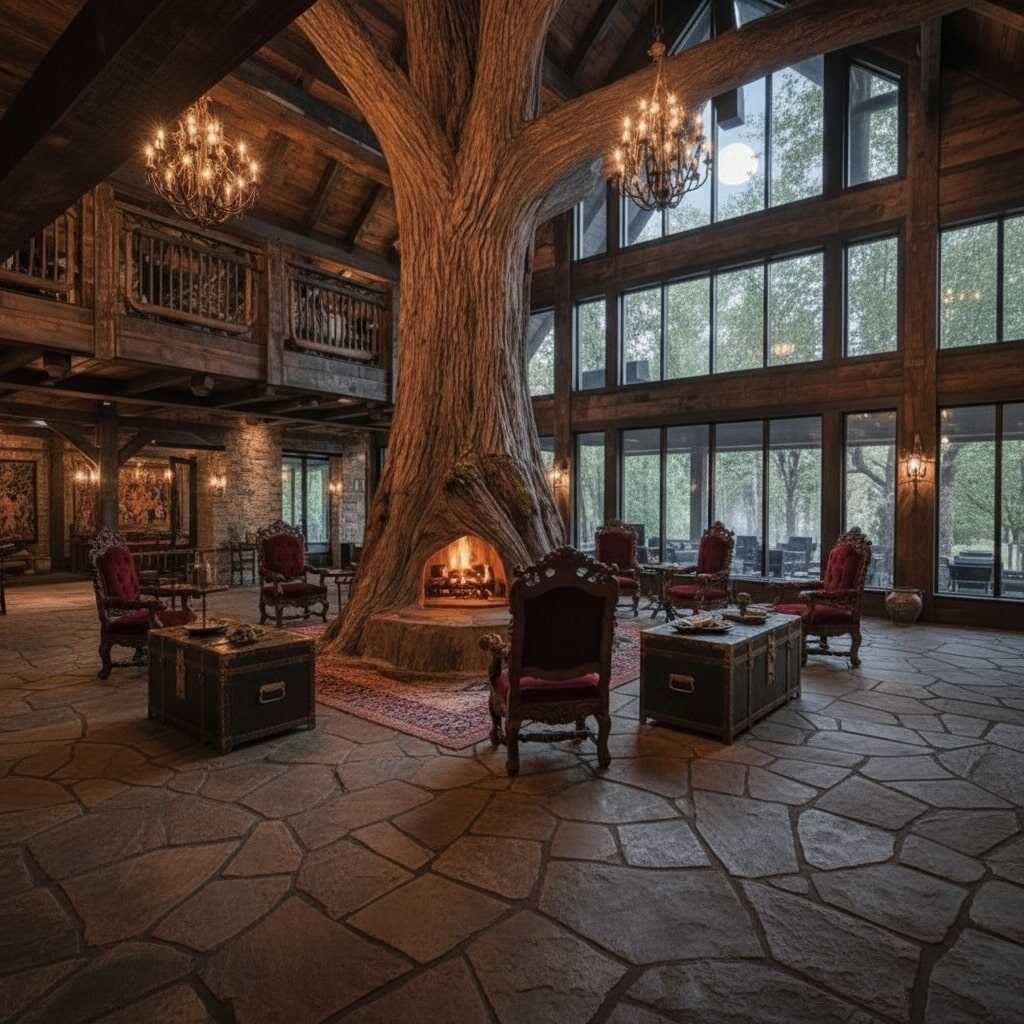
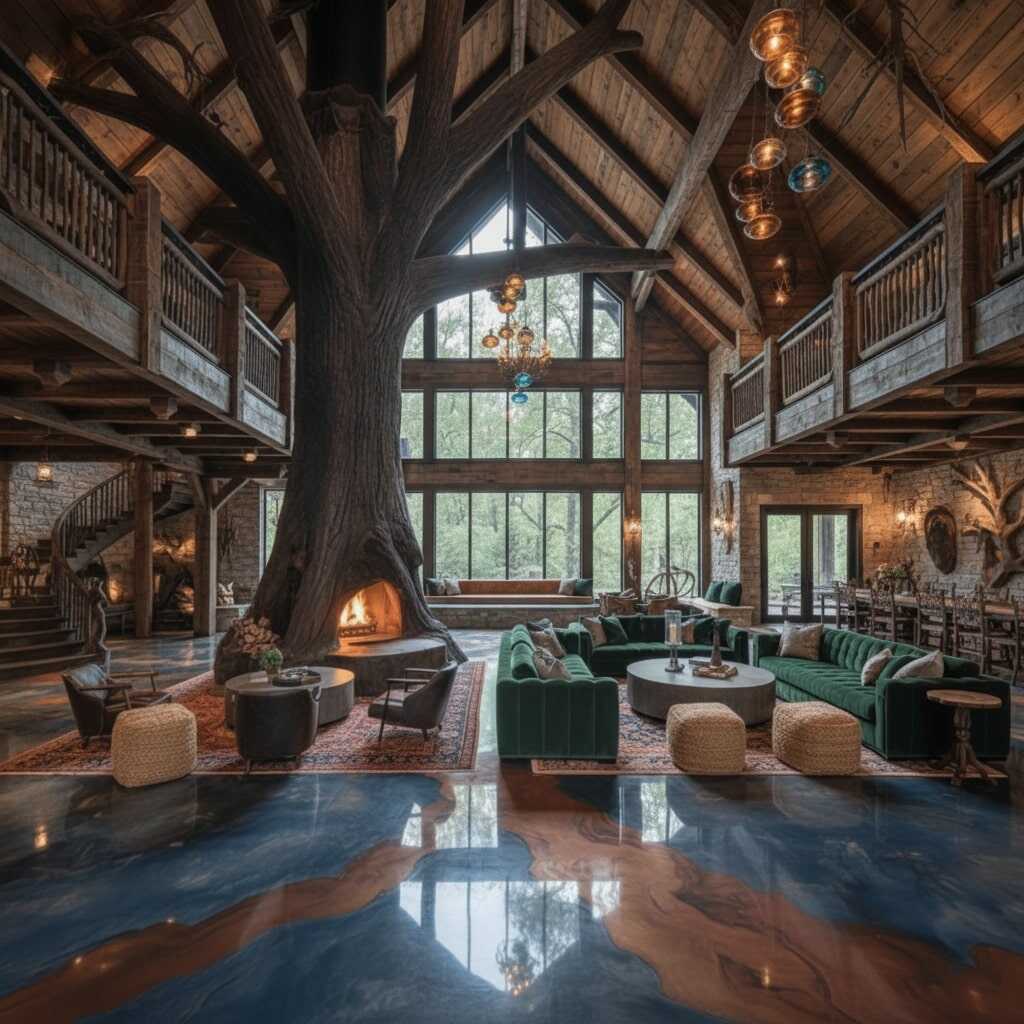
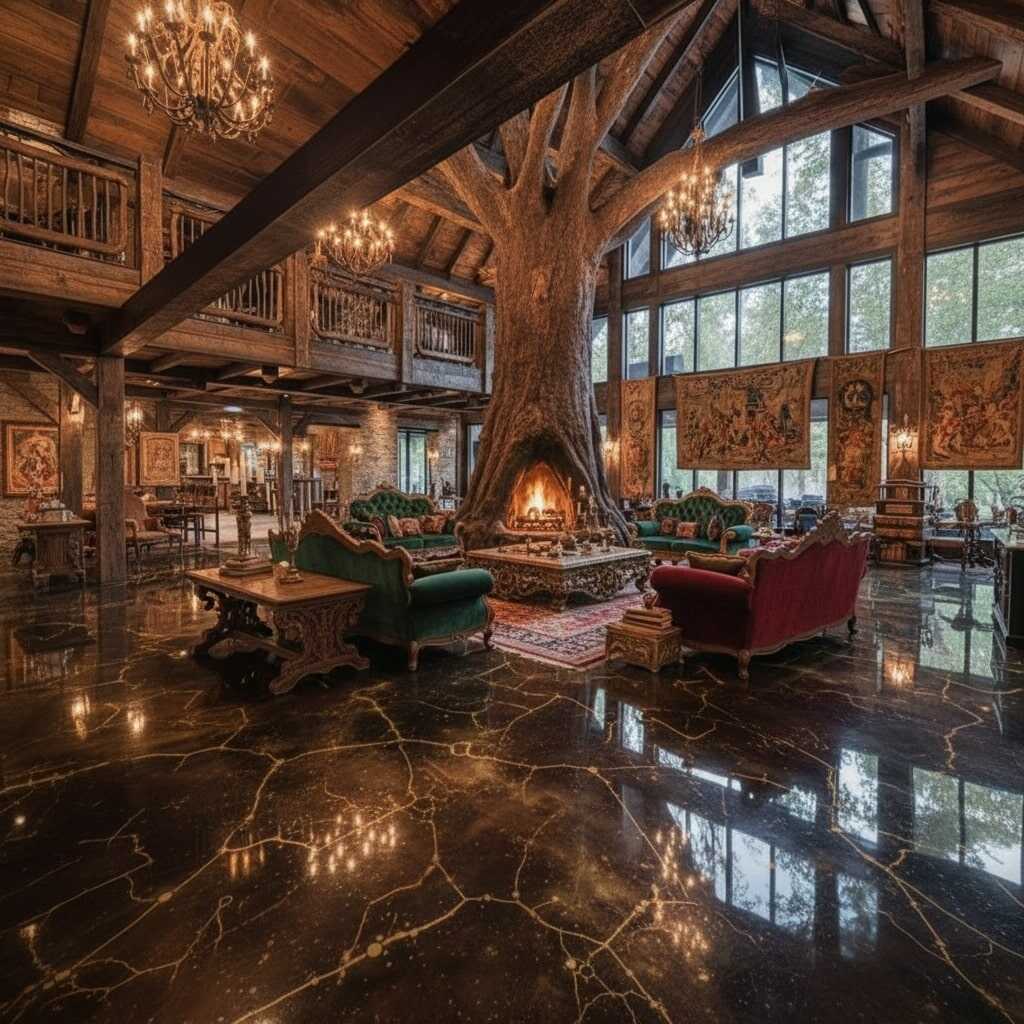
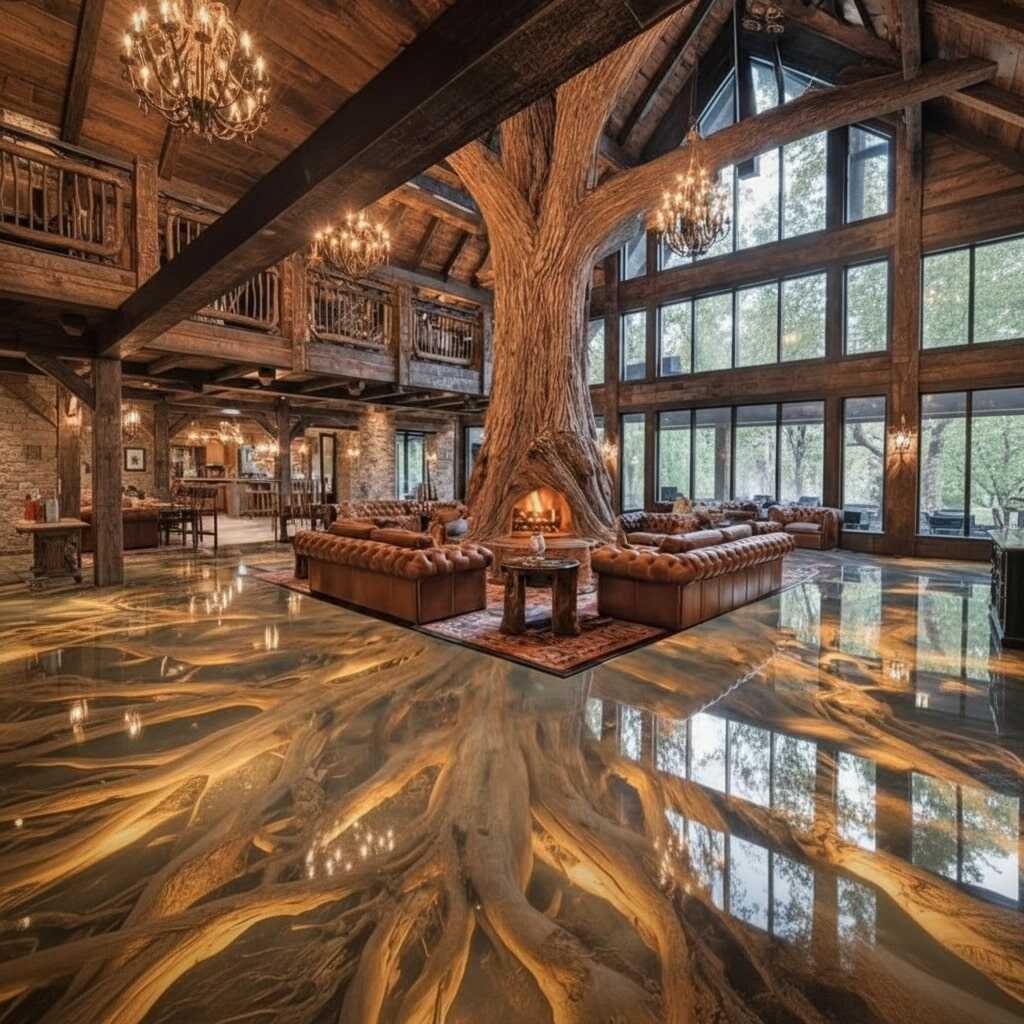
To preserve the tree in its raw, unplaned form—to leave the bark intact, the roots sprawling, the branches twisting upward like arms in supplication—is to honor that story. The trunk may serve as the central column of the fireplace, rising from floor to ceiling, its silhouette recalling cathedral pillars or sacred groves. The firebox, nestled at its base or carved into its core, becomes the heart of the tree reborn—not a wound, but a luminous cavity, a glowing seed from which warmth radiates outward. Here, time folds in on itself: the past life of the tree (its growth, its seasons) coexists with the present life of the flame (its flicker, its breath), and both point toward a shared future—the slow consumption of cellulose into ash, the release of stored sunlight, the return to elemental cycles.
This merging of chronologies is deeply meaningful. In modern life, time is often flattened—compressed into seconds on a screen, fragmented by notifications, measured in productivity. But the Epic Tree Fireplace restores a different temporal rhythm: slow time. As you sit before it, you see the years in the wood, you feel the heat that once was solar energy captured leaf by leaf, and you witness the flame’s fleeting beauty—its birth, its dance, its inevitable wane. It is a meditation on mortality and continuity: the tree is no longer living in the biological sense, yet it lives differently—as shelter, as art, as hearth. Its death is not an end, but a transformation. And in that transformation lies a quiet lesson: nothing is wasted in nature; everything is transmuted.
Moreover, the tree’s form resists industrial standardization. Unlike prefabricated fireplaces with smooth, symmetrical lines, the Epic Tree Fireplace bears the idiosyncrasies of its origin—knots where branches once reached for light, scars from lightning strikes or animal browse, curves shaped by wind and competition. These are not imperfections; they are signatures. They remind us that beauty in nature emerges from resilience, not perfection. To live with such a fireplace is to inhabit a space that refuses to conform—to celebrate irregularity, to privilege authenticity over uniformity. In doing so, it challenges the sterility of modern minimalism and re-enchants the domestic sphere with the wild, untamable spirit of the forest.
Part II: Architectural Alchemy—Form, Flow, and the Language of Verticality
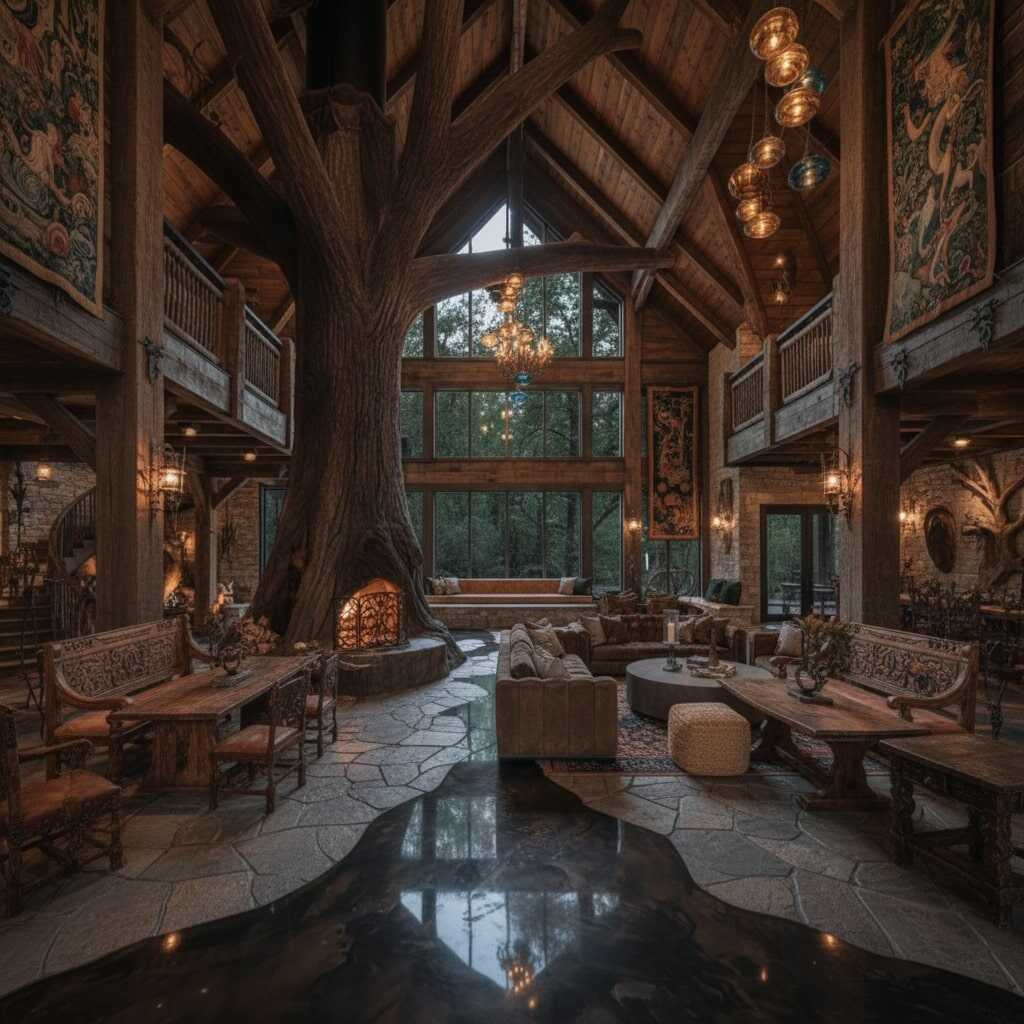
The Epic Tree Fireplace transcends function to become architecture as poetry. Its design is not imposed upon the tree but drawn out from it—a process akin to Michelangelo’s notion of releasing the figure imprisoned in marble. The architect or artisan becomes a listener, attuned to the tree’s inherent logic: its grain direction, its natural taper, its points of structural integrity and expressive potential. The result is a piece that feels inevitable, as though it had always been waiting within the wood, ready to be revealed.
One of the most powerful aspects of its design is verticality. Trees grow upward—toward light, toward sky—and the Epic Tree Fireplace honors this impulse. Even when the trunk is sectioned, its orientation remains upright, preserving the tree’s botanical memory. This vertical thrust creates a powerful spatial dynamic: it draws the eye upward, encouraging contemplation, aspiration, and a subtle reorientation of the occupant’s posture and perspective. In contrast to horizontal fireplaces—low, wide, earthbound—the vertical fireplace evokes aspiration. It recalls the World Tree of mythologies across cultures: Yggdrasil in Norse cosmology, the Bodhi Tree of enlightenment, the Asherah pole of ancient Semitic traditions—all symbols of connection between underworld, earth, and heavens.
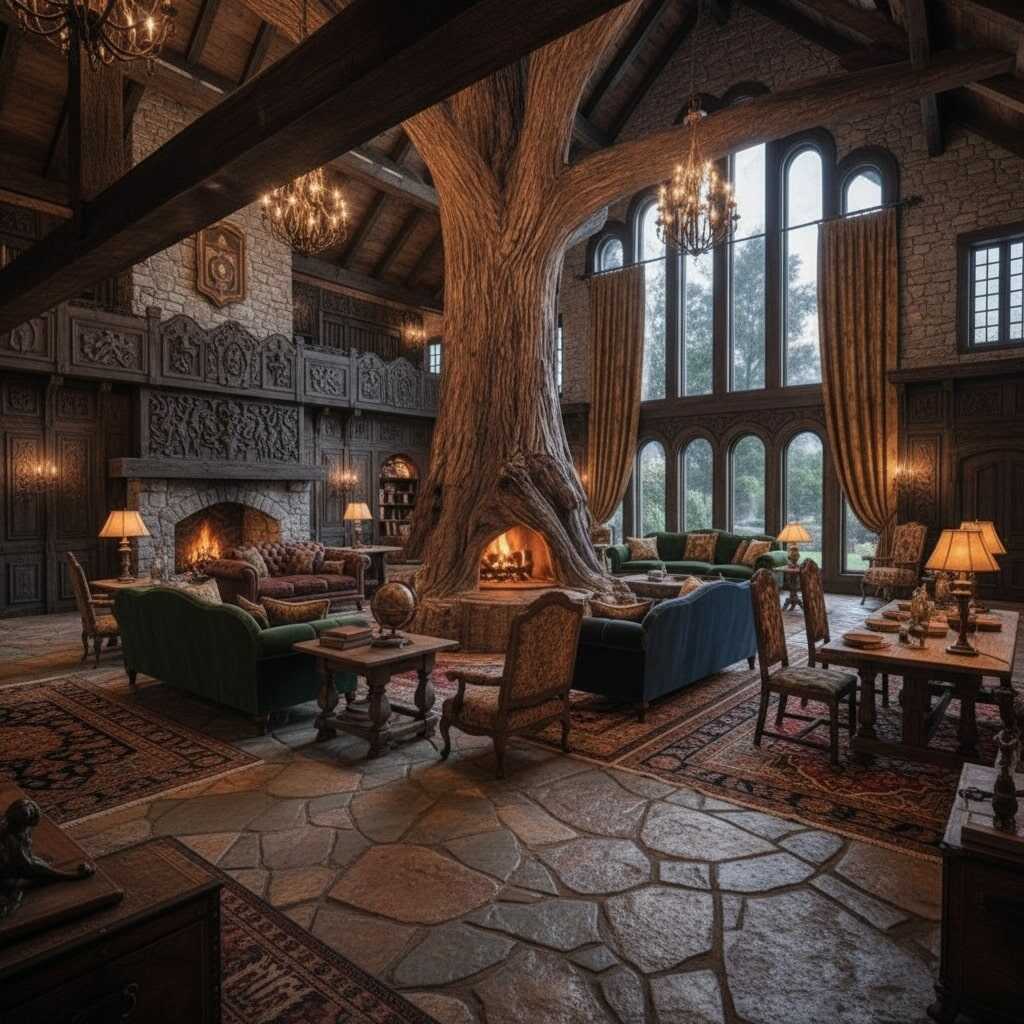
The integration of fire within this vertical form is alchemical. Flame, too, rises—nature’s most elemental expression of ascent. When fire emerges from the base of the tree-trunk, it appears not as an intrusion, but as an emanation: the tree breathing light. In some designs, the flame rises through a central flue concealed within the hollowed core, so that the fire seems to burn inside the tree, like a living spirit. In others, the firebox is open and organic, cradled by roots or nestled between forked limbs, as though the tree itself has opened its arms to welcome the flame home.
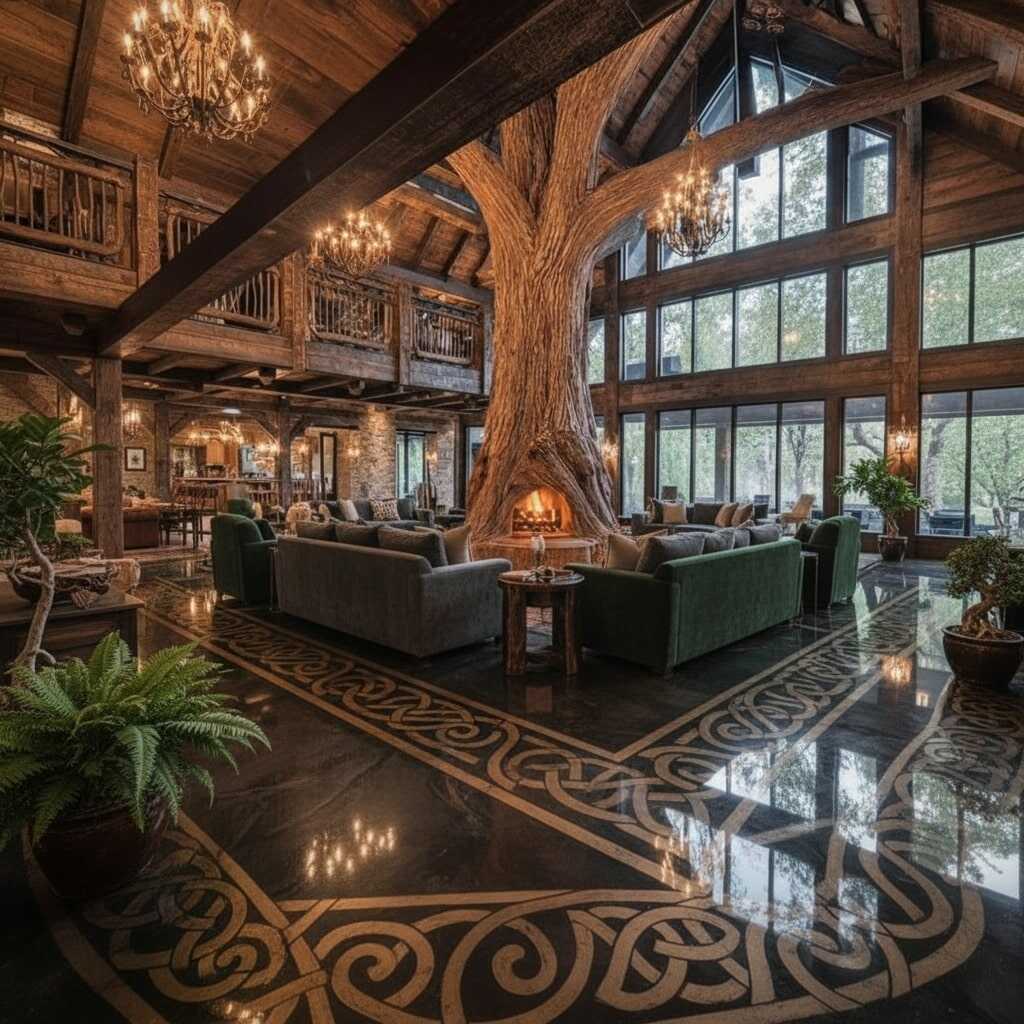
Materials amplify this harmony. Stone—granite, slate, river rock—often forms the hearth and surround, echoing the earth from which the tree sprang. Iron or forged steel may be used for grates and supports, their dark, sinuous forms mimicking vine or root. Glass, when employed, is minimal and strategic: a narrow pane to contain embers without obscuring the ritual of tending the fire. There is no chrome, no lacquer, no artificial gloss—only textures that speak of geology and biology: rough bark against smooth stone, charred wood beside cool metal.
Light, too, becomes a collaborator. During the day, sunlight moves across the bark, revealing topography—ridges, crevices, lichen ghosts—like a slow caress. Come evening, the fire takes over, casting long, dancing shadows that animate the room. The bark, once inert, flickers with life; knots become eyes, grooves become rivers of molten gold. The room breathes with the fire, expands and contracts with its pulse. This interplay of natural and artificial light does not compete but converses—a duet between the sun’s ancient gift and its present rekindling.
Crucially, the Epic Tree Fireplace does not dominate the space tyrannically. Rather, it anchors it. It becomes the gravitational center around which furniture arranges itself, not by dictate, but by instinct—the same instinct that once drew our ancestors into circles around the campfire. Its presence fosters intimacy without confinement, grandeur without arrogance. It is monumental yet humble—aware of its scale, yet respectful of the human body’s need for closeness, for touch, for shared silence.
Part III: The Hearth as Threshold—Between Interior and Wild, Self and Cosmos
Perhaps the most profound dimension of the Epic Tree Fireplace lies in its role as a threshold—a liminal space where boundaries dissolve. It stands at the intersection of interior and exterior, domestic and wild, cultivated and untamed. Though housed within walls, it carries the forest inside—not as décor, but as essence. The scent of seasoned oak or cedar smoke evokes autumn woods; the crackle of burning wood recalls distant campfires; the texture of bark beneath fingertips reconnects us to tactile memory long dulled by smooth plastics and sterile surfaces.
In this way, the Epic Tree Fireplace functions as a portal. It does not erase the distinction between home and wilderness; it mediates it. Modern architecture often seeks to separate us from nature—to seal, insulate, and control. But the Epic Tree Fireplace insists on permeability. It reminds us that shelter need not mean separation—that to dwell well is to remain in dialogue with the world beyond the window. The tree, once rooted in soil, now roots us—psychically, emotionally—in place. It grounds the home in a specific ecology: the species of the tree signals region (a Douglas fir speaks of the Pacific Northwest; a live oak, the Deep South); its form reflects local climate and topography. In an age of placelessness, of interchangeable suburbs and globalized aesthetics, the Epic Tree Fireplace reasserts genius loci—the spirit of place.
This threshold quality extends inward, as well. The hearth has long been symbolically linked to the heart—the center of feeling, intuition, identity. To gather around the Epic Tree Fireplace is not merely to seek warmth, but to enter a space of psychological safety and symbolic renewal. Fire transforms; so does story. And stories, since time immemorial, have been told by the hearth. Here, the vertical tree becomes a silent witness to confessions, to laughter, to grief, to epiphanies. Its rings hold time; its flame holds attention. In its glow, distractions recede. Screens go dark. Voices lower. We remember how to listen—not just to each other, but to ourselves.
There is also an ecological ethics embedded in this convergence. The Epic Tree Fireplace does not glorify consumption; it sanctifies reciprocity. A tree gives its life—not for timber alone, but for warmth, for beauty, for meaning. In return, we honor it—not by forgetting its origin, but by remembering it daily. We do not hide the wood beneath veneer; we celebrate its authenticity. We do not discard it when trends change; we live with it, grow older alongside it. This is a model of sustainability not rooted in efficiency alone, but in reverence—a recognition that to use the earth’s gifts is a sacred trust, not a right.
And finally, the Epic Tree Fireplace points beyond utility to awe. It is a modern instantiation of the sublime: that trembling recognition of our smallness before forces greater than ourselves—time, growth, fire, decay. To sit before it on a winter night, snow falling beyond the window, the tree’s silhouette stark against the flames, is to feel both sheltered and exposed, comforted and humbled. You are safe, yes—but you are also within something vast. The tree connects you to photosynthesis, to mycorrhizal networks, to carbon cycles. The fire connects you to stellar nucleosynthesis, to the sun’s furnace, to the very chemistry of life. In that convergence, you are no longer just in a house. You are in a node of cosmic continuity.
Conclusion: The Continuum of Hearth and Habitat
The Epic Tree Fireplace is more than a design. It is a philosophy made manifest—a declaration that beauty and meaning arise not from domination, but from collaboration; not from erasure, but from integration. It refuses the false dichotomy between nature and culture, insisting instead that the human habitat can—and must—be a continuation of the natural world, not its antithesis.
In its form, we see the dignity of the individual tree, honored in death as it was in life.
In its function, we re-engage with elemental forces—fire, air, wood—in their raw, unmediated truth.
In its presence, we reclaim slowness, attention, and the sacred art of gathering.
The title—Epic Tree Fireplace: Where Nature and Hearth Converge in Stunning Harmony—is not hyperbole. It is literal truth. “Epic” speaks to scale and story: the epic of the tree’s life, the epic of human seeking, the epic of fire’s journey from star to spark. “Tree” is the protagonist—not backdrop, but bearer of wisdom. “Fireplace” is the stage—not a fixture, but a locus of transformation. And “harmony” is the outcome—not mere aesthetics, but alignment: of material and meaning, of past and present, of self and world.
To live with an Epic Tree Fireplace is to choose a different kind of domesticity—one that does not shut out the wild, but invites it in. One that does not rush through time, but dwells within it. One that remembers: we did not invent fire. We learned it from lightning-struck pines. We did not build shelter from nothing. We borrowed the tree’s form, its strength, its vertical hope. And in returning to that source—not sentimentally, but sincerely—we find not regression, but reconnection.
In the end, the Epic Tree Fireplace is a quiet revolution. It does not shout. It glows. And in that glow, if we are willing to sit long enough, to watch closely enough, to listen deeply enough—we remember who we are: creatures of earth and flame, heirs to an ancient covenant, still learning how to dwell—gracefully, gratefully, in stunning harmony—with the world that made us.