
There is a special kind of magic that settles into a home during the weeks leading up to Christmas—not the loud, glittering, party-filled kind, though that has its own charm—but the quieter, more intimate enchantment of soft light, familiar scents, and the gentle rhythm of shared presence. Nowhere is this magic more felt than in the bedroom, a space that, by its very nature, invites rest, reflection, and connection. And when that space is shared with a cat—curled at the foot of the bed, perched on a windowsill watching snowflakes drift, or nestled trustfully against your side as carols murmur in the background—the holiday feels not just celebrated, but lived in its truest, most tender form.
A Christmas bedroom for you and your cat isn’t about grand gestures or elaborate décor meant solely for human eyes. It’s about crafting a haven where comfort is mutual, where joy is measured in purrs and shared naps beneath a quilt, where tradition includes not just stockings hung with care, but also a velvet-lined basket placed just so, near the radiator’s warmth. It’s about recognizing that the season’s deepest meaning—belonging, love, safety—is embodied in the simple act of sharing your rest with a creature who chooses, every day, to curl up beside you.
This article invites you into that vision: a bedroom transformed not just for the holidays, but with them—infused with the spirit of Christmas in ways that resonate with both your human heart and your feline companion’s senses. We’ll explore how to weave warmth, scent, texture, light, and quiet ritual into a space that feels like a gentle embrace—a Christmas bedroom for you and your cat, where every detail honors the quiet, profound companionship that makes the season glow a little brighter.
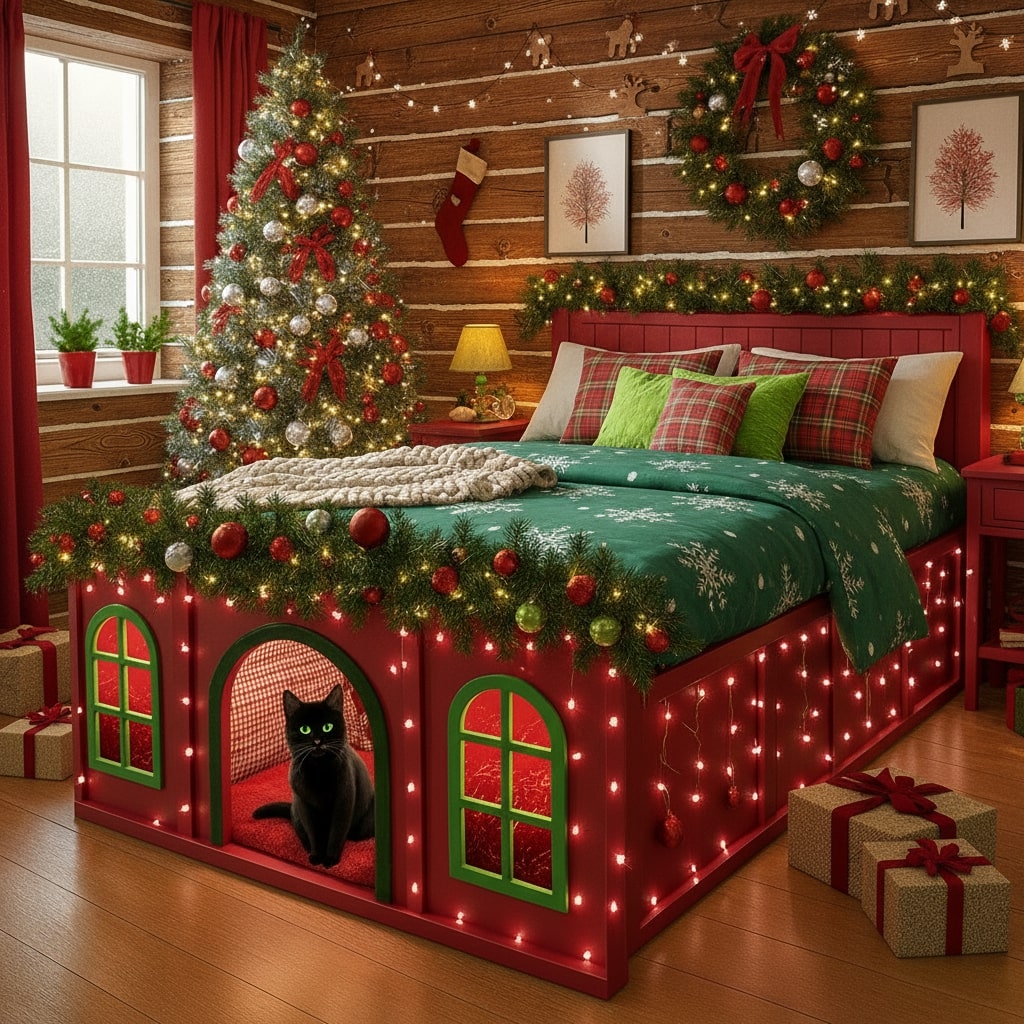
Part One: Foundations of Warmth—Textures, Layers, and Safe Spaces
The essence of coziness lies in tactile richness and thermal comfort—elements that appeal to both humans and cats on a primal level. As temperatures dip and nights stretch long, the bedroom becomes a refuge, and thoughtful layering is your first step toward a shared holiday sanctuary.
Begin with bedding. Opt for natural fibers—undyed wool throws, brushed cotton duvet covers, or linen-blend sheets in soft ivory, oatmeal, or muted forest green. These materials breathe, regulate temperature, and offer varying degrees of softness that invite touch. For your cat, who may spend upward of sixteen hours a day resting, the quality of surfaces matters deeply. A chunky-knit wool throw draped at the foot of the bed isn’t just decorative; its irregular texture offers satisfying crevices for kneading paws and the slight resistance cats love when settling in. Place a small, low-profile cushion—filled with buckwheat hulls or a memory foam core wrapped in organic cotton—on your side of the bed or tucked beside your pillow. Many cats prefer elevated perches near their humans, and this offers a designated “spot” that feels intentional, not intrusive.

Next, consider floor-level comfort. Cats often gravitate to warmer zones near baseboards or radiators. A heated pet pad (set to a safe, low temperature—never exceeding 102°F, a cat’s natural body heat) beneath a plush faux-fur rug in a corner creates a microclimate of comfort. Choose rugs with deep pile or shag in neutral tones—taupe, cream, or charcoal—so they blend with seasonal décor without overwhelming the space. Layer them: a flat-weave jute rug for grounding, topped with a smaller sheepskin or faux-fur square. This not only adds visual depth but offers your cat choices: cool, firm surfaces for stretching; soft, insulating ones for deep sleep.
Crucially, integrate cat-sized retreats that feel part of the room, not afterthoughts. A woven seagrass basket lined with a removable fleece insert can sit beside the bed, echoing the room’s natural palette. Or repurpose an old wooden crate—sanded smooth, edges softened—with a cushion inside and a string of battery-operated fairy lights draped over (not inside) it, casting a gentle halo. These are not “pet furniture”; they are shared design elements—quiet invitations to rest, placed with intention, not tucked away in a closet or corner.
Remember: safety and accessibility are part of comfort. Avoid tinsel, loose ribbon, or small ornaments at floor or bed level—tempting but dangerous. Instead, let texture do the storytelling: a sprig of dried eucalyptus tied with twine on a nightstand (non-toxic and pleasantly aromatic), a hand-thrown ceramic bowl holding pinecones collected on a winter walk. These speak of the season without risk, grounding the festive in the earthly and safe.
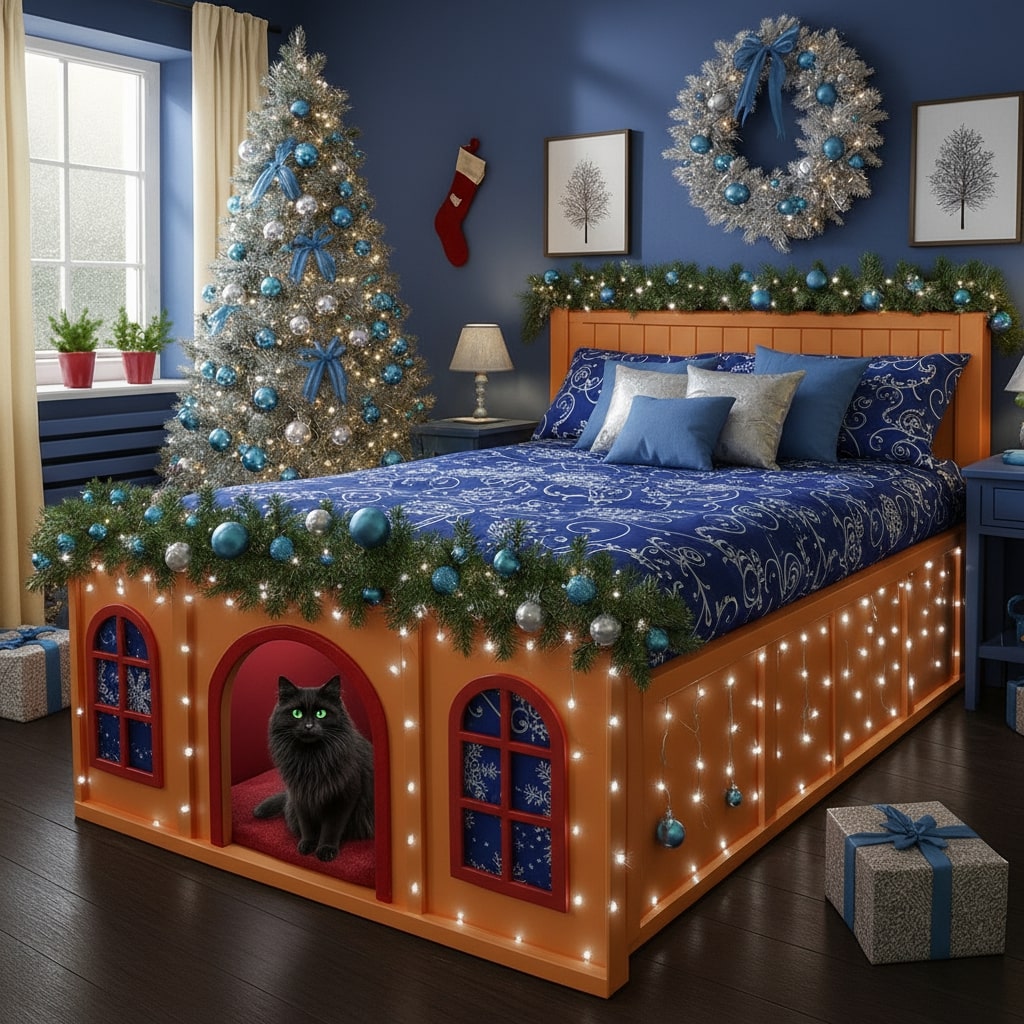
Part Two: Light, Scent, and Sound—Engaging the Senses with Gentle Intention
Christmas is a sensory season—the crackle of a fire, the scent of evergreen, the soft glow of candlelight. But cats experience these stimuli differently. Their hearing is acute, their sense of smell 14 times stronger than ours, and their eyes are exquisitely sensitive to light. A Christmas bedroom for you and your cat honors these differences, transforming sensory elements into shared comfort rather than stress.
Light should be warm, indirect, and layered. Harsh overhead lighting disrupts the circadian rhythms of both human and cat; instead, rely on low-wattage bulbs (2700K color temperature) in table lamps with fabric shades. Place one on each nightstand—even if you sleep alone, symmetry feels balanced and peaceful. String lights are a holiday staple, but choose LED fairy lights with a steady (non-blinking) warm-white glow. Drape them loosely around the headboard frame, or coil them in a glass cloche on the dresser—never where cords are exposed or dangle within batting range. The soft luminescence mimics the gentle radiance of early dawn or candlelight, creating a cave-like sense of security. At night, keep one small lamp on a dimmer or use a salt rock nightlight; total darkness can unsettle some cats, especially older ones.
Scent is where the season truly comes alive—but tread carefully. Pine, cinnamon, and clove may evoke nostalgia for us, but strong essential oils, diffusers, or potpourri can overwhelm or even harm cats, whose livers cannot process many botanical compounds. Instead, opt for passive, natural fragrance: a small bowl of whole cloves and orange peels (refreshed weekly), a bundle of dried lavender and rosemary tied with raffia and hung inside the closet (out of reach), or a cedarwood sachet tucked between folded blankets. Simmer a pot on the stove outside the bedroom—water with apple slices, a cinnamon stick, and a few cranberries—but avoid bringing strong vapors into the sleeping space. The goal is subtle suggestion, not saturation. Your cat will appreciate the absence of chemical air fresheners far more than any overpowering “festive” mist.

Sound is perhaps the most overlooked element. Cats are attuned to acoustic nuance—the hum of the heater, the rustle of sheets, the cadence of your breathing. Introduce holiday music, but choose wisely: instrumental arrangements (harp, piano, or acoustic guitar) of carols, played at low volume well before bedtime. Avoid brass-heavy or choir-dominant versions—the sudden dynamic shifts can startle. Better yet, create a custom playlist: soft jazz interpretations of classics, or nature soundscapes layered with distant sleigh bells and gentle choral harmonies. Let it play for 20–30 minutes as you wind down, then fade to silence. The silence itself becomes part of the ritual—the shared listening, the slowing of breath, the synchronized rhythm of two beings settling into stillness.
Observe your cat’s responses. Does she stretch and yawn when the harp plays? Does she sit beside the simmer pot, whiskers twitching with interest? These are affirmations that your sensory choices are resonating—not as decoration, but as environment, as language she understands.

Part Three: Rituals of Togetherness—Small Acts That Deepen the Bond
A Christmas bedroom for you and your cat is ultimately defined not by objects, but by moments—the small, repeated gestures that turn a space into a shared story. These rituals need not be elaborate; they thrive in simplicity and consistency.
Begin with the bedtime routine. Ten minutes before sleep, dim the lights, turn on the soft music, and invite your cat onto the bed—not with insistence, but with open space and gentle pats. Brush her slowly with a soft-bristle grooming tool (many cats adore this at day’s end), or simply rest your hand on her side, feeling the rise and fall of her breath. This tactile connection releases oxytocin in both of you—the “bonding hormone”—and signals safety. Whisper a phrase: “Goodnight, little star,” or “Sweet dreams, my warm shadow.” Over time, the words themselves become a cue, a verbal lullaby.
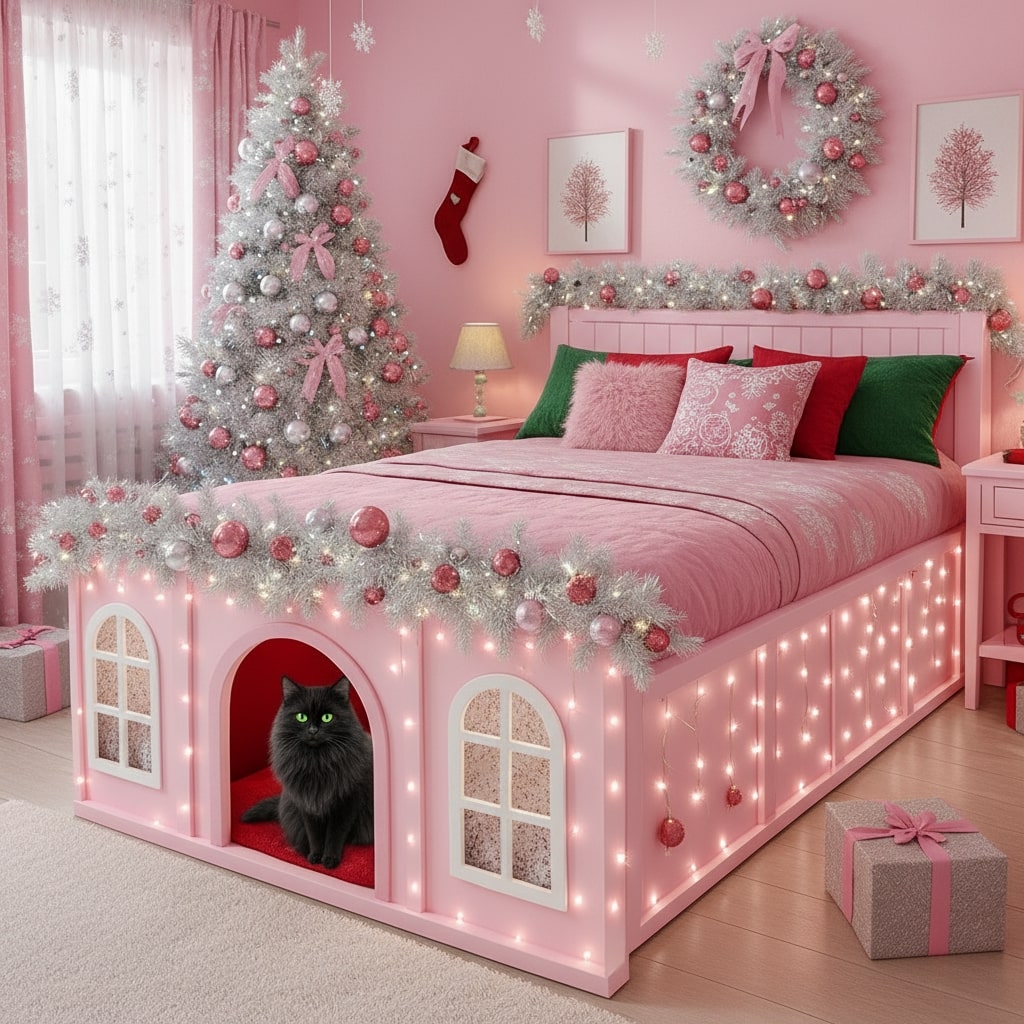
On Christmas Eve, make a quiet tradition. After the house settles, light a single beeswax candle (unscented, placed securely away from paws and tails) and read aloud—perhaps a favorite passage from A Christmas Carol, or a poem by Mary Oliver about light and belonging. Let your cat curl where she will: on your lap, beside your thigh, or watching from her basket, eyes half-closed. The act of reading aloud, of voice filling the room with calm intention, is profoundly soothing. You are not performing; you are being, together, in the hush of anticipation.
Morning light holds its own magic. Keep sheers drawn to diffuse the dawn—harsh sunlight can disturb sensitive feline eyes. Place a soft blanket on the windowsill (if safe and secure) or a low perch near the glass. On snowy mornings, sit with your coffee and watch the world turn white—your cat beside you, tail curled around her paws, equally entranced by the silent ballet of falling snow. There is no need to speak. Shared observation is communion.
And if your cat chooses to sleep through the “important” moments—if she naps while you hang garlands, ignores the carolers outside, or prefers her basket to your lap—that, too, is part of the bond. Her trust is in her relaxation, her vulnerability in her sleep beside you. A Christmas bedroom for you and your cat understands that love is not always active—it is often, beautifully, passive: the weight of a sleeping body against your leg, the soft snore beneath the quilt, the quiet certainty that you are home, and so is she.

Conclusion: The Gift of Shared Stillness
In a world that often measures Christmas in gifts exchanged, parties attended, and photos curated, the quiet power of a shared bedroom space can feel radical—even sacred. A Christmas bedroom for you and your cat is not about perfection. It won’t always be tidy; there will be stray hairs on the quilt, a paw-print in the dust on the windowsill, a chewed corner on a festive pillow. And that’s precisely its beauty.
This space is a testament to a different kind of abundance: the richness of presence, the luxury of slowing down, the deep comfort of being known—by a creature who doesn’t care about your productivity, your appearance, or your holiday to-do list, but only that you are warm, safe, and near.

As the year turns and the longest nights give way to returning light, this bedroom becomes more than a room. It becomes a vessel—holding the soft weight of a sleeping cat, the echo of a purr, the shared breath in the dark. It is where the spirit of Christmas reveals itself not in spectacle, but in stillness; not in giving, but in receiving—the gift of companionship, offered without condition, accepted without performance.
So light the gentle lamps. Layer the soft textures. Open your hand, your lap, your heart. Let this bedroom be where you both—human and feline, weary and wise—rest in the quiet certainty that you belong to each other.
That is the truest Christmas magic of all.