
Where Botany Meets Architecture
In an era defined by digital saturation, hyper-urbanization, and increasingly homogenized interiors, the human spirit yearns for reconnection—with slowness, with authenticity, and above all, with nature. This yearning has given rise to a quiet but profound design movement: biophilic interiorism. Unlike fleeting aesthetics, biophilic design is rooted in evolutionary psychology and environmental neuroscience, recognizing that spaces imbued with natural motifs, textures, and rhythms measurably reduce stress, enhance cognitive function, and foster emotional well-being.
Enter the Wildflower Epoxy Floor—not merely a flooring choice, but a deliberate spatial gesture toward re-enchantment. It transcends the literal replication of flora; instead, it evokes the essence of wildflower meadows: their spontaneity, their delicate asymmetry, their seasonal ephemerality, and their quiet resilience. This design approach does not transplant nature indoors—it translates it, using the fluid, luminous medium of epoxy resin as its canvas.
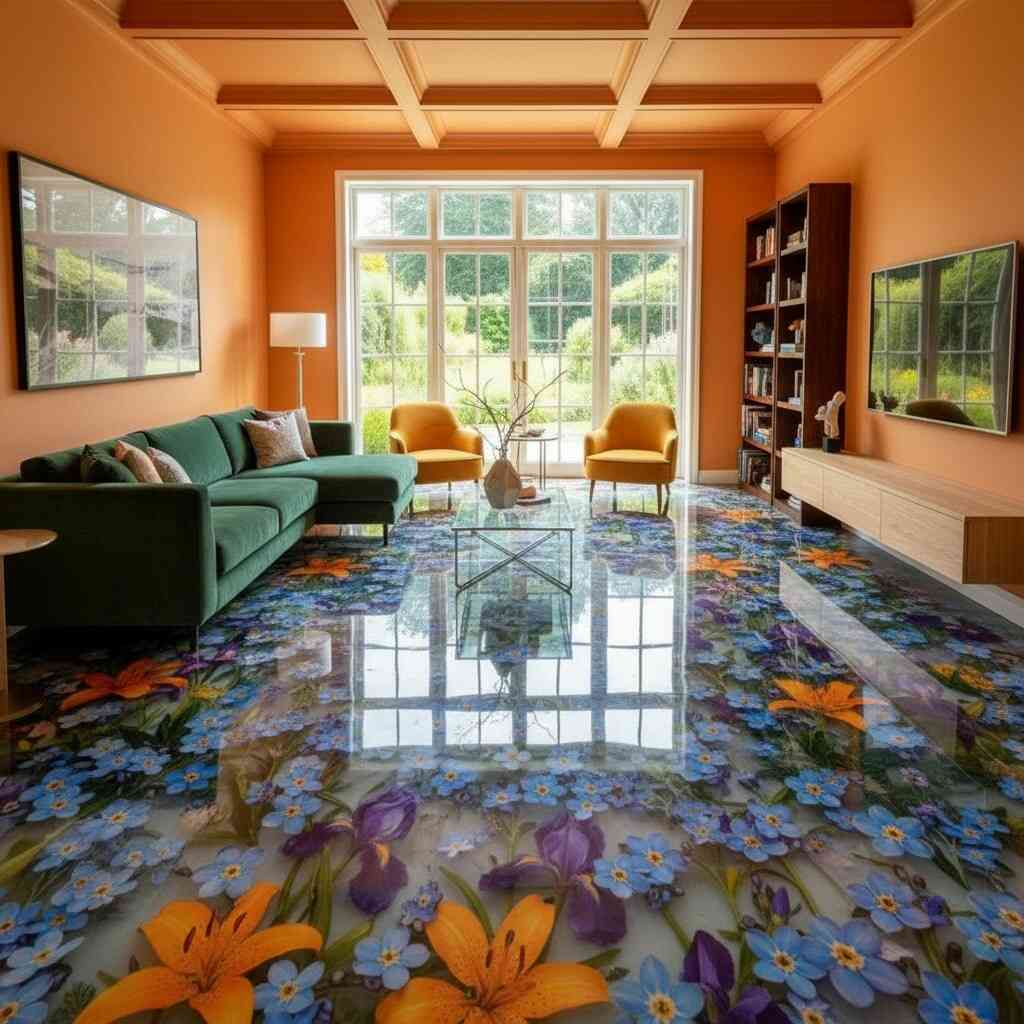
The term wildflower here is deeply intentional. Unlike horticulturally curated gardens, wildflowers thrive in margins—roadside verges, abandoned fields, rocky outcrops—places where nature asserts itself without permission. They bloom unpredictably, in colors that shift with light and soil, their forms unrefined yet harmonious. To choose a Wildflower Epoxy Floor is to invite this untamed elegance into the controlled geometry of modern architecture: a poetic tension between precision and organic chaos, between the man-made and the self-sown.
This guide explores the philosophical, aesthetic, and experiential dimensions of the Wildflower Epoxy Floor—not as a trend, but as a design language. We will delve into its conceptual foundations, unpack its material poetry, and consider how it functions within contemporary spatial narratives. This is not a manual for installation, but an invitation to contemplate how floors—long relegated to passive surfaces—can become active participants in the storytelling of a space.
Part I: The Philosophy of the Wild—Reclaiming the Unmanicured in Design
1.1 Beyond Ornament: Wildness as Ethos
The Wildflower Epoxy Floor begins not with pigment or aggregate, but with a worldview. To understand its resonance, we must first interrogate the cultural bias toward order in interior design. Since the Enlightenment, Western architecture has privileged symmetry, proportion, and legibility—principles inherited from classical ideals and reinforced by industrial standardization. Floors, in particular, became uniform: seamless tiles, monolithic slabs, machine-laid planks—all testaments to human mastery over material.
Nature, by contrast, is rarely symmetrical. A wildflower meadow does not bloom in grids. Poppies lean into the wind; cornflowers cluster where moisture lingers; daisies emerge in the cracks of stone. Their beauty resides in disorder—a complex, non-linear order known to ecologists as stochastic patterning. This is not randomness, but responsive adaptation.
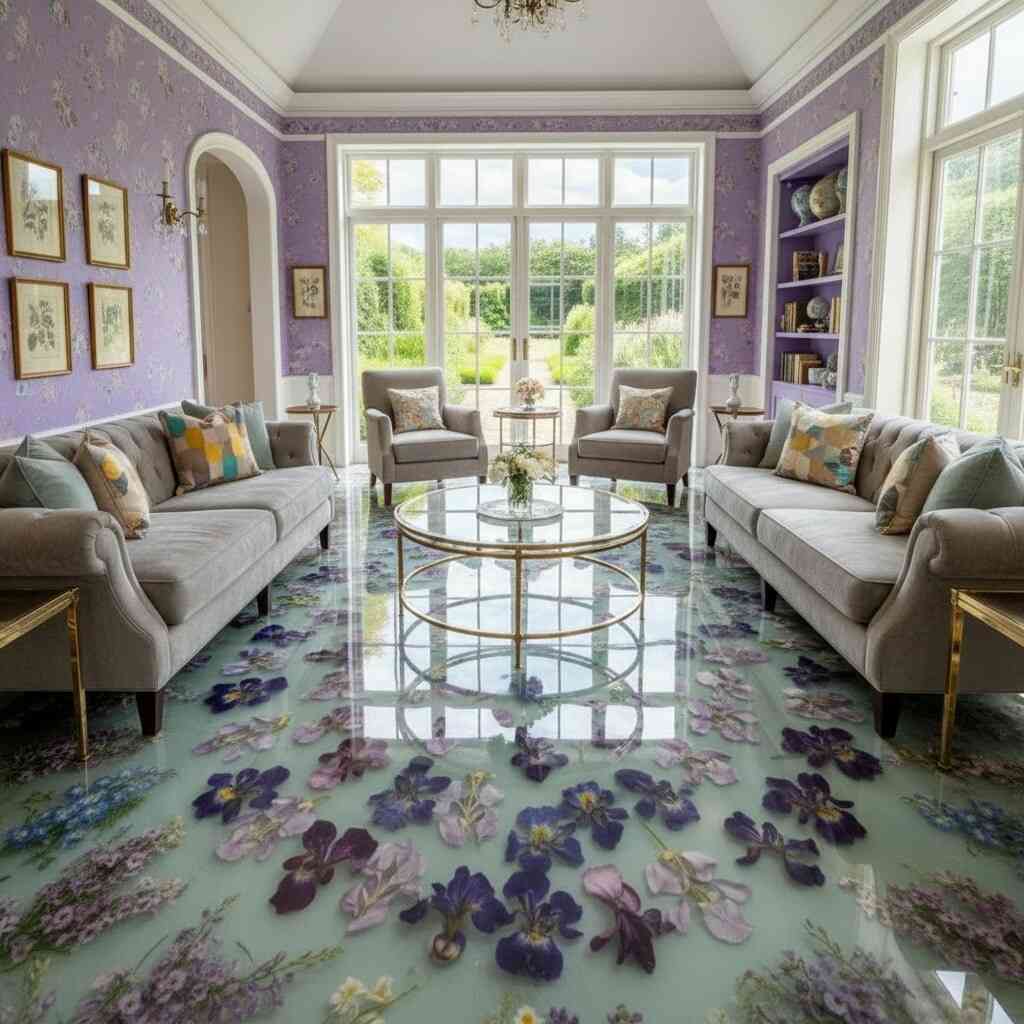
The Wildflower Epoxy Floor consciously embraces this ethos. Its design avoids repetition. No two square meters are identical. Pigment veins drift like pollen on a breeze; embedded botanical inclusions—dried petals, seed husks, or micro-fragments of pressed flora—are distributed with the irregular hand of a passing bee, not the algorithm of a CAD program. In doing so, the floor becomes a meditation on acceptance: of imperfection, of transience, of the beauty inherent in systems that resist total control.
1.2 Epoxy as a Living Medium: Fluidity and Transformation
Epoxy resin, in its raw state, is paradoxical: a viscous liquid that hardens into glass-like permanence. This alchemical transformation mirrors the life cycle of wildflowers themselves—ephemeral blooms giving way to enduring seeds, buried in soil until conditions align for renewal.
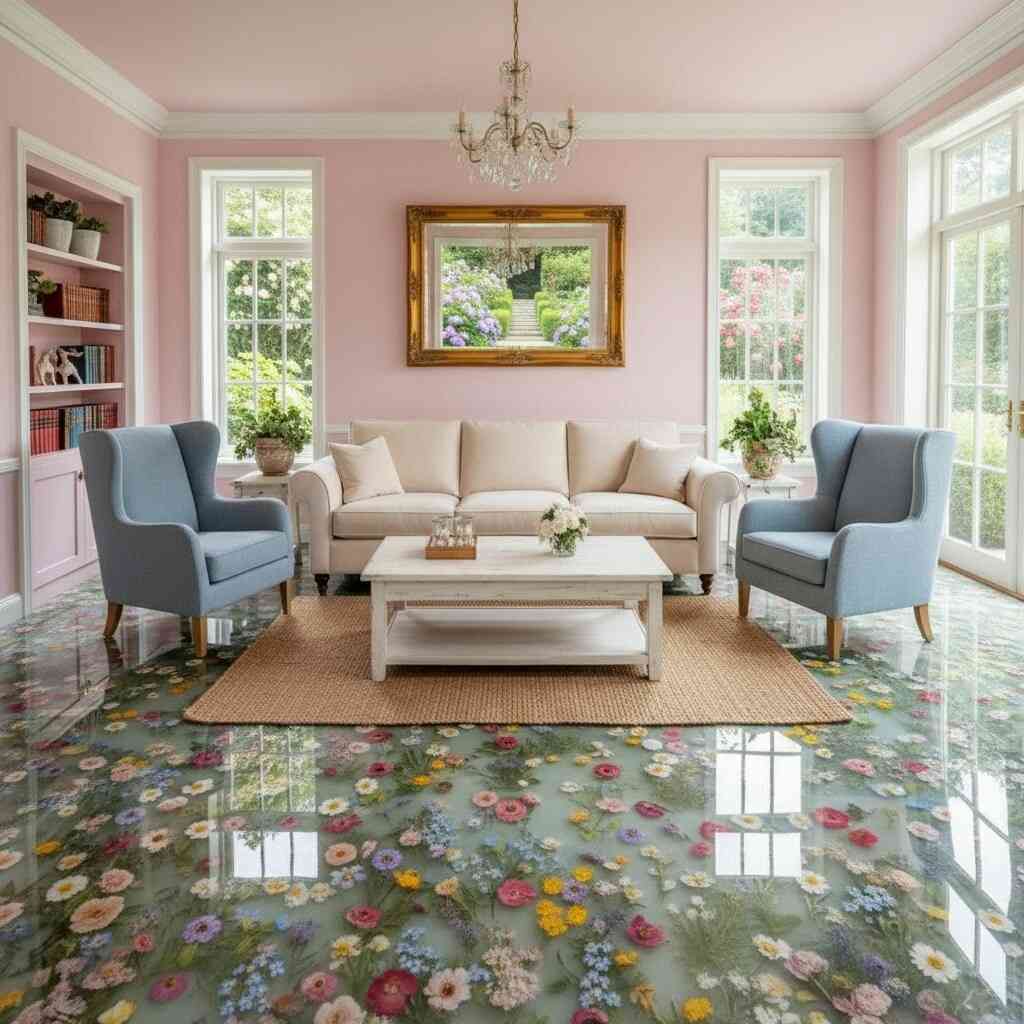
Artisans who craft Wildflower Epoxy Floors treat resin not as a binding agent, but as a medium for temporal expression. The pour is timed with environmental awareness: temperature and humidity affect flow, creating subtle ripples that echo morning dew on grass blades. Layers are built slowly—base tones evoking earth and loam, mid-tones suggesting stem and leaf, top layers infused with translucent tints that catch light like petals backlit by sun.
Importantly, this is not trompe-l’œil realism. A Wildflower Epoxy Floor does not strive to fool the eye into believing one walks upon an actual meadow. Instead, it operates on the level of suggestion—an abstraction, like a haiku or an ink wash painting. A swirl of cerulean may hint at chicory; a burst of ochre, at yarrow; a fine filament of silver, at the delicate tracery of Queen Anne’s lace. The viewer’s imagination completes the scene, engaging not just sight, but memory and association.
1.3 The Floor as Ground—Reconnecting to Place
In architectural theory, the floor is ground—the foundational plane that anchors us spatially and psychologically. Traditional flooring often obscures this relationship: carpets muffle, tiles compartmentalize, polished concrete reflects but does not receive. A Wildflower Epoxy Floor reestablishes tactile and symbolic contact with the earth.
Consider how wildflowers belong to their terrain: alpine species cling to granite; prairie blooms root in deep loess; coastal varieties tolerate salt spray. A thoughtfully composed Wildflower Epoxy Floor can echo local ecologies. A home in the Pacific Northwest might feature gradients of moss green and huckleberry violet, with inclusions of crushed Douglas fir cone scales. A desert dwelling could evoke ocotillo blooms and creosote wash with sun-bleached yellows and dusty rose. Even in urban apartments, the floor becomes a memory landscape—a personal archive of walks in childhood fields, of mountain hikes, of roadside stops on cross-country drives.
This locative resonance deepens the inhabitant’s sense of rootedness. The floor is no longer neutral—it is a palimpsest, bearing traces of place, season, and personal narrative.
Part II: Aesthetic Syntax—Reading the Language of the Wildflower Floor
2.1 Chromatic Poetry: The Palette of the Uncultivated
The color theory of the Wildflower Epoxy Floor diverges sharply from conventional interior palettes. It rejects the safety of neutrals—not out of rebellion, but out of fidelity to botanical truth.
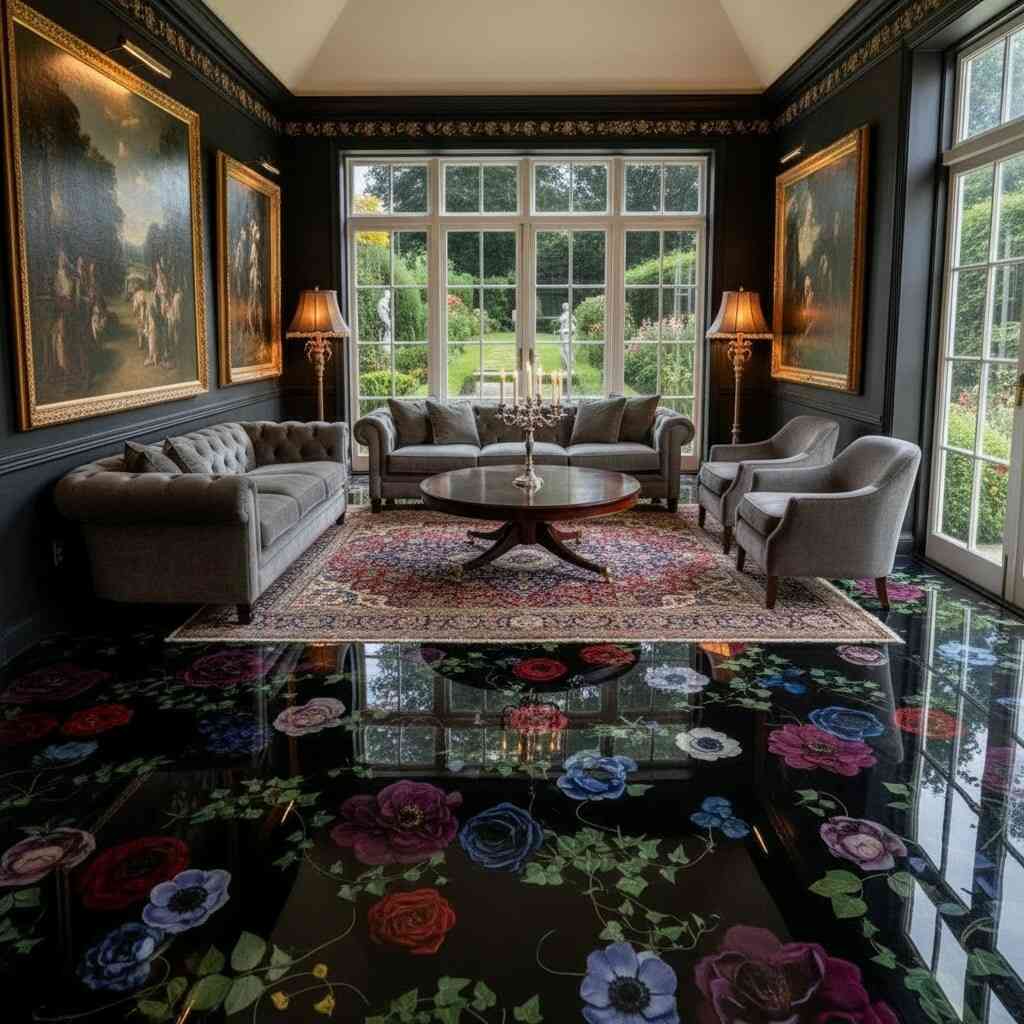
Wildflower hues are inherently unsaturated and context-dependent. A cornflower appears electric blue against dry grass, but muted when shadowed by yarrow. This dynamic informs the pigment strategy: colors are layered, glazed, and veined—not applied flatly. Iron oxide washes create rust undertones; mica flakes catch light to simulate the iridescence of beetle wings on petals; translucent tints allow lower strata to glow through, mimicking the way light filters through layered canopies.
Crucially, the palette avoids primary purity. There is no “true red” of a geranium (a cultivated hybrid), but rather the dusty crimson of a fading fireweed bloom at dusk. Greens are never emerald, but sage, olive, or the silvery gray-greens of drought-tolerant species. This chromatic humility renders the floor restful—never shouting, always whispering.
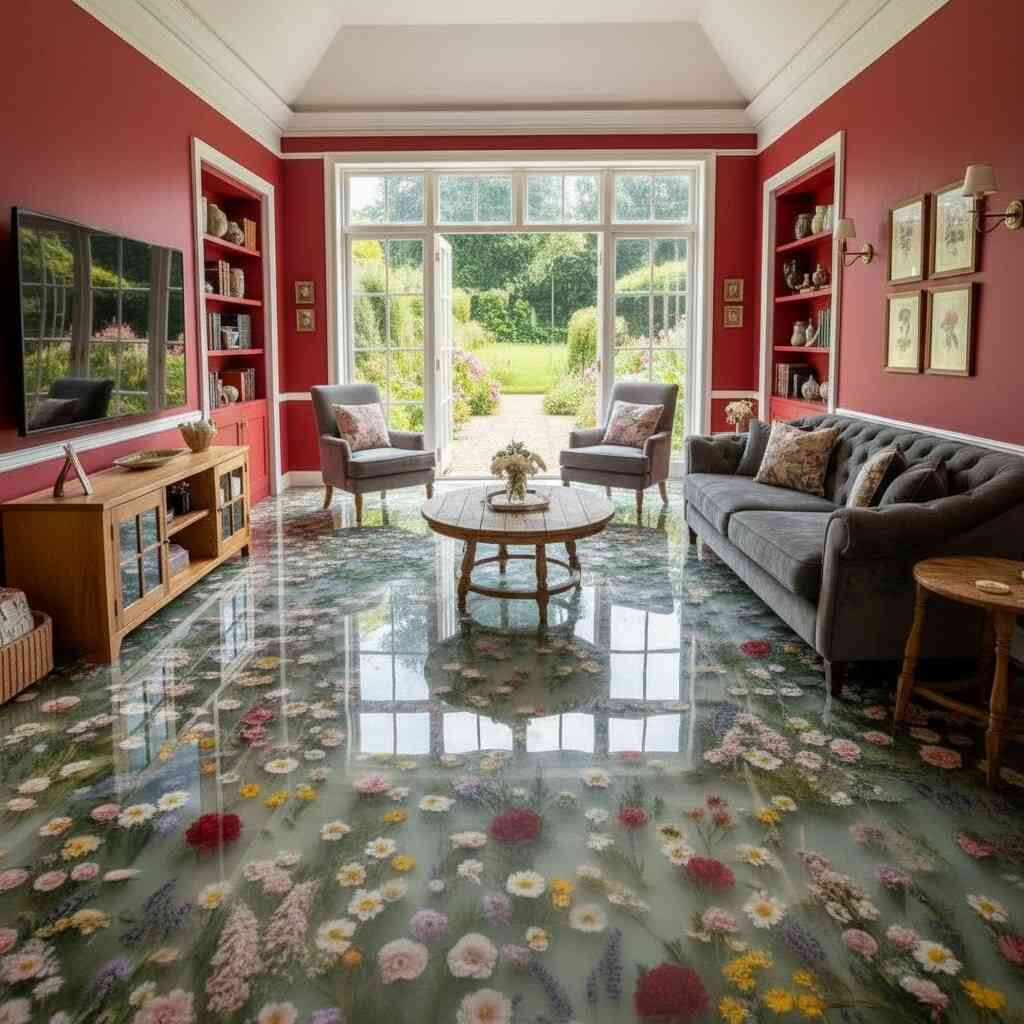
2.2 Texture as Tactile Memory
Texture in a Wildflower Epoxy Floor operates on two registers: visual and haptic.
Visually, depth is achieved through stratification. Artisans may embed fine aggregates—crushed quartz, recycled glass frit, or even sterilized soil particles—within specific layers to suggest granular earth, dew drops, or pollen dust. Delicate, hand-scribed lines (using fine combs or feather-edge tools) mimic the venation of leaves or the fine hairs on a stem. Some designs incorporate negative space: voids left unfilled, later sealed with clear resin, evoking the hollow stems of grasses or the delicate architecture of seed pods.
Haptically, the surface remains smooth—epoxy’s inherent property—but its visual texture triggers embodied memory. The brain recalls the crunch of dry grass, the soft give of loam, the coolness of shaded earth. Neuroaesthetics research shows that textured visual cues alone can activate somatosensory cortex responses, effectively allowing one to “feel” the floor with the eyes.
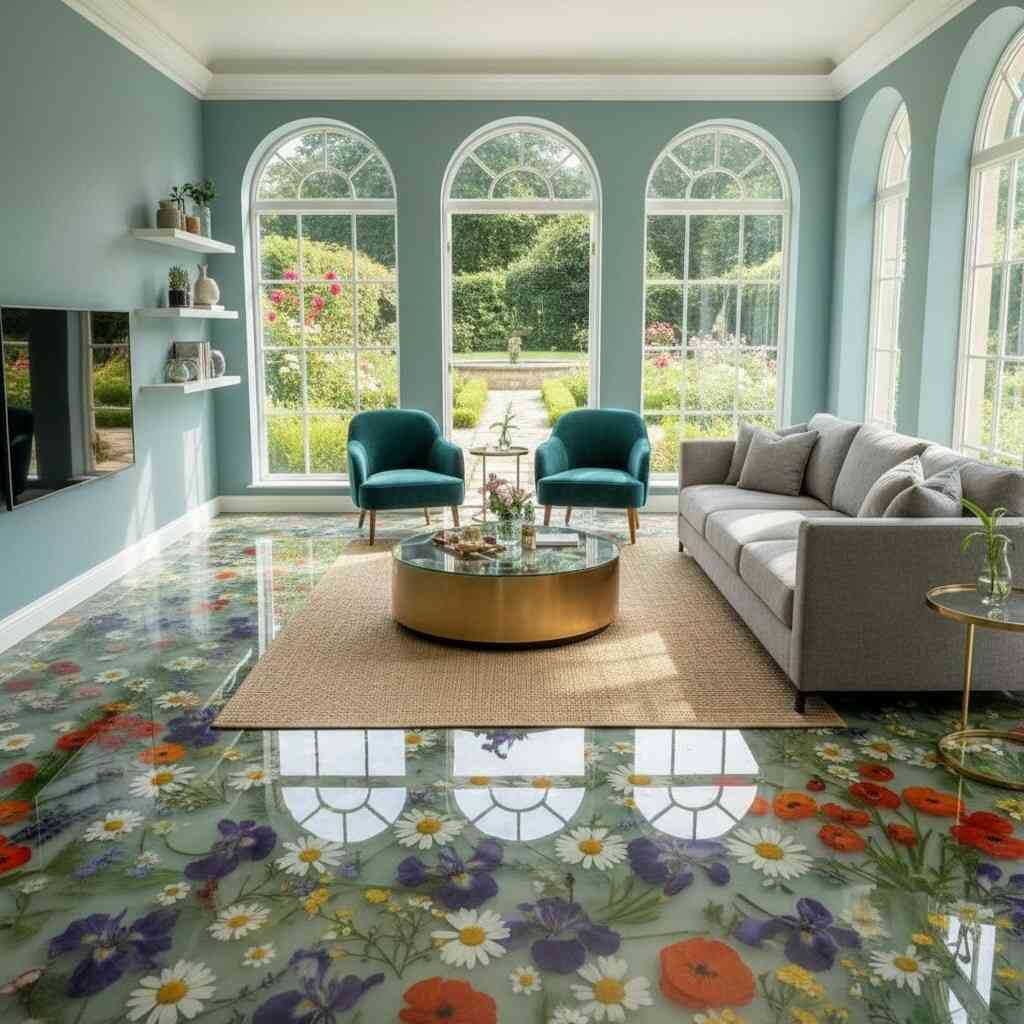
2.3 Light as Co-Creator
A Wildflower Epoxy Floor is never static. Its appearance shifts diurnally and seasonally, collaborating with natural light in ways few floors do.
Morning light, low and golden, warms the amber and ochre veins, casting elongated shadows that animate embedded inclusions. Noon sun reveals the full chromatic complexity—translucent layers gleam, mica sparks, subtle gradients emerge. In overcast conditions, the floor softens, its colors deepening like a forest in mist. Artificial lighting at night can be tuned to enhance this: warm LEDs accentuate earthy tones; cooler sources highlight blues and lavenders.
This dynamism makes the floor an active participant in the room’s temporal rhythm. It does not merely occupy space—it registers time.
Part III: Integration and Intention—Curating Wildness Within Modern Interiors
3.1 Dialogue with Architecture: Softening the Grid
Modern interiors—especially those in the minimalist or Scandinavian traditions—often rely on rectilinear forms, open plans, and monolithic surfaces. While serene, such spaces can risk sterility: a museum-like stillness that feels more curated than lived-in.
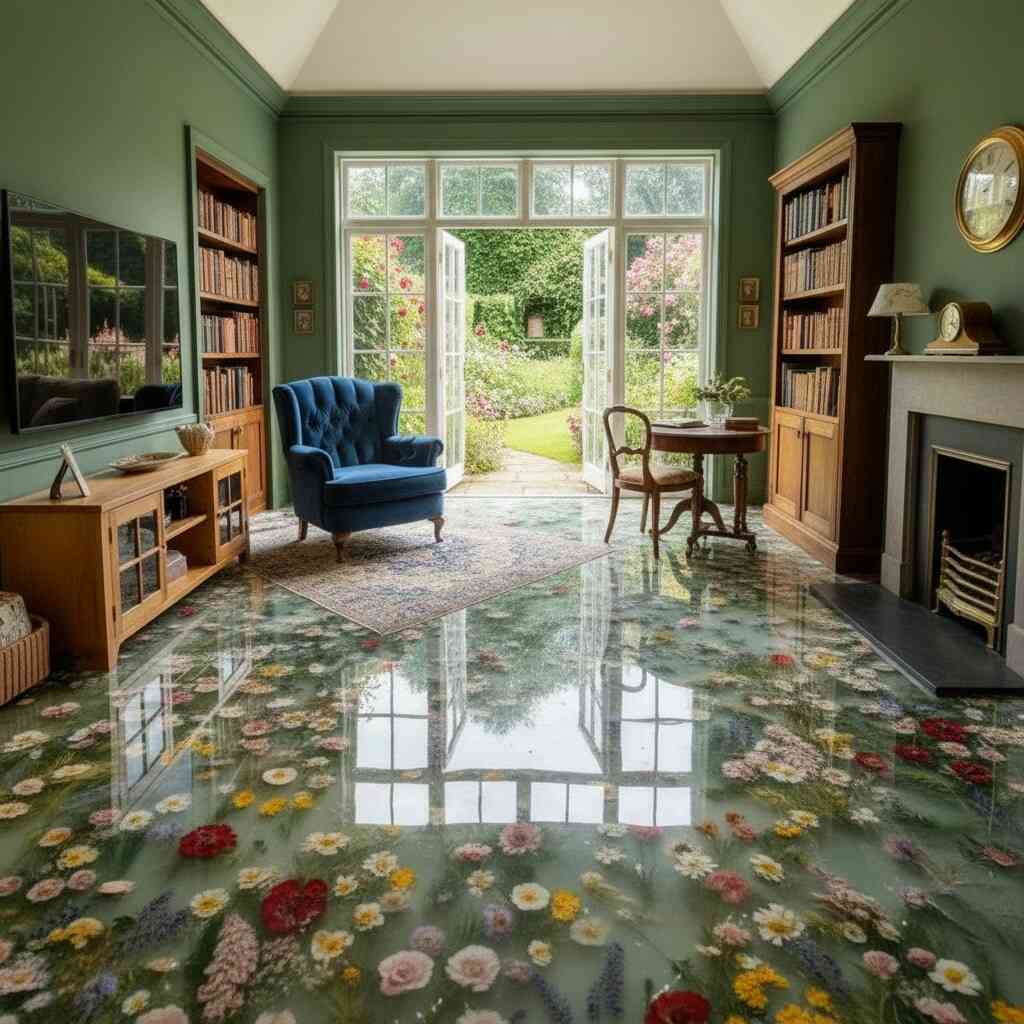
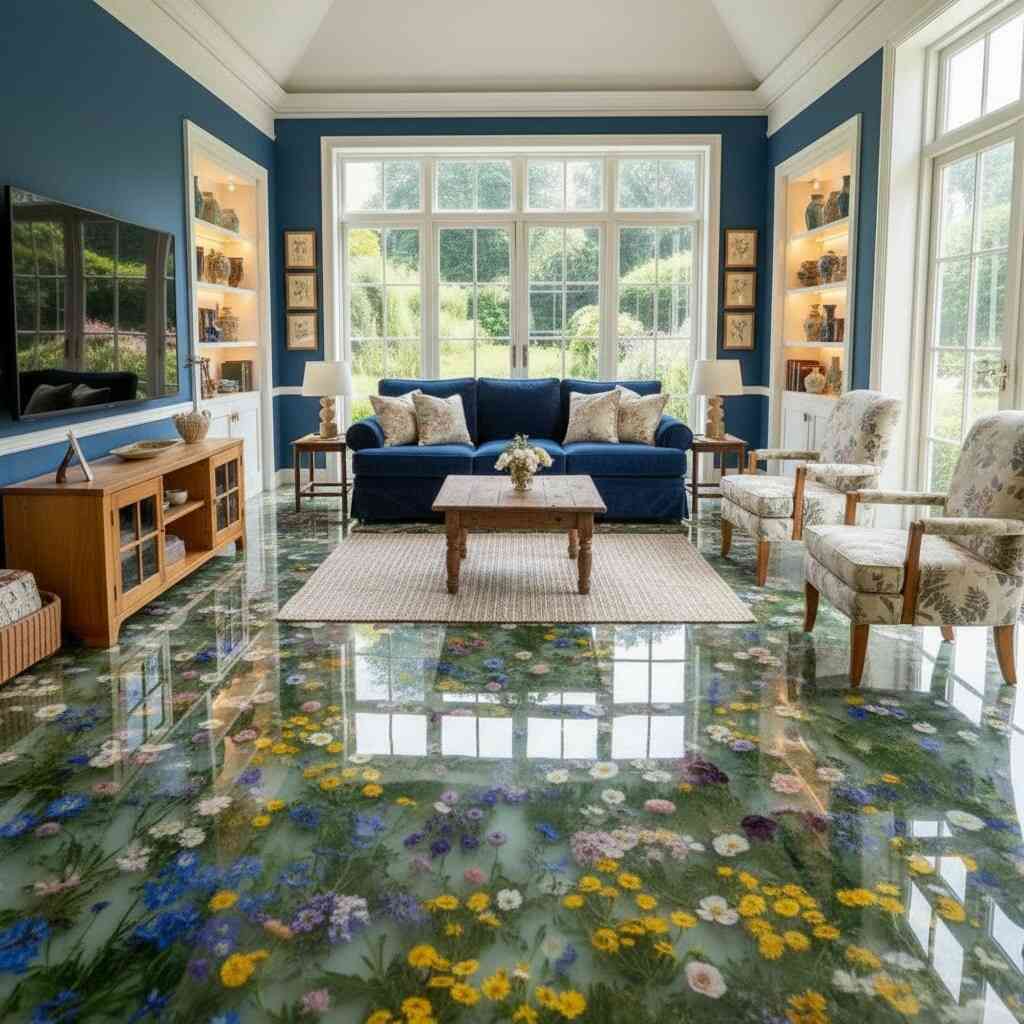
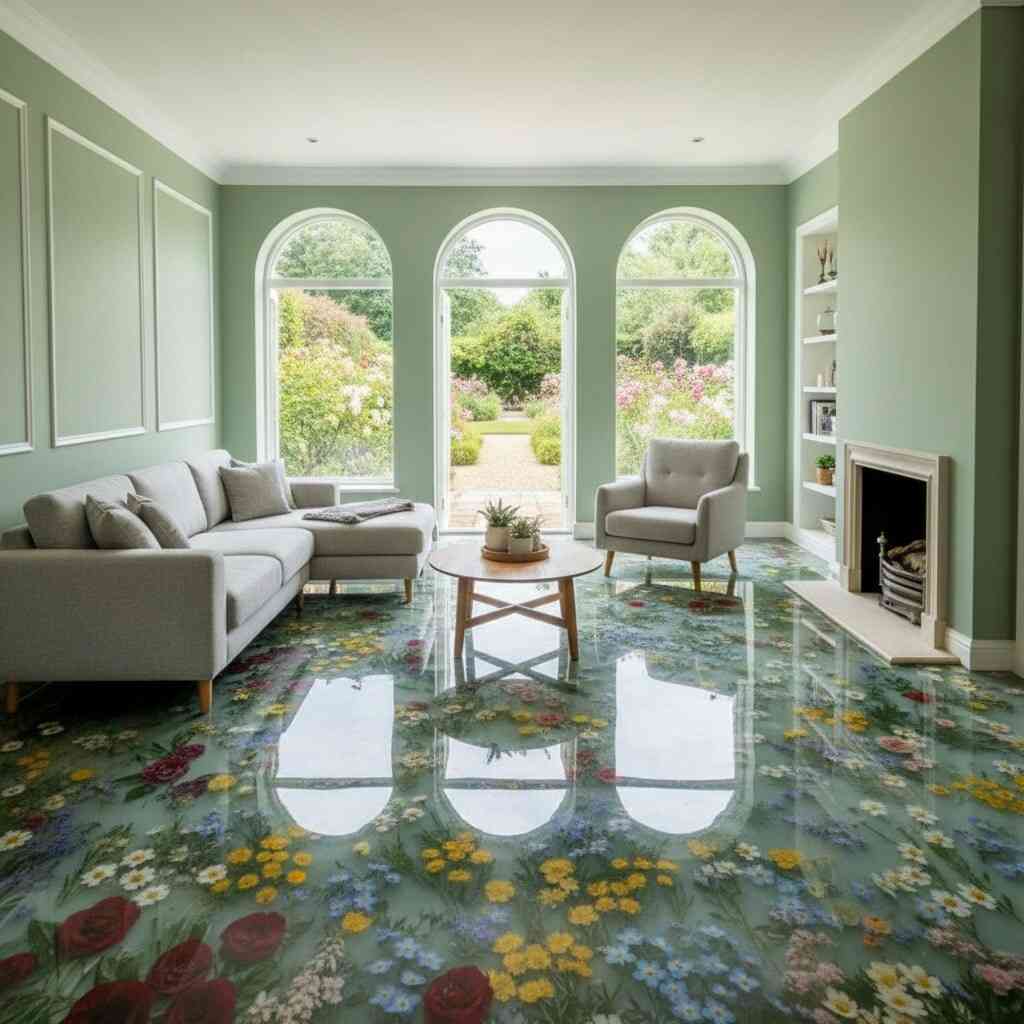
The Wildflower Epoxy Floor introduces organic counterpoint. Its irregular patterns soften sharp edges. A dining table’s clean geometry is grounded by the “meadow” beneath it; a stark white kitchen island floats above a field of implied blooms. Rather than clashing, the contrast creates balance: human order coexisting with natural spontaneity.
Crucially, this integration requires restraint elsewhere. Walls, cabinetry, and large furnishings benefit from neutrality—soft whites, warm grays, untreated woods—to allow the floor to breathe. Think of it as a gallery wall: the frame must recede for the artwork to speak.
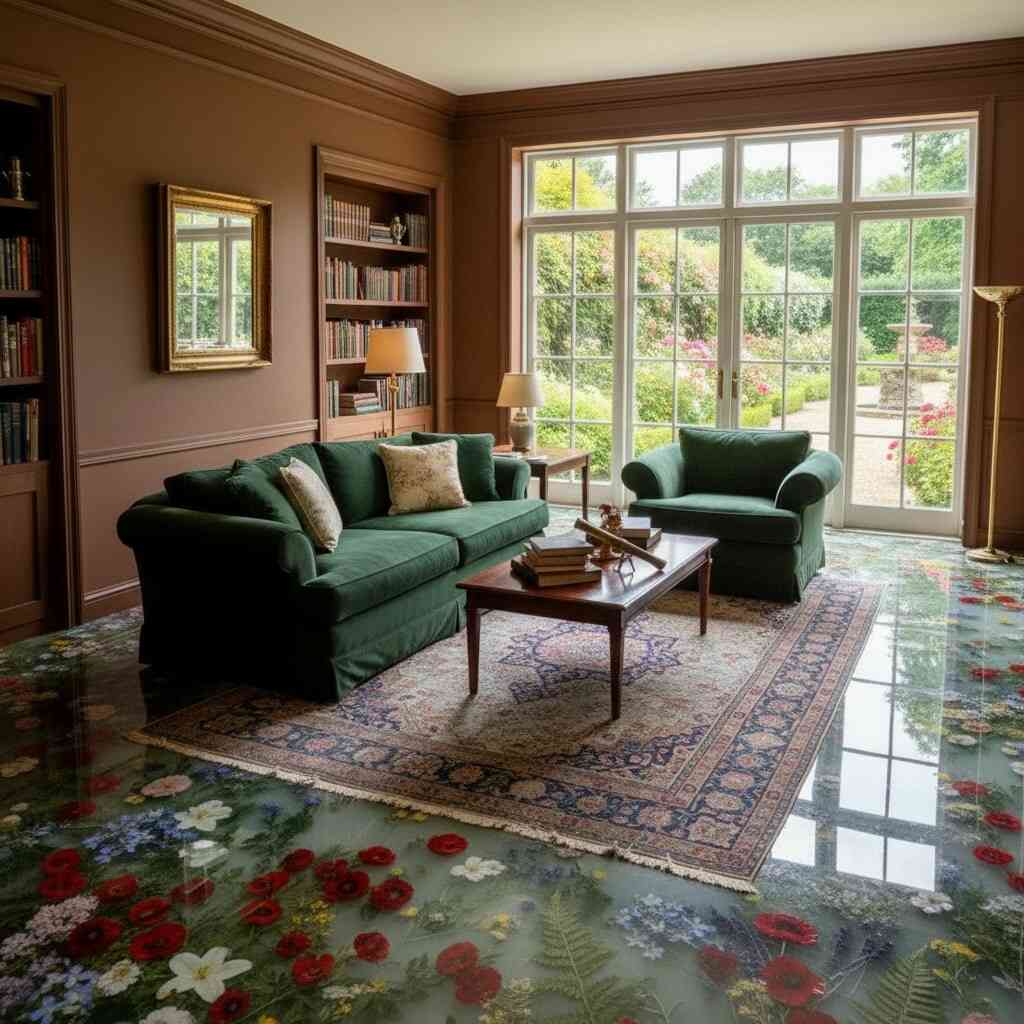
3.2 Scale and Proportion: From Accent to Immersion
A Wildflower Epoxy Floor can function at multiple scales:
- Full-Field Application: Covering an entire open-plan living space, it becomes the defining spatial motif, dissolving boundaries between kitchen, dining, and lounge into a continuous “landscape.”
- Zonal Definition: Used in a reading nook, entry vestibule, or bathroom wet-room, it creates an intimate biome—a micro-habitat within the larger structure.
- Threshold Moments: As a transition strip between rooms—say, from a hardwood hallway into a tiled kitchen—it serves as a ritual passage, akin to stepping from forest into clearing.
Each scale invites different compositional strategies. Large fields benefit from broader color washes and macro-patterns; intimate zones allow for intricate detail—individual “blooms” rendered with fine pigment work.
3.3 The Ethical Dimension: Sustainability and Reverence
While epoxy is a petrochemical product, the ethos of the Wildflower Epoxy Floor aligns with deeper sustainability: durability as conservation, and meaning as antidote to disposability.
A high-quality epoxy floor lasts decades—far outpacing carpet, laminate, or even many hardwoods. Its permanence rejects the throwaway culture of fast interiors. Moreover, many artisans now use bio-based epoxy resins (derived from plant oils) and incorporate reclaimed or foraged botanicals—petals gathered post-bloom, seed pods fallen naturally, avoiding harm to living ecosystems.
More profoundly, this floor cultivates reverence. By embedding the memory of wildflowers—a species threatened globally by habitat loss and monoculture agriculture—it becomes a quiet act of preservation. It reminds daily: This existed. This matters. This fragility is worth honoring.
Conclusion: The Floor That Breathes
The Wildflower Epoxy Floor is ultimately an invitation—to pause, to look down, and to re-engage with the world beyond the window. It asks us to reconsider the floor not as dead space, but as living ground—a surface that holds stories, responds to light, and echoes the quiet resilience of untamed nature.
In a time of climate anxiety and digital dissociation, such spaces are not luxuries; they are necessities. They offer what philosopher Glenn Albrecht terms solastalgia relief—the comfort of finding familiarity and beauty in one’s immediate surroundings, even as the wider world changes.
This floor does not demand attention. It waits. Like a meadow in early spring, it reveals its details slowly: a glint of mica like morning frost, a pigment swirl resembling a bee’s flight path, a subtle gradient echoing the shift from hilltop to valley. It rewards contemplation. It fosters presence.
To walk upon a Wildflower Epoxy Floor is to tread lightly—not just physically, but existentially. It is to acknowledge that beauty thrives in the margins, that order can be found in apparent chaos, and that even the most controlled environments can make room for the wild.
In the end, the greatest function of architecture is not shelter alone, but sanctuary. And sanctuary, as any wildflower knows, begins with the ground beneath our feet.