
When Stairs Cease to Be Passive Infrastructure
Staircases have long stood as silent conduits—functional, often ornamental, but fundamentally inert. Whether carved from marble in Renaissance palazzos or forged in steel for industrial lofts, stairs have traditionally served one core purpose: vertical circulation. Yet in the 21st century, the boundaries between built environment and digital experience are softening, dissolving even, as responsive architecture redefines what infrastructure can do. Among the most compelling manifestations of this paradigm shift are active scene staircases—dynamic architectural installations that transform the act of ascending or descending into a narrative, sensory, or participatory journey.
At the heart of this transformation lies a singular technological enabler: the OLED screen. Unlike conventional lighting or projection systems, OLED (Organic Light-Emitting Diode) panels offer unparalleled contrast, flexibility, thinness, and pixel-level emissivity—qualities that make them uniquely suited for embedding within architectural surfaces without compromising structural integrity or aesthetic coherence. When integrated into the treads, risers, or balustrades of staircases, OLED screens cease to be mere displays; they become conduits for immersion—responsive canvases that react to presence, pace, and pattern, turning passive transit into active engagement.
This article delves deeply into the phenomenon of active scene staircases OLED screens, not as a product showcase or a sales pitch—nor as a superficial tech trend—but as a profound architectural and experiential evolution. We will examine how OLED’s intrinsic properties allow staircases to function as living interfaces; how designers harness real-time data, generative algorithms, and environmental sensing to craft evolving visual narratives; and how such installations invite users to reconsider their relationship with space, movement, and perception. In doing so, we aim to uncover the philosophical, sensory, and spatial implications of stairs that no longer simply connect floors—but communicate, respond, and transform.
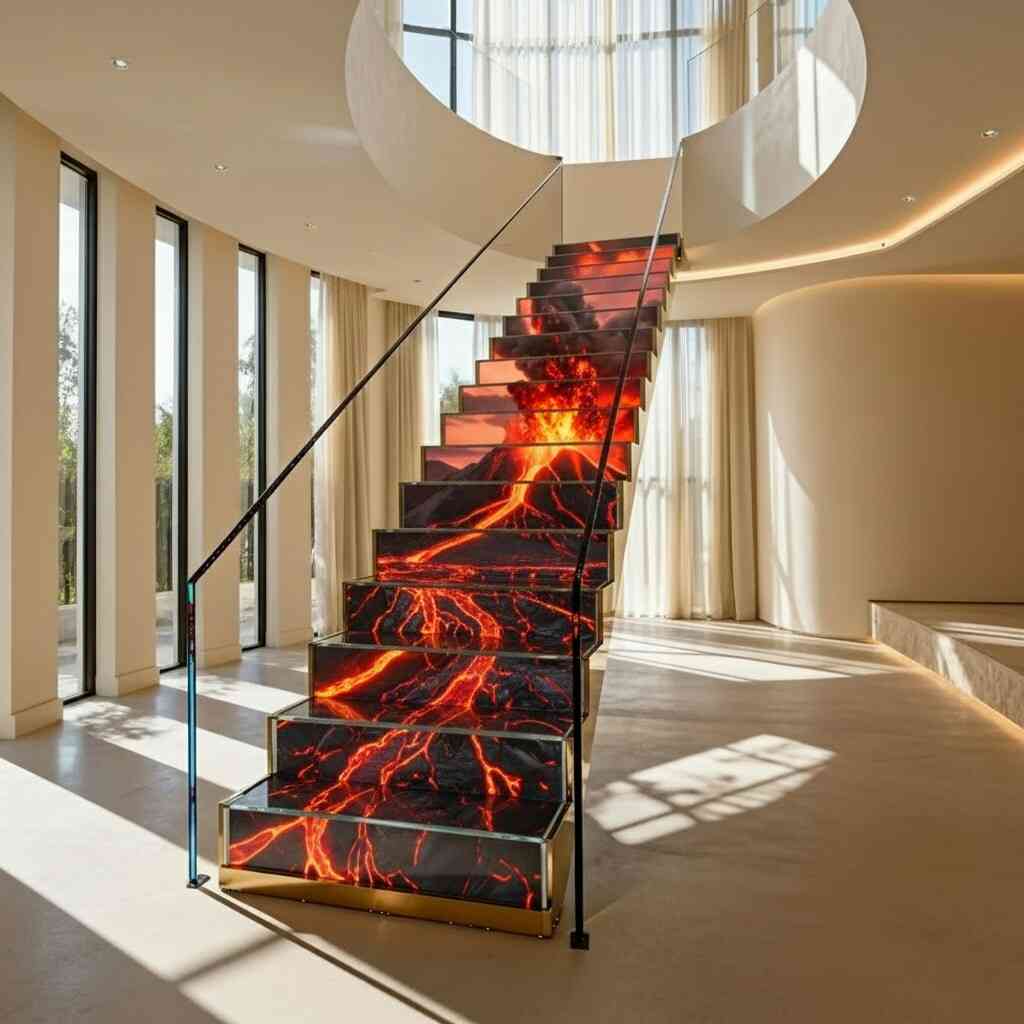
Part I: The Material Intelligence of OLED in Architectural Integration
To understand why OLED screens are pivotal to the emergence of active scene staircases, one must first grasp their material and optical distinctiveness—not in comparison to LCD or LED arrays, but in terms of how they behave within an architectural context.
OLED technology operates on a fundamentally different principle than its backlit counterparts. Each pixel is a self-emissive organic compound that produces light when an electric current passes through it. There is no need for a backlight, diffusers, or bulky housings. This allows OLED panels to be astonishingly thin—often under 1 mm—and flexible enough to conform to curved or stepped geometries. More critically, OLEDs achieve true black by simply turning off pixels, enabling infinite contrast ratios and a depth of visual field that mimics natural perception. In dim or controlled lighting, an OLED-lit staircase doesn’t glow—it appears, as though light is emanating from within the architecture itself.
This emissivity is not merely aesthetic; it is phenomenological. When a user steps onto a tread embedded with OLEDs, the screen doesn’t illuminate around the foot—it responds beneath it, with precise spatial fidelity. A ripple of bioluminescent blue may bloom from the point of contact, fading outward in concentric waves. Or a constellation of stars may scatter as if startled, reorganizing only when the next step is taken. Because OLED pixels can be individually addressed with microsecond precision, the staircase becomes a high-resolution sensor-and-display hybrid: the surface knows where you are and shows you the consequence in real time.
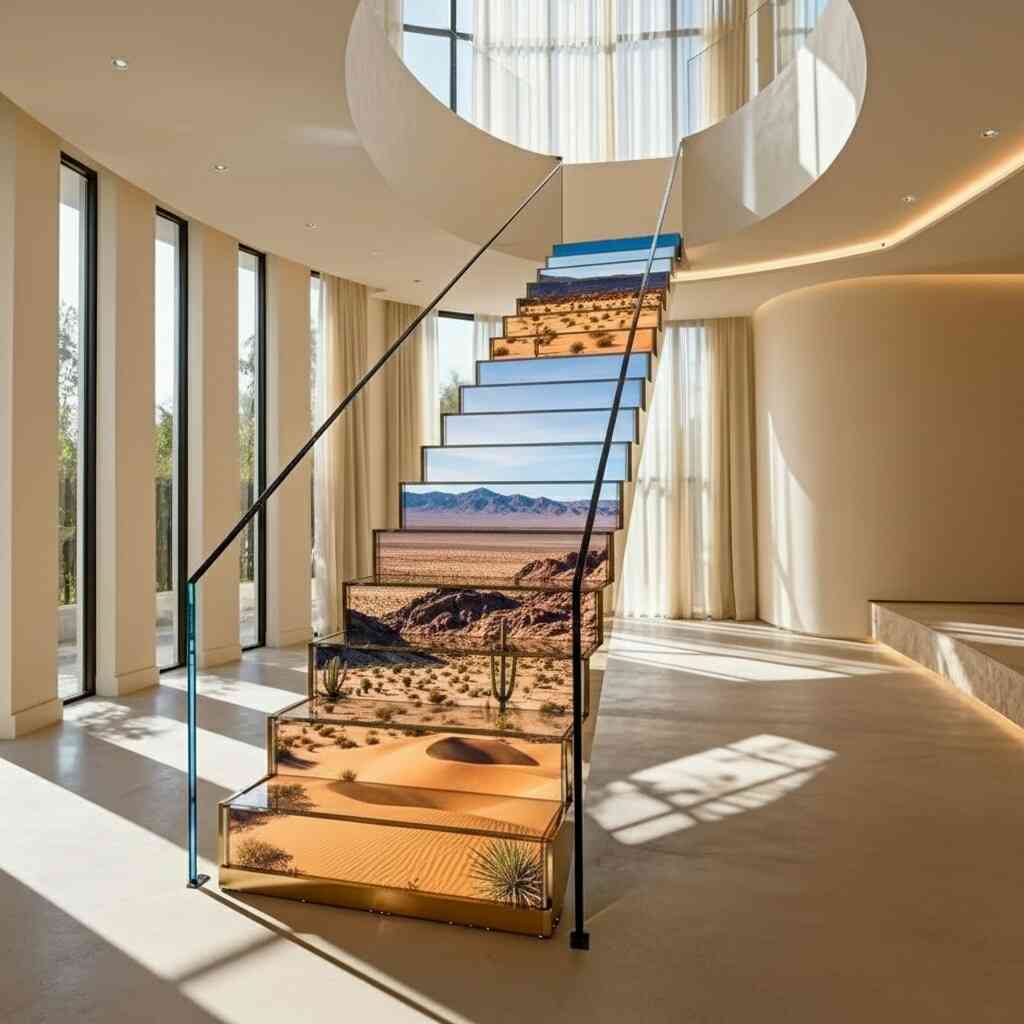
Moreover, OLED’s diffuse, glare-free emission eliminates hotspots and reflections that would otherwise disrupt immersion. Traditional LEDs, especially high-brightness arrays, often create visual noise—specular highlights, color fringing, or uneven saturation—that pulls the observer out of the experience. OLEDs, by contrast, offer a velvety uniformity of light, akin to the soft luminescence of fireflies or deep-sea organisms. This quality is essential for maintaining the illusion that the staircase is not a screen with content, but a living surface—a distinction that lies at the core of true immersion.
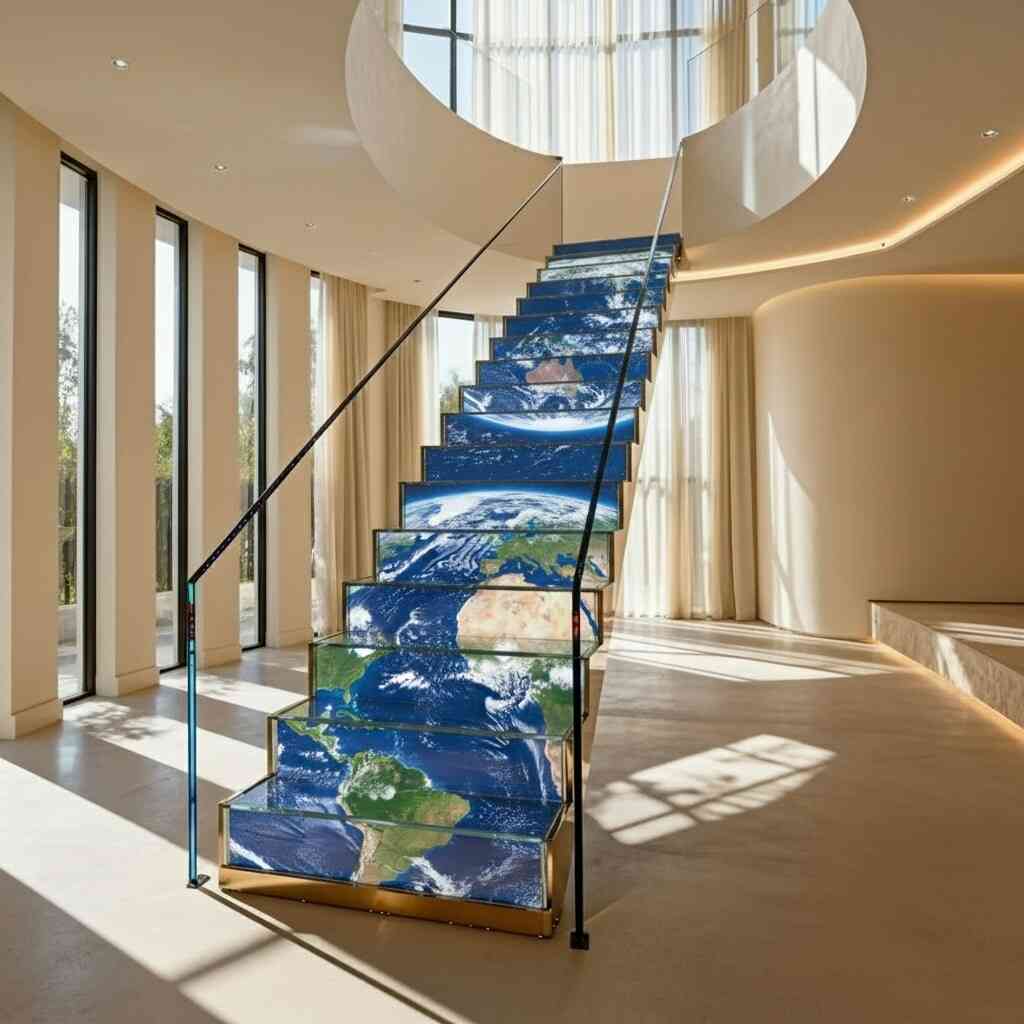
Architects and interaction designers have exploited these properties in increasingly sophisticated ways. In installations such as “The Pulse Stair” (Oslo, 2024), OLED strips were laminated between layers of translucent resin treads, creating a seamless gradient from solid to luminous. Pressure sensors embedded beneath each tread triggered localized illumination—not as a binary on/off, but as a pressure-sensitive bloom, where the intensity and hue shifted with the weight and duration of contact. In Tokyo’s “Chrono Descent” (2025), OLED risers displayed time-lapsed celestial movements; ascending the stairs reversed the flow of constellations, collapsing millennia of stellar drift into a 30-second climb—a poetic compression of cosmic and bodily time.
The material intelligence of OLED, then, is not in its novelty, but in its invisibility as technology. It disappears into the architecture, allowing the experience—not the hardware—to dominate perception.
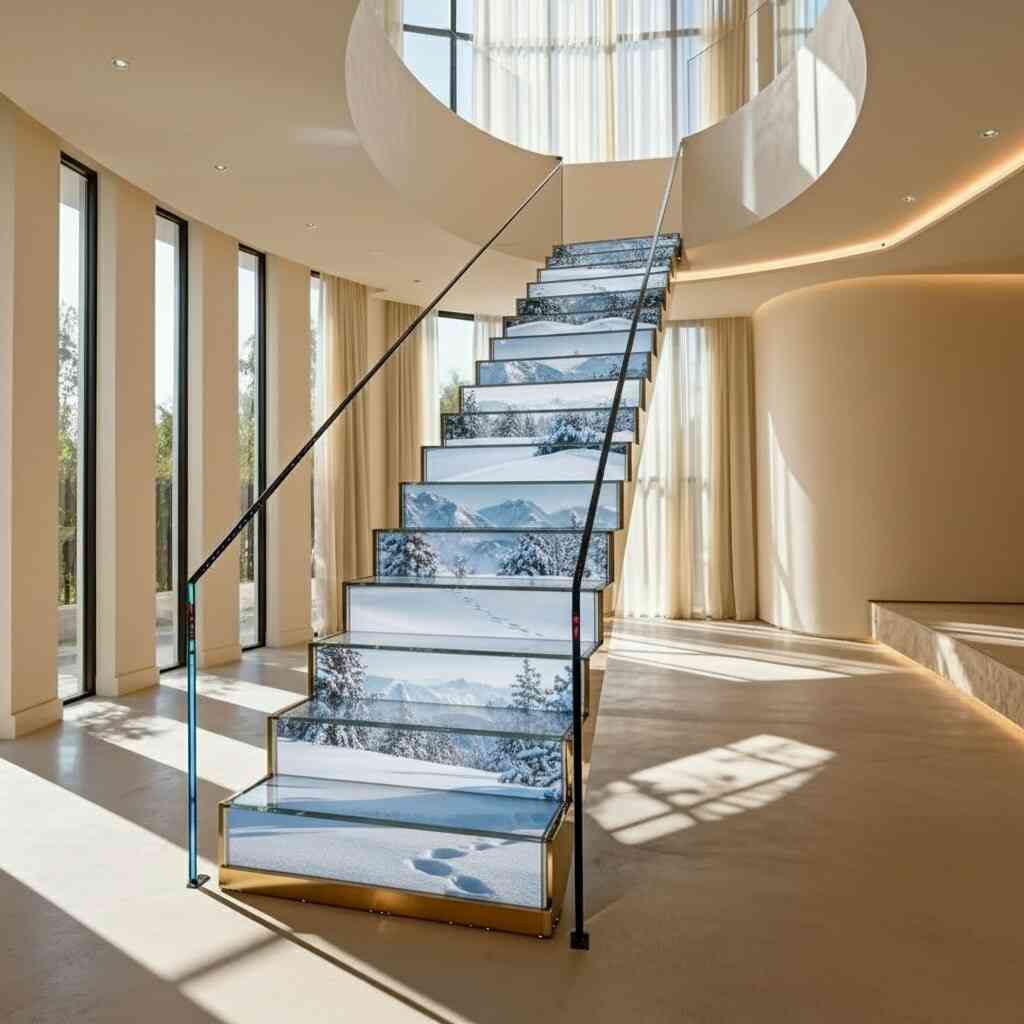
Part II: Choreographing Experience Through Dynamic Scene Logic
An active scene staircase does not display static imagery. It does not loop pre-rendered videos like a digital billboard. Rather, it operates as a scene engine—a system that generates, modulates, and evolves visual narratives in response to real-time inputs. This is where the term active scene becomes meaningful: active denotes agency (the staircase acts upon data), and scene implies a coherent, time-based environment with internal logic, rhythm, and spatial grammar.
The backbone of such systems is a multi-layered sensing and processing architecture. Common inputs include:
- Presence detection (via capacitive or pressure-sensitive treads),
- Velocity and gait analysis (using under-tread accelerometers or LiDAR),
- Ambient conditions (light levels, sound, temperature),
- External data feeds (weather APIs, live seismic activity, stock market volatility, social media sentiment).
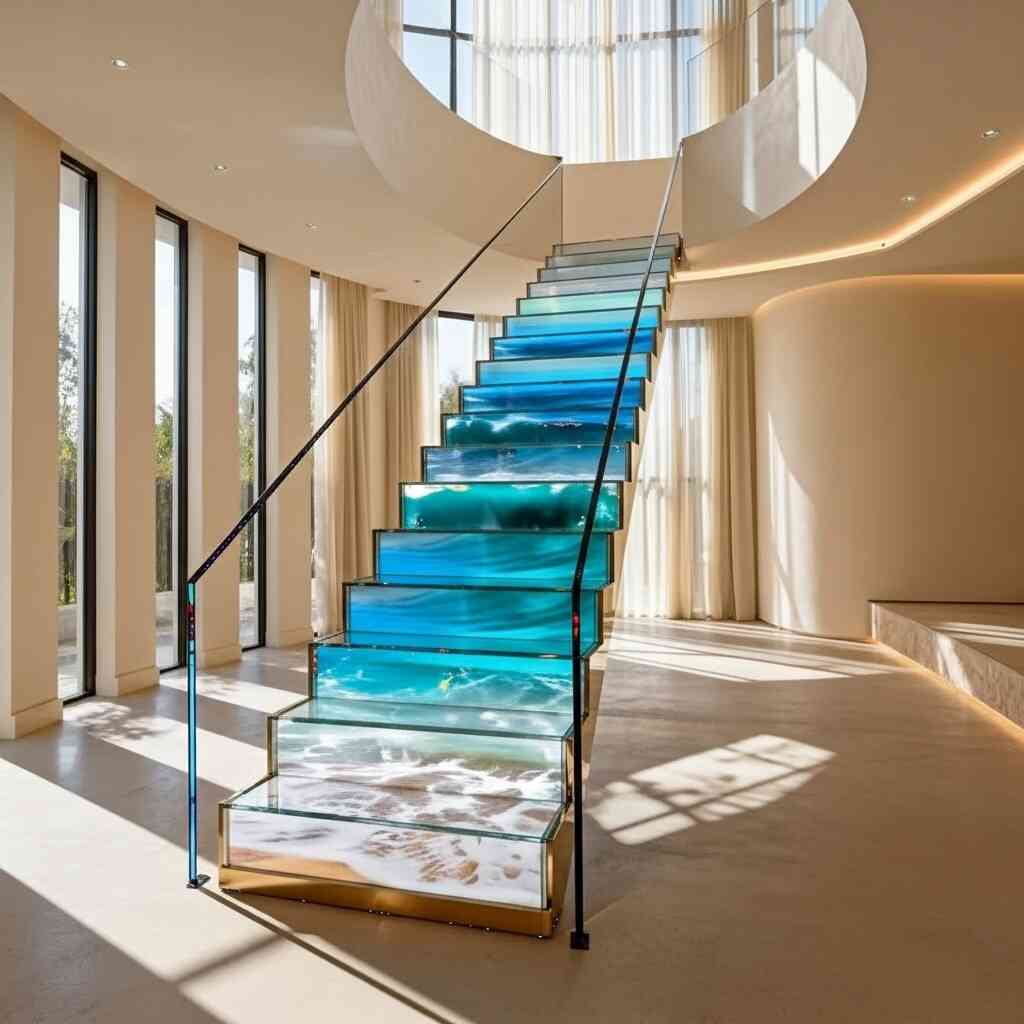
These inputs are processed by embedded microcontrollers or edge-computing nodes running generative algorithms—often built in environments like TouchDesigner, openFrameworks, or custom C++ engines. The outputs are not predetermined animations but emergent behaviors: visual ecosystems that adapt without repetition.
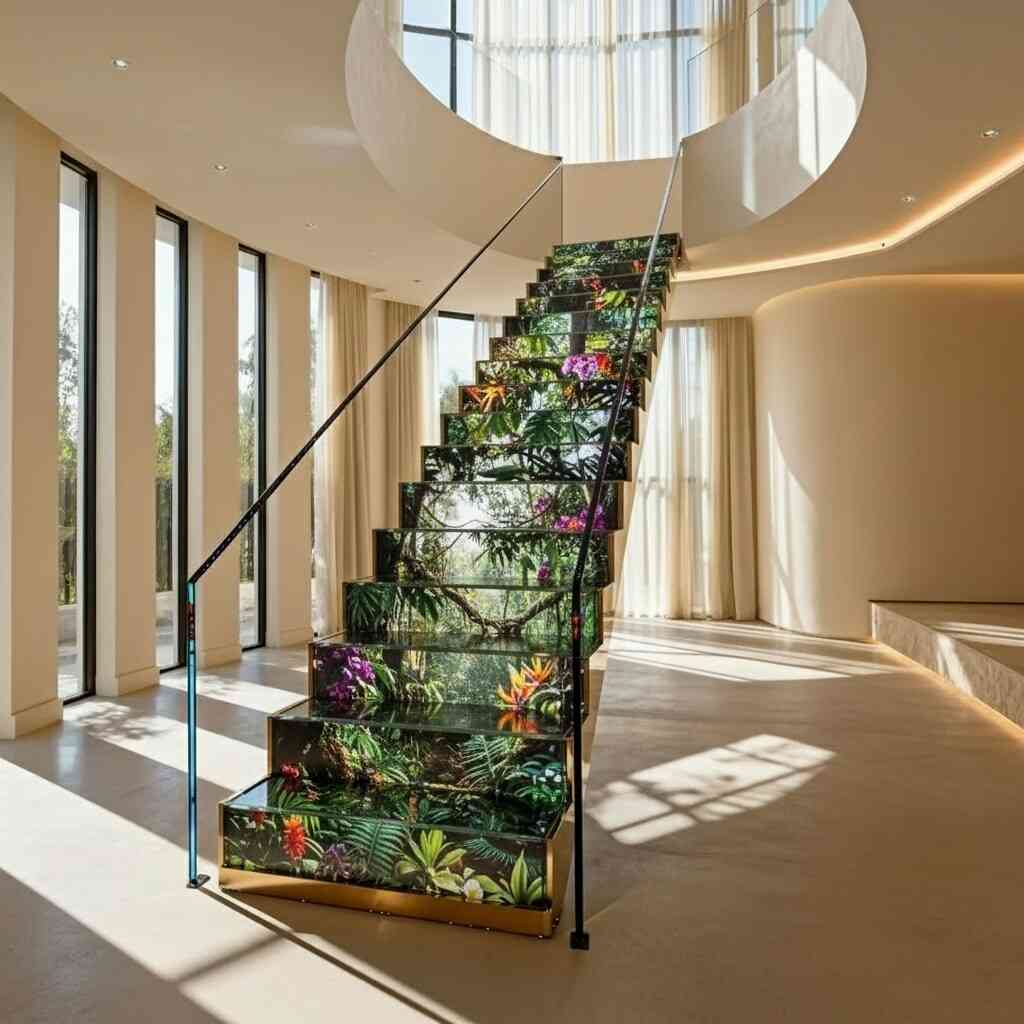
Consider, for instance, a staircase designed around the theme of hydrodynamics. As a user begins their ascent, a faint aquamarine current appears along the outer edge of the risers. If they pause, eddies form—swirling vortices that accumulate at the point of hesitation. If they quicken their pace, the current accelerates, forming turbulent whitecaps that crash against the next tread. Should two users ascend simultaneously, their individual flows merge, interfere, and—depending on relative speed—create standing wave patterns or laminar separation. Here, the OLED screens do not illustrate fluid dynamics; they embody them, translating physical interaction into visual physics.
Another example is the “Mnemosyne Stair” (Berlin, 2023), which responded to vocal input via directional microphones. Whispering near the balustrade triggered fragments of archived oral histories—projected not as subtitles, but as glyph-like particles that coalesced into abstract portraits before dissolving. Louder speech caused the glyphs to fracture, symbolizing the fragility of memory under distortion. The OLED panels’ high refresh rate and per-pixel control allowed for micro-expressions—flickers of recognition, hesitation, erasure—that would be impossible with slower, coarser display technologies.
Crucially, these scenes are not merely reactive; they are anticipatory. Machine learning models can infer intent from early behavioral cues. A hesitant first step might trigger a “guiding path” of soft light ahead; a confident stride may activate a more complex, layered visual motif further up. In this way, the staircase learns the user’s rhythm and tailors its response—not for personalization in a commercial sense, but for synchronicity. The user and the architecture enter a feedback loop: movement shapes light; light shapes movement.
This dynamic scene logic transforms the staircase from a spatial connector into a temporal instrument. Each passage becomes a unique performance—a duet between body and building. The repetition of daily use no longer breeds monotony; it reveals nuance. Over days, users may begin to notice subtle shifts: a change in palette correlating with seasonal light, or a new visual motif introduced after a city-wide event. The staircase becomes a chronicle—not of dates and facts, but of presence, pace, and participation.
Part III: The Phenomenology of Vertical Immersion
Beyond technical execution, the deeper significance of active scene staircases OLED screens lies in their capacity to reframe human phenomenology—the way we experience space through embodiment.
Phenomenologists such as Maurice Merleau-Ponty emphasized that perception is not passive reception, but an active, bodily engagement with the world. We do not see a staircase and then decide to climb it; we feel its invitation in our muscles, balance, and intentionality. Active scene staircases amplify this embodied cognition by closing the feedback loop between intention and sensation. When a tread lights up just before your foot lands—not after—you experience a strange prescience, as if the architecture anticipates your will. This subtle temporal inversion (effect preceding cause) generates a sensation of flow, where decision and action become indistinguishable.
Furthermore, vertical movement is inherently liminal. Stairs exist in thresholds—between floors, functions, states of mind. They are transitional spaces where attention often wanders, where routines calcify. By inserting dynamic visual narratives into this liminality, active scene staircases reclaim transitional time as experiential time. A 15-second climb becomes a meditative descent into a bioluminescent forest, or an ascent through strata of geological time. The user is not distracted from their purpose; they are deepened within it.
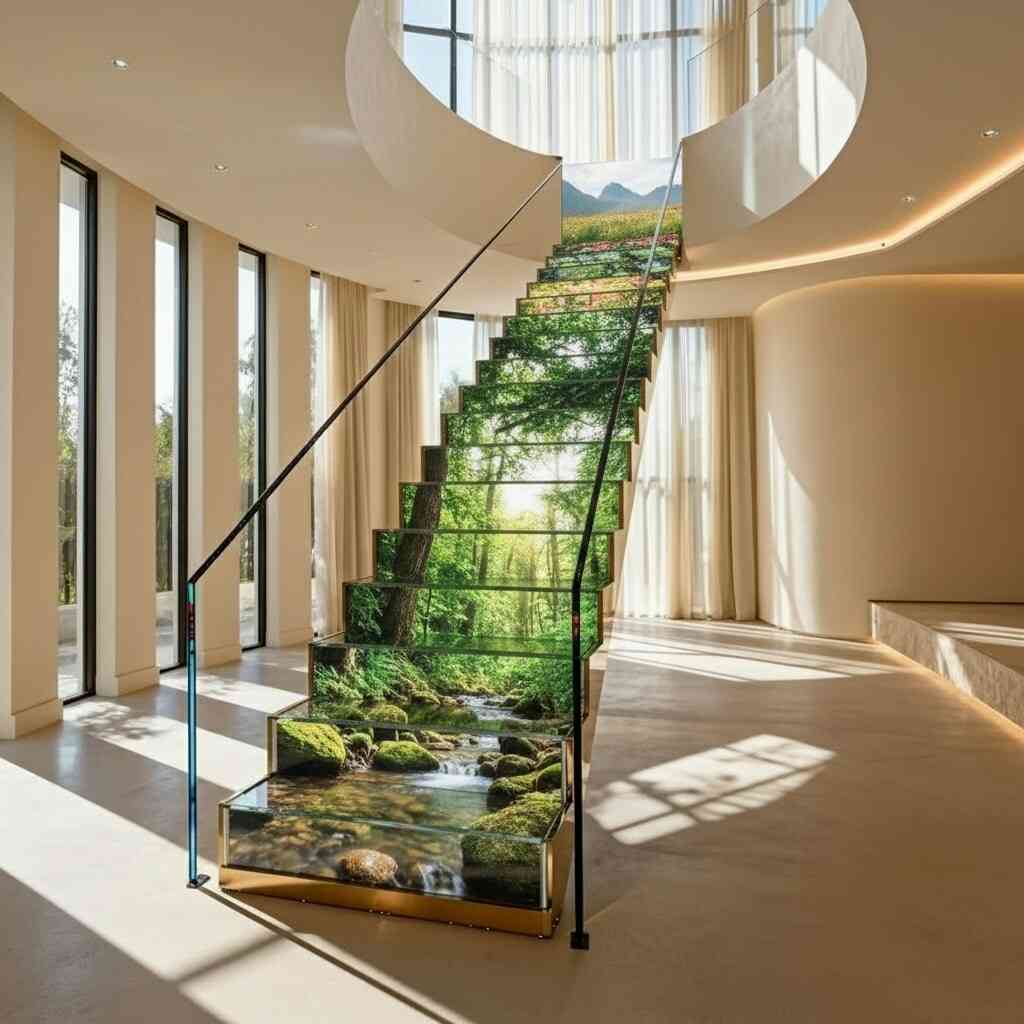
Importantly, immersion here is not about escapism—not about simulating a beach or a spaceship. It is about amplification. The OLED screens heighten awareness of the act itself: the lift of the knee, the transfer of weight, the rhythm of breath. In one installation, each step triggered a harmonic tone paired with a slow radial pulse of amber light; ascending at a natural gait produced a coherent chord progression, while rushing created dissonance—a gentle, non-intrusive prompt toward mindful movement.
This has profound implications for neuroaesthetics. Studies in environmental psychology suggest that dynamic, responsive environments can reduce cognitive load and increase spatial orientation—particularly in complex or unfamiliar buildings. An active staircase in a hospital, for instance, might use color gradients to guide patients toward departments without signage, leveraging intuitive color-motion associations (cool receding hues for waiting areas; warm advancing tones for consultation rooms). The OLED surface becomes a calm technology—present when needed, receding when not—its intelligence felt but never demanded.
Even in purely artistic contexts, the verticality of the staircase offers a unique canvas for narrative. Unlike horizontal interfaces (floors, walls), stairs impose a directional constraint: you move up or down, rarely sideways. This linearity lends itself to storytelling structures—mythological descents into underworlds, ascents toward enlightenment, cycles of decay and renewal. OLED’s ability to render deep blacks and subtle gradients allows for chiaroscuro storytelling: a single point of light in an abyssal riser, growing as you rise; or a fading ember that rekindles only when you pause and look back.
In this sense, the active scene staircase is not a gadget. It is a medium—one that merges architectural form, digital expression, and corporeal rhythm into a singular act of co-creation. The user does not consume content; they complete the work.
Conclusion: Staircases as Living Interfaces in the Post-Digital Epoch
We stand at a threshold—not just architecturally, but culturally. The era of “smart” environments, with its emphasis on automation and efficiency, is giving way to something more nuanced: sensitive environments. Spaces that don’t just respond, but resonate; that don’t optimize behavior, but enrich perception.
Active scene staircases OLED screens exemplify this shift. They reject the notion that technology must dominate or hide. Instead, they propose integration: OLEDs as skin, not screen; algorithms as choreographers, not controllers; stairs not as infrastructure, but as interlocutors.
The brilliance of this approach lies in its restraint. There is no explosion of light, no overwhelming spectacle. Immersion is achieved not through intensity, but through attunement—to pace, to pressure, to pause. It is quiet technology, speaking in whispers of light.
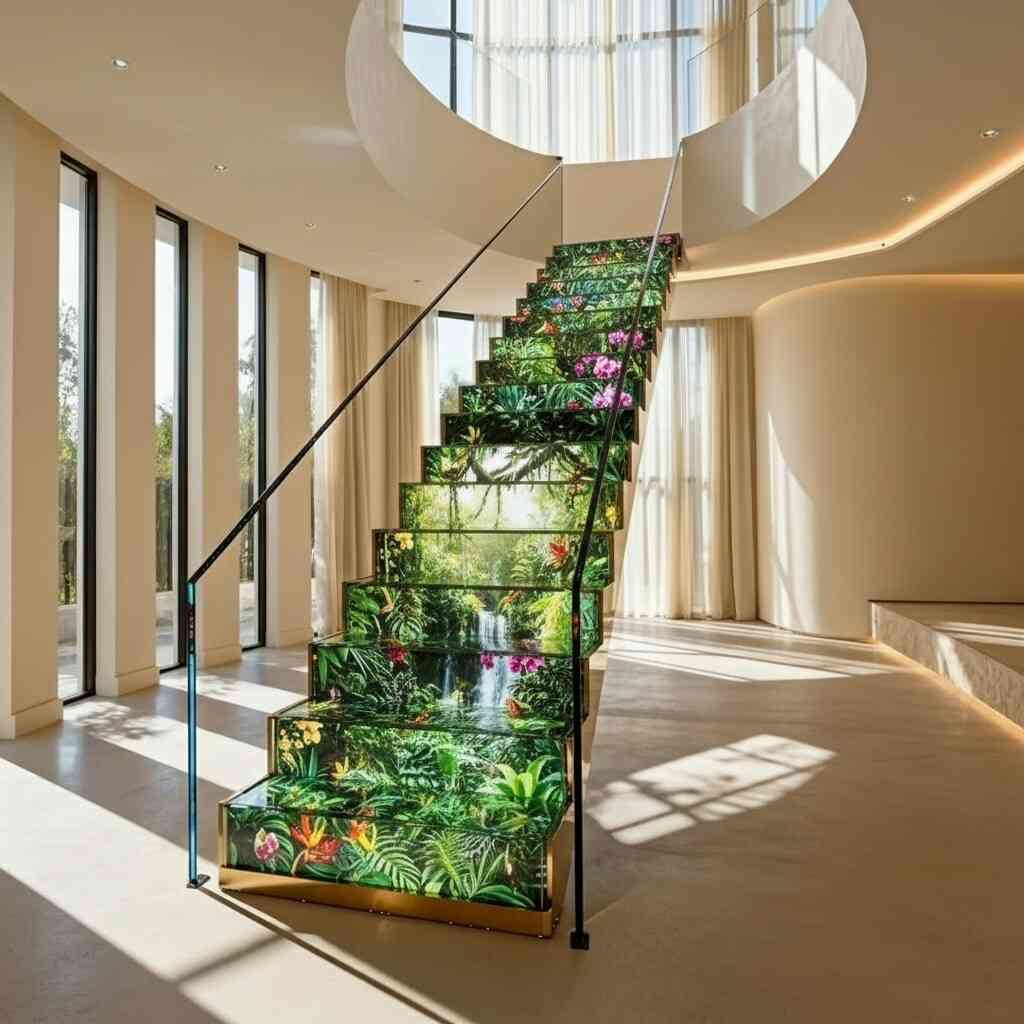
As we move toward increasingly hybrid realities—where physical and digital are no longer dichotomous but entangled—the active staircase offers a model for thoughtful synthesis. It reminds us that immersion is not about spectacle, but about synchrony; not about replacing reality, but about deepening our inhabitation of it.
In the end, the most profound experiences offered by these staircases are not visual, but existential: the sudden awareness, mid-step, that you are not merely moving through space—but being met by it. That the building is not inert. That architecture, too, can breathe.
And when your foot leaves the final tread, the light does not snap off. It lingers—fading slowly, like a memory—before the staircase returns to stillness, waiting for the next body, the next story, the next pulse of life to stir its luminous depths once more.