
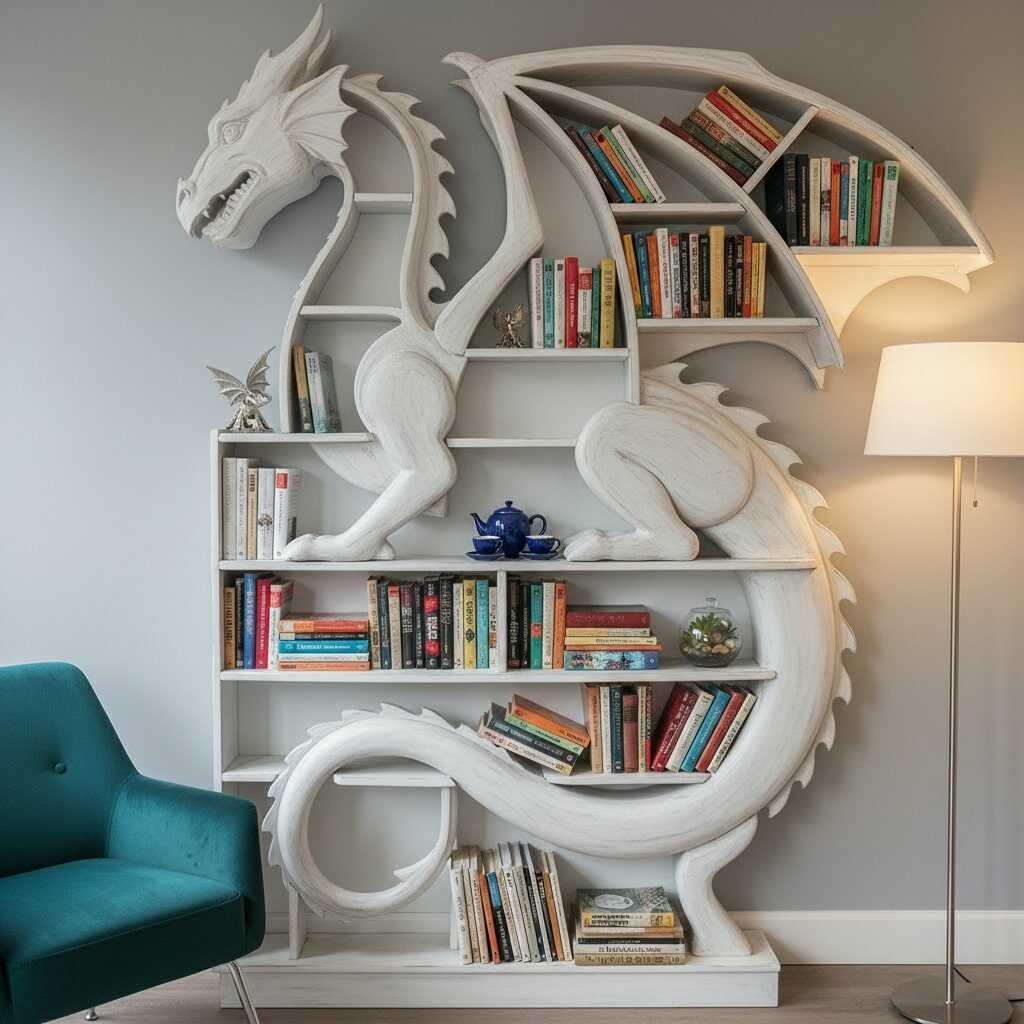
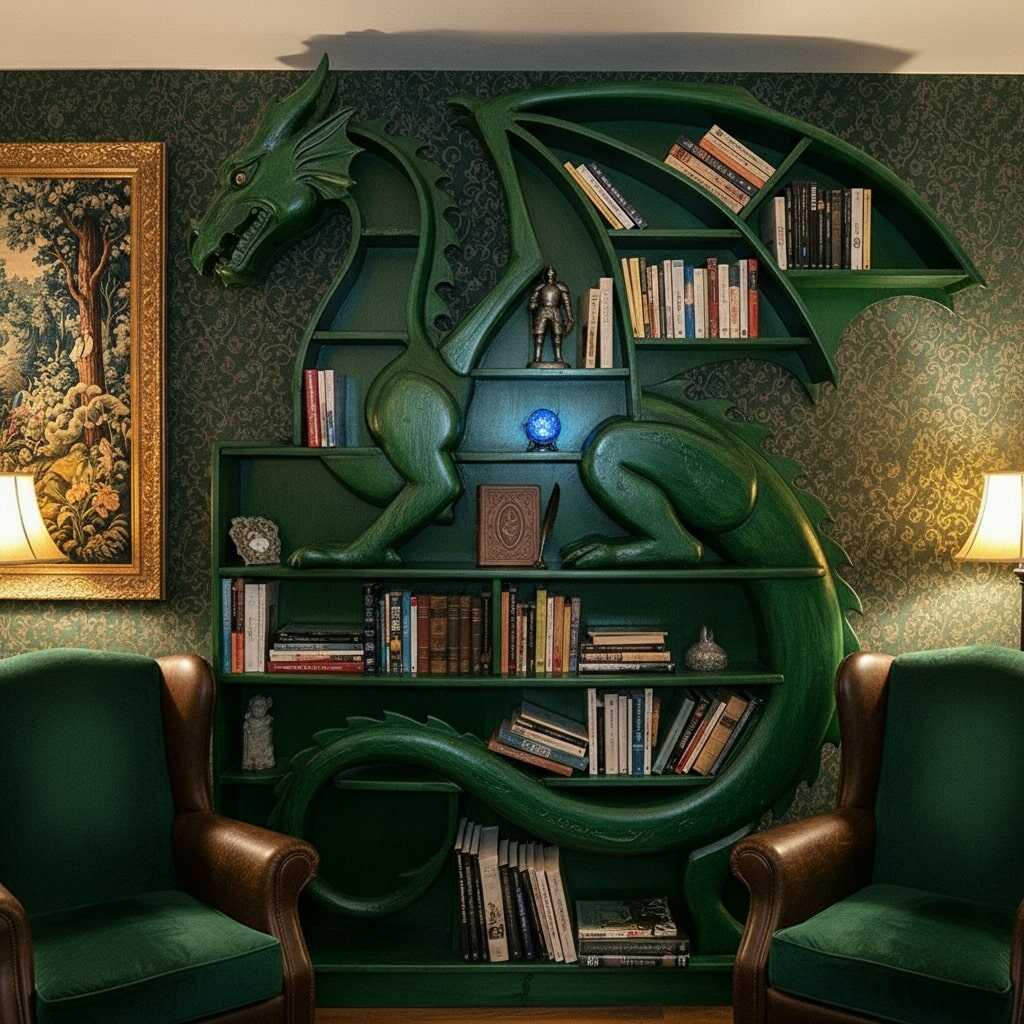
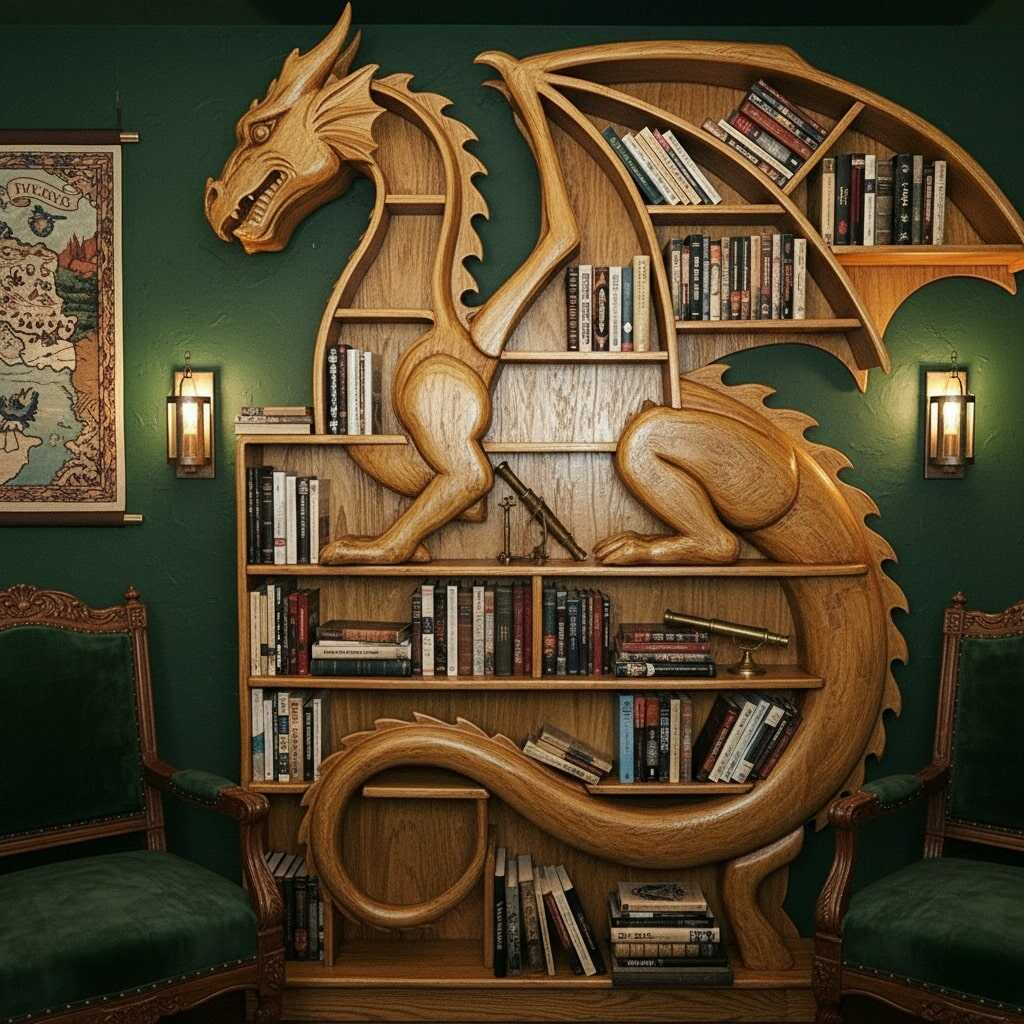
In the quiet sanctum of a personal library—sunlight filtering through tall windows, dust motes catching golden light like suspended stars—a Dragon Inspired Bookshelf stands not merely as furniture but as a sentinel of stories. Its sinuous spine curves along the wall, scales rendered in carved wood or cast metal catching the light; wings unfurl as broad shelves; claws cradle volumes with reverence; eyes—perhaps inlaid with obsidian or amber—gaze inward, as if guarding the collective wisdom of ages. This object is more than utilitarian. It is a threshold, a liminal artifact that bridges the tangible and the transcendent, the rational and the mythic.
The Dragon Inspired Bookshelf invites us to reconsider how we house knowledge—not as sterile containment, but as sacred invocation. Across cultures and epochs, the dragon has embodied paradox: destruction and creation, chaos and wisdom, terror and guardianship. To shape a bookshelf in its likeness is to acknowledge that imagination, like myth, is not ancillary to reason—it is its engine. In an era increasingly dominated by digital minimalism and functional austerity, such a piece resists reduction. It declares that the life of the mind is not silent, monochrome, or passive—but vibrant, ancient, and fiercely alive.
This article explores the Dragon Inspired Bookshelf not as décor or novelty, but as a profound convergence of art, psychology, and cultural symbolism. In three movements—The Dragon as Archetype, The Bookshelf as Ritual Space, and The Fusion: A Locus of Creative Becoming—we will journey into the deeper resonance of this extraordinary object: how it speaks to our longing for meaning, how it re-sacralizes the act of reading, and how, ultimately, it becomes an externalization of the inner world—where imagination, once unleashed, takes flight on leathery wings.
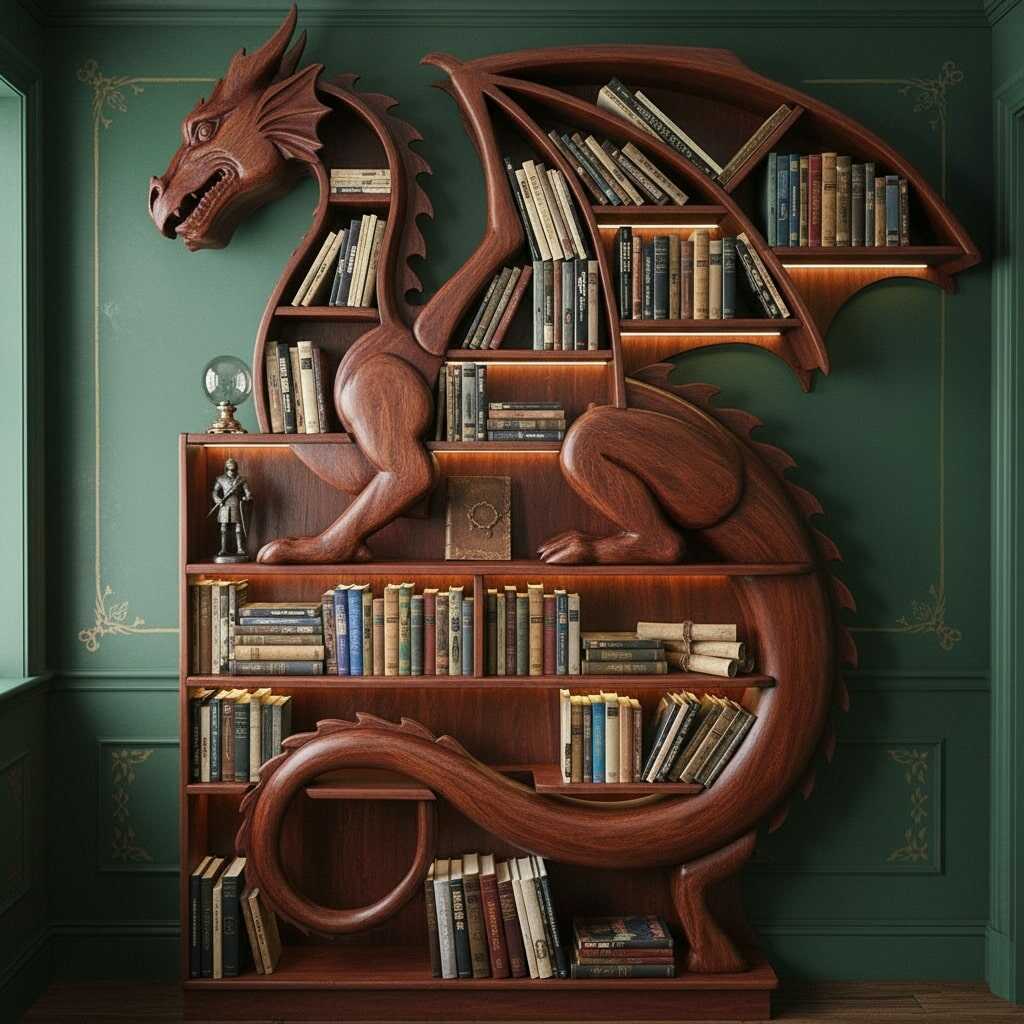
Part I: The Dragon as Archetype — Keeper of Thresholds and Keeper of Flame
Long before it appeared in fantasy novels or game lore, the dragon dwelled in the collective unconscious—not as monster, but as mythos. Carl Jung saw the dragon as a primordial symbol of the shadow self: the repressed, instinctual, untamed dimensions of human nature. Yet its symbolism is far richer, more multivalent.
In Eastern traditions—particularly Chinese, Japanese, and Korean cosmologies—the dragon is a celestial being, a bringer of rain, a symbol of imperial authority, wisdom, and cosmic harmony. Unlike its Western counterpart, it rarely hoards gold out of greed; rather, it coils around pearls of enlightenment, guarding sacred knowledge. Its serpentine form suggests continuity, cyclical time, and the unbroken flow of qi—the vital life force. To place books within such a creature’s embrace is to acknowledge that knowledge is not inert data, but living energy, circulating and transforming.
In Western myth, the dragon is often adversarial—St. George’s foe, the beast slain to liberate a kingdom. Yet even here, paradox abounds. The dragon guards treasure, and that treasure is rarely mere coin. In Norse legend, Fáfnir’s hoard includes the ring Andvaranaut, bound with fate and curse—but also with power. In Tolkien’s world, Smaug knows the names and lineages of those he observes, whispering riddles and truths beneath layers of arrogance. The Western dragon, then, is not simply evil, but sovereign. Its hoard is a repository of memory, lineage, and latent potential. To confront it is to engage the self’s deepest challenges: pride, fear, the reluctance to change.
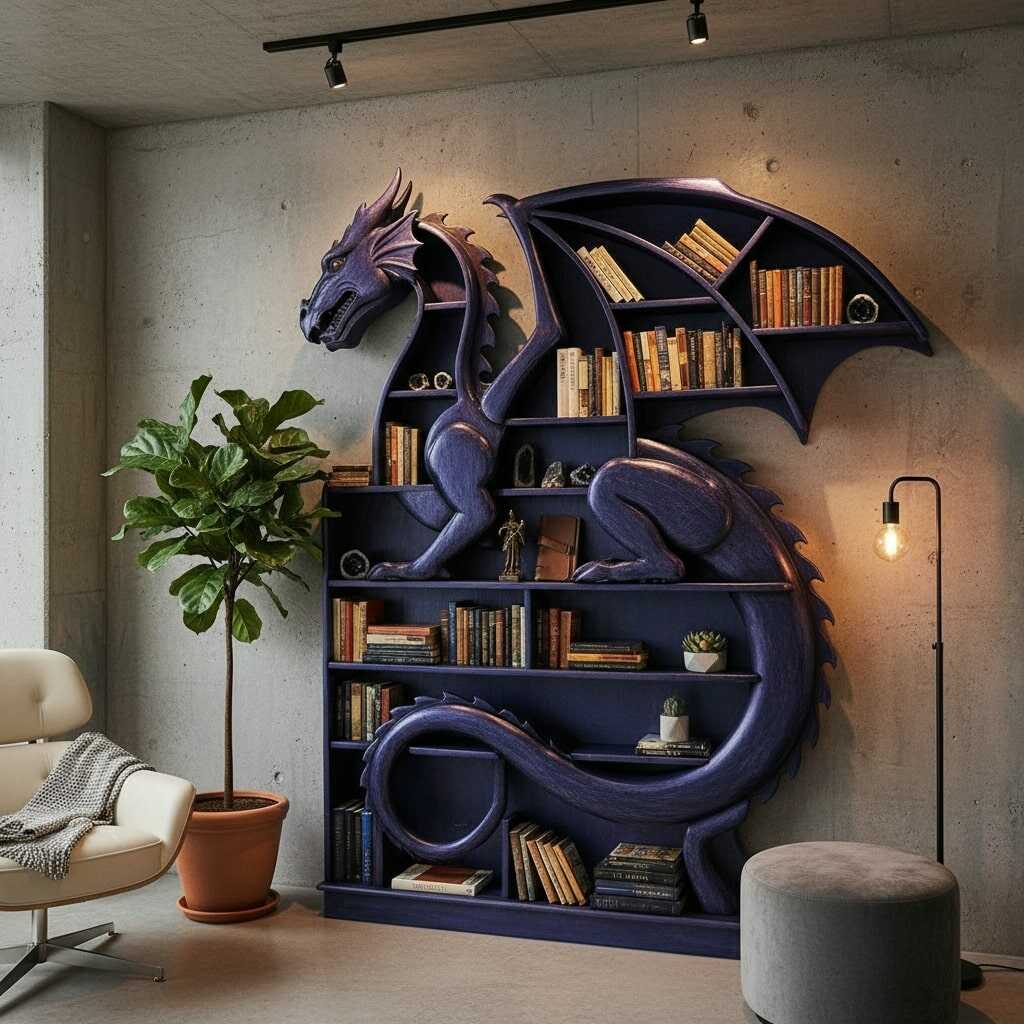
A Dragon Inspired Bookshelf thus inherits this dual heritage. Its form may evoke the sinuous elegance of an Eastern long, coiling vertically like a pillar of ascending wisdom—or the muscular, winged bulk of a European wyrm, crouched protectively over its domain. Either way, it does not store books—it watches over them. Each spine pressed against its scaled flank becomes part of its hoard: not gold, but ideas; not jewels, but narratives. The dragon here is not slain but invoked—a willing guardian, awakened by intention. In this, the shelf reclaims the dragon from monstrosity and restores it to its original role: psychopomp, guide between worlds; kouros, embodiment of transformative power.
Critically, the dragon is a creature of thresholds—caves, mountains, bridges between sea and sky. Likewise, the bookshelf occupies a threshold in domestic space: between public and private, utility and artistry. When designed with draconic intent, it becomes a liminal altar, marking the passage from the mundane into the realm of deep thought, reverie, and intellectual risk. To approach it is to cross a boundary—not unlike Theseus entering the Labyrinth, not to slay the Minotaur immediately, but to find one’s way through complexity toward self-knowledge.
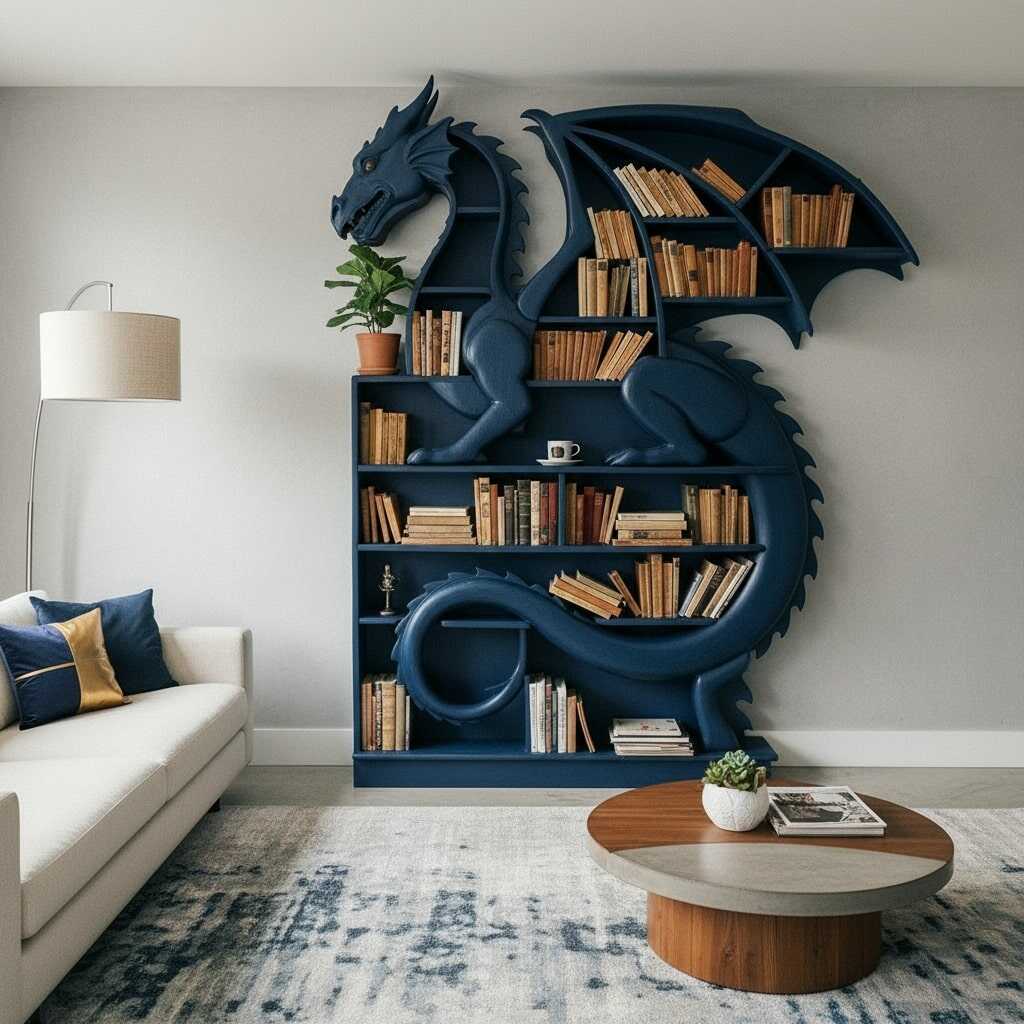
Part II: The Bookshelf as Ritual Space — Architecture of the Inner Sanctum
A bookshelf, at its core, is an architectural act. It imposes order on chaos—or, more precisely, it negotiates order and chaos. Books arrive haphazardly: gifts, impulse buys, library discards, inherited collections. They accrue like sedimentary layers of a life—childhood fairy tales beneath scholarly monographs, poetry nestled beside field guides. A Dragon Inspired Bookshelf, however, does not impose rigid taxonomy. Instead, it sanctifies accumulation.
Traditional shelving—clean lines, uniform cubbies, neutral finishes—often reflects Enlightenment ideals: classification, neutrality, objectivity. Knowledge, in this model, is de-personalized, democratized, interchangeable. There is virtue in this, certainly. But the Dragon Inspired Bookshelf speaks to a different epistemology—one older, more intimate, more animistic.
Consider the physicality of its design: the dragon’s ribcage may form arched compartments; its tail spirals upward, supporting staggered tiers; wings, outstretched, create asymmetrical bays where volumes lean at angles, suggesting spontaneity, organic growth. Some designs embed actual ritual elements: a hollow in the chest cavity for a single, sacred text (the Tao Te Ching, the Odyssey, a handwritten journal); small niches beneath clawed feet for talismans—quartz crystals, dried lavender, a child’s drawing. These are not decorative whims but intentional gestures, transforming storage into ceremony.
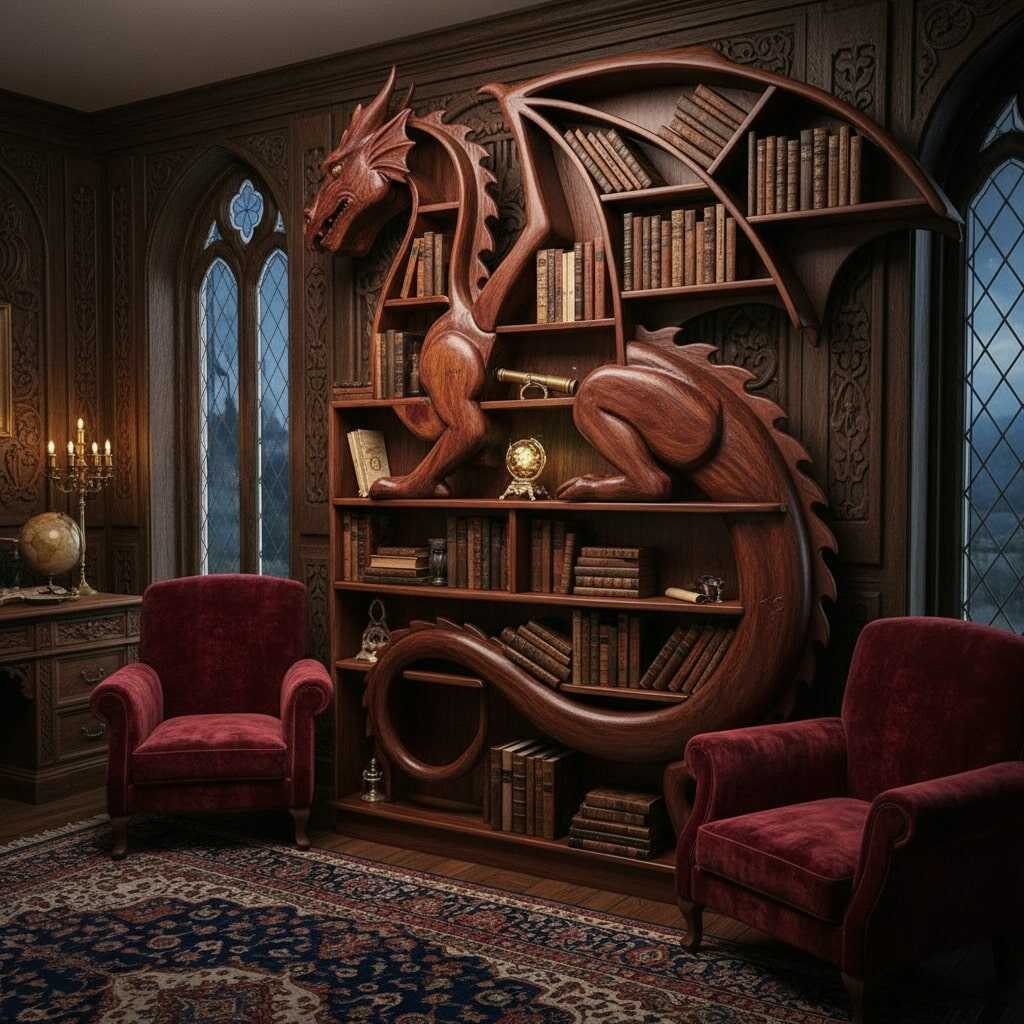
Reading, in this context, becomes a devotional act. One does not simply pull a book from a grid. One requests it—from the dragon’s hoard, from its vigilant care. There is a moment of pause, a tactile engagement: fingers brushing textured scale-work, the slight resistance as a volume is drawn from between wing and flank. This micro-ritual re-enacts ancient patterns: the initiate approaching the oracle, the scholar entering the scriptorium, the seeker kneeling before the fire-keeper. Time slows. Attention sharpens.
Moreover, the Dragon Inspired Bookshelf disrupts the passive consumption of information. Its presence demands participation. A visitor cannot ignore it; it occupies space with mythic weight. Children ask: Does it breathe? Does it dream? What stories does it protect? Adults, perhaps more quietly, feel stirred—recalling childhood tales, half-forgotten legends, the raw thrill of storytelling before irony calcified wonder. The shelf becomes a prompt, a catalyst.
Psychologically, this resonates with theories of environmental psychology and embodied cognition. We think not just with our brains, but with our surroundings. A sterile, anonymous room encourages transactional thinking. A space animated by symbolic resonance—like a dragon-formed library—invites associative, lateral, mythic cognition. It whispers: What if? Why not? Remember when…? In this way, the bookshelf functions as an external cognitive scaffold, expanding the mind’s capacity by giving tangible form to its deeper structures: memory as hoard, curiosity as flame, interpretation as flight.
Part III: The Fusion — A Locus of Creative Becoming
The true power of the Dragon Inspired Bookshelf emerges in the fusion of its dual elements: the dragon, archetype of transformation; the bookshelf, vessel of accumulated thought. Together, they create a topography of becoming—a map not of where knowledge resides, but of how it lives within us.
Consider the dragon’s most iconic attribute: fire. In myth, dragonfire consumes—but also purifies, forges, illuminates. It is the fire of the forge (where swords are tempered), the hearth (where stories are told), and the mind (where insight ignites). Books, likewise, are kindling. A single sentence may spark revolution; a poem, solace; a theory, a new world. The Dragon Inspired Bookshelf, then, is not a tomb for dead texts, but a dragon’s lair in which the flame is ever-ready.
Its form embodies dynamic tension: strength and grace, protection and threat, stillness and imminent motion. A well-crafted piece seems poised to stir—to uncoil, to lift its head, to speak. This latent animation mirrors the state of the reader’s mind: quiet on the surface, roiling with connections beneath. The shelf, in its stillness, holds space for that inner turbulence. It is a companion in solitude, a witness to midnight epiphanies and tear-stained pages.
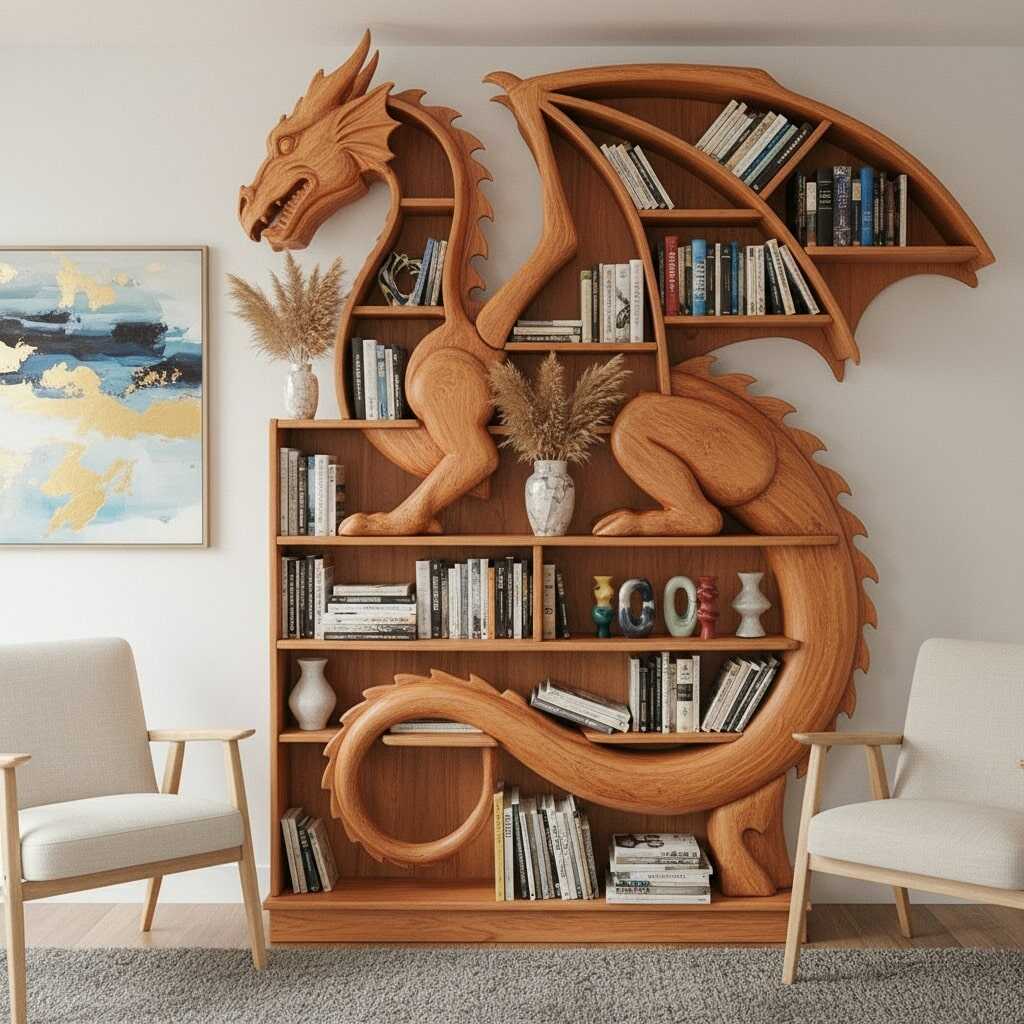
Artistically, such a bookshelf is a collaboration across time. The designer channels centuries of iconography—the coil of a Han dynasty bronze ding, the interlacing of Celtic knotwork in a Viking dragon-prow, the anatomical precision of Renaissance bestiaries. Woodworkers may use reclaimed timber, its grain echoing dragon-scale patterns; metalworkers forge wings with veins like gossamer filigree. Each craftsperson becomes, in their way, a bard, adding a verse to the dragon’s eternal song.
But the ultimate artist is the occupant—the person who fills its niches. No two Dragon Inspired Bookshelves are alike, for the hoard reflects the hoarder. One may hold volumes of astrophysics and ancient poetry, its dragon gazing toward the stars. Another cradles field guides and folktales, its claws rooted in earth and forest. A third overflows with comics and philosophy—modern myths beside ancient ones—the dragon grinning, tongue flicking, savoring the irony.
This personalization is essential. The dragon, in myth, is not generic. It has a name, a history, a temperament. So too does the bookshelf gain identity through use. Marginalia, cracked spines, bookmarks left like offerings—these are the scales that grow over time, unique to this creature, this keeper, this mind.
In a broader cultural sense, the Dragon Inspired Bookshelf is a quiet act of resistance. Against disposability, it asserts permanence. Against algorithmic curation, it champions idiosyncrasy. Against the fragmentation of attention, it invites slow, embodied engagement. It says: Some things must be held. Some stories must be guarded. Some fires must not go out.
To live with such a piece is to practice a kind of domestic sacredness—not dogma, but devotion. It is to say: Here, in this room, imagination matters. Here, wonder is not childish, but essential. Here, I do not merely consume culture—I converse with it, wrestle with it, let it change me.
Conclusion: The Dragon Awakens Within
A Dragon Inspired Bookshelf does not roar. It does not breathe fire (unless lit by candlelight flickering in its eyes). Its power is subtler, more enduring. It is the power of presence—the insistence that meaning can be made manifest in wood and metal and story.
We began with the title: Unleashing Imagination. Note the verb: unleashing. Not creating—imagination is innate, primal, already there, like the dragon curled in the cave of the unconscious. Our task is not to fabricate it, but to release it. To unchain it from utility, from fear, from the tyranny of the “practical.” The Dragon Inspired Bookshelf is a key—not a literal one, but a symbolic lever—that helps pry open the gates.
For the child, it is proof that magic is real—because look: here is a dragon, real, solid, holding their books. For the writer, it is a muse: a reminder that language, too, has scales and wings, that stories hoard power. For the elder, it is a mirror: the dragon, like them, has seen centuries pass; its hoard, like theirs, is a testament to a life read, lived, reflected upon.
Ultimately, the Dragon Inspired Bookshelf is an invitation—to wonder, to question, to dwell in ambiguity. It does not offer answers. It offers questions, coiled in its form: What do you treasure? What do you protect? What fire do you carry?
And perhaps, in the stillness of evening, when the last page is turned and the room darkens, one might swear the dragon shifts—just slightly—its wings settling, its eyes gleaming in the gloom. Not threatening. Not sleeping.