
In the evolving landscape of interior design, where innovation and aesthetics converge to shape human experience, the ground beneath our feet has long been an overlooked canvas. For decades, flooring served a largely functional role—durability, ease of maintenance, and cost-efficiency dominated decision-making, often at the expense of imagination. Yet in recent years, a quiet but profound shift has taken root: flooring is no longer merely a surface to walk upon. It has become a storyteller, a mood-setter, a spatial orchestrator. Among the many avant-garde solutions emerging in this renaissance, Epoxy Cloud Flooring stands out—not as a mere material choice, but as a transformative design philosophy.
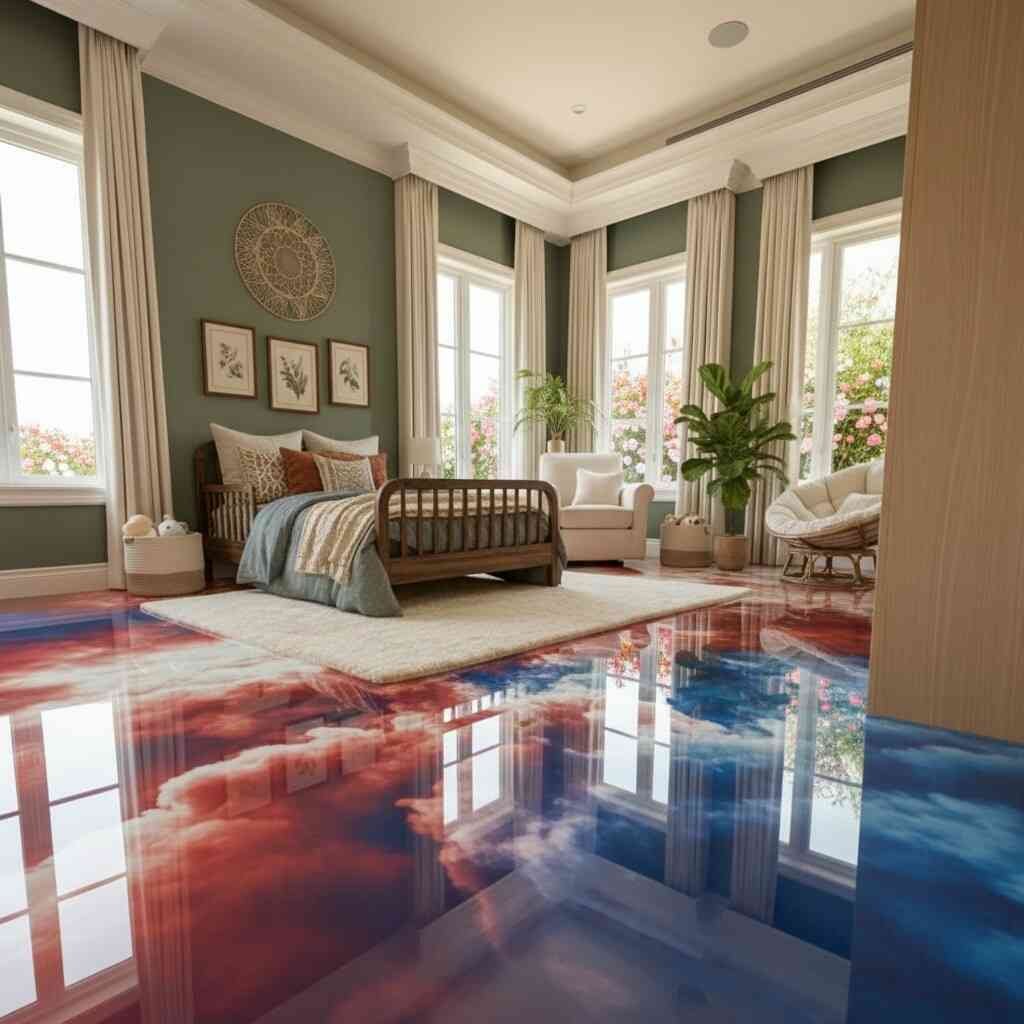
Epoxy Cloud Flooring is more than a technical term; it is a visual and experiential phenomenon. It refers to a bespoke application of high-performance epoxy resin systems, layered and manipulated to emulate the soft, drifting forms of cumulus clouds—ethereal, luminous, and endlessly variable. Unlike standard epoxy floors that prioritize uniformity and industrial resilience, Epoxy Cloud Flooring embraces organic irregularity, harnessing light, depth, and texture to dissolve boundaries between floor and atmosphere. The result is a surface that does not sit passively in a room but actively participates in its spatial narrative.
This article explores how Epoxy Cloud Flooring transcends its physical form to reshape the perception, emotion, and functionality of interior spaces. Through three core dimensions—perceptual expansion, emotional resonance, and spatial harmony—we will delve into the deeper implications of this design intervention. Far from being ornamental, Epoxy Cloud Flooring functions as a subtle yet powerful agent of transformation, redefining how we inhabit, interpret, and connect with the built environment.
Part I: Perceptual Expansion — Dissolving Architectural Boundaries
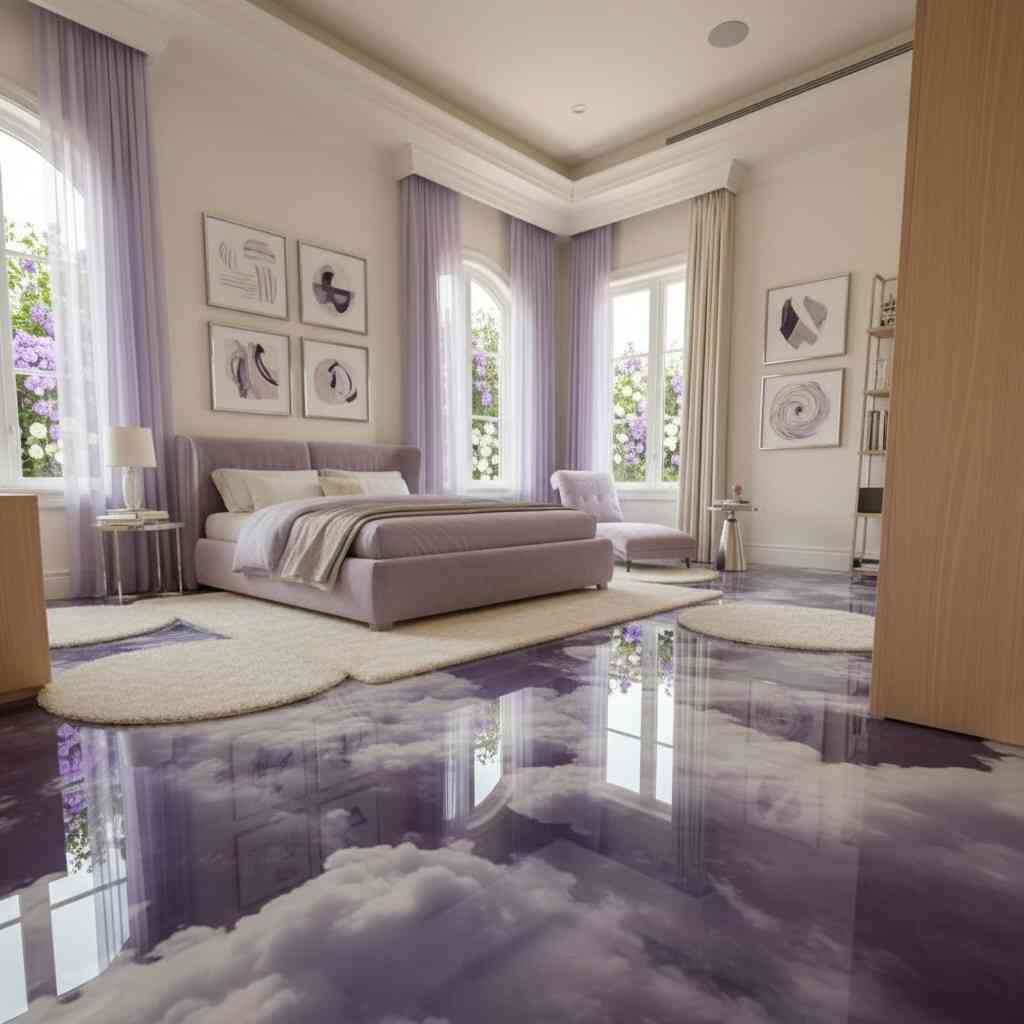
One of the most profound impacts of Epoxy Cloud Flooring lies in its ability to manipulate perception—specifically, how we experience scale, light, and spatial continuity. Traditional flooring materials, whether tile, wood, or plain epoxy, often reinforce the hard edges of a room. Joints, grout lines, and directional grain create visual segmentation, subtly reinforcing the box-like nature of interior architecture. In contrast, Epoxy Cloud Flooring operates as a visual solvent, softening those rigid delineations and expanding the psychological footprint of a space.
The key to this effect is in the depth illusion engineered into every installation. By layering translucent and semi-opaque epoxy pigments—often in gradients of ivory, pearl gray, soft blue, or even warm dawn hues—craftsmen simulate the volumetric light play of real clouds. Subsurface pigmentation, suspended metallic flakes, and strategic gloss variations create a dynamic interplay that shifts with ambient light and viewing angle. From one vantage point, the floor appears misty and shallow; from another, it deepens into an abyssal sky. This kinetic quality tricks the eye: ceilings feel higher, walls recede, and compact rooms gain a sense of airy openness.
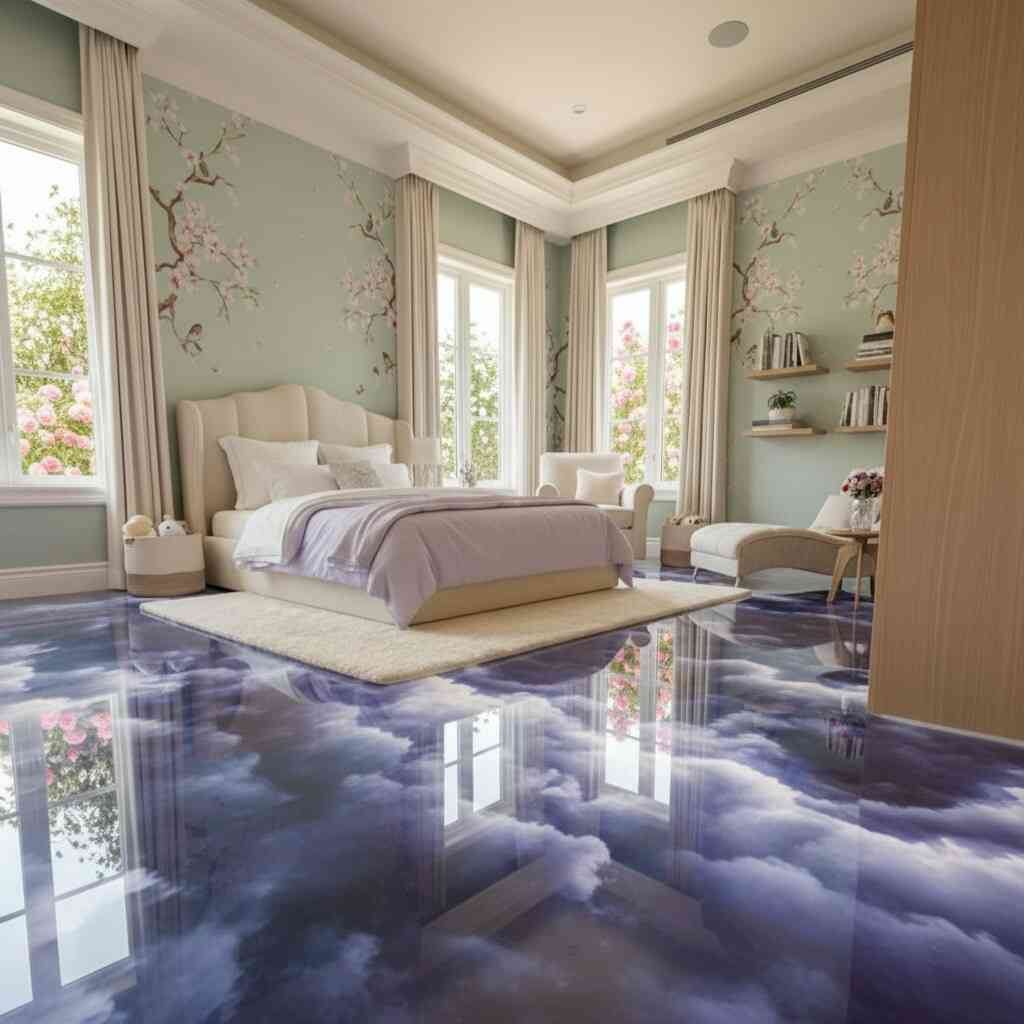
Consider a minimalist loft where structural beams and exposed ductwork might otherwise dominate. A floor grounded in concrete-gray industrial epoxy would amplify that raw, mechanical tone. But with Epoxy Cloud Flooring, the base plane becomes a counterpoint—a soft, luminous ‘sky’ that lifts the visual weight of the architecture. The floor no longer anchors the space downward; instead, it floats, inviting the gaze to travel upward and outward. In narrow corridors or basement-level rooms with limited natural light, this perceptual lift is especially potent. Mirrors and reflective surfaces amplify the effect, creating a seamless feedback loop of light and depth.
Moreover, Epoxy Cloud Flooring challenges the traditional hierarchy of architectural elements. In classical design, ceilings often bore decorative motifs—frescoes, cornices, medallions—while floors remained subordinate. Here, that hierarchy is inverted: the floor assumes the expressive role once reserved for overhead canvases. This inversion isn’t arbitrary; it reflects a contemporary sensibility that values groundedness and transcendence simultaneously. Walking upon a cloud—literally—becomes a metaphor for inhabiting a space that is both physically stable and imaginatively unbounded.
Importantly, this perceptual expansion is not illusory in a deceptive sense. It does not pretend to be something it is not (like faux-marble vinyl). Rather, it reveals latent possibilities within the material itself. Epoxy, when freed from prescriptive color charts and uniform finishes, proves remarkably malleable—capable of embodying atmosphere, not just surface. The cloud motif is not applied as a graphic decal; it emerges through process, timing, and painterly technique. Thus, the transformation is authentic, born from the material’s inherent properties, not imposed upon them.
Part II: Emotional Resonance — The Psychology of Atmosphere
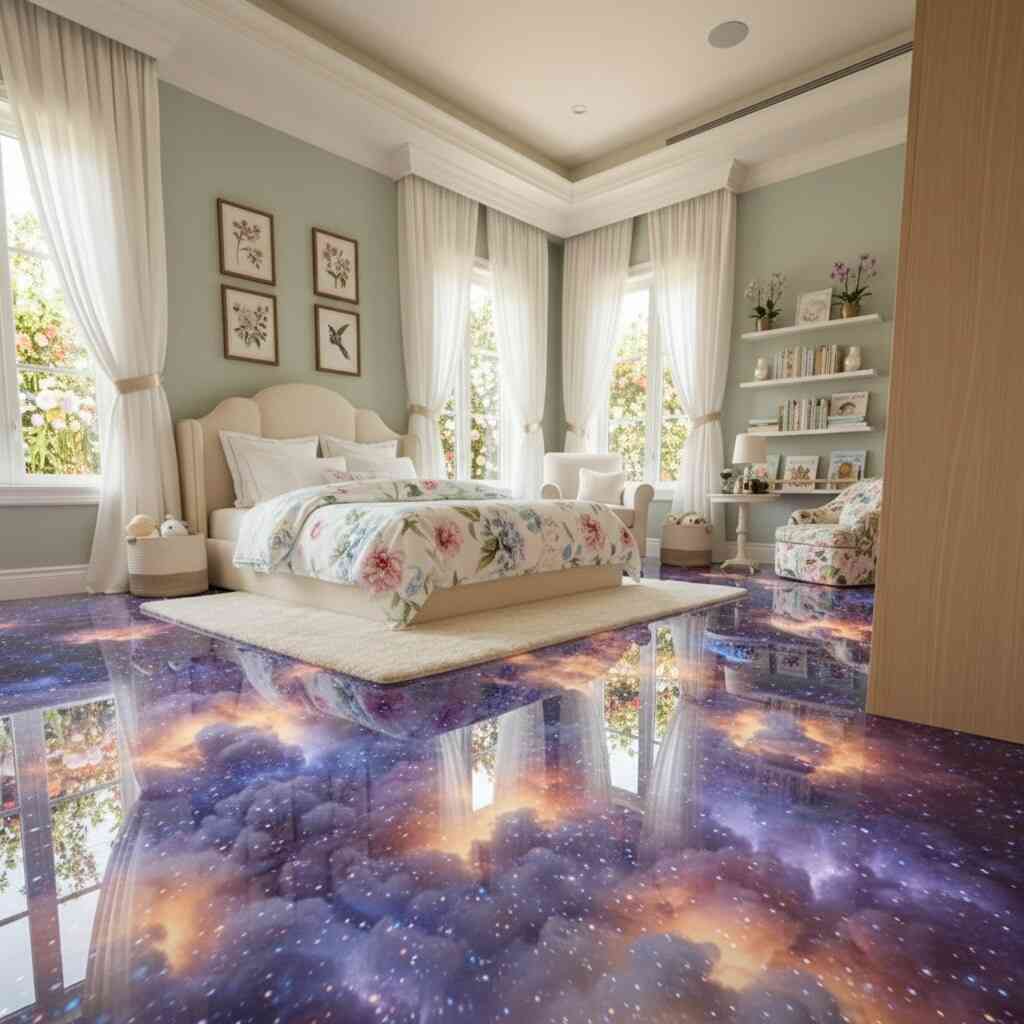
Beyond spatial manipulation, Epoxy Cloud Flooring exerts a subtle but significant influence on human emotion and well-being. Interior environments are not neutral containers; they are active participants in our psychological states. The textures, colors, and rhythms of surfaces affect mood, cognition, and even physiological responses—often below the threshold of conscious awareness. In this context, Epoxy Cloud Flooring operates as a form of environmental empathy, attuning spaces to the rhythms of human interiority.
Clouds, as natural phenomena, carry rich symbolic and emotional associations: serenity, impermanence, potential, and calm. They are transient yet reassuring—constantly changing, yet eternally present in the sky. To bring that motif indoors, underfoot, is to embed those qualities into the architecture itself. A healthcare clinic with Epoxy Cloud Flooring in its waiting areas may see reduced patient anxiety—not because the floor distracts, but because it anchors. Gazing down, one encounters soft gradients rather than sterile linoleum grids—a visual cue that encourages slowing down, breathing, and soft focus. Studies in environmental psychology support this: non-repetitive, low-contrast, organic patterns reduce cognitive load and promote parasympathetic activation.
In creative workspaces—studios, design agencies, innovation labs—the effect is equally meaningful. Rigid geometries can unconsciously reinforce linear thinking. Epoxy Cloud Flooring, with its fluid forms and absence of hard edges, fosters a liminal aesthetic: a space between definition and ambiguity. This liminality is fertile ground for ideation. When the boundary between floor and ‘sky’ blurs, so too does the boundary between known and unknown—creating a physical analogue for open-ended exploration.
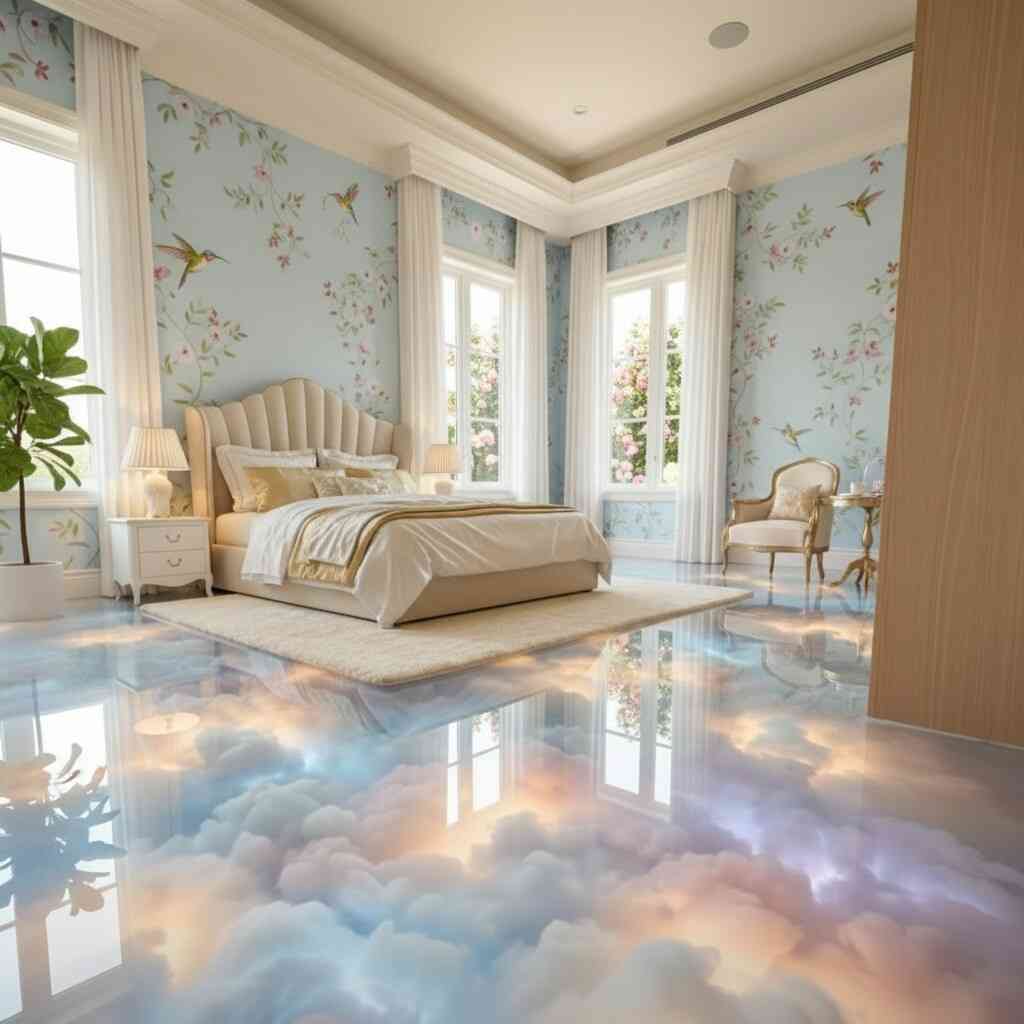
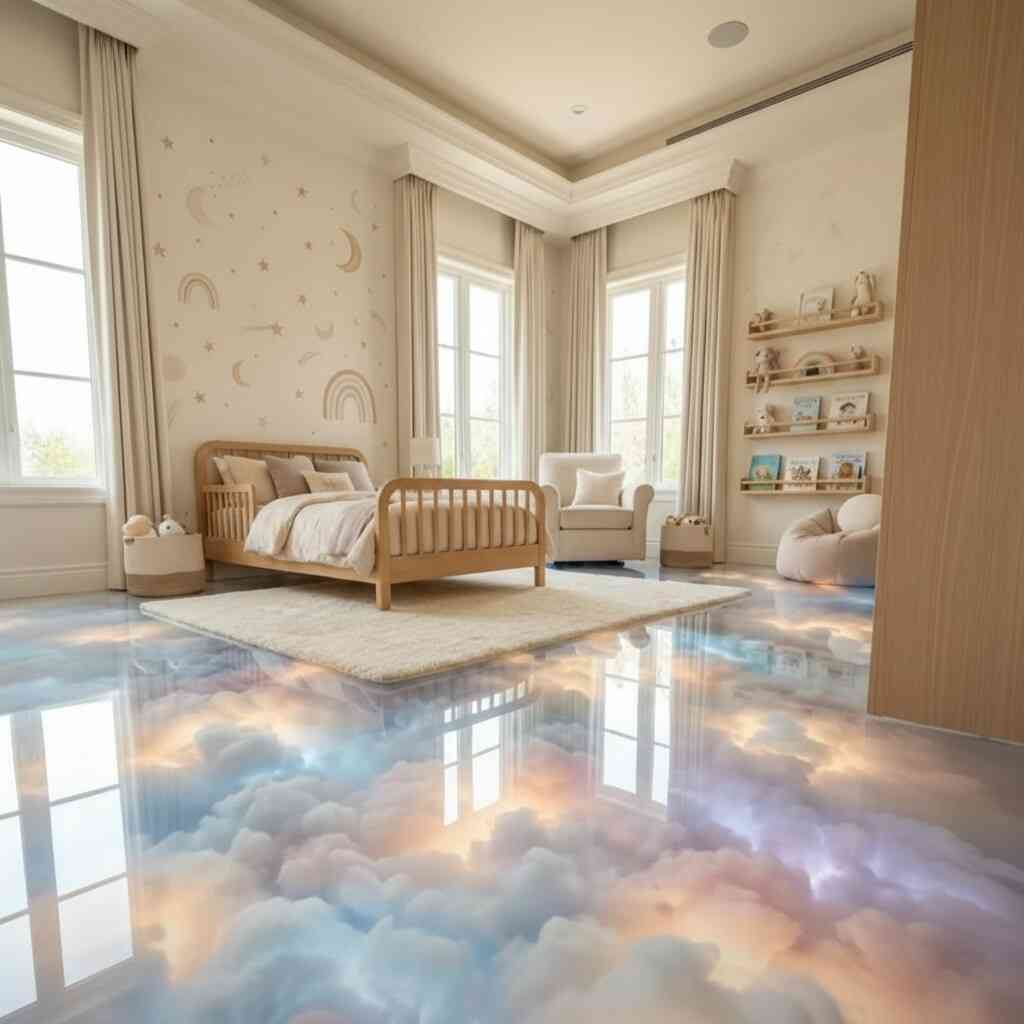
Even in domestic settings, the emotional resonance is palpable. A child’s playroom with Epoxy Cloud Flooring becomes a landscape of gentle wonder—a place where imagination can drift freely, unanchored by harsh lines or busy patterns. In a bedroom, where rest and restoration are paramount, the floor can extend the sensation of lying beneath open sky, enhancing the transition from wakefulness to sleep. The lack of visual ‘noise’—no grout, no knots, no seams—supports mental decluttering. It is not silence, but stillness rendered in material form.
What distinguishes Epoxy Cloud Flooring from other ‘calming’ surfaces is its tactile paradox. While visually soft and airy, the surface remains hard, seamless, and resilient—thermally conductive for radiant heating, impervious to moisture, and acoustically dampening. This duality is powerful: the mind perceives safety and weightlessness simultaneously. It echoes the human need for both security and freedom—a balance rarely achieved in built environments.
Furthermore, the bespoke nature of each installation ensures emotional authenticity. No two Epoxy Cloud Floors are identical. The flow of pigments, the density of ‘vapor’, the interplay of light—these are guided by the artisan’s hand in response to the room’s orientation, purpose, and energy. A north-facing meditation room might inspire cooler, denser cloud layers; a sun-drenched atrium, lighter, more diaphanous veils. This responsiveness makes the floor not just a feature, but a collaborator in emotional attunement.
Part III: Spatial Harmony — Integrating Ground, Object, and Occupant
The final transformative dimension of Epoxy Cloud Flooring lies in its capacity to unify disparate elements within a space—furniture, lighting, artwork, and human movement—into a coherent sensory whole. In traditional interiors, floors often act as neutral backdrops, deliberately receding to highlight furnishings or architectural details. Epoxy Cloud Flooring rejects this passive role. Instead, it functions as an integrative field, a continuous visual and tactile continuum that harmonizes otherwise fragmented components.
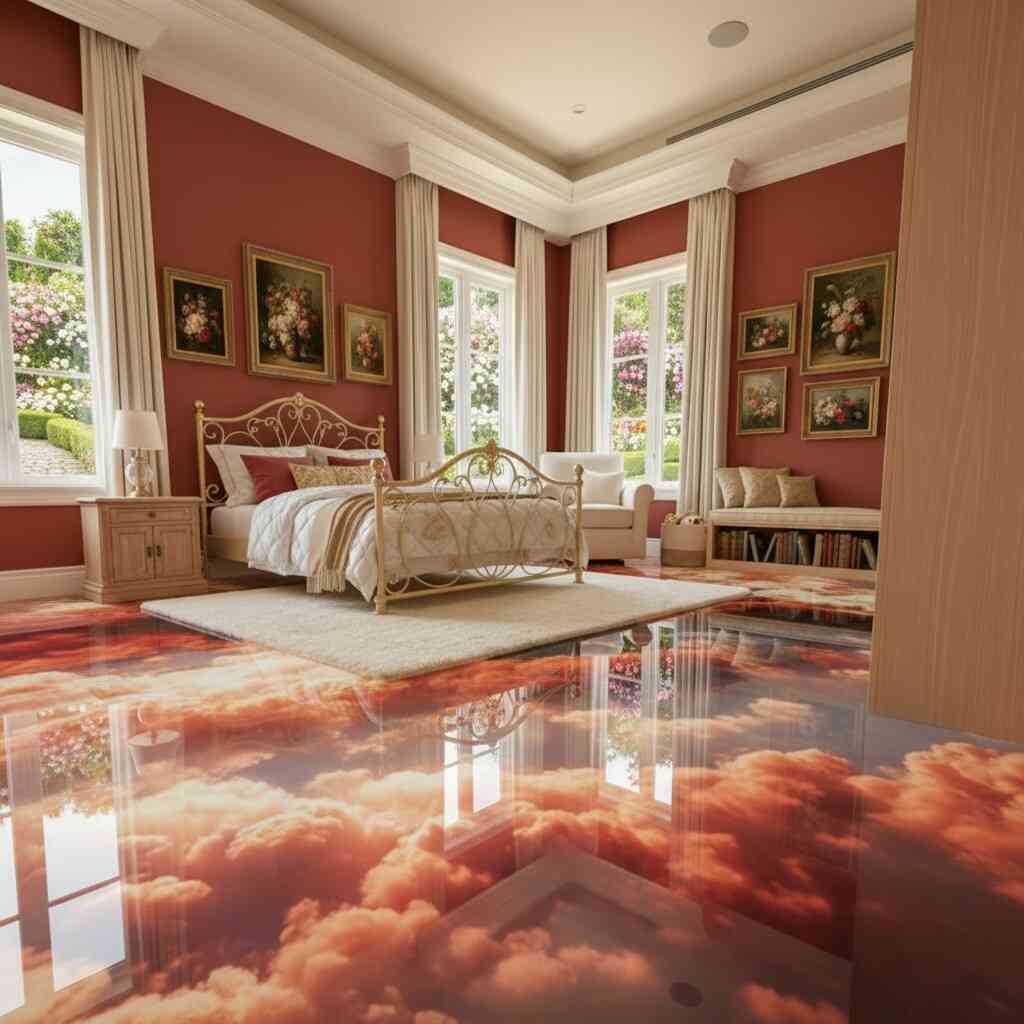
This integration begins with color theory and tonal continuity. Because Epoxy Cloud Flooring is custom-mixed on-site, it can be calibrated to resonate with existing palettes—not by matching them directly, but by echoing their undertones or complementing their temperature. A room with warm oak cabinetry and linen upholstery might receive flooring with creamy, sunlit cloud layers infused with the faintest amber iridescence. The floor does not ‘match’ the wood; it converses with it, creating a tonal dialogue that eliminates visual dissonance.
Lighting design is another critical partner. Recessed LEDs, cove lighting, or pendant fixtures cast reflections and shadows that animate the epoxy surface, turning the floor into a living projection screen. As light shifts through the day, so does the cloud pattern—morning light may reveal delicate silver veining, while evening warmth deepens the base into a dusky haze. This temporal responsiveness ensures that the space never feels static. Occupants become co-authors of the environment, their movements and habits influencing how the floor ‘performs’.
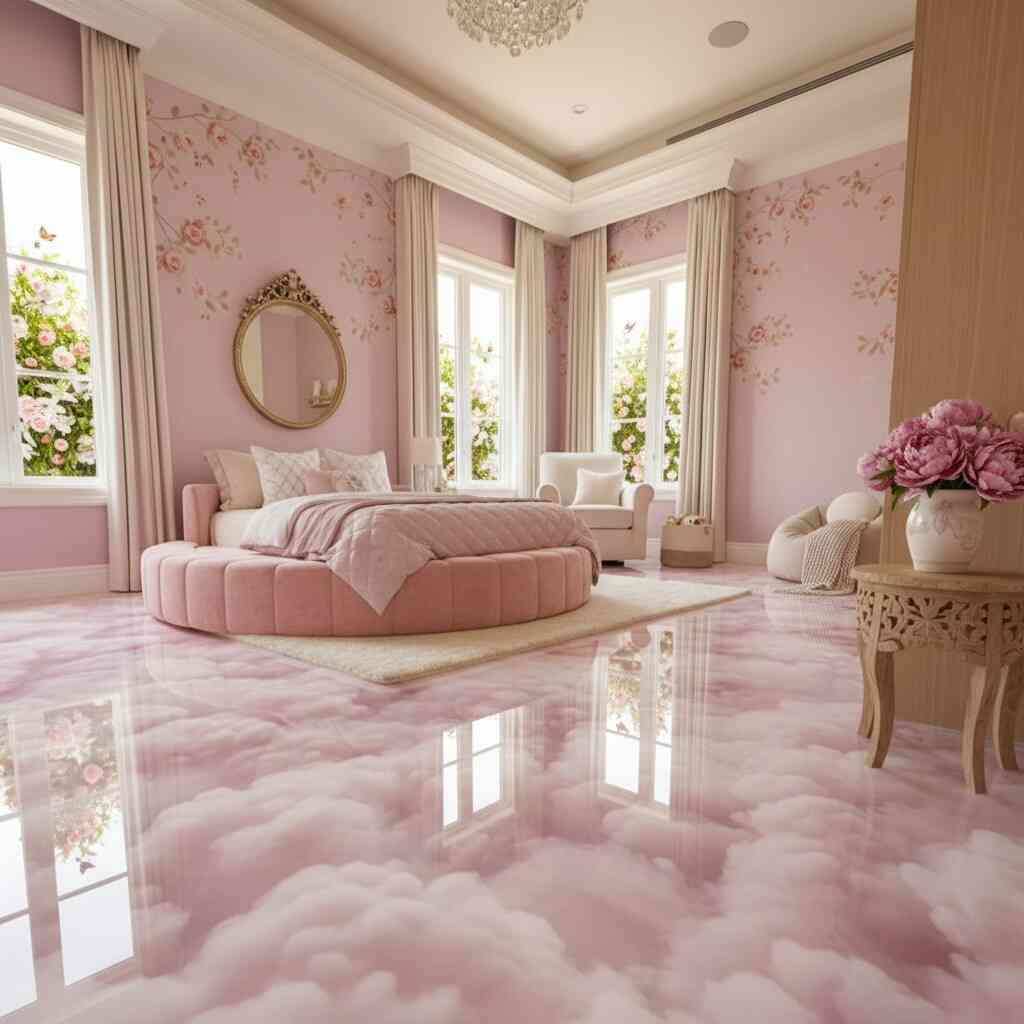
Furniture placement, too, is reimagined. Without grout lines or directional patterns to dictate orientation, pieces can be arranged more intuitively—grouped for conversation, dispersed for solitude, or floated freely as sculptural elements. The absence of hard visual boundaries encourages fluid circulation, supporting both social interaction and personal retreat. In open-plan homes or adaptive workspaces, this flexibility is invaluable.
Perhaps most significantly, Epoxy Cloud Flooring fosters a profound reconnection between occupant and environment. In an age of digital saturation and sensory fragmentation, walking across a surface that evokes natural phenomena—sky, light, atmosphere—reorients us toward embodied presence. The floor is no longer ‘underfoot’ in a dismissive sense; it is with us, a companion in daily life. Its seamless nature eliminates tripping hazards and cleaning seams, but more poetically, it removes the micro-fractures that separate us from our surroundings. We do not walk on the space—we move within it, as part of a continuous field.
This holistic integration extends to sustainability as well—not in a technical checklist sense, but in a philosophical one. Epoxy Cloud Flooring, when formulated with low-VOC, bio-based resins and installed over existing substrates (like concrete slabs), minimizes waste and demolition. Its longevity—decades without replacement—embodies a commitment to continuity over consumption. In this way, it harmonizes not only with interior elements but with broader ecological rhythms: slow, cyclical, respectful.
Conclusion: The Floor as Horizon
To speak of Epoxy Cloud Flooring as a design trend is to misunderstand its significance. It is not a style to be adopted and discarded, but a paradigm shift in how we conceive of foundational surfaces. It asks us to reconsider the floor not as the bottom of a hierarchy, but as the beginning of an experience—a threshold between earth and atmosphere, matter and imagination.
In transforming interior spaces, Epoxy Cloud Flooring does not impose a new aesthetic so much as it reveals hidden potentials: the capacity of floors to elevate, to soothe, to unify. It demonstrates that even the most utilitarian elements of architecture can become conduits for wonder—provided we approach them with curiosity, craftsmanship, and reverence for the intangible.
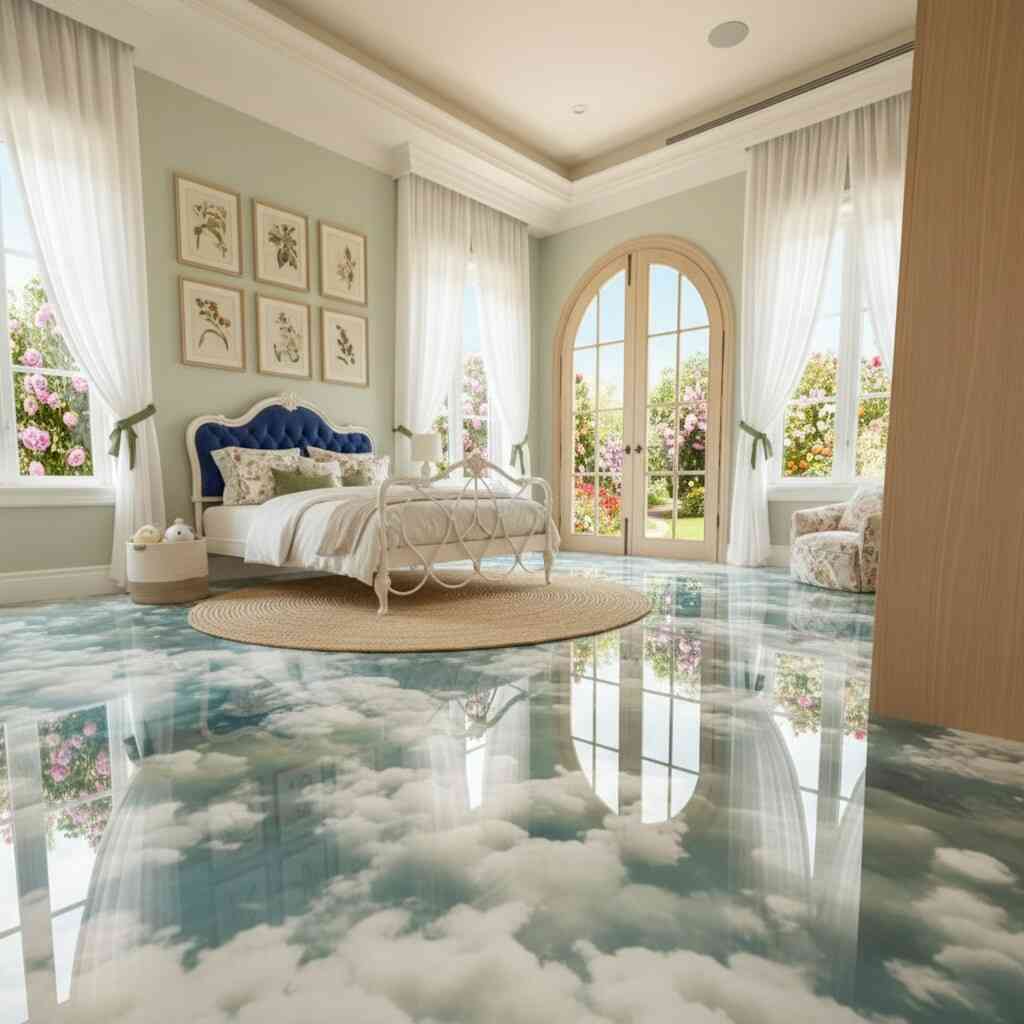
The cloud, after all, is both real and symbolic: a collection of water droplets, yes, but also a vessel for dreams, a marker of change, a reminder of vastness. To walk upon such a motif is to carry that awareness into daily life—to begin each step with a subtle uplift, a quiet expansion of possibility.
In a world increasingly defined by division—between indoors and out, digital and physical, self and environment—Epoxy Cloud Flooring offers a different proposition: continuity. It is the horizon brought down to human scale, not as a limit, but as an invitation. And in that invitation lies its true transformative power—not in what it covers, but in what it uncovers: the poetry of space, waiting, just beneath our feet.