
Architecture is more than the assembly of walls, floors, and roofs—it is an orchestration of space, light, and human experience. At its most profound, architecture invites movement: not just physical passage from one point to another, but a psychological and emotional journey. Within this choreography of built form, the staircase assumes a role far beyond utility. It is a vertical artery, a sculptural centerpiece, a threshold between realms of function and imagination.
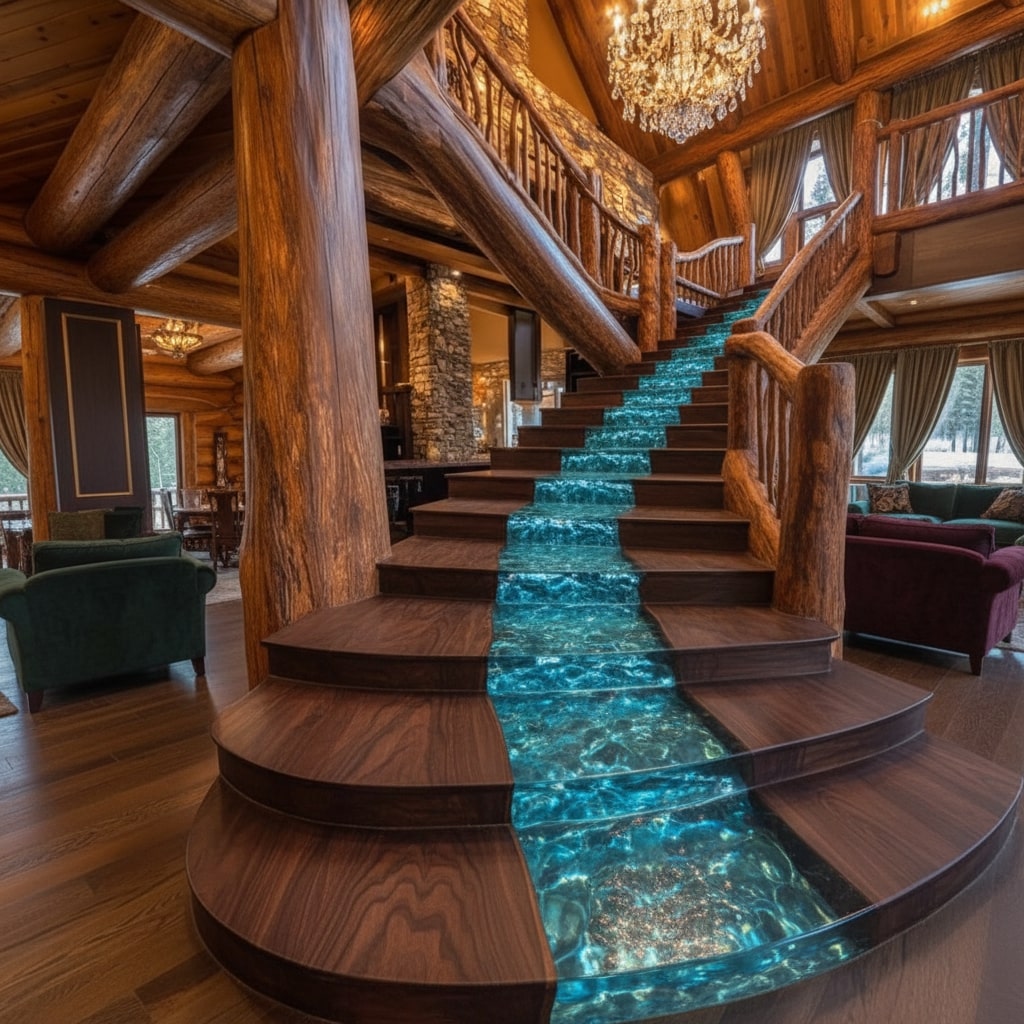
Enter the epoxy river staircase—a design phenomenon that, in the past decade, has redefined how we conceptualize and experience transitional space. Unlike conventional staircases, which often recede into the background as functional necessities, an epoxy river staircase commands presence. It does so by merging the geological poetry of natural riverbeds with the precision of modern material science. The result is neither purely organic nor wholly industrial, but a hybrid artifact that speaks to our deep-seated longing for continuity—between inside and outside, between craft and technology, between stillness and motion.
This article explores how the epoxy river staircase transforms architectural flow and aesthetic appeal—not as a decorative novelty, but as a deeply intentional intervention in spatial narrative. Through three interlinked explorations—material resonance, spatial choreography, and perceptual depth—we delve into the philosophical and experiential dimensions of this design form, revealing why it resonates so powerfully in contemporary architectural discourse.
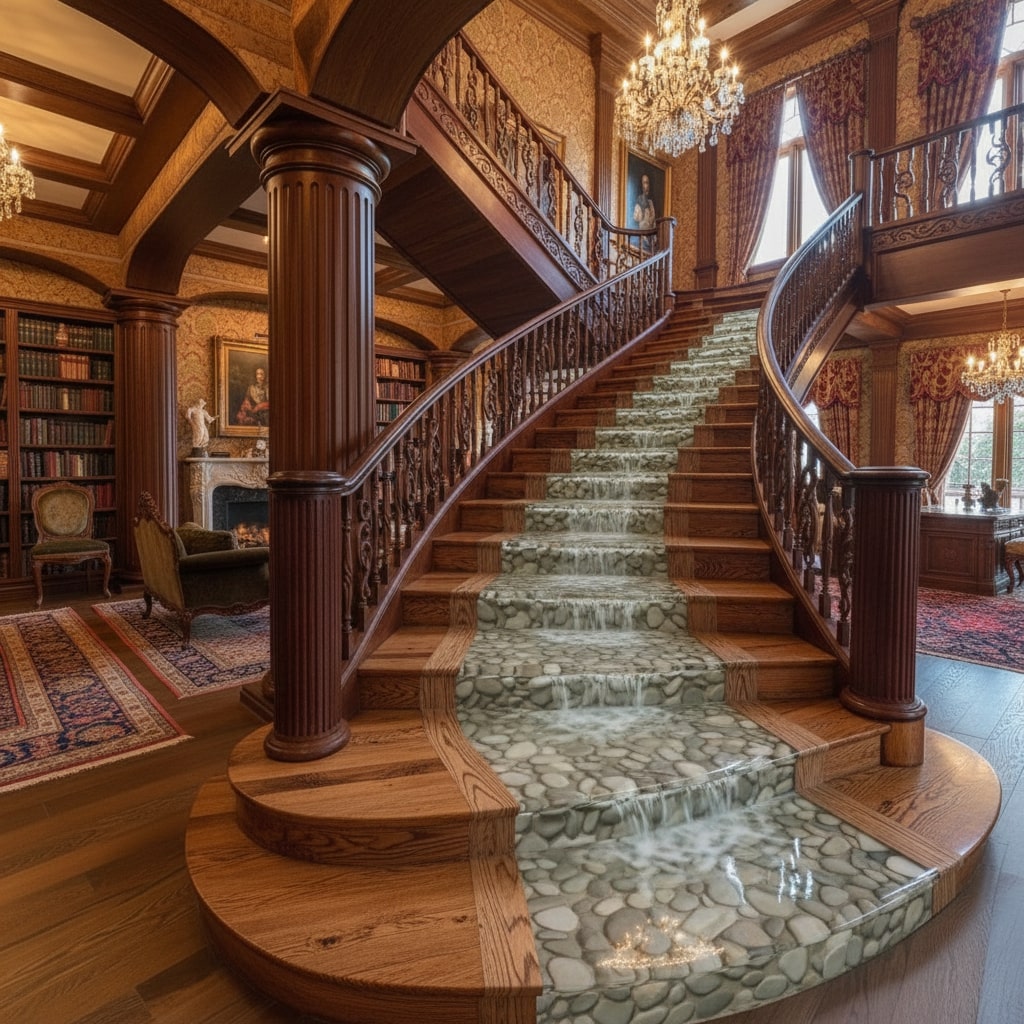
Part I: Material Resonance — Where Geology Meets Modern Craft
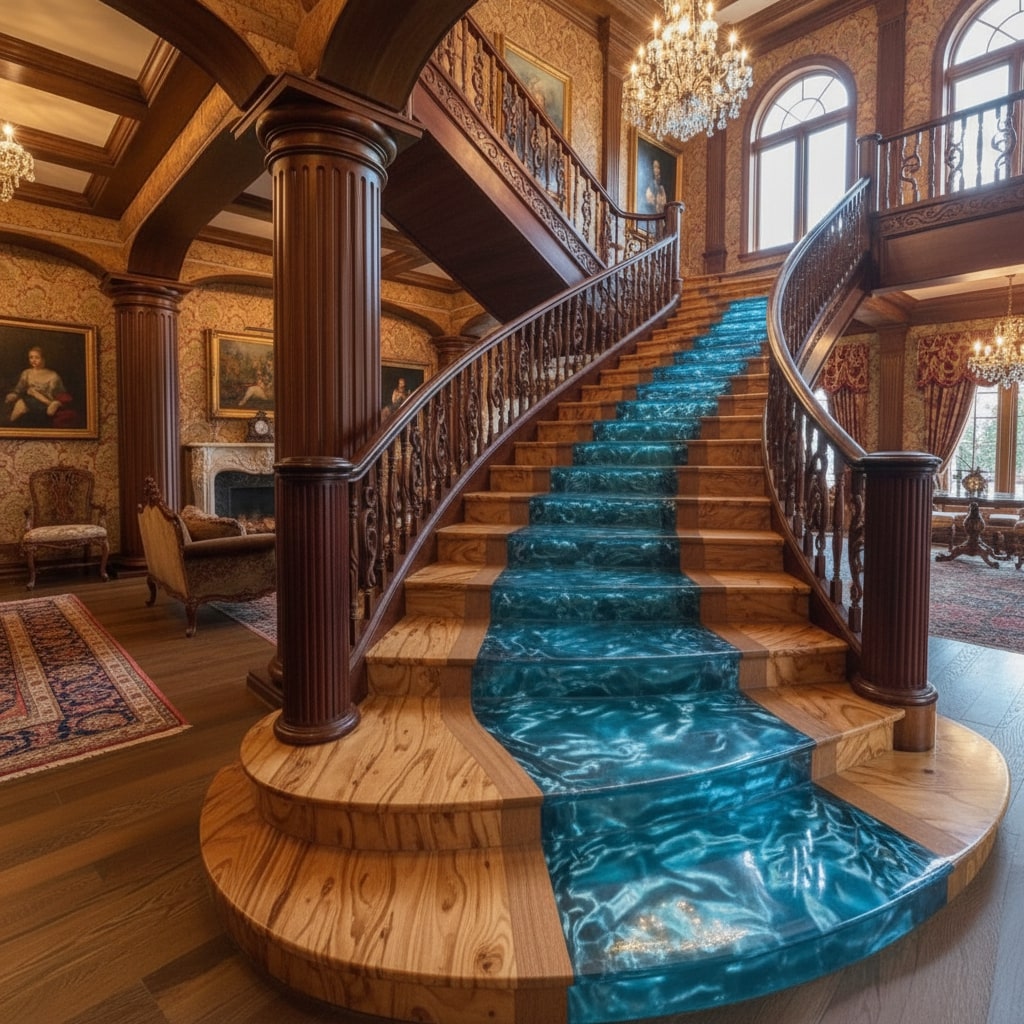
At the heart of the epoxy river staircase lies a paradox: it is artificial, yet it evokes the ancient. Its defining feature—the river-like channel of translucent or pigmented epoxy resin—mimics the meandering flow of a natural watercourse, frozen in time. This is no superficial mimicry. The craftsmanship involved in its creation demands a nuanced understanding of both geology and chemistry. The “river” is not poured arbitrarily; it is shaped with intention, guided by the contours of flanking wood slabs (often reclaimed hardwoods like walnut, oak, or maple), whose grain patterns echo sedimentary strata or eroded canyon walls.
The epoxy itself is a modern marvel: a two-part thermosetting polymer that, when cured, achieves optical clarity, structural integrity, and UV stability. Artisans manipulate its viscosity and curing time to embed pigments, metallic powders, or even bioluminescent particles—creating effects that range from the serene translucence of glacial meltwater to the iridescent shimmer of oil on a rain-slicked street. Some designers suspend botanical fragments—dried ferns, moss, or petals—within the matrix, evoking paleontological inclusions, as though the staircase preserves moments of ecological memory.
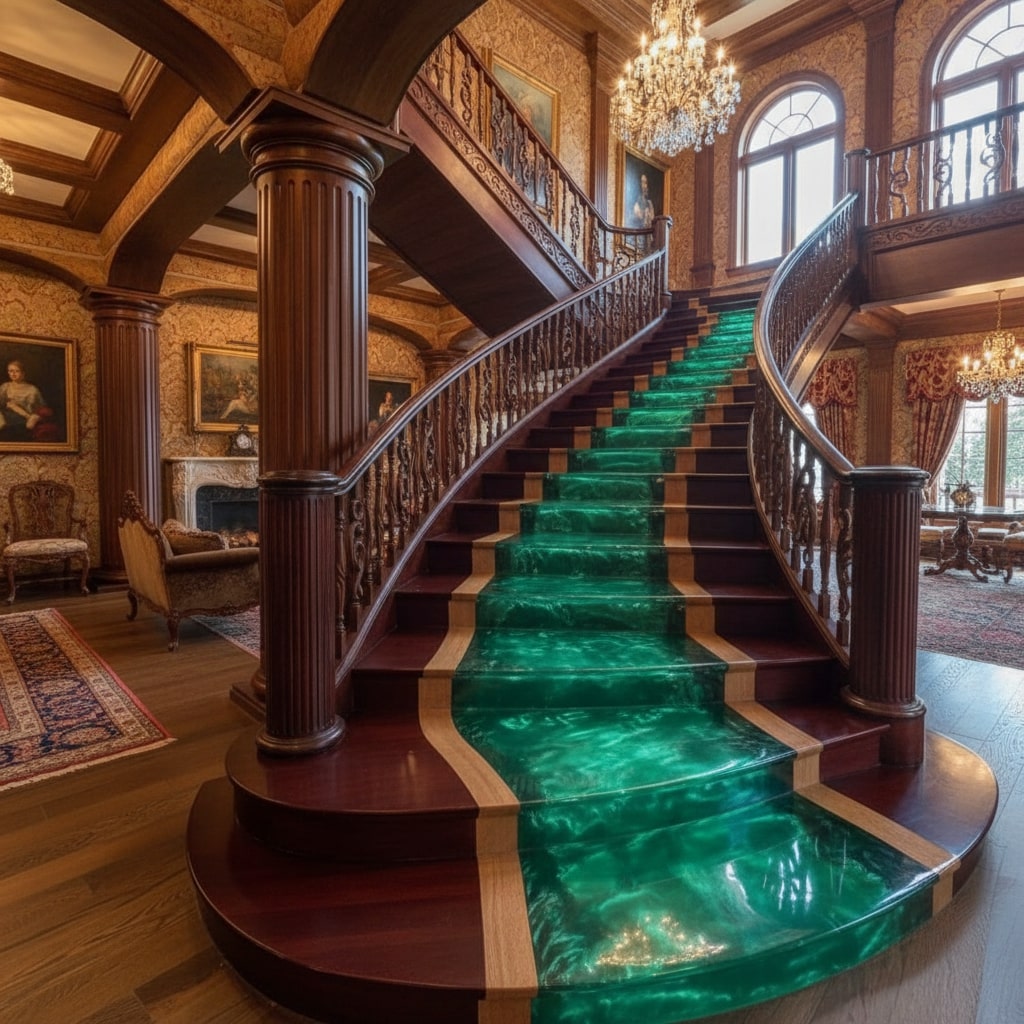
This material synergy does more than please the eye; it establishes resonance. The warmth and tactility of wood ground the composition in tradition and organic time, while the epoxy introduces a sense of futurity—fluid, luminous, mutable. Together, they suggest a continuum: that architecture need not choose between the ancestral and the avant-garde. Instead, the epoxy river staircase articulates a third path—one in which memory is not discarded in the name of progress, but reinterpreted through new means.
Critically, this resonance extends to sustainability. The use of salvaged timber and low-VOC resins aligns the epoxy river staircase with a growing ethos of regenerative design—not by overtly proclaiming eco-virtue, but by embodying cyclical thinking. The “river” does not consume; it circulates. It is not extractive; it integrates. In this way, the material language of the staircase becomes a quiet manifesto: architecture can be both beautiful and responsible, not despite its complexity, but because of it.
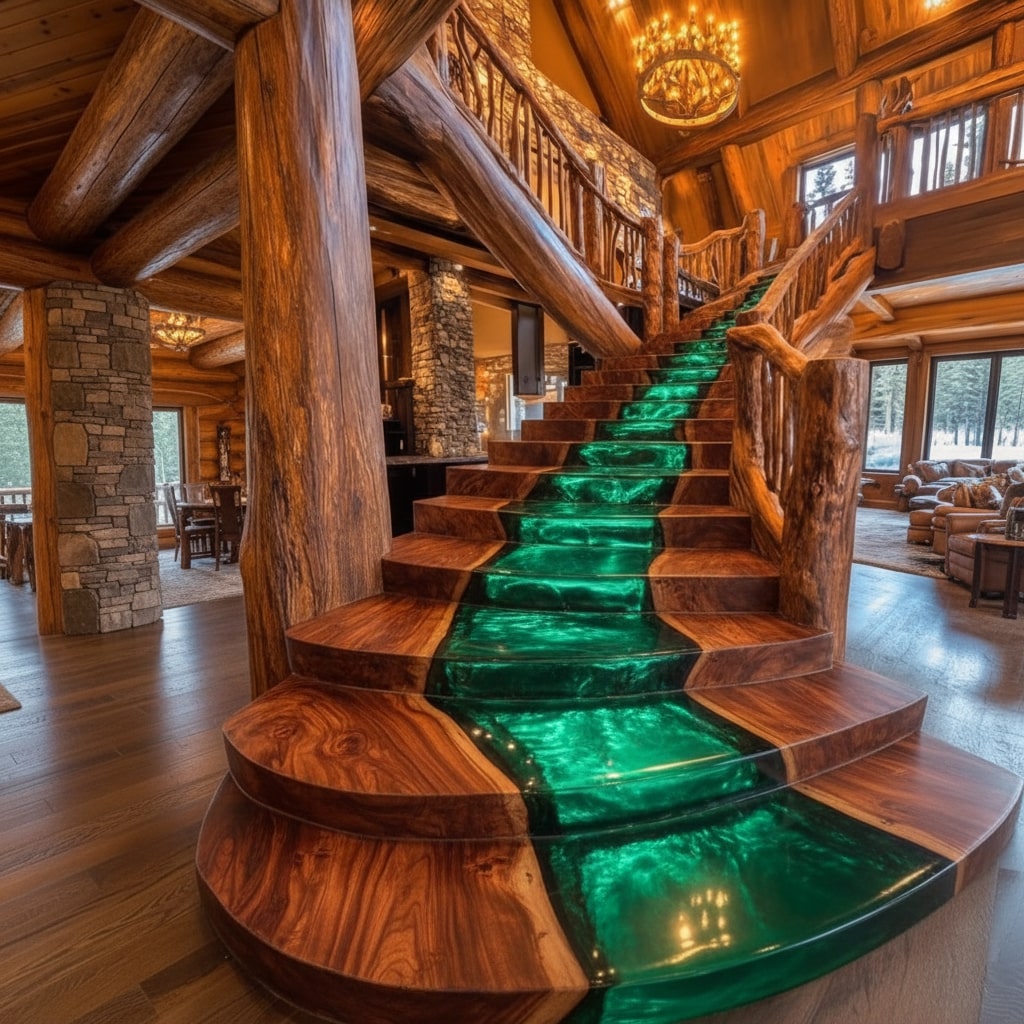
Part II: Spatial Choreography — Directing Movement, Shaping Experience
A staircase, by definition, mediates vertical displacement. But architecture distinguishes between access and experience. A fire escape grants access; a grand spiral in a Baroque palace stages experience. The epoxy river staircase belongs unequivocally to the latter category—not through scale or ornament, but through its capacity to recalibrate spatial perception and bodily engagement.
Consider the phenomenology of ascent. In a typical home, stairs are often tucked into corners or enclosed in utilitarian boxes—afterthoughts in the floor plan. An epoxy river staircase, by contrast, refuses concealment. Its presence radiates outward, influencing adjacent volumes. Because the resin channel catches and refracts ambient light—especially during golden hour or under carefully placed LED strips—it becomes a dynamic light source, casting ephemeral reflections on walls and ceilings. These shifting patterns animate otherwise static surfaces, turning the entire stairwell into a kinetic canvas.
Moreover, the visual linearity of the river guides the eye along the path of travel, reinforcing directional intent. Unlike a solid mass of treads and risers, which can feel obstructive, the epoxy channel acts as a luminous vector—inviting progression, not imposing it. This subtle cue enhances wayfinding intuitively: one does not merely use the staircase; one follows it.
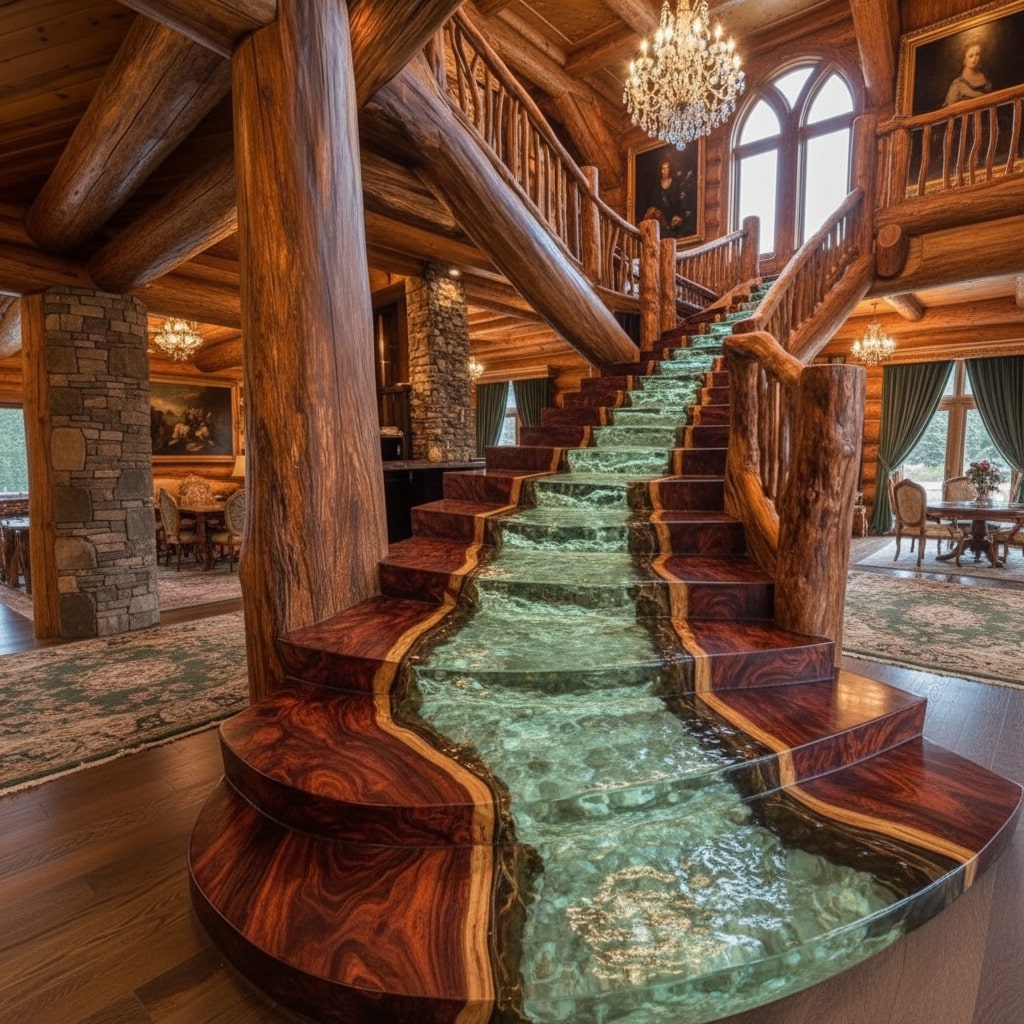
This principle extends to multi-story integration. When installed in open-concept atriums or double-height foyers, the epoxy river staircase functions as a vertical connective tissue—linking disparate programmatic zones (living, dining, study) not just physically, but narratively. The river becomes a leitmotif, reappearing on each landing like a recurring stanza in a poem. Its continuity across levels mitigates the disorientation that vertical transitions can induce, reinforcing a sense of spatial coherence.
Even the acoustic dimension is transformed. Wood absorbs mid- and high-frequency sound, while the rigid epoxy surface reflects and diffuses. The resulting sonic signature—soft footfalls punctuated by a faint, crystalline resonance—enhances the ritual quality of passage. You do not simply walk up an epoxy river staircase; you perform an ascent, aware of your own movement in dialogue with the material.
In high-density urban dwellings, where space is contested, this choreographic intelligence is invaluable. The epoxy river staircase does not demand more square footage; instead, it multiplies perceived space through reflection, transparency, and layered depth. It turns constraint into opportunity—proof that spatial generosity is not always a function of size, but of intention.
Part III: Perceptual Depth — Illusion, Immersion, and the Sublime
Beyond materiality and function, the epoxy river staircase operates on a deeply psychological plane. Its power resides in its capacity to generate perceptual depth—a layered experience that engages memory, imagination, and emotion.
This begins with optical ambiguity. Cured epoxy possesses a refractive index close to that of glass, allowing light to penetrate several centimeters into its body. When pigmented in gradient blues and greens, or embedded with suspended particles, the resin simulates aquatic depth. Viewed from above, the river appears shallow—rippled, sunlit. From the side, it seems fathomless, like looking into a mountain tarn at noon. This duality challenges the eye’s assumptions, creating a microcosm of visual uncertainty that is both unsettling and mesmerizing.
Such ambiguity activates the viewer’s interpretive faculties. Is the river in the wood—or through it? Is it liquid, solid, or something in between? These questions are not rhetorical; they reflect a broader architectural interest in liminality—the threshold between states. The epoxy river staircase is neither floor nor wall, neither furniture nor structure. It exists in the interstitial, a category-defying object that invites contemplation.
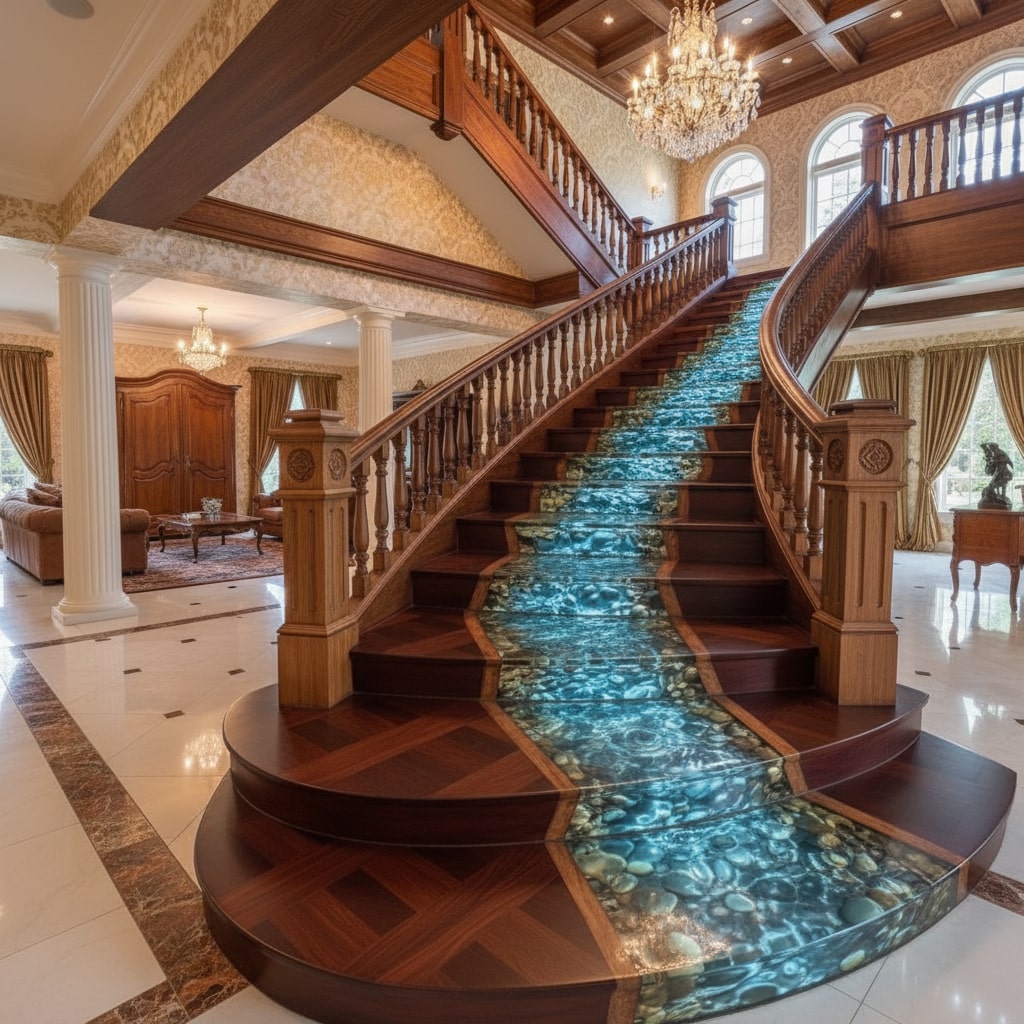
This liminality extends to time. Natural rivers are temporal markers—they erode, flood, shift course over centuries. An epoxy river staircase captures a moment of that continuum: a snapshot of flow, arrested yet still suggesting motion. In an age of digital acceleration, where immediacy dominates, this gesture toward geological time offers a counter-rhythm. It asks the inhabitant to slow down, to consider duration. The staircase becomes a meditative device—not unlike a Zen garden’s raked gravel—where the passage of the body parallels the passage of thought.
Furthermore, the interplay of transparency and opacity generates immersive effects. In low light, the epoxy may seem like obsidian—dark, reflective, almost two-dimensional. Under direct illumination, it reveals internal strata: bubbles elongated during pouring, pigment swirls resembling plankton blooms, or fractures in the wood echoing dried river deltas. Each viewing condition produces a new reading, ensuring that the staircase never becomes background. It remains perpetually emergent—always partially unknown, always inviting closer inspection.
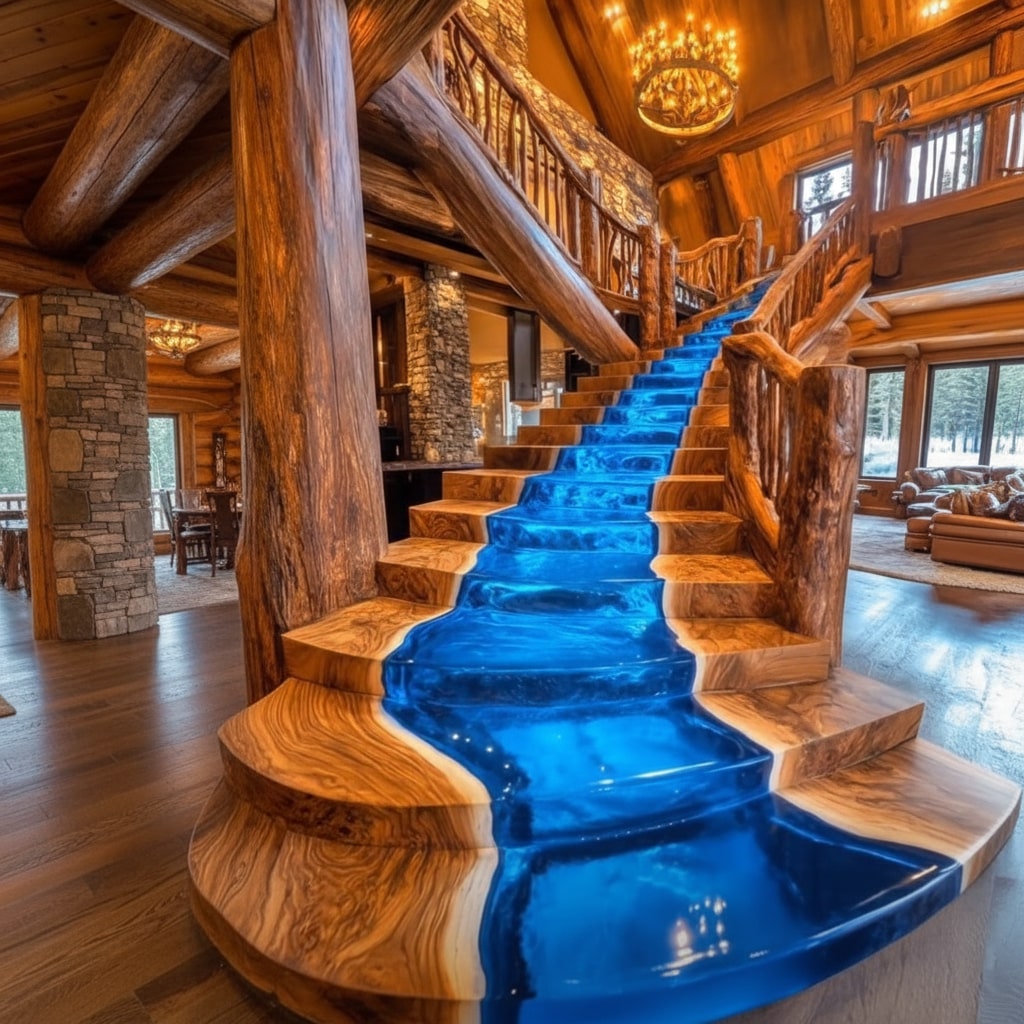
This perceptual richness feeds into what architectural theorist Juhani Pallasmaa calls “haptic vision”—a mode of seeing that is tactile, embodied, and multisensory. You feel the coolness of the resin before touching it. You anticipate its smoothness as your hand nears the railing. The epoxy river staircase thus collapses the distance between observer and object, turning passive occupancy into active participation.
In public or institutional settings—museums, libraries, boutique hotels—this immersive quality fosters communal resonance. Visitors gather not just to ascend, but to witness: to photograph the play of light, to trace the curve of the river with a finger, to share anecdotes sparked by its evocative form. The staircase becomes a site of collective pause in an otherwise transactional environment—a moment of shared wonder.
Conclusion: The Epoxy River Staircase as Architectural Metaphor
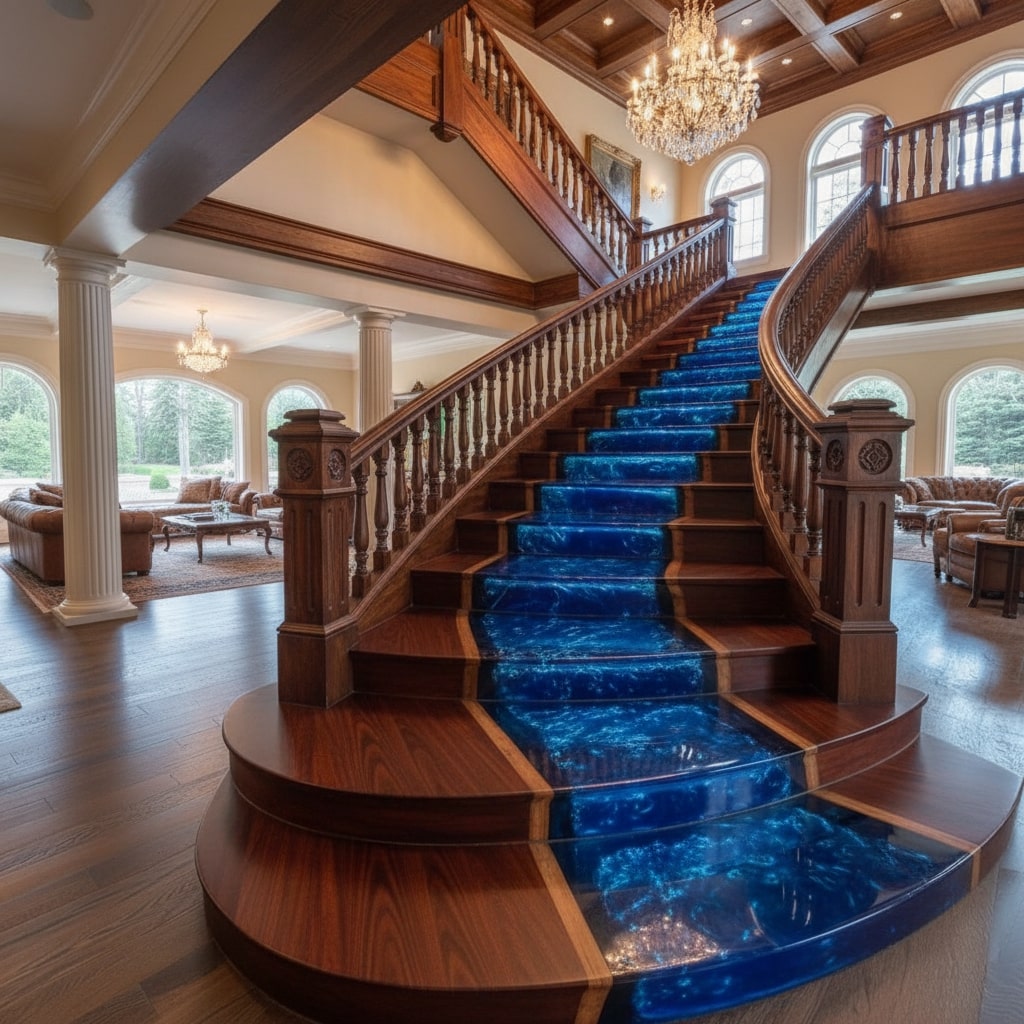
To reduce the epoxy river staircase to a trend is to miss its deeper significance. It is not merely a stylish reinterpretation of a structural element; it is a philosophical statement about how architecture can—and should—mediate between disparate realms.
It bridges the organic and the synthetic without hierarchy, suggesting that human ingenuity need not supplant nature, but collaborate with it. It reclaims the staircase as a site of narrative, transforming vertical transit from obligation into invitation. And it engages the senses not for spectacle, but for recalibration—urging us to move more thoughtfully, see more deeply, and inhabit space with greater awareness.
In a cultural moment marked by fragmentation—of attention, of community, of ecological continuity—the epoxy river staircase offers a quiet but potent counterpoint. It is a symbol of flow: of water, of time, of human passage. It reminds us that architecture, at its best, does not just shelter the body. It shapes how we perceive the world, how we move through it, and how we connect—with place, with others, and with ourselves.
The river does not end at the top step. It continues—through memory, through reflection, through the lingering sense that something ancient and essential has been reawakened in the heart of the built environment. That is the true transformation: not of space alone, but of experience. And in that transformation, the epoxy river staircase reveals itself not as an object, but as a threshold—one we cross not just with our feet, but with our imagination.