
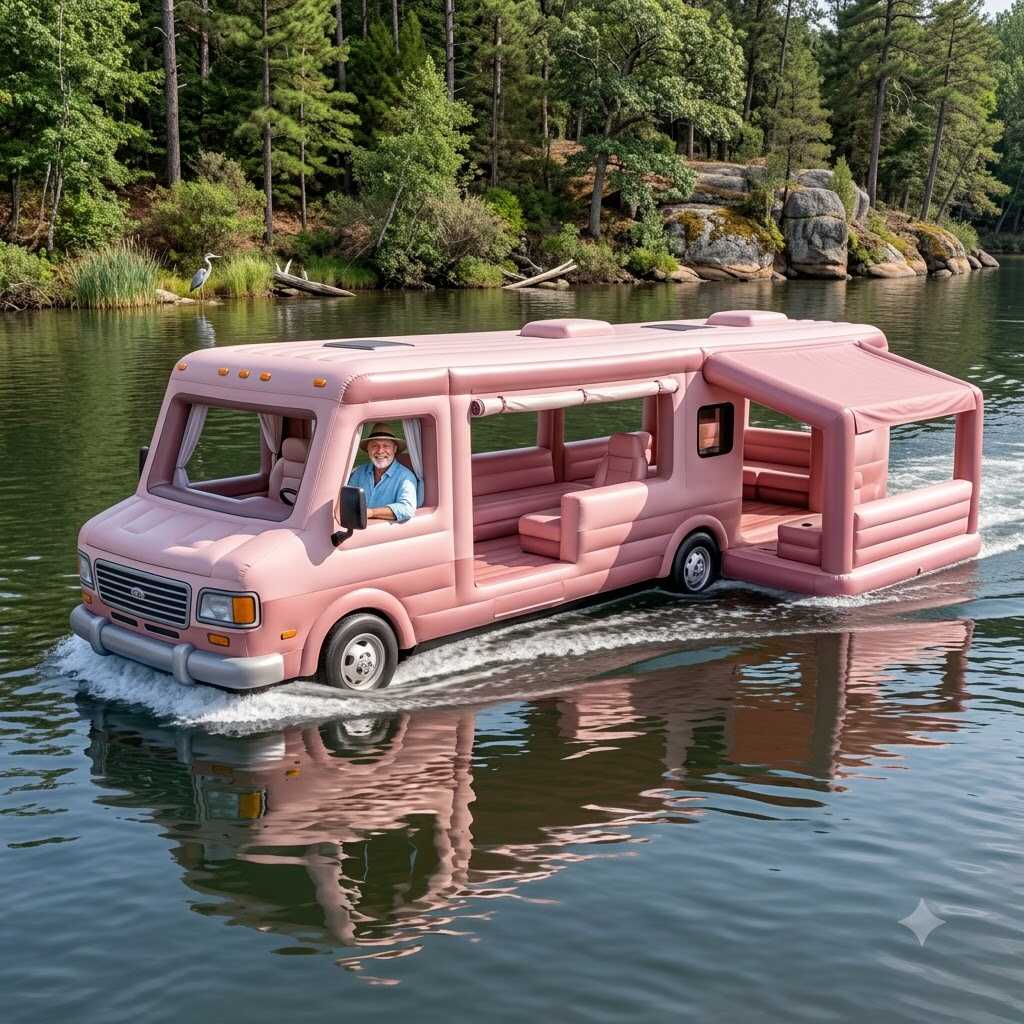
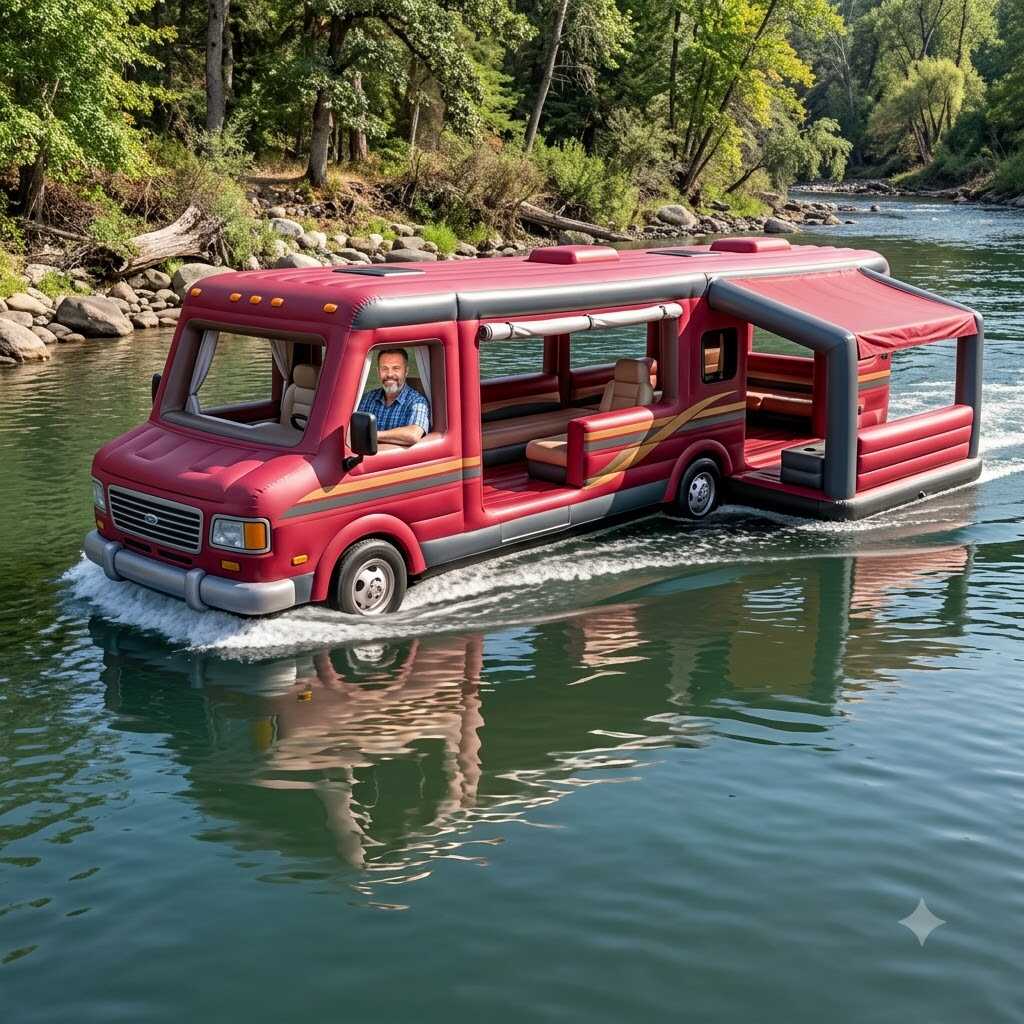
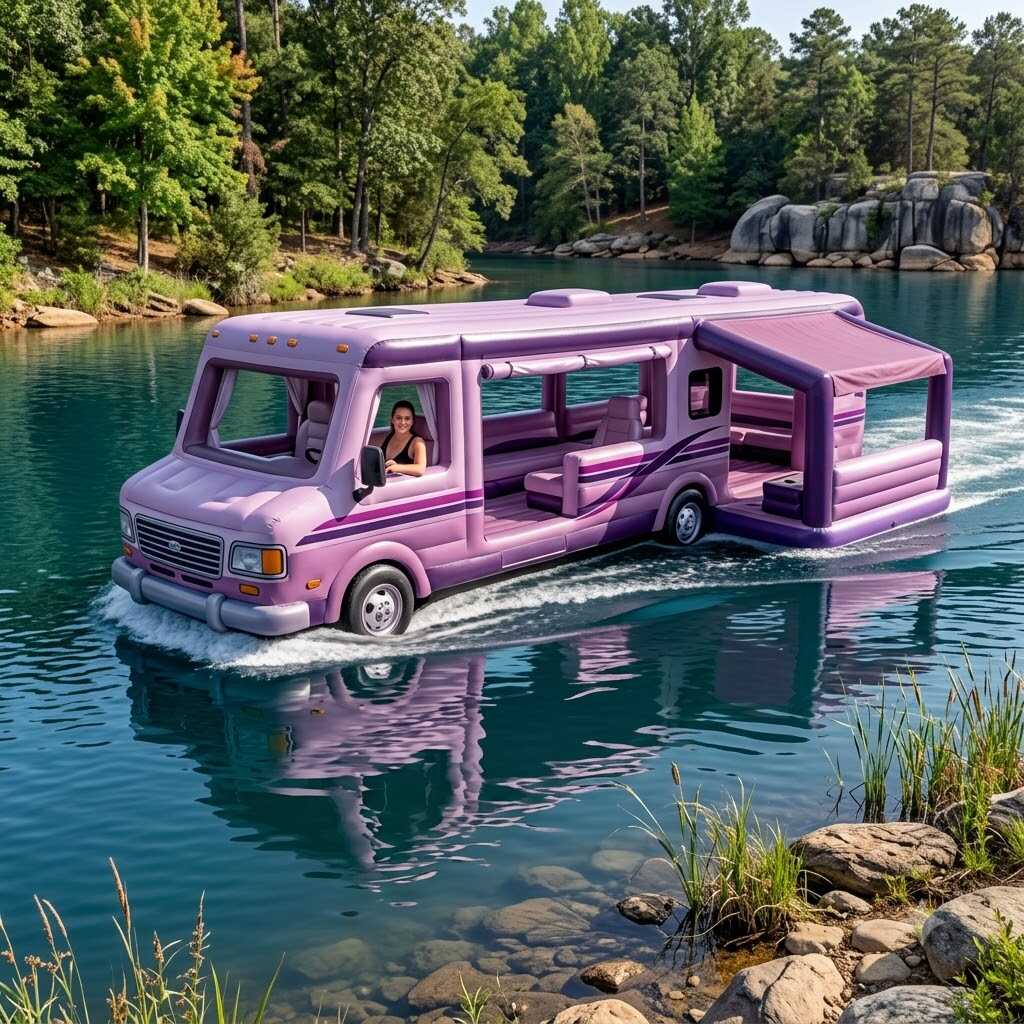
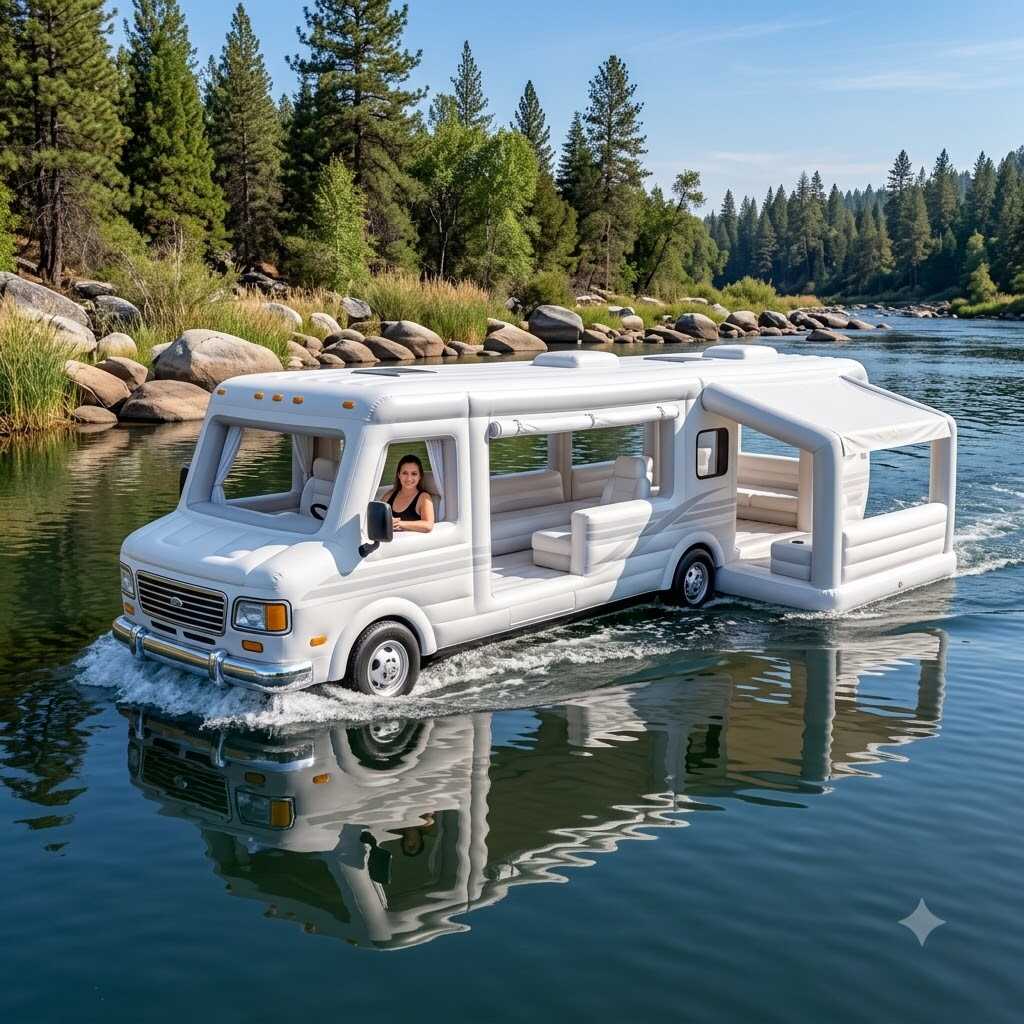
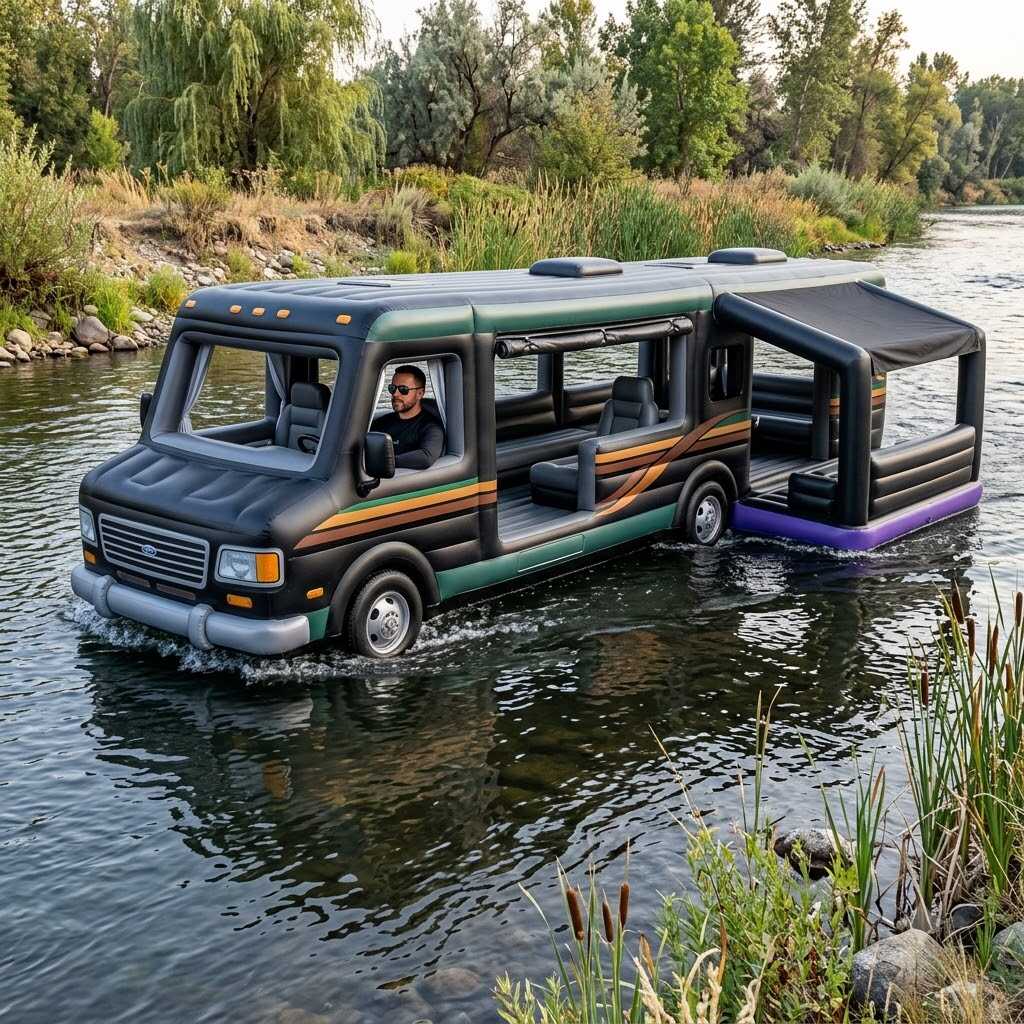
There’s a particular kind of double-take that happens on crowded lakes these days. Jet skis don’t cause it anymore. Neither do the usual flamingo or pizza-slice floats bobbing near the dock. What stops people mid-conversation now is a full-sized, unmistakably shaped RECREATIONAL VEHICLE, complete with windows, a cab, and sometimes even a little inflatable awning, drifting across the water like it wandered off the highway and into the lake by mistake. The giant inflatable RV lake float has become one of those objects that feels almost too absurd to be real, and yet it keeps showing up in more marinas, more group photos, and more “wait, what am I looking at” moments every summer.
What makes this trend interesting isn’t just the novelty. It’s the sheer engineering ambition behind turning a boxy, angular vehicle into something that floats, holds its shape under body weight, and survives a full day of sun, splashing, and questionable landings. This is less like a pool toy and more like a small inflatable structure — and that distinction is exactly why so many people are now trying to understand, and even build, their own versions.
Why an RV, of All Things?
Novelty floats have always leaned into recognizable silhouettes — swans, unicorns, donuts. But an RV is a strange leap because it’s not cute or whimsical in the traditional sense. It’s boxy, utilitarian, and defined by hard edges and flat panels, which happens to be one of the harder shapes to translate into soft, air-filled material. Curves are forgiving. Corners are not.
That challenge is part of the appeal for the DIY and novelty-manufacturing crowd. Recreating a vehicle’s silhouette in an inflatable format means solving a puzzle: how do you keep flat sides looking flat when they’re filled with pressurized air that naturally wants to bulge into a sphere? The answer lies almost entirely in a manufacturing technique called DROP-STITCH CONSTRUCTION.
The Manufacturing Trick That Makes It Possible
Drop-stitch fabric is the same technology used in high-pressure paddleboards, and it’s the quiet hero behind why this float can look boxy instead of blob-like. Instead of one big air chamber (like a standard beach ball), drop-stitch material uses thousands of tiny woven threads connecting two fabric layers internally. When inflated, those internal threads pull the top and bottom layers tightly toward each other, creating a rigid, flat panel rather than a rounded bulge.
For something shaped like an RV, manufacturers typically combine two techniques:
- Drop-stitch panels for the flat sides, roofline, and floor, where structural rigidity is critical for people to stand or sit without the whole thing folding.
- Traditional welded PVC or TPU chambers for rounded features like wheel wells, the cab’s curved nose, or add-on details like mirrors and bumpers.
This hybrid build is why the float can hold a recognizable boxy shape while still being safe to bounce around on. Pure drop-stitch throughout would make it prohibitively heavy and expensive; pure standard inflatable construction would leave it looking more like a lumpy potato than a vehicle.
From Flat Pattern to Floating Object
Before any air ever touches the material, the entire RV shape starts as a two-dimensional pattern — essentially a blueprint cut into dozens of individual fabric panels. Designers work backward from a 3D digital model, “unwrapping” the vehicle’s surface the same way a mapmaker flattens a globe into a 2D map. Every panel has to account for seam allowances, stitch or weld lines, and the slight stretch of the material once it’s pressurized.
Once the pattern is finalized, panels are cut using either die-cutting machines or CNC fabric cutters for precision, especially around tricky details like window outlines or wheel arches. These panels are then joined using HEAT-WELDING, a process where the edges of PVC or TPU material are melted just enough to fuse together permanently — far stronger and more waterproof than traditional stitching, which would let water seep through needle holes.
The windows, headlights, and any painted-on details are usually added at this stage too, either through printed vinyl overlays fused directly into the seams or through separate colored panels welded in place. This is where a lot of the personality comes through — a slightly cartoonish grille, oversized round headlights, or a mock license plate that turns a technical inflatable structure into something with actual character.
Getting the Proportions Right (Without Making It Tip Over)
Here’s where things get genuinely tricky from an engineering standpoint. A real RV is tall, narrow, and top-heavy — great for hauling gear down a highway, terrible for floating stability. If a float replicated those exact proportions, it would flip the moment someone climbed on board.
Designers compensate by widening the base significantly beyond what a real RV’s proportions would suggest, effectively giving it a lower center of gravity. The “wheels” are often oversized and semi-flattened at the bottom, acting less like decorative wheel shapes and more like stabilizing pontoons. Internal baffling — extra seams and air chambers running through the base — helps distribute weight and prevent the float from rolling under uneven pressure, like when three people all climb onto one side to take a photo.
This is also why most versions of this float sit lower and wider than a literal scale replica of an RV would. It’s a compromise between “looks exactly like an RV” and “doesn’t dump everyone into the lake within five minutes.”
The DIY Community Angle
Because the underlying materials — heavy-duty PVC, TPU film, drop-stitch fabric, and a decent heat-sealing setup — are increasingly accessible to hobbyists, a small but enthusiastic DIY inflatable-building community has started experimenting with homemade versions. Online forums dedicated to inflatable paddleboard repair and custom pool float fabrication have seen a noticeable uptick in posts about tackling boxy vehicle shapes specifically because of how visible this RV float trend has become.
Common DIY hurdles people report include underestimating how much extra material curved transitions require, choosing seam tape that isn’t rated for constant water exposure, and misjudging airflow — an inflatable this large typically needs a high-volume pump rather than a standard hand pump, or filling time balloons into the “go find something else to do for twenty minutes” territory.
There’s also a growing interest in customizing the concept entirely — vintage camper shapes instead of a modern RV cab, or mixing in mismatched design elements just to make something uniquely weird. The appeal isn’t really about replicating a specific vehicle perfectly; it’s about the challenge of making something rigid-looking float convincingly.
Why This Particular Float Keeps Going Viral
Part of the staying power comes down to scale and surprise. Most novelty floats are small enough to blend into a crowded swim area. An RV-shaped float is large enough — often stretching well over ten feet — that it dominates whatever body of water it’s on. It photographs well from drone shots, it looks genuinely bizarre from a distance, and it invites the kind of “what is that” reaction that spreads naturally without needing much promotion at all.
Final Thoughts
Strip away the novelty factor and what’s left is a legitimately interesting case study in inflatable manufacturing — how flat, rigid-looking shapes get engineered out of soft material, how drop-stitch technology solves problems that pure air-chamber design can’t, and how proportion and stability get quietly reworked behind the scenes so the whole thing doesn’t tip over the second someone climbs aboard. Whether you’re admiring one from a kayak or seriously considering sketching out your own version in a garage, this float is a reminder that