
The Open Road and the Need for Refuge
There is an unmistakable poetry in motorcycle travel—a rhythm of motion that syncs pulse with piston, where the landscape unfolds in unbroken continuity and the horizon remains perpetually just beyond reach. To ride a motorcycle across vast distances is to enter into a covenant with freedom: the freedom to depart without itinerary, to pause where the light falls just so, to sleep beneath unfamiliar stars. Yet this freedom, however exhilarating, carries with it the implicit vulnerability of exposure. Unlike the enclosed cabins of cars or the insulated compartments of trains, the motorcycle rider inhabits an open interface with the world—wind, rain, dust, and temperature all make their unmediated acquaintance. And when the day’s ride concludes, the question of where to rest becomes more than logistical; it becomes existential.
Enter the motorcycle tent—a deceptively simple structure that performs an extraordinary act of translation. It converts the raw immediacy of roadside existence into a space of repose, protection, and dignity. More than just nylon and poles, a motorcycle tent is a mobile hearth: a symbolic threshold between the chaos of the journey and the sanctuary of temporary home. It speaks to an ancient human need—the desire to carve out a private, protected sphere within the indifferent vastness of nature and infrastructure alike. In this article, we explore how motorcycle tents fulfill two foundational human imperatives on the road: shelter and security—not as abstract ideals, but as lived, embodied experiences.
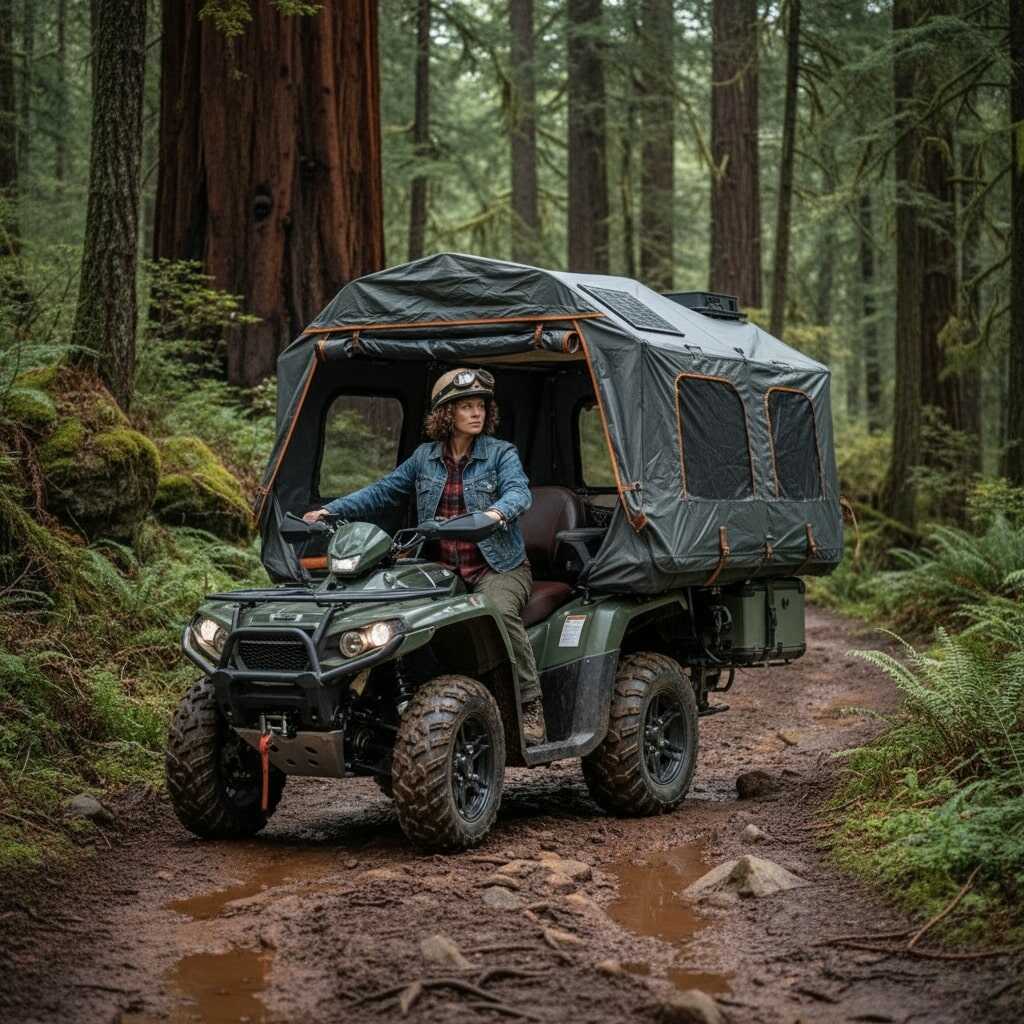
Part I: Shelter—The Architecture of Temporary Belonging
Beyond Weatherproofing: The Sensory Dimension of Refuge
At its most basic functional level, a motorcycle tent provides protection from the elements—rain, wind, cold, and sun. But to reduce its role to mere weatherproofing is to overlook its deeper spatial and psychological resonance. Shelter, in the context of motorcycle travel, is not passive resistance to discomfort; it is active creation of atmosphere. Consider the moment of pitching a tent after hours on the road: the unfurling of fabric, the rhythmic tension of guy lines, the soft thunk of stakes sinking into soil or gravel. These are not utilitarian gestures alone. They are ritual acts—small ceremonies of self-reliance that mark the transition from traveler to dweller, however briefly.
A well-designed motorcycle tent responds acutely to the scale and rhythm of motorcycle travel. Unlike backpacking tents, which prioritize minimal weight above all, or car-camping shelters, which trade portability for volume, motorcycle tents occupy a distinct middle ground. They must be compact enough to strap securely to luggage systems—either hard panniers, soft saddlebags, or tail packs—yet expansive enough to admit not only the rider but also essential gear: helmet, boots, gloves, perhaps a small stove or hydration reservoir. This balance yields a space that is neither cramped nor excessive: intimate, but not suffocating; functional, but not sterile.
The interior of a motorcycle tent becomes, over successive nights, a repository of sensory memory. The faint scent of damp earth after a drizzle, mingling with the synthetic tang of polyester-coated fabric. The muffled percussion of distant traffic or the sigh of wind through nearby trees. The glow of a headlamp casting long, trembling shadows on the inner canopy—a private theatre of solitude. These are not incidental details; they constitute the texture of shelter—the way a space feels when it is truly inhabited.
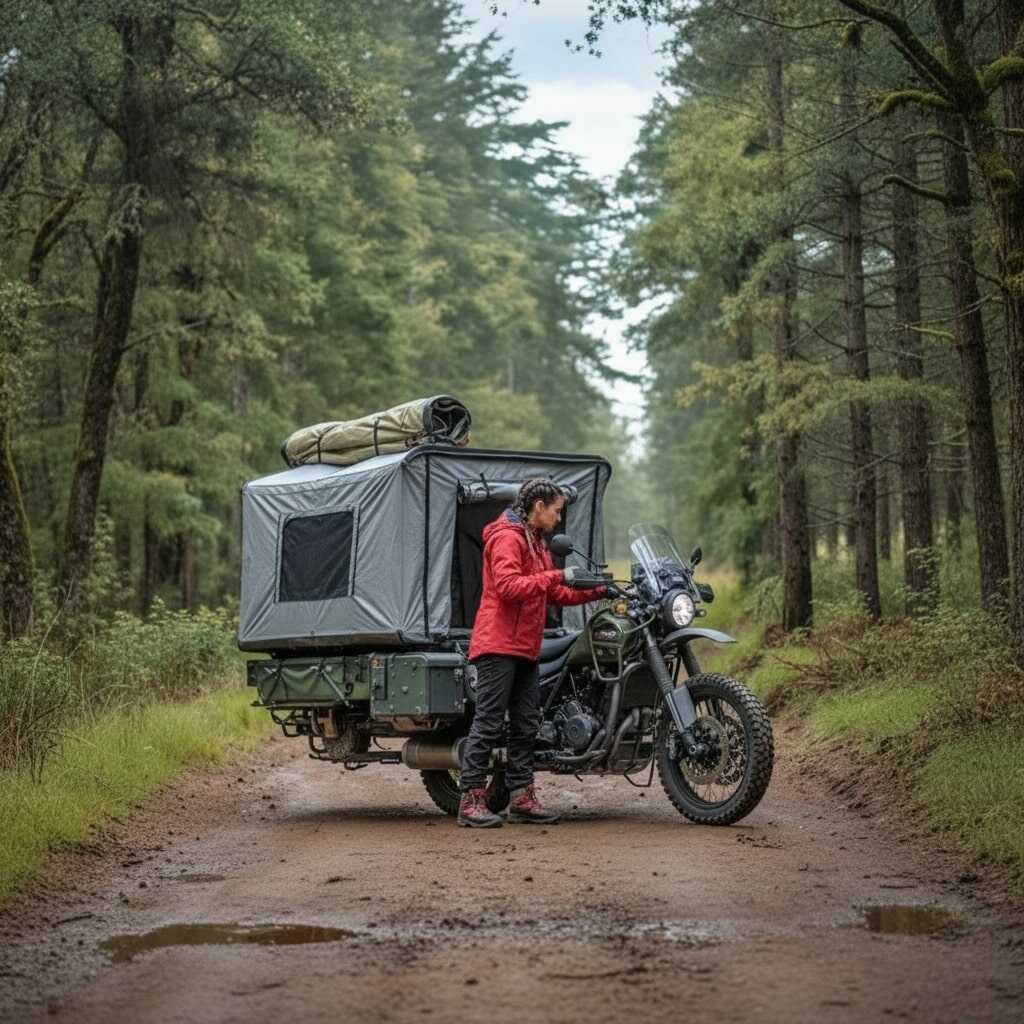
Thermal Integrity and Microclimate Control
Shelter on the road is also deeply thermodynamic. A motorcycle tent must mediate between wildly fluctuating external conditions and the fragile equilibrium of the human body at rest. This is where design subtleties matter profoundly. Single-wall tents, favored for their lightness and fast setup, rely on breathable membranes and vent placement to manage condensation—a constant challenge when a rider’s exhaled moisture meets cool night air. Double-wall designs, though bulkier, offer superior moisture management, with an inner mesh layer allowing airflow while the outer flysheet deflects rain and wind.
But more than material science, thermal shelter is about behavioral adaptation. Riders learn to position their tents with intention: orienting the door away from prevailing winds, situating the vestibule to catch morning sun, using natural topography—like the lee side of a boulder or the gentle slope of a hill—for added protection. The tent thus becomes an extension of the rider’s environmental literacy, a tool for reading and responding to microclimates. In high alpine passes, where temperatures can plummet after sunset, a motorcycle tent may be lined with a reflective thermal blanket; in desert basins, where radiant heat lingers, ventilation is maximized, and the tent is pitched in the shadow of a mesquite or juniper.
In this way, the motorcycle tent facilitates a form of embodied intelligence—a knowing that resides not in manuals or apps, but in the calluses of the hands, the tilt of the head to assess wind direction, the intuitive placement of gear to weight the tent against gusts. Shelter, then, is not just provided—it is co-authored by rider and environment.
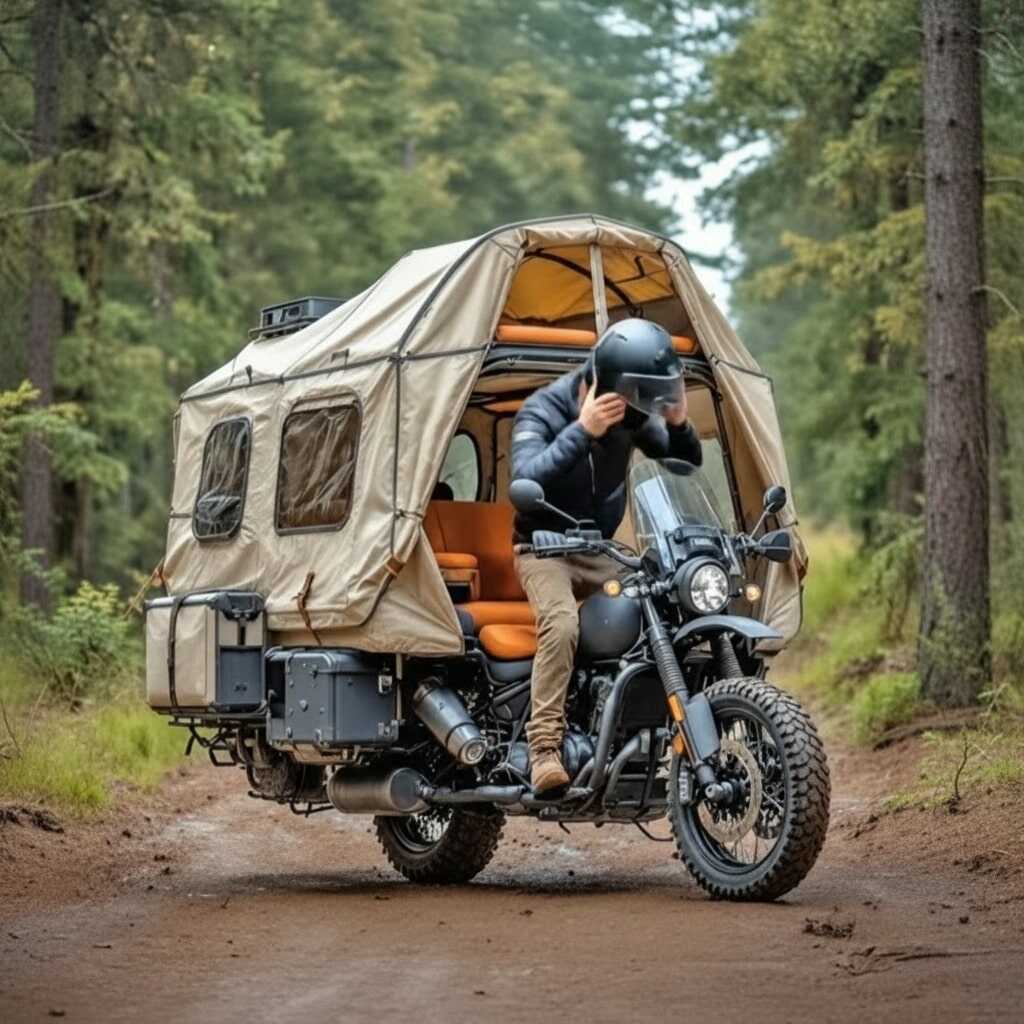
The Threshold Space: Vestibules, Porches, and Transitional Zones
A critical yet often underappreciated aspect of motorcycle tents is the vestibule—the covered, floorless extension beyond the main sleeping compartment. This space functions as a liminal zone, a buffer between the outside world and the inner sanctum. Here, muddy boots are removed; wet gear is hung to dry; the day’s map is consulted by headlamp. It is a space of preparation and decompression—where the rider ritually sheds the road before entering rest.
For many, the vestibule becomes a kind of outdoor room—a place to sit cross-legged on a folded sleeping pad, brew tea on a compact stove, and journal by the light of a red-filtered lamp. Its semi-enclosure provides psychological containment: open enough to feel connected to the night, yet shielded enough to foster introspection. In cultures where porches and verandas serve as social and contemplative thresholds, the motorcycle tent’s vestibule performs a similar function—scaled to the solitary traveler. It is, in essence, the smallest possible front porch in the world.
Part II: Security—The Psychology and Practice of Safe Ground
Physical Security: Anchoring in an Unanchored World
Security on the road is multifaceted. At the most immediate level, a motorcycle tent offers physical protection—not just from weather, but from wildlife, opportunistic theft, and environmental hazards. While no tent is impenetrable, thoughtful design contributes significantly to perceived and actual safety. Reinforced stake-out points prevent the structure from collapsing or lifting in high winds. Durable, tear-resistant fabrics resist abrasion from rough ground or accidental contact with gear. Zipper garages and storm flaps prevent water ingress and deter casual tampering.
More subtly, the tent’s placement contributes to security. Experienced riders avoid low-lying areas prone to flash flooding; they steer clear of dead branches overhead (the dreaded “widowmakers”); they choose ground that offers visibility without exposure—perhaps near a service road, but not directly on it. Some riders use natural barriers—rock outcrops, dense thickets—as windbreaks and visual screens. Others deploy tripwire-style perimeter alerts (a string of cans, a taut cord with bells) not out of paranoia, but as a low-tech extension of situational awareness.
Crucially, the motorcycle tent allows the rider to camp discreetly. Unlike RVs or even car campers, who often require designated sites with hookups, motorcyclists can vanish into the margins of the landscape: a pullout shaded by pines, a meadow tucked behind a ridgeline, the forgotten corner of a rest area. This invisibility is not evasion—it is a form of autonomy. It allows the rider to rest without performance, without the self-consciousness of being observed or judged. In a world increasingly surveilled and curated, the ability to disappear—even for a single night—is a rare and vital form of security.
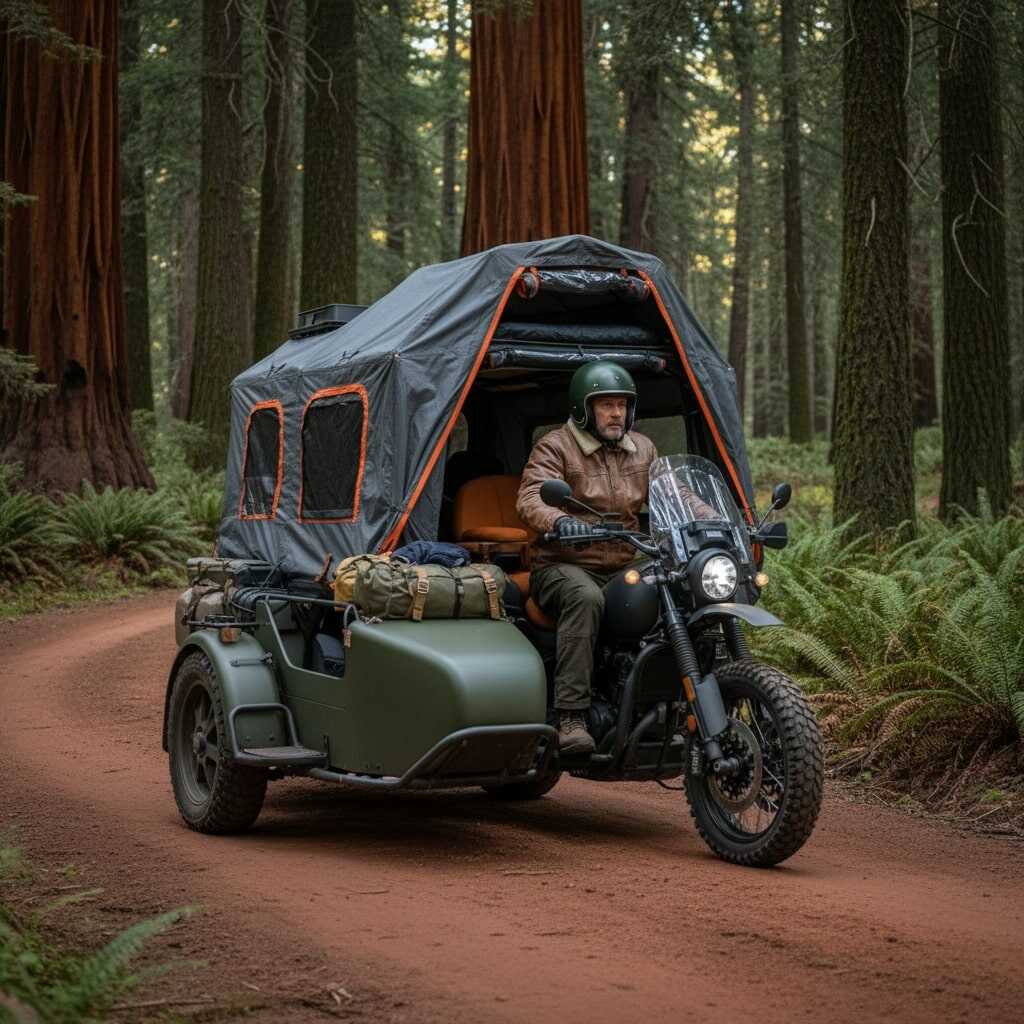
Psychological Security: The Comfort of Contained Space
Beyond physical defenses, motorcycle tents provide a profound psychological security—one rooted in the human need for bounded space. Neuroscience tells us that enclosed environments trigger parasympathetic responses: lowered heart rate, reduced cortisol, the onset of restorative rest. A tent, even a small one, creates a defined volume—a finite world within the infinite. Its walls, though thin, represent a cognitive boundary: here, inside, is mine; there, outside, is not.
This containment is especially vital after hours of hyper-vigilance on the road. Riding a motorcycle demands relentless attention: reading traffic patterns, anticipating surface hazards, calculating braking distances, navigating unfamiliar routes. The brain remains in a state of low-grade emergency readiness. The tent, by contrast, signals permission to de-escalate. To unzip the door, crawl inside, and seal it behind you is to enact a symbolic closure—a ritual of release.
Many riders describe a particular sensation upon entering their tent at night: a deep, almost gravitational sigh—the body recognizing safety before the mind articulates it. The weight of armor (jacket, knee guards, gloves) comes off. The helmet, that second skin of protection and isolation, is set aside. In the dim light, the rider becomes simply a person again—vulnerable, yes, but willingly so, within a space they have claimed and secured through their own agency.
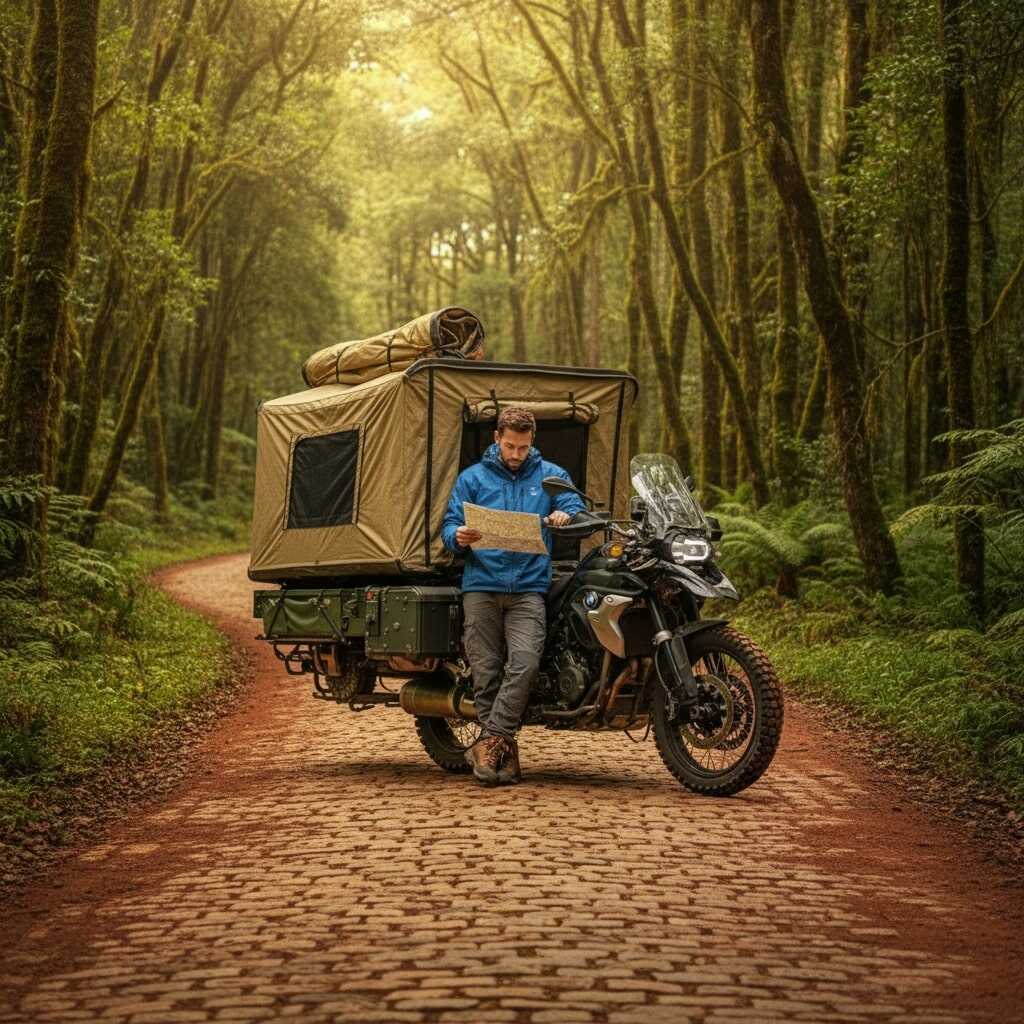
Temporal Security: Owning the Night
Security also manifests in the temporal dimension. A motorcycle tent grants the rider sovereignty over time. There is no check-in desk, no curfew, no “quiet hours” dictated by campground management. The rider determines when to arrive, when to sleep, when to rise. This autonomy over one’s daily rhythm is not trivial—it aligns travel with natural cycles rather than institutional ones. Dawn can be greeted from a sleeping bag unzipped to the waist, coffee brewed as mist lifts from a nearby creek. Stars can be watched through a mesh ceiling until drowsiness claims the eyelids.
Moreover, the tent enables spontaneity—a cornerstone of authentic motorcycle travel. A sudden storm rolling in across the plains? Pitch the tent beneath a highway overpass (where permitted) and wait it out. A scenic overlook that steals your breath at golden hour? Set up camp and wake to that same view at sunrise. A mechanical delay in a remote area? The tent becomes not a last resort, but a dignified pause—a place to troubleshoot, rest, and regroup without panic.
This ability to absorb uncertainty—to transform disruption into opportunity—is perhaps the highest form of security the motorcycle tent provides. It converts vulnerability into resilience.
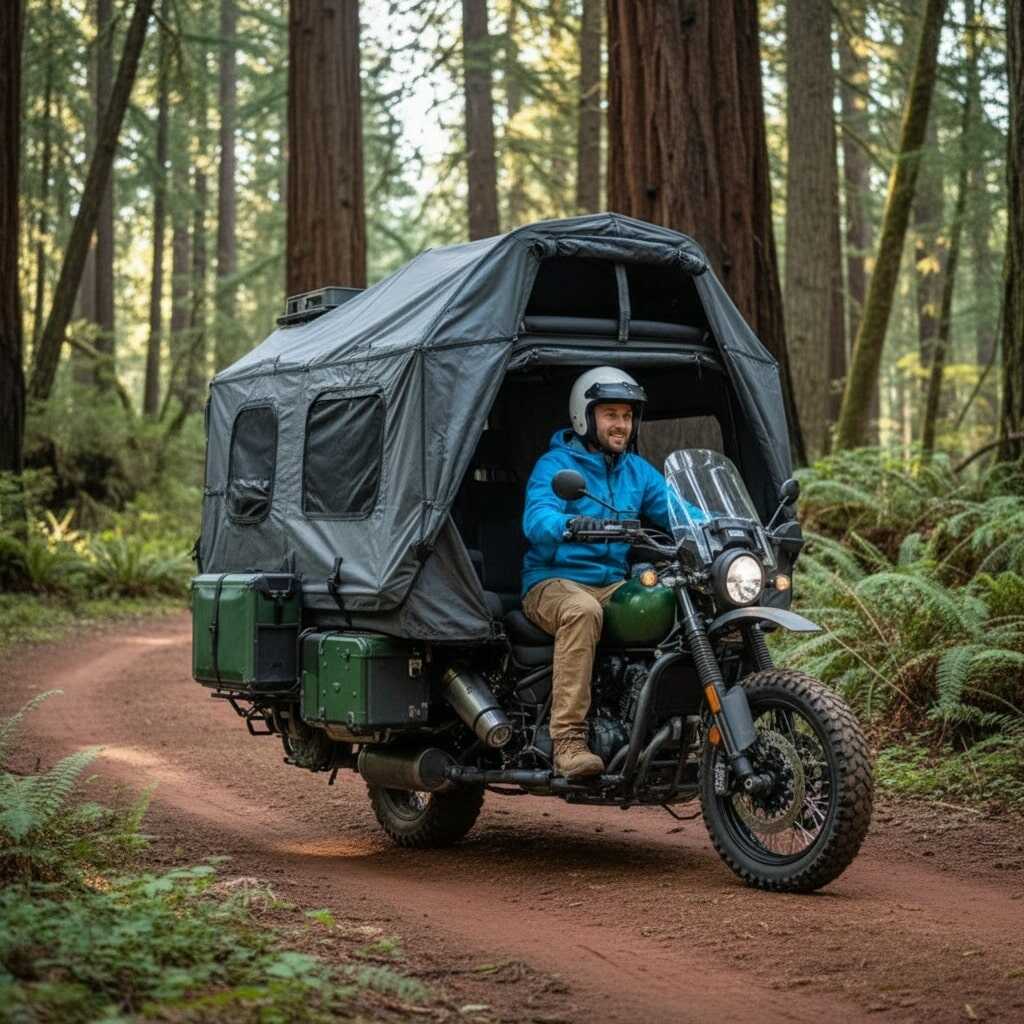
Part III: The Symbolic Weight—Tents as Mobile Sanctuaries
Continuity and Ritual in a Discontinuous Life
For long-distance riders—those undertaking cross-continental treks or seasonal migrations—the motorcycle tent becomes more than gear. It becomes a constant: the one familiar space that travels with them through deserts, mountains, forests, and cities. Its scent, its sound in the wind, the pattern of wear on its floor—these details accrue meaning. The tent is where blisters are dressed, where letters are written home, where grief or joy is processed in solitude. It witnesses the rider at their most unguarded: exhausted, elated, contemplative, afraid.
In this sense, the motorcycle tent functions as a portable hearth—a concept borrowed from anthropology, where the hearth represents the center of domestic life, a site of warmth, nourishment, and storytelling. On the road, with no fixed abode, the tent is the hearth. Meals are prepared nearby. Journals are kept inside. Small mementos—a pressed flower, a ticket stub, a smooth stone—are tucked into gear pockets. Over time, the tent accumulates what writer Rebecca Solnit calls “the archaeology of intention”—the physical traces of a life deliberately lived.
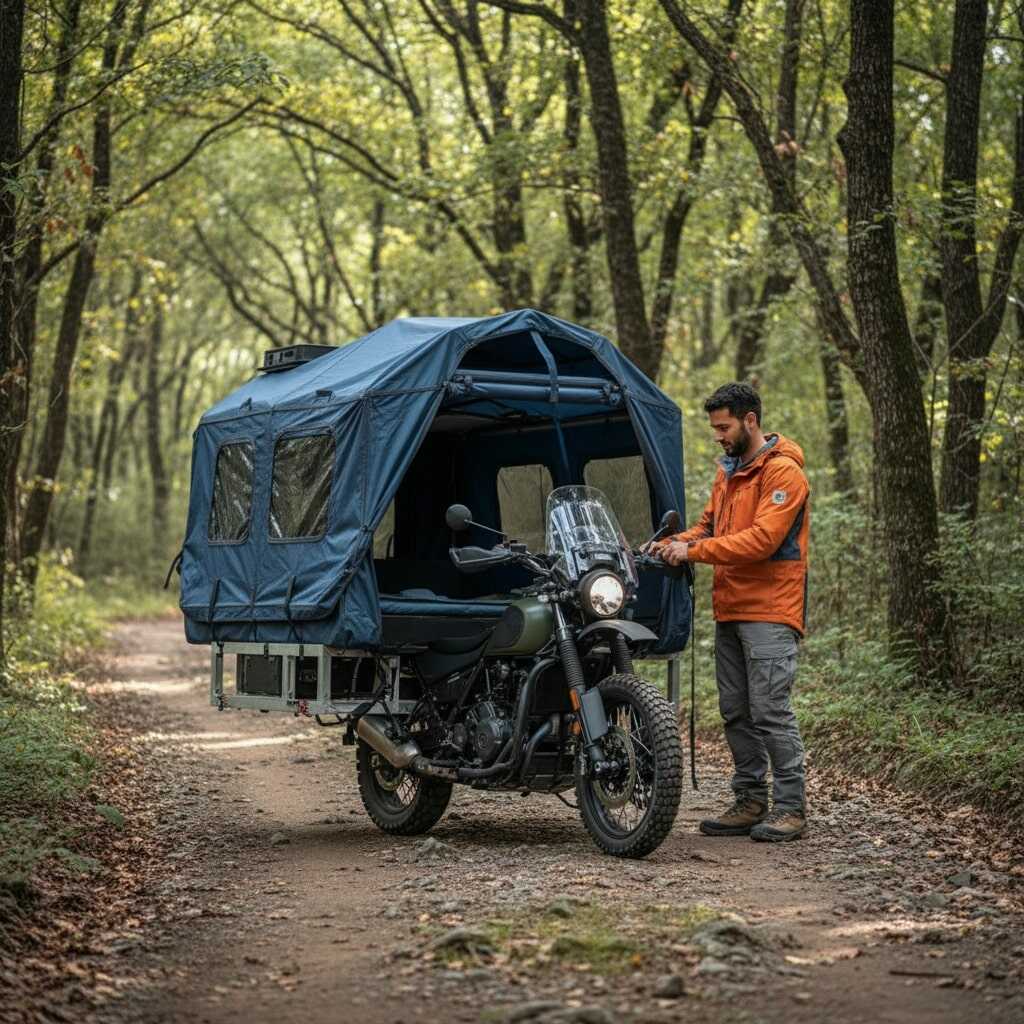
Ethics of Lightness: Minimal Impact, Maximum Presence
The use of motorcycle tents also reflects a broader ethos—one of minimalism, self-reliance, and environmental respect. Because they leave no permanent footprint, allow for dispersed camping (where regulations permit), and require no infrastructure, motorcycle tents embody a light touch on the land. Riders who use them often adhere to Leave No Trace principles not as rules, but as philosophy: pack out all waste, minimize campfire impacts, respect wildlife corridors.
This ethic extends to interactions with communities. A rider in a discreetly pitched tent does not demand services, does not congest campgrounds, does not contribute to the commodification of outdoor experience. Their presence is transient but respectful—a quiet acknowledgment that they are guests in a landscape that does not belong to them.
The Tent as Teacher
Finally, the motorcycle tent teaches. It teaches patience—when stakes won’t bite into rocky soil. It teaches adaptability—when wind demands a last-minute repositioning. It teaches humility—when condensation pools despite best efforts. And it teaches gratitude—for dry socks, for still air, for the simple joy of lying flat after hours in the saddle.
Most of all, it teaches presence. In a tent, there is no buffering—no screens, no climate control, no ambient noise of appliances. There is only the now: the sound of breath, the pressure of ground beneath the pad, the slow turning of the earth through night into day. To sleep in a motorcycle tent is to consent to intimacy—with oneself, with the land, with the raw fact of being alive and moving through the world under one’s own power.
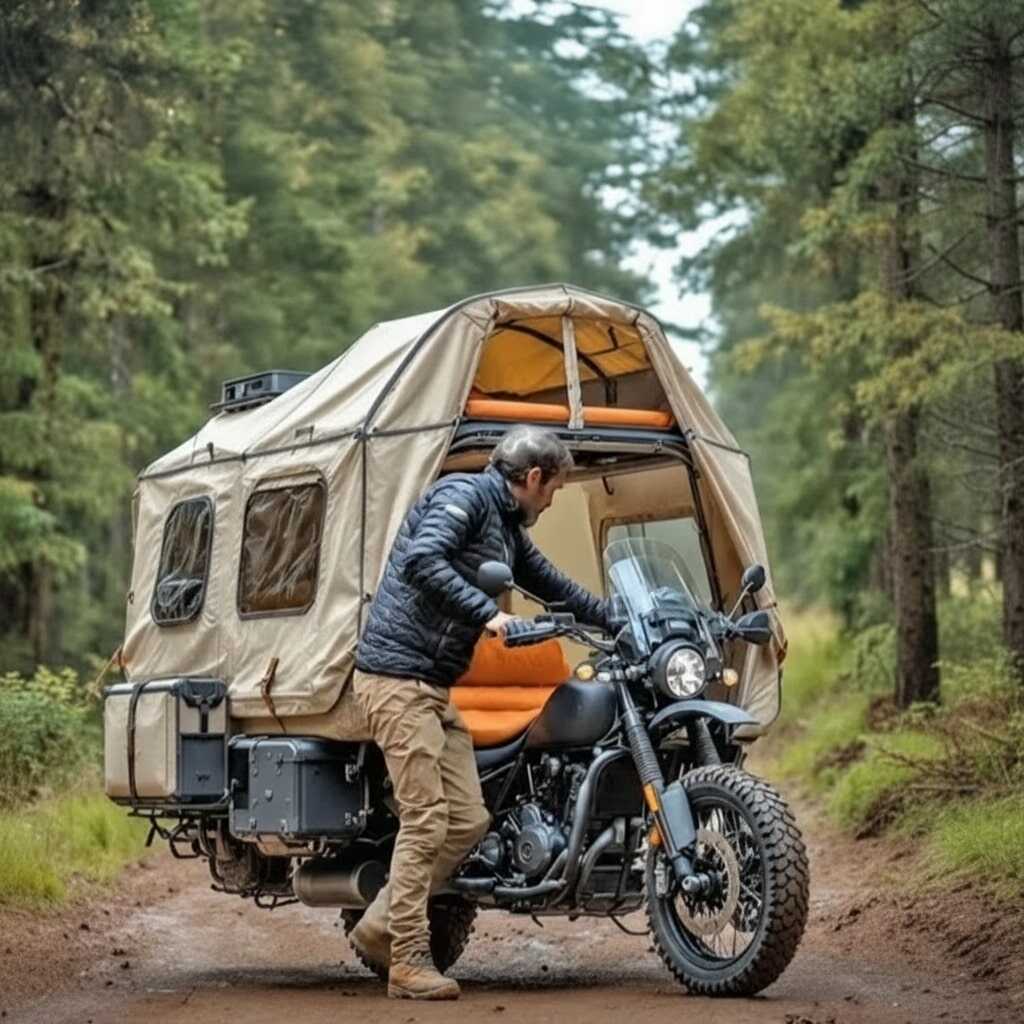
Conclusion: The Quiet Dignity of the Roadside Hearth
The motorcycle tent is neither glamorous nor technologically dazzling—at least not on the surface. It does not accelerate, does not gleam in the sun, does not roar to life with a twist of the wrist. And yet, in the ecosystem of motorcycle travel, it occupies a place of quiet centrality. It is the punctuation mark in the run-on sentence of the journey—the comma that allows for breath, the period that permits closure.
To speak of shelter and security in the context of motorcycle tents is to speak of more than fabric and poles. It is to acknowledge the deep human yearning for refuge in motion, for safety without stasis, for belonging that is not tied to a fixed address. The rider who carries a tent does not flee the world—they engage with it more deeply, on terms both humble and fiercely independent.
In a time when so much of life is mediated, optimized, and outsourced, the act of pitching a tent beside a two-wheeled machine remains a radical assertion of agency. It says: I will go where I choose. I will rest where I land. I will carry my home with me—not as burden, but as birthright.
The motorcycle tent, then, is more than equipment. It is a promise—whispered in nylon and aluminum—that no matter how far the road extends, there will always be a space, however small, where the rider can draw a line in the earth and say: Here. For tonight, this is enough.