
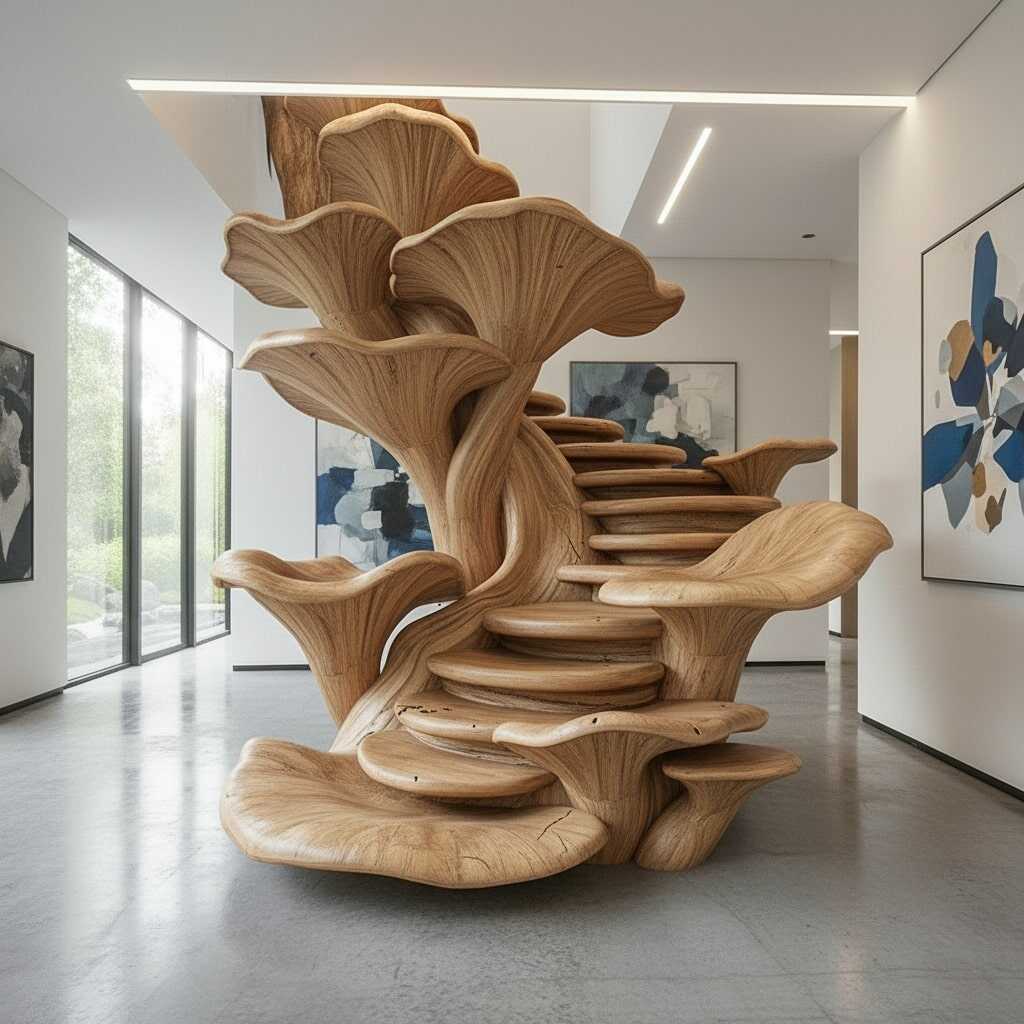
Architecture has long borne witness to humanity’s dialogue with the natural world—not as a backdrop, but as a co-author. From the soaring vaults of Gothic cathedrals mimicking forest canopies to the sinuous curves of Art Nouveau echoing vine and tendril, nature has served not only as muse but as mentor. In recent decades, this dialogue has deepened into what many now term biophilic design—a philosophy grounded not in ornamentation alone, but in an ontological resonance with living systems. Within this evolving canon, a singular motif has begun to emerge, delicate yet potent in its implications: the mushroom-inspired wooden staircase.
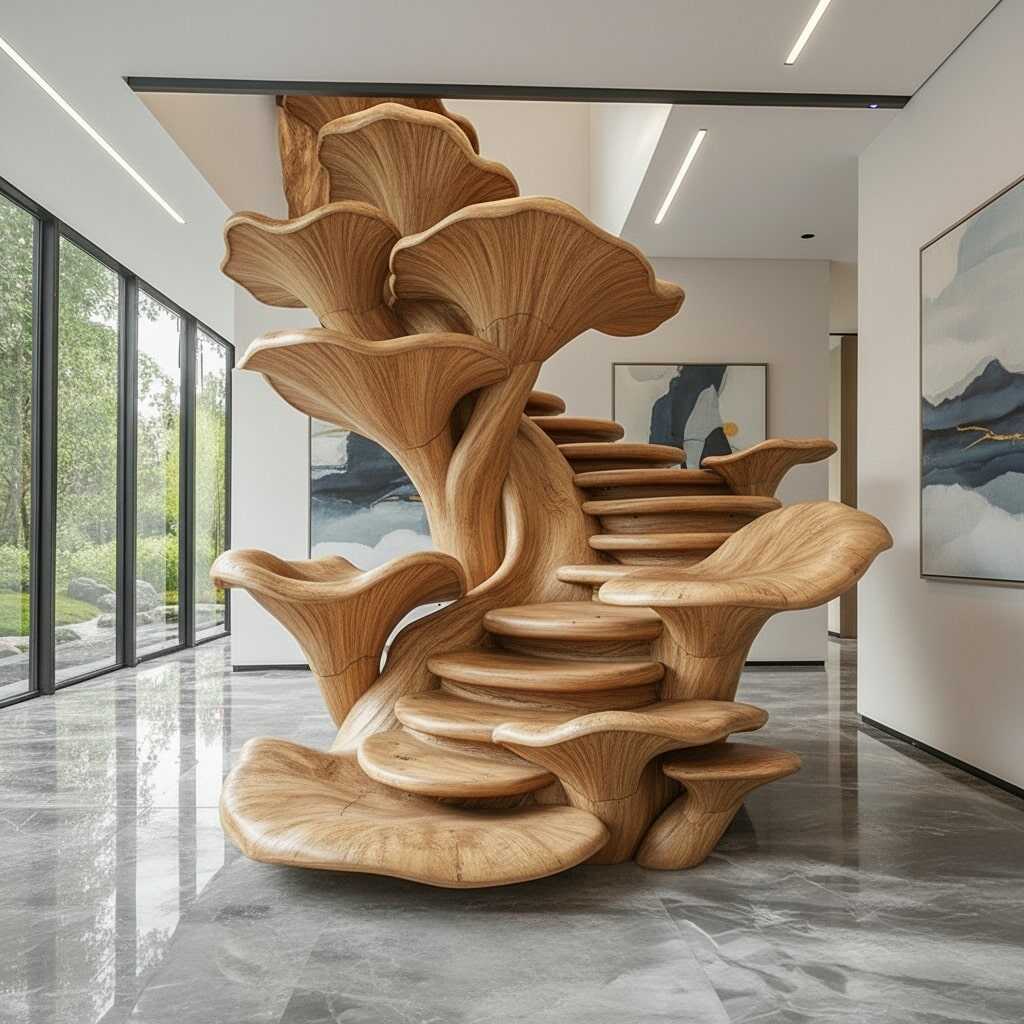
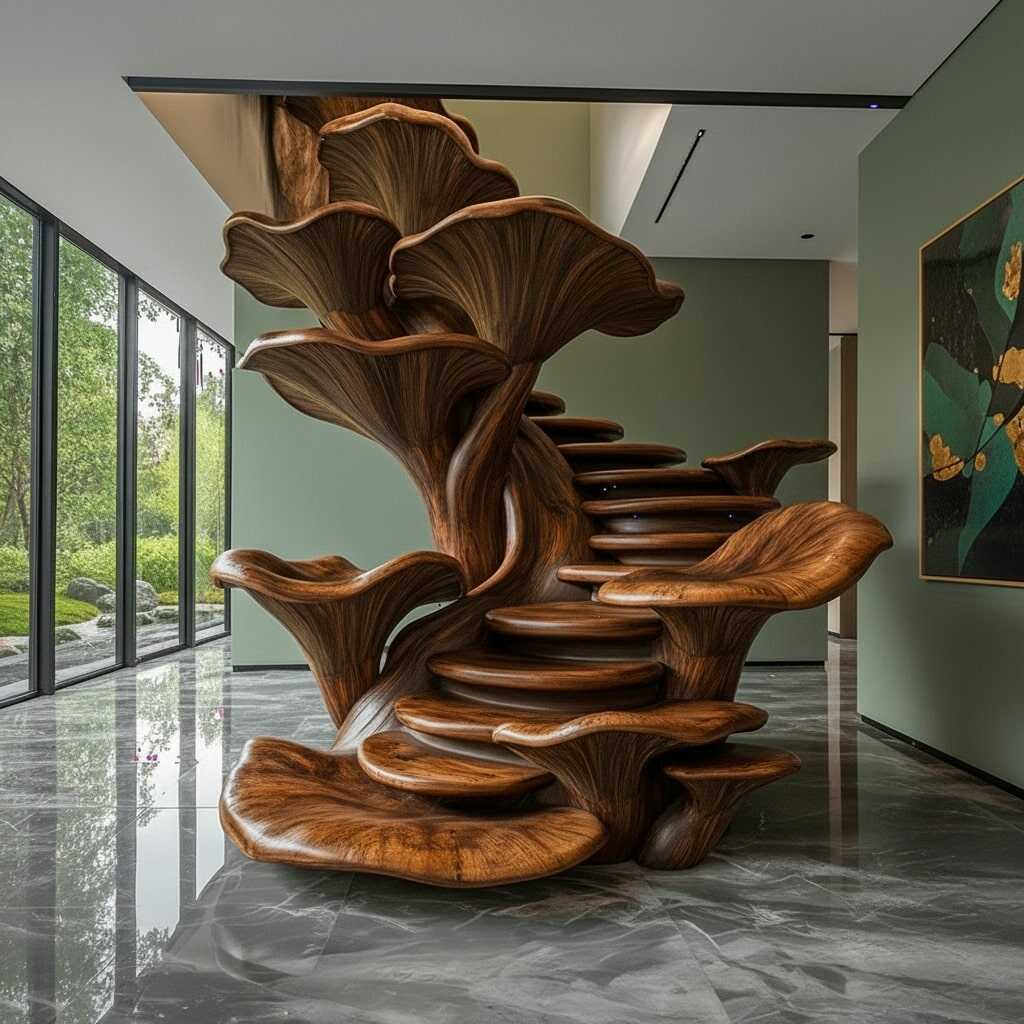
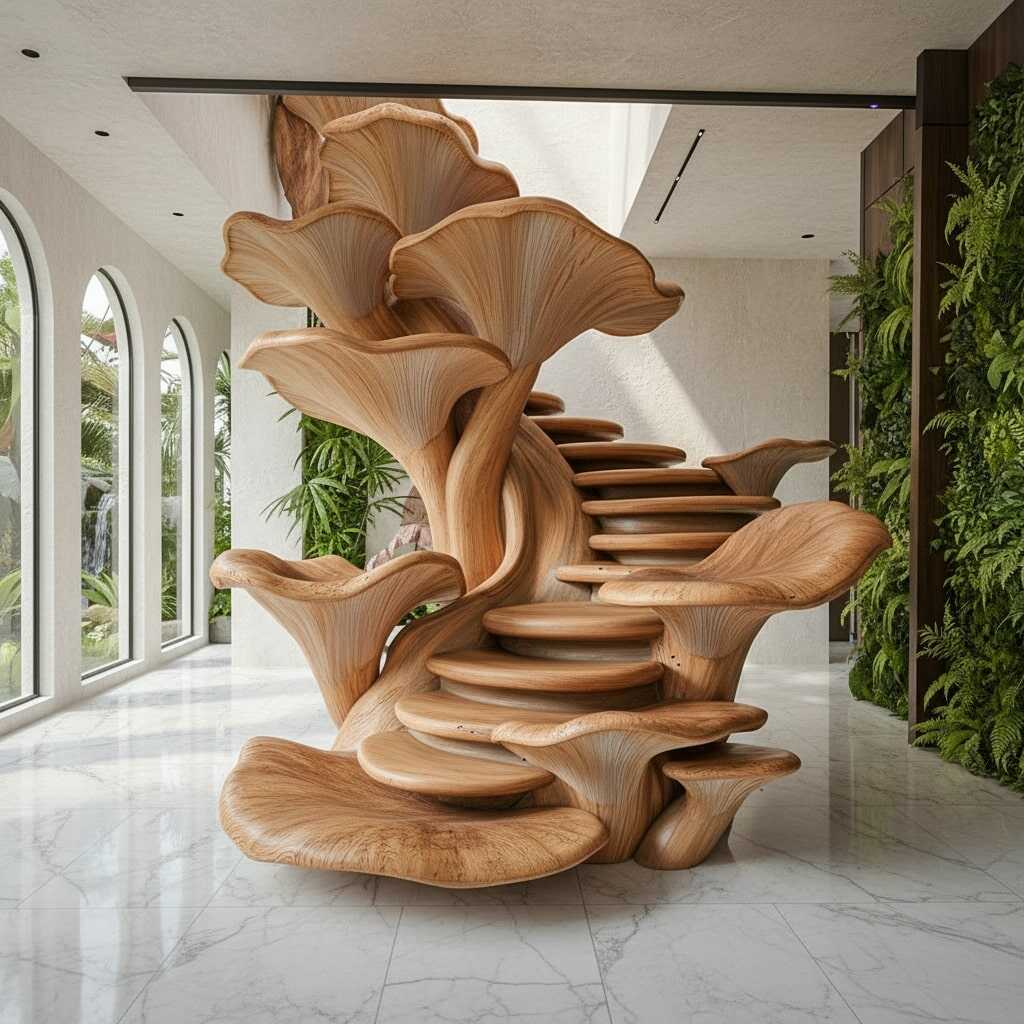
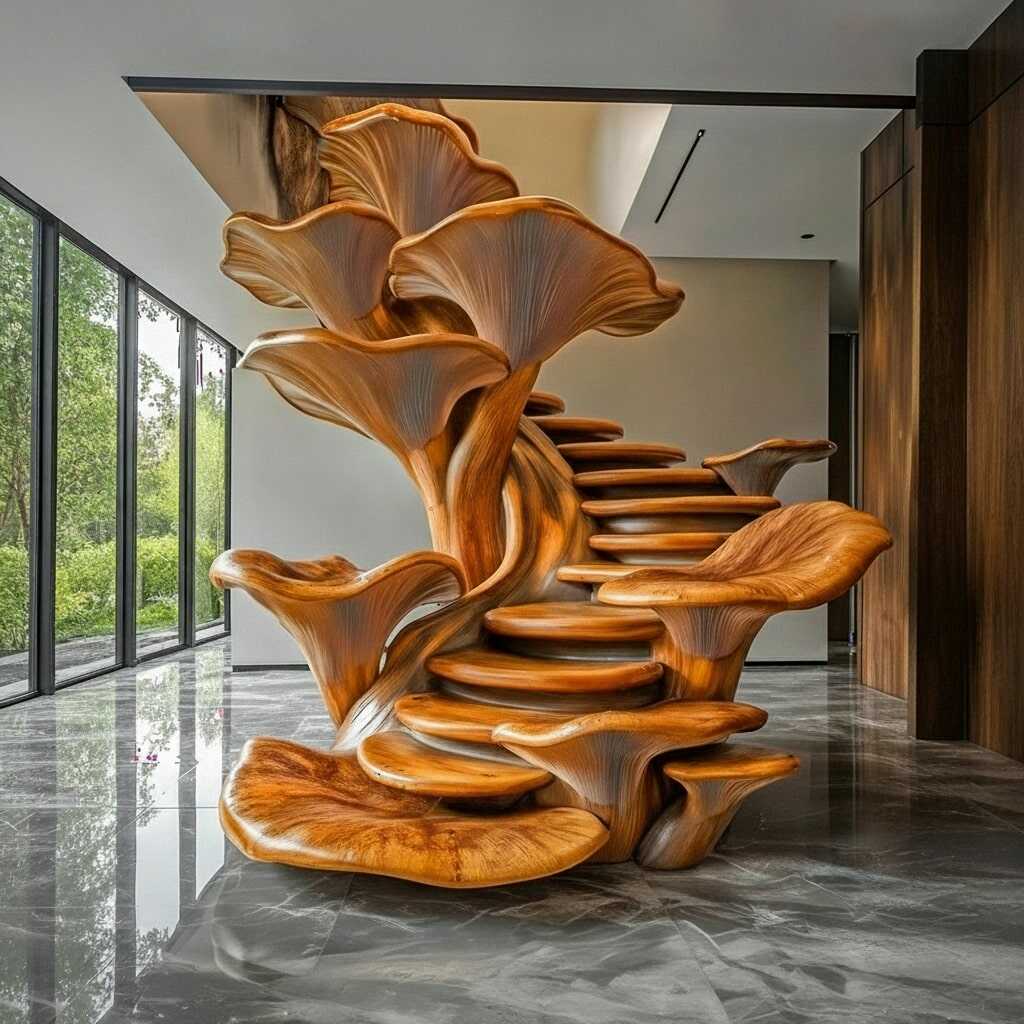
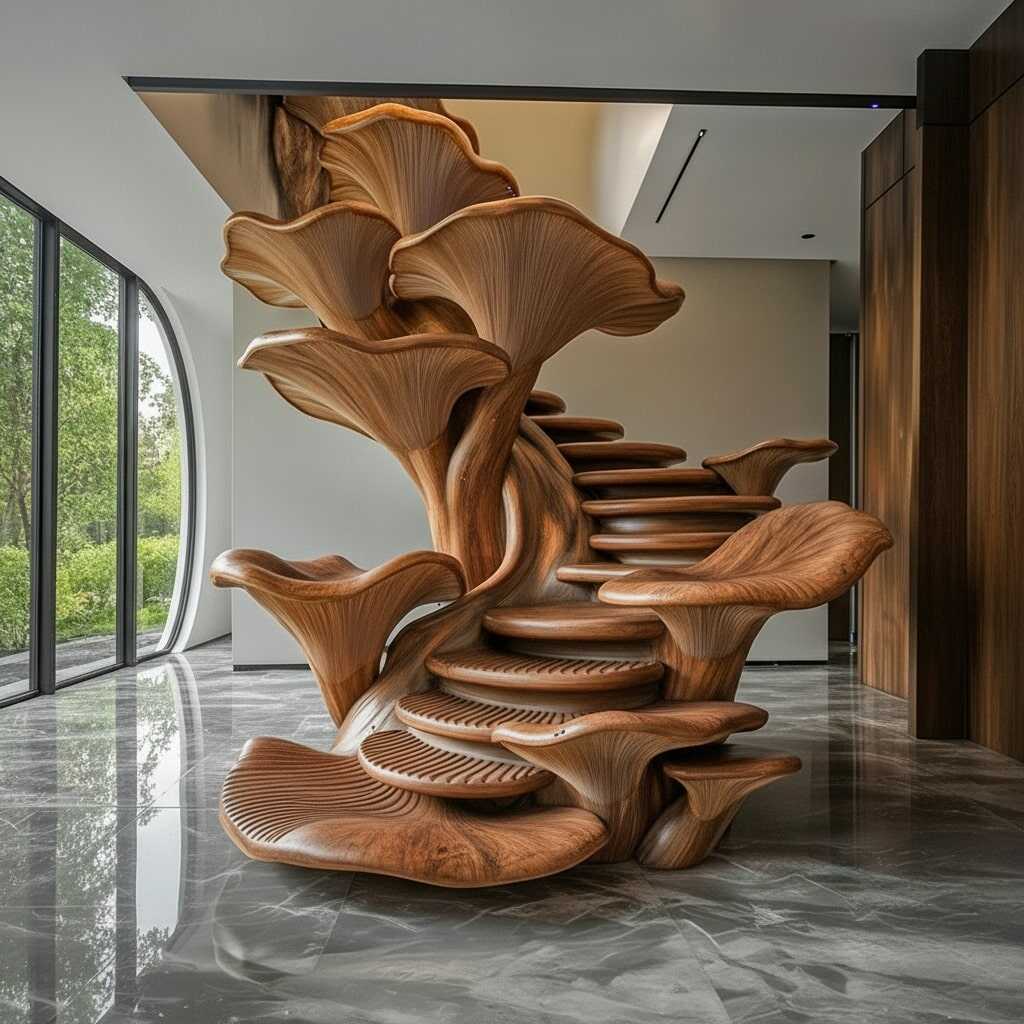
At first glance, such a phrase may invite skepticism—after all, mushrooms are ephemeral, soft-bodied organisms, while staircases are structural necessities, load-bearing, and permanent. Yet it is precisely in this tension—between the transient and the enduring, the organic and the engineered—that the mushroom-inspired wooden staircase reveals its deeper significance. This is not a literal replication of fungal morphology, nor a kitschy homage. Rather, it is an architectural interpretation grounded in principles observed in mycology: resilience through adaptability, elegance through economy, and strength through interconnectedness. The form evokes the cap-and-stem silhouette of certain fungi—the proud curve of an Amanita, the fluted gills of a Pleurotus, or the clustered emergence of Clavaria—but rendered not in chitin, but in oak, ash, walnut, or reclaimed Douglas fir.
This article explores how the mushroom-inspired wooden staircase functions not merely as a vertical circulation element, but as a spatial manifesto—a quiet declaration that architecture can embody nature’s intelligence without imitating its surface. It invites us to reconsider not only how we move through buildings, but how buildings think. We will examine, in three movements, the philosophical underpinnings of such design, the formal and material translations from mycelial logic to timber construction, and the experiential resonance such structures evoke in daily life. In doing so, we hope to illuminate how whimsy, far from being frivolous, is one of nature’s most sophisticated strategies—and how architecture, in embracing it, may rediscover its own soul.
Part I: The Mycological Mind – Architectural Lessons from the Fungal Kingdom
Before understanding how a staircase might draw inspiration from mushrooms, we must appreciate what mushrooms are—and what they represent in the broader ecological and philosophical landscape.
Mushrooms are the fruiting bodies of vast, subterranean networks known as mycelium: a lacework of hyphae that can extend over hundreds of acres, communicating, exchanging nutrients, and responding to environmental stressors with astonishing intelligence. Mycologist Paul Stamets famously characterized mycelium as “nature’s internet”—a decentralized, adaptive neural net woven into the soil. Unlike trees, whose strength lies in singular trunks and rigid architecture, fungi thrive on distributed resilience. Their structures are optimized for minimal material use and maximal functional response: caps arch to shed rain, stems taper to conserve resources, gills fold to increase surface area—all while remaining lightweight, self-supporting, and exquisitely site-responsive.
This biological economy offers a powerful counterpoint to industrial-era architectural paradigms, which often prioritize rigidity, repetition, and separation of form and function. Modern staircases, for instance, are frequently conceived as utilitarian insertions—steel skeletons wrapped in cladding, right-angled and repetitive, designed for code compliance rather than experiential richness. To propose a mushroom-inspired wooden staircase is thus to advocate for a shift in design ethos: away from mechanical efficiency toward ecological intelligence.
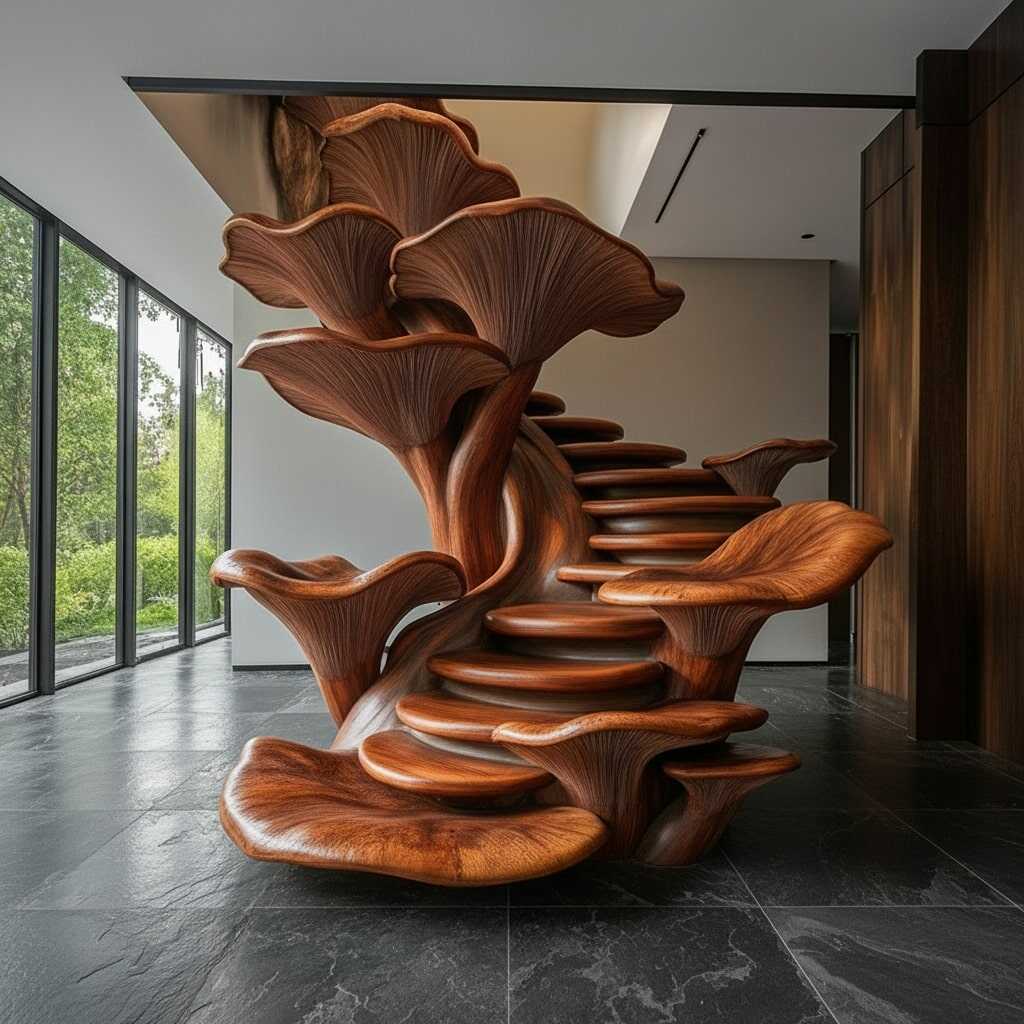
Consider the Amanita muscaria, with its convex red cap resting atop a slender white stalk. Its geometry is not arbitrary. The cap’s curvature distributes wind load evenly, preventing collapse; the stem’s taper minimizes material while maintaining axial strength; the volva at its base—often overlooked—anchors the organism and interfaces with the soil’s microbial community. Translate this into architectural language, and we begin to see how a staircase might cap a void with a gently arched tread surface, stem from a central or offset column with organic tapering, and ground itself into the floor not with a bulky landing, but with a flared, root-like base that dissipates force and invites tactile engagement.
More profoundly, fungi challenge our anthropocentric notions of individuality. A single mushroom is never truly solitary—it is the visible expression of a collective. This relational ontology finds poetic expression in the mushroom-inspired wooden staircase, where each tread, riser, and stringer functions not as an isolated element, but as part of an integrated organism. The staircase becomes a node—a place of pause, transition, and awareness—rather than a mere conduit. In this sense, the design transcends aesthetics; it becomes an act of philosophical alignment with a worldview in which boundaries blur, systems interpenetrate, and form emerges from function in symbiosis with context.
Part II: From Hyphae to Hardwood – Formal and Material Translations
Translating the ephemeral elegance of fungi into permanent timber construction requires more than superficial mimicry. It demands a deep engagement with both craftsmanship and computational design—where tradition meets algorithm, and intuition meets analysis.
The most compelling mushroom-inspired wooden staircases emerge from a triad of formal strategies: cap modulation, stem articulation, and mycelial patterning.
Cap Modulation: The Tread as Canopy
Rather than flat, rectilinear treads, the mushroom-inspired approach often employs subtly convex or saddle-shaped surfaces—evoking the domed caps of Boletus or Lactarius species. These are not mere decorative flourishes. A gently curved tread introduces micro-movements in the user’s gait: the foot rolls naturally from heel to toe, reducing impact stress. The curvature also channels light differently—casting soft, diffused shadows that shift with the sun’s arc, turning the staircase into a sundial of domestic ritual. Craftsmen achieve this not through laminated bending alone (though steam-bent ash or beech is common), but by carving from solid stock—a method that honors the wood’s grain, allowing the material’s memory to guide the form. The result is a tread that feels grown, not assembled.
Stem Articulation: Structural Grace in Taper and Twist
The supporting element—whether a central column, cantilevered brackets, or a sinuous stringer—echoes the stem’s functional elegance. Unlike a uniform steel post, a mushroom-inspired support tapers, thickening at points of maximum stress (e.g., where it meets the floor or ceiling) and thinning where loads diminish. Some designs introduce a gentle torsion along the vertical axis, inspired by the helical growth patterns of certain fungi responding to light gradients. This is not arbitrary; finite element analysis shows that controlled torsion can enhance lateral stability while reducing material mass. Importantly, this articulation is revealed, not concealed: the wood’s tool marks—adze scars, chisel grooves—remain visible, celebrating the hand that shaped it. In Japanese miyadaiku tradition, such honesty of joinery is spiritual; here, it becomes ecological—each cut a testament to mindful resource use.
Mycelial Patterning: Aperture, Texture, and Interconnection
The third layer of translation lies in surface and void. Mushroom gills—those densely packed, radiating lamellae—are not merely for spore dispersal; they are masterclasses in maximizing surface area within constrained volumes. In architecture, this principle manifests as perforated risers or laser-cut balustrades whose apertures follow fractal branching patterns reminiscent of mycelial networks. These are not random: the density of perforations increases where visual privacy or acoustic dampening is desired, and opens where light and air are to be invited. Texturally, wood may be burned (shou sugi ban), carved, or sand-blasted to mimic the velvety, porous skin of Pholiota or the rough, scaly texture of Strobilomyces. The goal is not imitation, but allusion—a whisper of the forest floor in the grain of the stair.
Material choice is equally intentional. Reclaimed timber—salvaged from decommissioned barns, water towers, or storm-felled trees—carries temporal depth, its knots and checks echoing fungal colonization patterns. New timber is often selected for its response to decay: species like black locust or white oak, which resist rot not through chemical treatment, but through natural tannins—mirroring fungi’s own biochemical strategies. Even the finish is considered: oils infused with mycelial extracts (such as Ganoderma lucidum spore oil) are being explored in experimental studios—not for preservation, but for scent: a subtle, earthy aroma that activates olfactory memory, deepening the sense of place.
Part III: The Experience of Ascent – Whimsy as Embodied Wisdom
The true measure of a mushroom-inspired wooden staircase lies not in its construction, but in its inhabitation. How does it feel to ascend? To pause midway and look back? To run a hand along its balustrade at dusk?
Here, “whimsy”—often dismissed as capricious or unserious—reveals its deeper valence. In nature, whimsy is adaptive play: the irregular polka dots of Amanita, the bioluminescence of Mycena chlorophos, the improbable symmetry of Geastrum (earthstars)—all serve functions (warning, attraction, spore dispersal) wrapped in delight. Whimsy, then, is evolution’s way of ensuring attention, retention, and care. A staircase that embodies this principle doesn’t just facilitate movement—it invites presence.
Users report a slowing of pace. The irregular rhythm of tapered treads disrupts autopilot gait; the curvature encourages looking down at one’s feet, then up at the play of light through gill-like balusters. Children instinctively touch the wood, tracing grain like maps. Elders find the gentle incline and ergonomic curvature more forgiving on joints—proof that whimsy and accessibility are not opposites, but allies.
Psychologically, the form triggers soft fascination—a term from environmental psychology describing the effortless attention we give to natural patterns (clouds, flames, foliage). Unlike the hard focus demanded by digital screens or rectilinear grids, the staircase’s organic variation engages the mind without exhausting it. Studies in biophilic design show such environments reduce cortisol, improve cognitive recovery, and foster prosocial behavior. In a home anchored by a mushroom-inspired wooden staircase, the stairwell becomes a sanctuary within circulation—a vertical hearth.
Moreover, the staircase functions as a temporal marker. Wood expands and contracts with humidity; finishes deepen with age; light shifts across its surfaces with the seasons. Unlike static, industrial alternatives, it lives—subtly, incrementally, in dialogue with its environment. After a rainstorm, the scent of damp oak may evoke forest walks. In winter low light, the grain glows like embers. It becomes a record of time passed—a diary in timber.
This experiential richness is not incidental. It is the culmination of a design ethos that rejects the false dichotomy between beauty and utility, between nature and culture. The mushroom-inspired wooden staircase does not bring nature indoors—it reveals that nature was never out there to begin with. We are, and always have been, participants in a fungal-forested world; this staircase is an acknowledgment, in oak and ash, of that kinship.
Conclusion: The Staircase as Spore—Scattering Possibility
A mushroom’s purpose is not to endure, but to release—to scatter spores into the wind, trusting that some will find fertile ground and begin anew. In this light, the mushroom-inspired wooden staircase takes on a final, profound resonance: it is not an endpoint, but a vector.
It scatters spores of a different kind—ideas, sensibilities, ways of seeing. It whispers that architecture need not dominate nature, but converse with it. That strength can be supple. That function can flourish in the company of poetry. That a staircase—so often reduced to code tables and load calculations—can be a site of wonder, a vessel for memory, a silent teacher of ecological humility.
We stand at a threshold—not only of rooms, but of paradigms. Climate disruption, sensory alienation, and the erosion of place-based identity call for design that heals rather than extracts, that roots rather than uproots. The mushroom-inspired wooden staircase offers no grand manifesto, no technological fix. Instead, it proposes something quieter, and perhaps more radical: attention. Attention to how a cap curves under its own weight. To how a stem finds equilibrium without rigidity. To how light filters through gills at golden hour.
In honoring the mushroom—not as decoration, but as co-designer—we relearn an ancient grammar: the language of growth, decay, and renewal. And in doing so, we may find that the most visionary architecture is not the tallest or the fastest, but the most alive—waiting, patiently, for the next rain, the next footfall, the next breath of wind to carry its message upward.