
There is a quiet magic in the spaces we inhabit—especially in the places where we rest, dream, and return to ourselves each night. A child’s bedroom is more than just a room; it is a sanctuary, a laboratory of fantasy, a canvas upon which identity begins to form. In recent years, a singular design motif has emerged as a potent symbol of wonder, transformation, and unbridled creativity: the Unicorn Beds. More than a piece of furniture, a Unicorn Bed is a portal—a threshold between reality and reverie. It is not defined solely by its physical structure but by the intangible alchemy it enacts in a child’s inner world.
Unicorns, long associated with purity, mystery, and the miraculous, have reentered the cultural imagination not merely as mythical creatures but as emblems of possibility. When this symbolism is woven into the very architecture of a sleeping space—through sculpted headboards shaped like rearing unicorns, iridescent canopies evoking enchanted forests, or subtle flourishes of silver horn and star-etched flanks—the bed ceases to be just a place to sleep. It becomes a stage for stories yet unwritten, an invitation to step beyond the ordinary.
This article explores how Unicorn Beds act as catalysts for imaginative development, emotional resonance, and spatial transformation. We’ll delve into the psychological and symbolic significance of the unicorn as a narrative archetype, examine how design elements of these beds engage sensory and cognitive faculties, and reflect on the way such beds redefine domestic space—not through opulence, but through meaning. Ultimately, we ask: what happens when the boundary between furniture and fiction dissolves? How does sleeping in the presence of a unicorn recalibrate a child’s relationship to night, to self, and to the infinite landscapes of imagination?
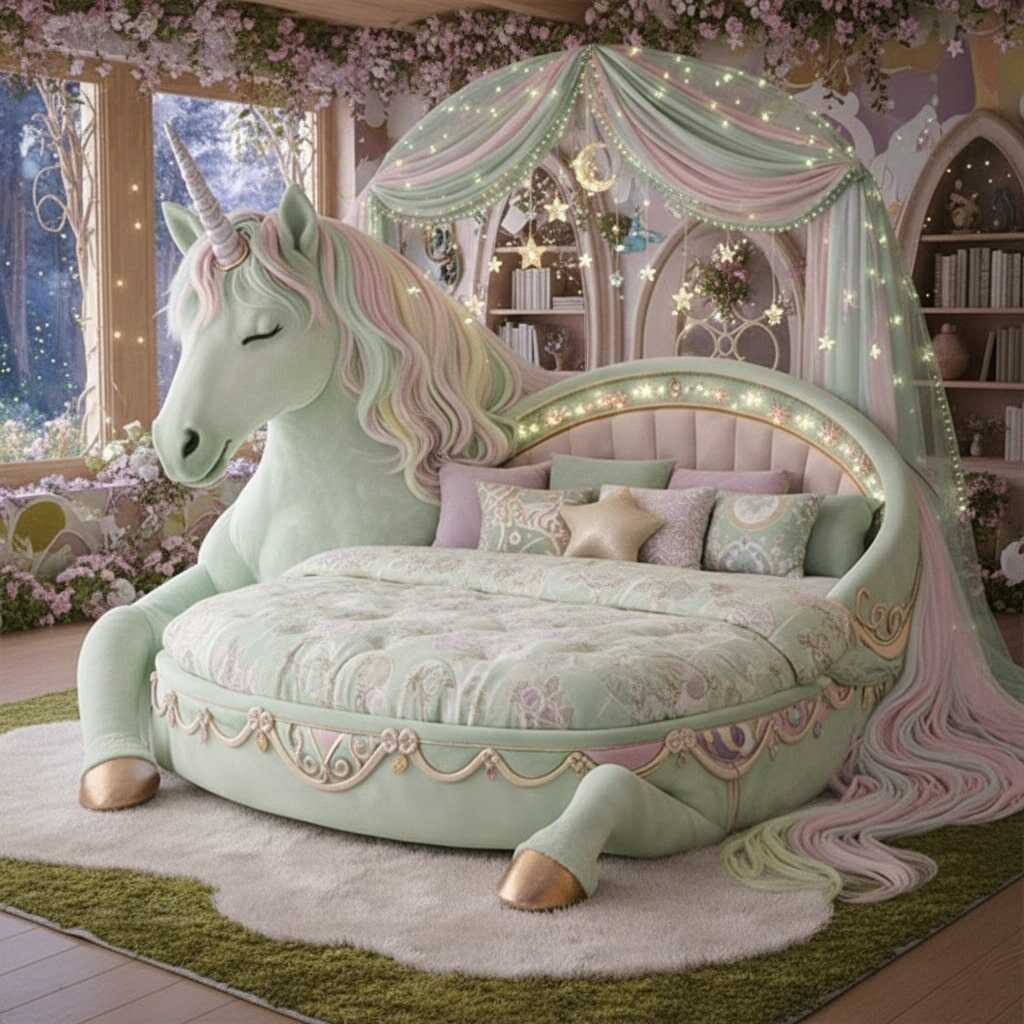
Part I: The Mythic Resonance—Why the Unicorn Endures
To understand the power of Unicorn Beds, we must first return to the mythos from which they spring. The unicorn is not a modern invention; its lineage stretches across millennia and cultures. In ancient Mesopotamian seals, in Indus Valley iconography, in Chinese qilin lore, and later in Greco-Roman natural histories, the unicorn appears as a liminal being—part beast, part spirit—elusive, noble, and fiercely independent. Medieval bestiaries depicted it as untamable except by innocence: only a pure-hearted maiden could lure it from the forest, a narrative that evolved into associations with grace, healing, and divine grace.
Unlike dragons—often adversaries to be slain—or griffins, guardians of treasure, the unicorn rarely represents raw power or dominion. Instead, it embodies potential: the miraculous made manifest in gentleness. Its horn, the alicorn, was believed to purify poisoned waters, to detect deceit, to heal the incurable. In this, the unicorn speaks to an ageless yearning—not for conquest, but for restoration, for truth, for the revelation of hidden goodness.
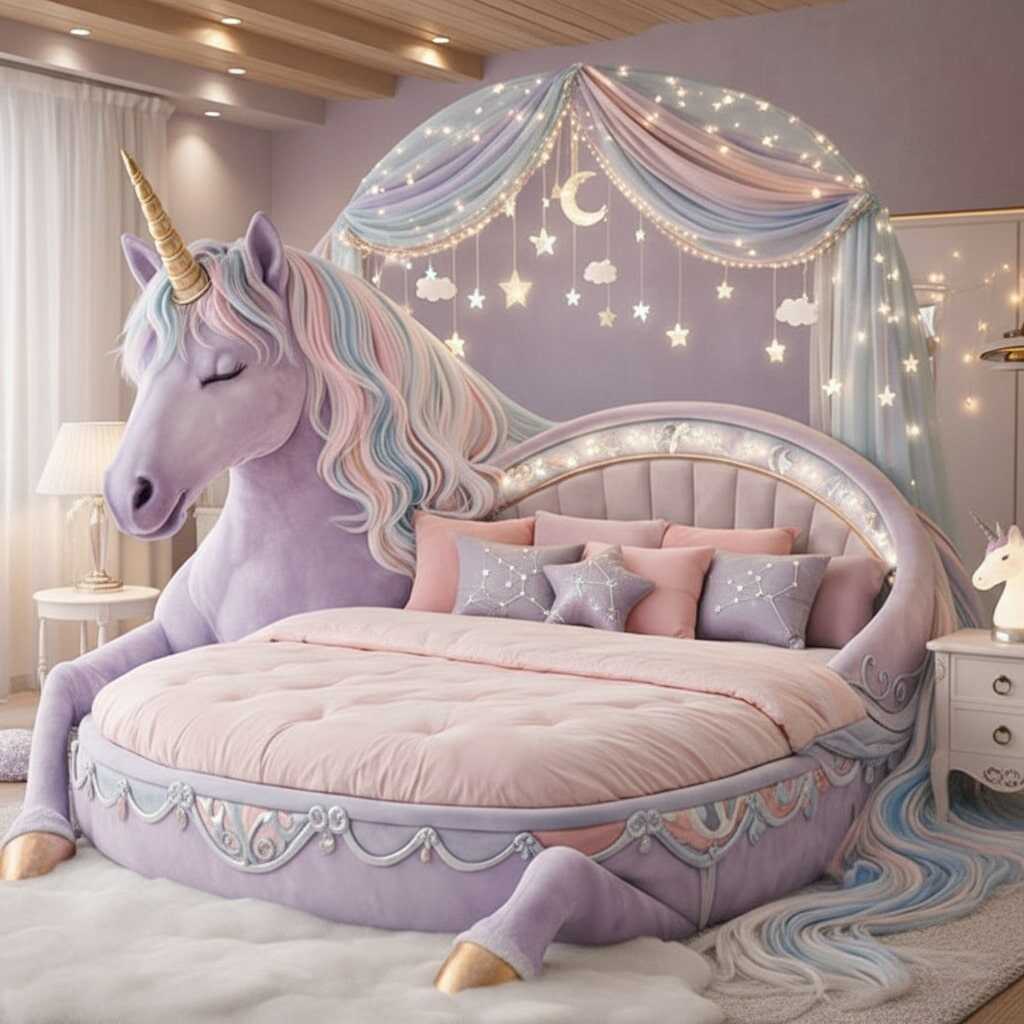
For the modern child, raised in a world of concrete schedules and digital saturation, the unicorn offers something radical: permission to believe in the unseen. It is a creature of both/and—wild yet tender, solitary yet deeply connected to nature, real in story though absent in taxonomy. In developmental psychology, such paradoxical figures are invaluable. They allow children to hold multiple truths simultaneously: that the world can be harsh and enchanted; that they can feel small and wield great inner strength.
When a child climbs into a Unicorn Bed, they are not simply lying down—they are entering into a covenant with myth. The bed becomes a vessel for this ancient dialogue. The arch of the unicorn’s neck framing the headboard is not mere decoration; it is a protective gesture, a silent vow: You are safe here. Your dreams matter. Your inner world is sacred. The very posture of the unicorn—often depicted mid-gallop, horn uplifted—suggests motion, ascent, transcendence. It whispers: Tonight, you, too, may soar.
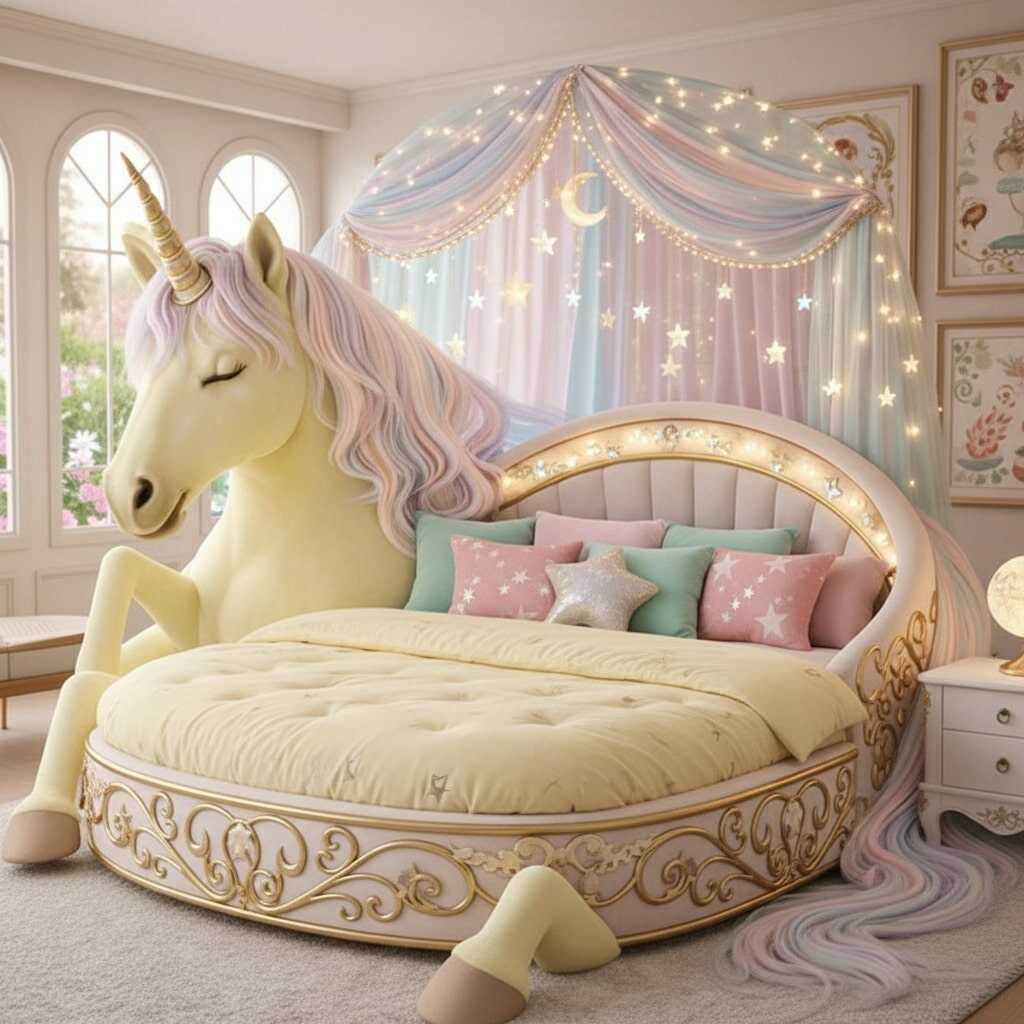
Part II: Architecture of Wonder—Design as Narrative Catalyst
The transformative power of Unicorn Beds lies not only in their symbolism but in their design intent—how form, texture, light, and scale conspire to activate the imagination. Unlike standardized furniture, which recedes into the background of daily life, a Unicorn Bed insists on presence. It is sculptural. It performs.
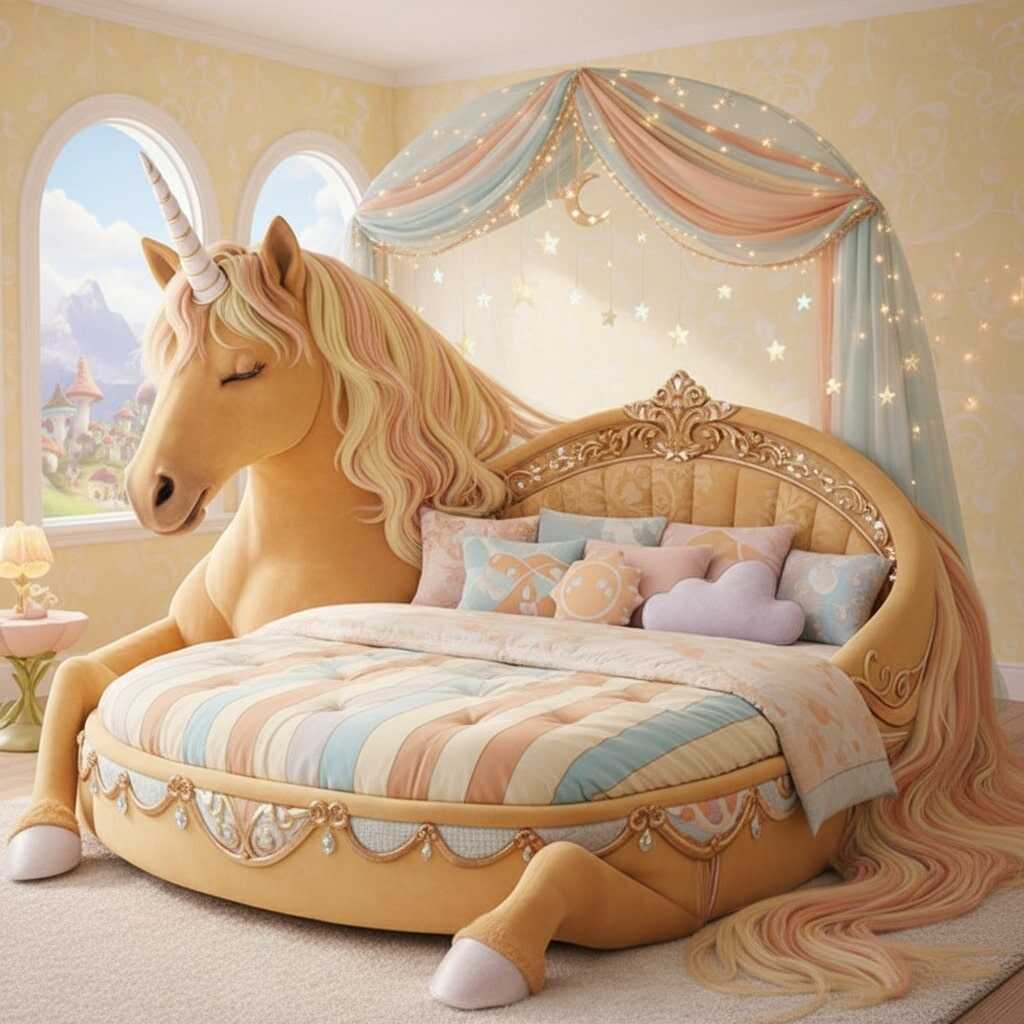
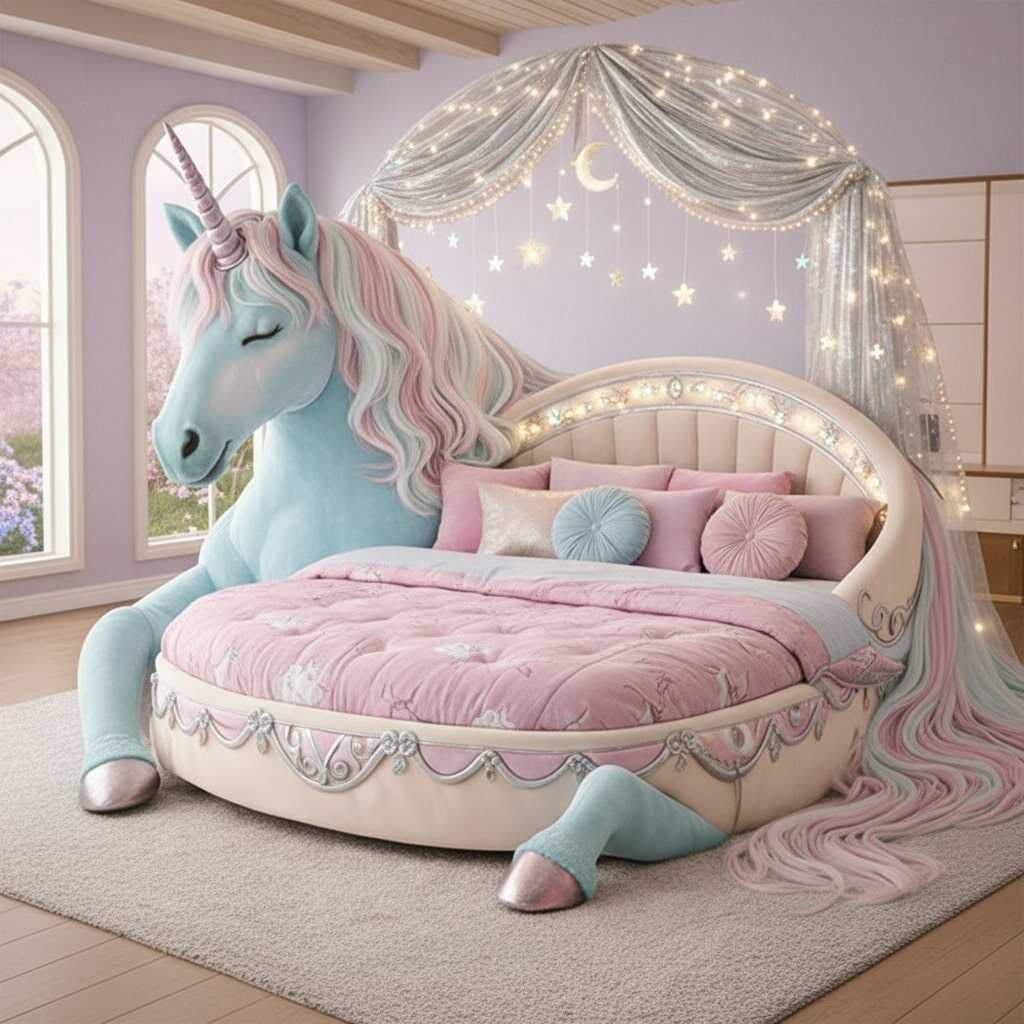
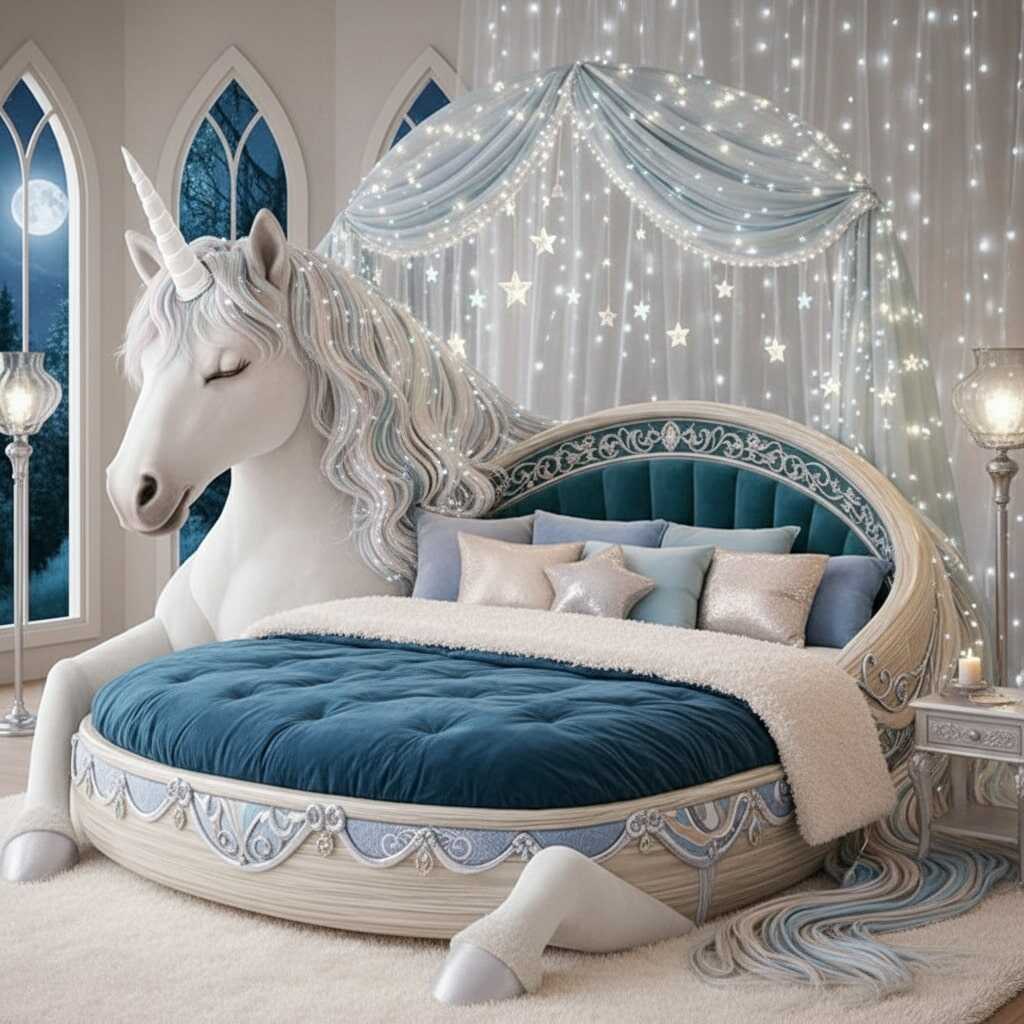
Consider the headboard: often carved from sustainable wood or molded composite, it may rise several feet above the mattress, culminating in a spiraled horn that catches the light. Some designs embed fiber-optic strands along the mane, mimicking starlight; others use layered acrylic to create a prismatic shimmer, so that as the child shifts position, colors bloom and fade like auroras. These are not flashy gimmicks—they are sensory invitations. The soft glow at twilight signals the transition from day to dreamtime, easing the nervous system into rest while simultaneously sparking curiosity: What magic lives in that light?
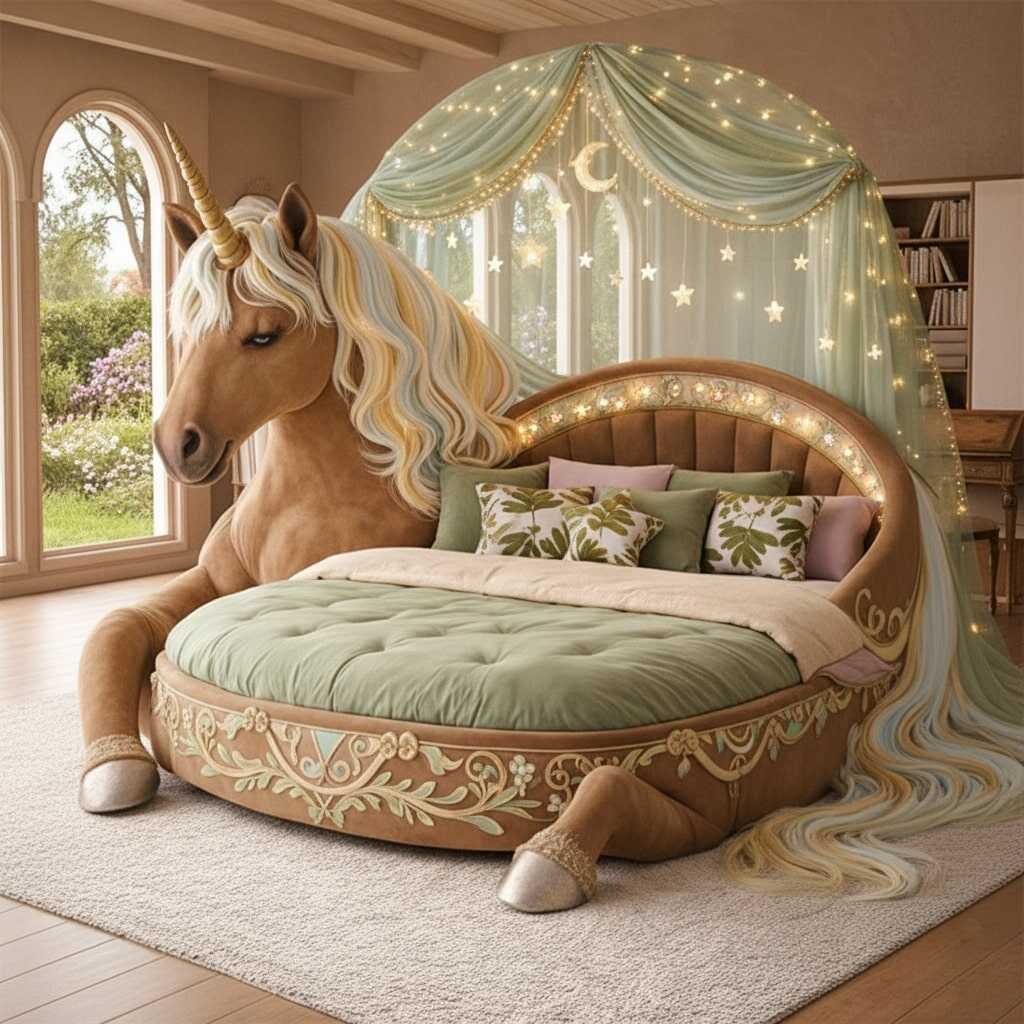
Then there is the canopy. Many Unicorn Beds incorporate draped fabrics—silvery gauze, iridescent tulle, or deep indigo velvet—evoking everything from moonlit glades to celestial vaults. A canopy is inherently theatrical: it frames, it conceals, it reveals. It turns the bed into a theater in the round, where the child is both audience and protagonist. Within this intimate enclosure, the rules of physics soften. Gravity loosens its grip. Here, a stuffed animal becomes a loyal steed; a flashlight, a wizard’s orb; a whispered word, an incantation.
Even the structural choices carry narrative weight. Beds on raised platforms suggest castles or cloud-islands; integrated drawers shaped like treasure chests or enchanted trunks encourage curated collecting—not of possessions, but of meaning. A smooth river stone, a fallen feather, a drawing of a three-headed dragon—each item placed within becomes part of the bed’s evolving mythology. The child is no longer just storing toys; they are archiving fragments of their inner epic.
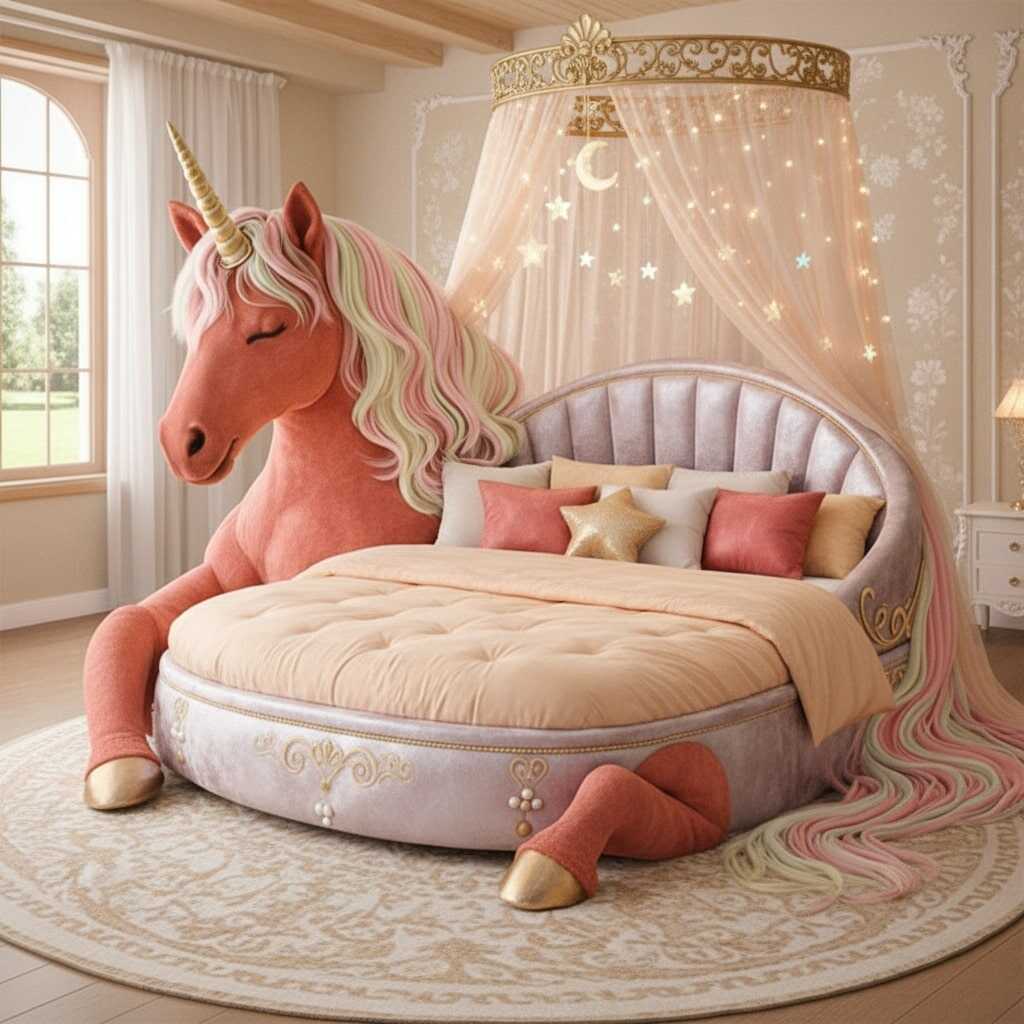
Moreover, Unicorn Beds often defy gendered expectations. Their palette—pearl, amethyst, seafoam, gold—draws from nature’s iridescence rather than binary coding. The unicorn itself resists categorization: neither wholly masculine nor feminine, it stands as a symbol of wholeness. In a world that pressures children to conform early, such design quietly affirms: You need not choose. You may be fierce and gentle. Bold and reflective. You may be many things at once.
Critically, these beds do not impose a story. They offer a setting—a rich, resonant environment in which the child becomes author. The unicorn does not speak; it listens. It does not command; it invites. This distinction is vital. Imagination flourishes not under directive, but under suggestion. A blank page is paralyzing; a single line—Once, there was a unicorn who could only be seen at dawn—unleashes a thousand stories. Unicorn Beds provide that first, luminous line.
Part III: The Bedroom Re-enchanted—From Space to Sanctuary
A bedroom with a Unicorn Bed undergoes a profound metamorphosis—not in square footage or material value, but in atmosphere. It shifts from functional zone to emotional ecosystem. This transformation ripples outward, influencing how the child interacts with time, solitude, and selfhood.
Nighttime, for many children, is fraught with shadows—not just literal ones, but the uncertainties of growing up: separation anxiety, the weight of unspoken emotions, the disorientation of rapid cognitive development. A Unicorn Bed reframes the night not as a void to be endured but as a realm to be explored. The dread of darkness gives way to anticipation: What will the unicorn show me tonight? Will we ride through crystal caves? Will we meet the moon-fox who guards the dream-gates? Sleep becomes an adventure, not an erasure.
This reframing has tangible psychological benefits. Studies in environmental psychology demonstrate that spaces imbued with personal meaning reduce cortisol levels and increase feelings of security. When a child feels seen by their environment—when their room reflects their inner world back to them in symbolic form—they develop stronger self-concept and emotional regulation. The Unicorn Bed, as anchor of this symbolic landscape, becomes a companion in resilience. On difficult days, the act of burrowing beneath the canopy is not escape—it is recalibration. It is returning to a place where one is inherently worthy, inherently magical.
Furthermore, the presence of such a bed cultivates what philosopher Gaston Bachelard called “the poetics of space”—the idea that intimate environments shape our capacity for reverie. A child who regularly engages in imaginative play within a richly symbolic setting develops stronger narrative intelligence: the ability to construct coherent internal stories, to empathize with others’ perspectives, to envision alternative futures. These are not “soft skills”; they are foundational to ethical reasoning, creative problem-solving, and existential courage.
Parents and caregivers often report subtle shifts beyond the child’s experience. The bedroom itself becomes a site of shared storytelling—where bedtime is no longer a struggle but a ritual of co-creation. Grandparents recount unicorn tales from their own childhoods; siblings invent elaborate continuities; even pets are woven into the mythology (“Sir Whiskers is the unicorn’s shadow-guardian, remember?”). The Unicorn Bed, in this sense, is a hearth—not for fire, but for narrative warmth.
And because unicorns belong to no single culture, the bed becomes a nexus for cross-cultural exploration. A child might learn about the kirin of Japan, the shadhavar of Persian lore, or the narwhal—nature’s own unicorn—of the Arctic seas. The myth expands, carrying with it geography, ecology, and history. The bedroom, once a private refuge, becomes a microcosm of global wonder.
Perhaps most profoundly, Unicorn Beds teach reverence for the unseen. In an age of hyper-rationalism and screen-mediated experience, they affirm that not everything of value can be measured or captured. The unicorn’s power lies in its elusiveness—in the fact that it vanishes when pursued directly, revealing itself only in moments of stillness and openness. The bed, then, is a daily reminder: Pay attention. The extraordinary is adjacent to the ordinary. It blooms in the margins of attention, in the hush between breaths.
Conclusion: The Horn That Points Inward
A Unicorn Bed is not an escape from reality—it is an expansion of it. It does not promise that the world is already perfect, but insists that it is perfectible—that we carry within us the capacity to envision, to heal, to transform. The unicorn’s horn, in myth, does not strike or conquer; it purifies. It turns poison to water. In symbolic terms, it represents discernment, intuition, the inner compass that guides us toward truth when external noise grows overwhelming.
For the child who sleeps beneath its arc, the Unicorn Bed becomes a silent mentor in this art of inner navigation. Night after night, it models a different way of being: one rooted in gentleness, attuned to mystery, unafraid of solitude. It does not teach obedience to the world as it is, but fidelity to the world as it could be—a world where difference is luminous, where vulnerability is strength, where every heart holds a hidden horn waiting to gleam.
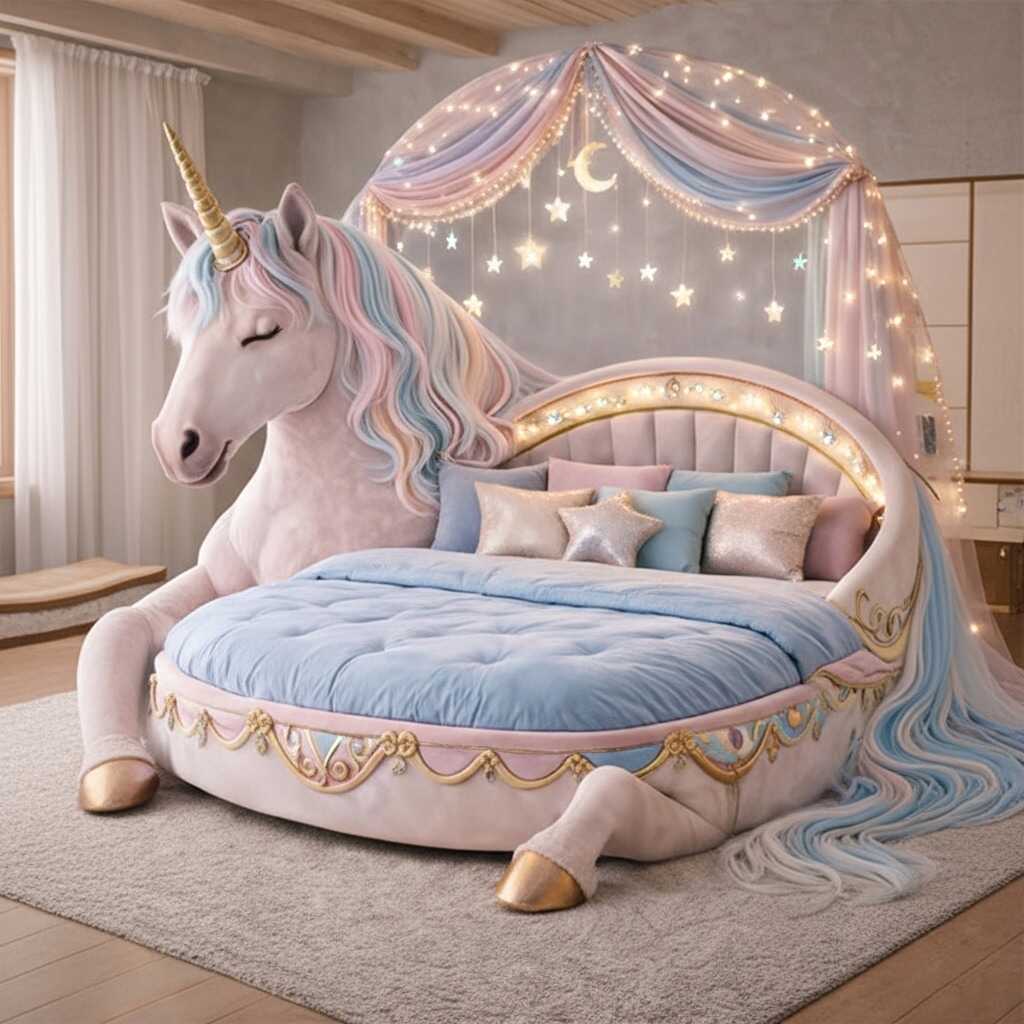
As we grow older, many of us outgrow such beds—physically, at least. But the imprint remains. Decades later, the memory of that horn catching the moonlight may surface in an artist’s brushstroke, a scientist’s leap of insight, a teacher’s patience, a leader’s compassion. The child who once whispered secrets to a wooden unicorn may become the adult who dares to imagine justice, sustainability, grace—not because they were told to, but because, for a time, they lived inside a story that made such things feel inevitable.
In the end, Unicorn Beds do not merely furnish a room. They cultivate a way of seeing. They remind us that imagination is not frivolity—it is the first draft of reality. And perhaps, in a quiet bedroom on a winter night in 2025, a child pulls the iridescent curtain closed, curls beneath the stars woven into the canopy, and begins, softly, to dream—not of unicorns, but as one: rare, resilient, radiant, and real.
For in the space between waking and sleep, between wood and wonder, between child and cosmos—that is where magic takes root.
And from such roots, entire worlds grow.