
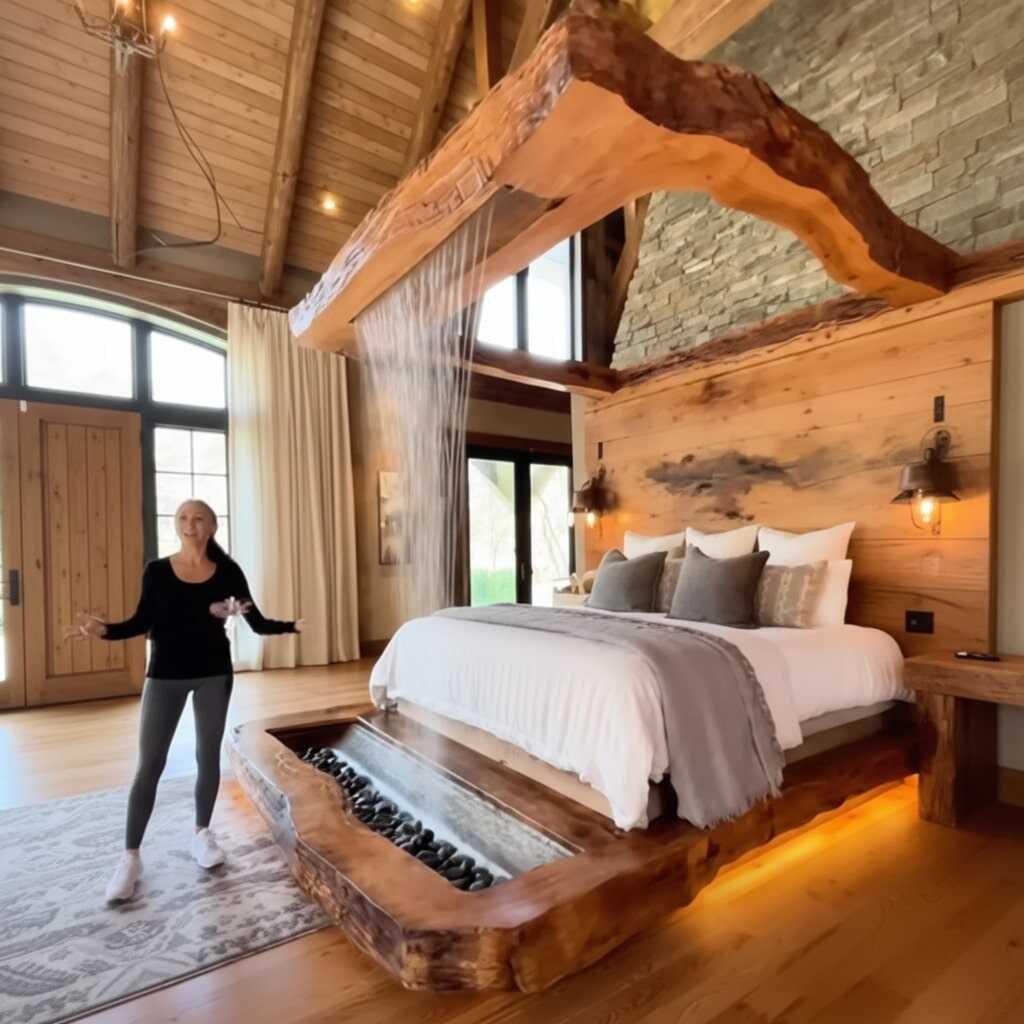
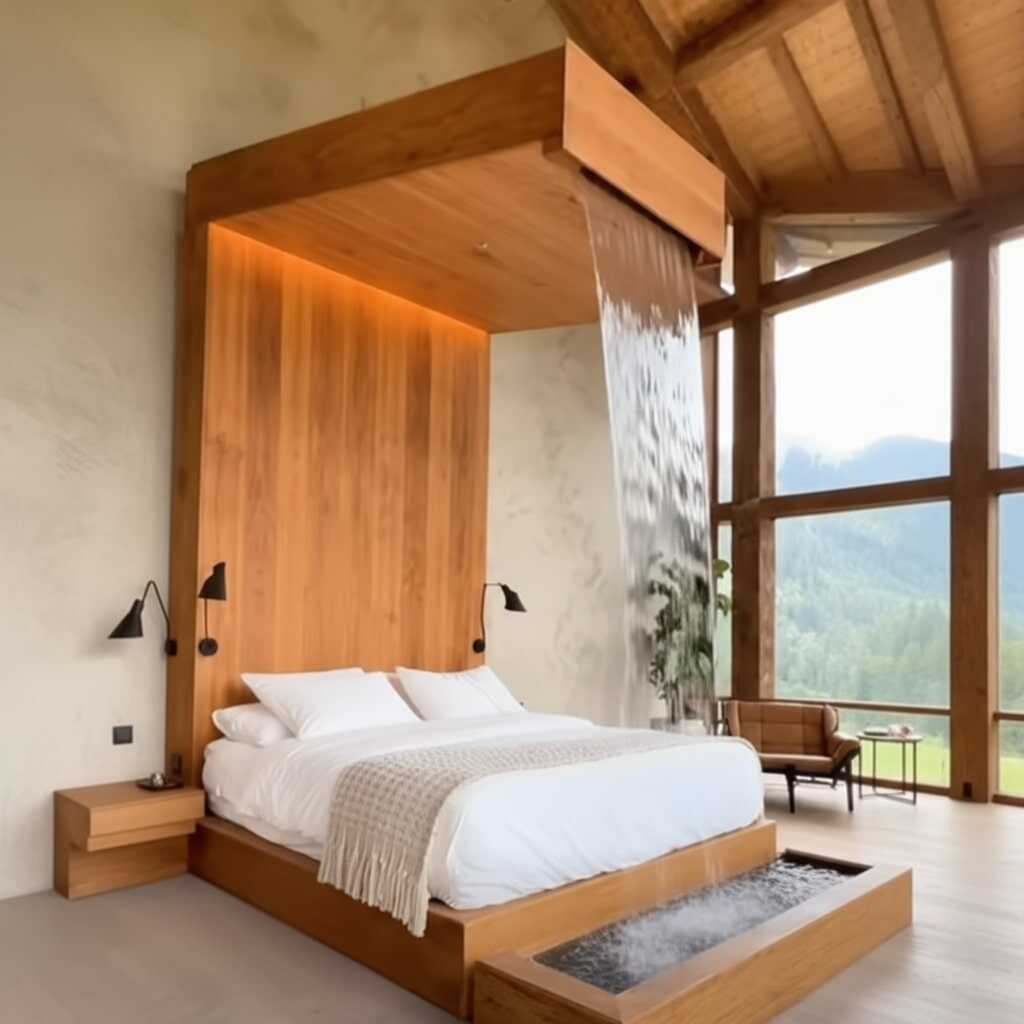
In the realm of furniture design, certain forms transcend utility to become statements—objects that fuse craftsmanship, aesthetics, and cultural resonance into a singular piece. Among these, the Waterfall Bed occupies a rarefied position: simultaneously emblematic of mid-century modern innovation and timeless elegance, it stands as a paradigm of how form can echo natural phenomena. The term “Waterfall Bed” does not denote a bed that produces water, nor does it refer to literal cascades—but rather to a distinctive visual motif: the smooth, uninterrupted descent of wood grain or veneer from the headboard (and often footboard), flowing downward like liquid over a precipice. This illusion of motion, of arrested gravity, is what gives the Waterfall Bed its name and enduring fascination.
To encounter a Waterfall Bed is to be drawn into a dialogue between material and imagination. It evokes not only the serene power of falling water—calm yet relentless, graceful yet elemental—but also the mid-century designer’s reverence for organic forms, streamlined silhouettes, and the honest expression of materials. Though rooted in a specific historical moment, the Waterfall Bed continues to inspire reinterpretations and remain a coveted artifact in design-conscious interiors. This article explores the phenomenon in depth: tracing its origins in the furniture workshops of the 1930s and ’40s, unpacking its defining design features and technical ingenuity, and highlighting iconic examples that cemented its status in the canon of American and global design. More than a stylistic footnote, the Waterfall Bed reveals how furniture can embody a philosophy—an ethos of harmony between human intention and natural expression.

Part I: Origins — From Art Deco Curves to Mid-Century Momentum
The Waterfall Bed did not emerge in isolation. Its lineage can be traced through overlapping currents in early 20th-century design, particularly the transition from the ornate symmetry of Art Deco to the functional minimalism of the International Style—and the uniquely American synthesis that became known as Streamline Moderne and, later, Mid-Century Modern.
In the late 1920s and early 1930s, Art Deco dominated high-end interiors with its geometric rigor, lacquered surfaces, and motifs drawn from antiquity and industry. Yet even within this formal language, a softer, more biomorphic tendency began to emerge—especially in France, where designers like Émile-Jacques Ruhlmann employed luxurious veneers in gently curving forms. However, it was not in Paris but in the burgeoning furniture manufacturing centers of the American Midwest—Grand Rapids, Michigan, and Jamestown, New York—where the Waterfall aesthetic truly took hold.
Here, affordability, mass production, and changing domestic ideals converged. The Great Depression necessitated cost-effective methods, and new techniques in wood veneering offered a solution: thin slices of highly figured wood (such as walnut, maple, or birch) could be bent and laminated onto curved plywood substrates, yielding rich visual effects without the expense of solid hardwood carving. This technical innovation was crucial. The “waterfall” edge—the signature cascade of grain—was achieved not by shaping solid wood (prohibitively difficult and wasteful) but by carefully matching and wrapping veneer sheets over the curved front edges of headboards and case pieces. As the veneer bent downward beyond the horizontal plane, the grain appeared to pour over the edge, uninterrupted, in a seamless, liquid fall.
The term “Waterfall” itself likely originated in trade catalogs of the late 1930s. Companies such as Heywood-Wakefield, Ethan Allen, and Bassett Furniture began marketing bedroom suites featuring this distinctive edge treatment, often under names like “Cascade,” “Streamline,” or explicitly “Waterfall.” These suites were marketed toward the growing middle class—modern, aspirational, and eager for stylish yet attainable furnishings for the postwar home. Unlike European modernism, which often rejected ornamentation outright, American designers retained a sense of warmth and tactility. The Waterfall Bed was modern, yes—but it was also inviting: its curves softened the austerity of modernism, its wood grain offered natural variation, and its proportions were domestic rather than institutional.
By the 1940s and ’50s, the Waterfall style had matured into one of the most recognizable idioms of American bedroom furniture. Its popularity peaked during the postwar housing boom, when millions of new suburban homes required complete, coordinated interiors. The Waterfall Bed, typically part of a matching suite including a dresser, nightstands, and chest, became a symbol of domestic order and contemporary taste. Though later dismissed by some critics as “kitsch” during the minimalist ascendencies of the 1970s and ’80s, the Waterfall Bed endured—preserved in vintage markets, mid-century revivals, and the quiet admiration of design historians who recognized its ingenuity and expressive power.

Part II: Design Features — Anatomy of a Fluid Form
What distinguishes a true Waterfall Bed from other curved or laminated headboards? The answer lies in a constellation of interrelated design elements—material, construction, silhouette, and visual rhythm—that work in concert to produce the signature effect.
1. The Waterfall Edge: Veneer as Continuum
At the heart of the design is the continuous grain flow. Unlike a beveled or rounded edge where the surface terminates abruptly—or a laminated edge where a separate banding piece is applied—the Waterfall Bed’s veneer is wrapped over the front edge and extends down the vertical face, often several inches or more. This demands extraordinary precision in veneer selection and application. The grain must be book-matched or slip-matched so that as it descends, it reads as a single, unbroken cascade. Designers favored woods with bold, linear figuring—American black walnut with its rich chocolate tones and pronounced cathedrals, curly maple with its shimmering ripple, or blond birch for a lighter, Scandinavian-inflected palette. The result is a kinetic illusion: when light moves across the surface, the grain appears to shift and flow, reinforcing the aqueous metaphor.
2. Curvilinear Silhouette and Structural Integration
The headboard (and, in full suites, the footboard) typically features a gentle, compound curve: convex at the top, transitioning into a concave or vertical descent. This is not arbitrary ornamentation but a response to both ergonomic comfort and visual harmony. The curve cradles the sleeper, offering subtle support for the back when sitting up in bed, while eliminating sharp corners that might disrupt the room’s flow. In more refined examples, the curve extends into the side rails or integrates with the bed’s framework, suggesting that the headboard is not an add-on but an organic extension of the whole.
3. Minimal Hardware and Concealed Joinery
Authentic Waterfall Beds eschew visible screws, brackets, or decorative hardware on the primary surfaces. Joinery—often involving dowels, biscuits, or hidden metal clips—is designed to disappear, preserving the purity of line. Drawer fronts on accompanying dressers continue the theme: flush-mounted, with pulls either recessed (finger pulls) or subtly integrated (such as small brass or bakelite knobs that recede visually against the wood). This restraint amplifies the sense of seamlessness—the furniture appears almost grown rather than assembled.
4. Proportional Harmony and Spatial Presence
Unlike the towering, canopy-draped beds of earlier centuries or the platform minimalism of later decades, the Waterfall Bed occupies a distinct middle ground. It is low-slung but not diminutive; architectural but not imposing. Its horizontal emphasis—reinforced by the long, flowing lines of the veneer—anchors the room without dominating it. In period interiors, this proportionality allowed the bed to coexist comfortably with other case pieces, all sharing the same design language. The effect is one of equilibrium: the bedroom becomes a cohesive environment, where each element supports the others in a quiet symphony of form.
5. Material Honesty and Surface Treatment
Though sometimes finished with lacquer for durability (especially in commercial or institutional settings), the finest Waterfall pieces were treated with oils or shellac to enhance the wood’s natural luster without masking its texture. The goal was material honesty—letting the wood speak for itself. This stands in contrast to later trends involving painted finishes or synthetic laminates, which, while practical, dilute the essential connection between the waterfall motif and the organic origin of the material.
It is worth noting that the Waterfall aesthetic was not confined to beds alone. The same principles governed dressers, vanities, and even radio cabinets—any piece where a horizontal surface met a vertical one became an opportunity for the cascade. Yet it is in the bed, the most intimate and essential piece of furniture, that the motif achieves its fullest emotional resonance. There, the waterfall becomes more than a design trick: it is a threshold between waking and dreaming, a gentle descent into rest.
Part III: Iconic Examples — Masters of the Cascade
While countless manufacturers produced Waterfall furniture, several designers and firms elevated the form to an art, creating pieces now celebrated in museums and design archives.
1. Paul Frankl and the “Skyscraper” Influence
Though better known for his stepped “Skyscraper” furniture—a quintessential Art Deco form—Paul Frankl experimented with fluid, biomorphic shapes in the late 1930s. His lesser-known Cascade Bed (c. 1938) features an exaggerated waterfall edge in Macassar ebony veneer, where the grain plunges almost vertically, creating a dramatic, almost geological effect. Frankl’s background in architecture informed his interest in structural metaphor: here, the waterfall suggests erosion, time, and the softening of rigid forms—a poetic counterpoint to his earlier urban motifs.
2. Russel Wright and American Modern
Industrial designer Russel Wright championed accessible modernism for the American home. His American Modern line (launched 1935) included bedroom furniture with subtle waterfall treatments in birch and maple. Wright prioritized user experience: his beds featured gently rounded edges for safety, easy-to-clean surfaces, and modular sizing. Though less flamboyant than Hollywood Regency interpretations, Wright’s Waterfall pieces embodied democratic design—beautiful, functional, and attainable. His influence extended beyond aesthetics; he helped standardize dimensions for mass production without sacrificing integrity.
3. Adrian Pearsall and the Jazz Age Inflection
Moving into the 1950s and ’60s, designer Adrian Pearsall reinterpreted the Waterfall motif with a bolder, more sculptural hand. His Gondola Bed (c. 1960), crafted by Craft Associates, features a deeply scooped headboard in walnut, with the veneer flowing in a wide, parabolic arc—less a trickle than a cresting wave. Pearsall often paired this with floating nightstands and cantilevered dressers, creating bedroom suites that felt dynamic, even performative. His work bridged Mid-Century Modern and the emerging Brutalist sensibility, proving the Waterfall form could evolve without losing its essence.
4. The Heywood-Wakefield “Blond” Suite
No discussion of Waterfall Beds is complete without acknowledging Heywood-Wakefield’s iconic Champagne and American Walnut lines. Their “Blond” suites—featuring light-stained birch with a gentle waterfall edge—became synonymous with 1950s suburban aspiration. Clean, cheerful, and meticulously engineered, these beds offered middle-class families a taste of modern sophistication. Though mass-produced, they exhibited remarkable consistency in veneer matching and finish, a testament to American manufacturing at its postwar zenith.
5. Contemporary Echoes: Gaetano Pesce and Experimental Revivals
In recent decades, designers have revisited the Waterfall concept with conceptual rigor. Gaetano Pesce’s Up Bed series (1969–present), while not a literal waterfall, shares its interest in fluid, anti-orthogonal form—his poured resin pieces evoke geological strata and liquid suspension. More directly, contemporary artisans like Dakota Jackson and the Brooklyn-based Workstead studio have produced limited-edition beds using steam-bent solid wood and digital veneer mapping to achieve hyper-precise grain continuity, honoring the tradition while pushing its technical boundaries.
These examples illustrate a crucial truth: the Waterfall Bed is not a static style but a design principle—one that invites reinterpretation across eras and ideologies. Whether expressed in Depression-era pragmatism, postwar optimism, or 21st-century craftsmanship, it remains tethered to a core idea: that furniture can embody natural forces, and that rest itself can be framed as a return to elemental grace.
Conclusion: The Enduring Flow
The Waterfall Bed endures not because it is nostalgic, but because it answers a perennial human desire: to dwell in harmony with natural rhythms. Its cascading lines are more than aesthetic—they are a visual haiku on continuity, transition, and gentle descent. In an age of digital fragmentation and angular minimalism, the Waterfall Bed offers a counter-narrative: one of warmth, tactility, and quiet poetry.
To study its origins is to recognize the ingenuity of anonymous craftsmen in Midwestern factories, bending veneer with steam and patience; to analyze its design is to appreciate the synthesis of engineering and artistry; to view its iconic manifestations is to witness how a single motif can ripple across decades, adapting without dissolving.
Ultimately, the Waterfall Bed reminds us that the most resonant design does not shout—it flows. It does not interrupt—it integrates. And in the hush of a bedroom, as lamplight glides over the descent of grain, one can almost hear the distant, soothing sound of water—timeless, unhurried, falling not into oblivion, but into rest.