
Where Function Meets Macabre Symbolism
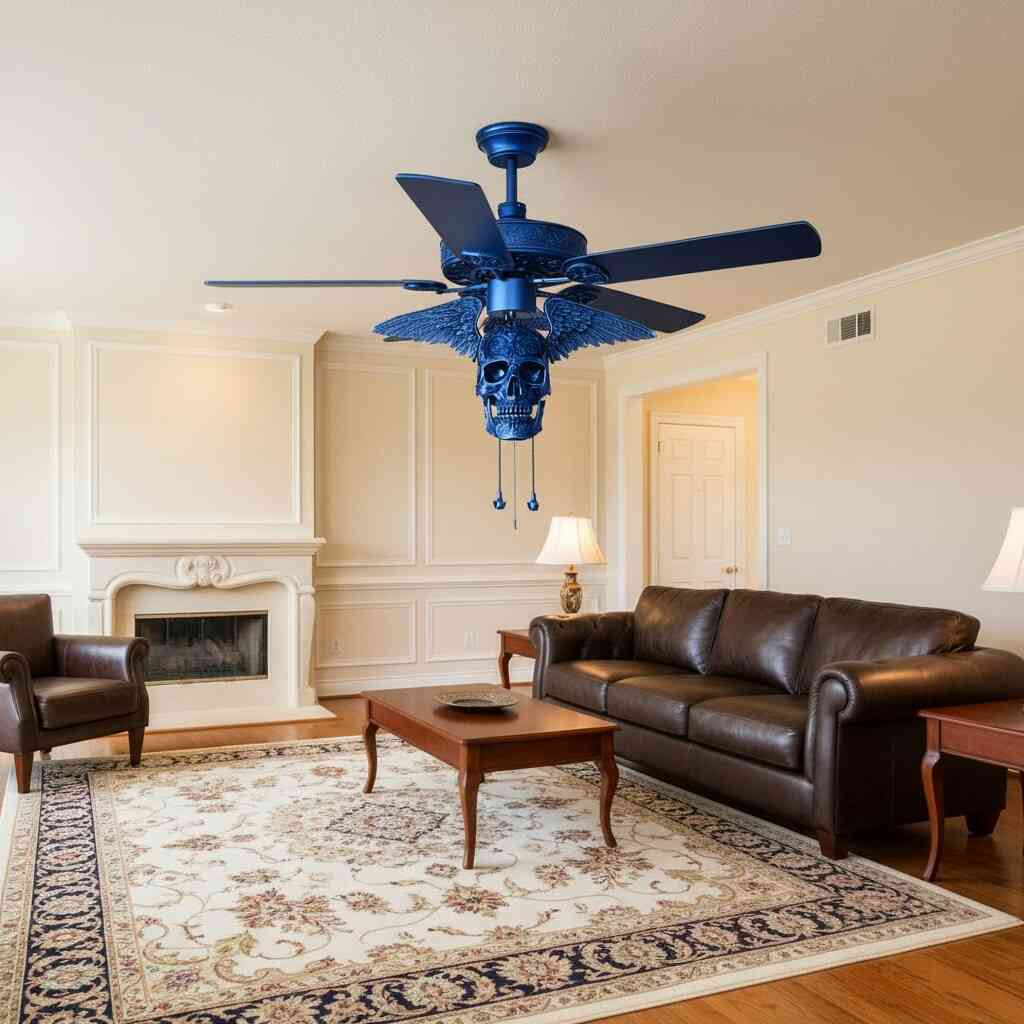
In the evolving tapestry of interior design, few motifs carry the enduring weight, cultural resonance, and aesthetic magnetism of the skull. Once relegated to the peripheries of subculture and countercultural expression, the skull has undergone a quiet but profound metamorphosis—transitioning from a shorthand for rebellion or mortality into a sophisticated, even reverent, design element. Within the niche yet deeply expressive realm of Gothic interior design, this transformation has culminated in one of the most unexpected yet symbolically potent fixtures of the modern era: the skull themed ceiling fan.
At first glance, the notion of integrating a skull—a universal emblem of death, impermanence, and existential reflection—into a functional household object may strike some as jarring, even provocative. Yet this juxtaposition lies at the very heart of contemporary Gothic aesthetics: the harmonious fusion of utility and meaning, of daily life and metaphysical contemplation. The skull themed ceiling fan is not mere decoration; it is a deliberate architectural statement. Suspended at the nexus of vertical and horizontal space—the ceiling, where air and light converge—it becomes both a mechanical necessity and a philosophical anchor.
Gothic interior design, rooted in medieval ecclesiastical architecture, Victorian romanticism, and later infused with punk, industrial, and postmodern sensibilities, has always thrived on duality: light and shadow, decay and preservation, the sacred and the profane. In this tradition, the skull themed ceiling fan emerges not as a novelty, but as a natural evolution—a convergence of form, function, and semiotic depth. This article explores the ascendance of this singular object, tracing its lineage through art history, symbolic lexicons, and spatial theory, ultimately positioning it as a defining emblem of 21st-century Gothic interiority.
Part I: The Skull in Design History — From Memento Mori to Decorative Motif
To understand the resonance of the skull themed ceiling fan, one must first trace the skull’s long and layered journey through visual culture.
In medieval and Renaissance Europe, the memento mori—“remember you must die”—was not a morbid fixation but a spiritual discipline. Skulls appeared in devotional paintings, prayer books, and funerary monuments as invitations to humility, introspection, and ethical living. Artists like Hans Holbein the Younger embedded skulls anamorphically in masterworks such as The Ambassadors (1533), forcing viewers to confront mortality through an act of physical repositioning—a literal shift in perspective.
By the 17th century, vanitas still-life paintings elevated the skull to a central motif, surrounded by wilting flowers, hourglasses, and extinguished candles: transient symbols of earthly pleasures juxtaposed with the eternal silence of the skull. These were not celebrations of death but meditations on time, virtue, and the soul’s journey.
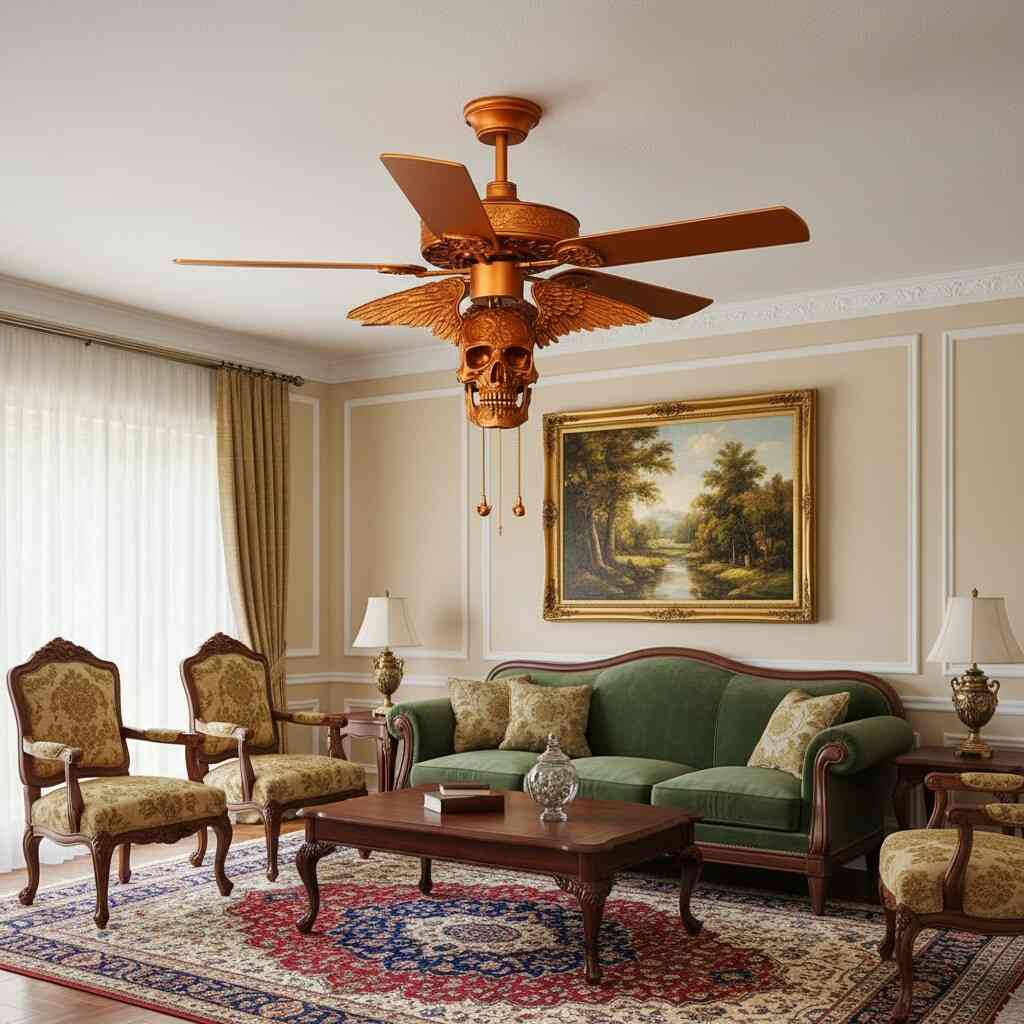
The Victorian era intensified this fascination, particularly after the Industrial Revolution and the trauma of widespread mortality (cholera epidemics, the Crimean War, and later the American Civil War). Mourning jewelry, post-mortem photography, and decorative arts integrated skulls and skeletal forms—not as ghoulish spectacles, but as tokens of remembrance and continuity. A skull carved into a chair back or etched into a mirror frame was an acknowledgment of love persisting beyond bodily dissolution.
Fast-forward to the late 20th century: punk, goth rock, and alternative fashion reclaimed the skull as a symbol of resistance—against conformity, consumerism, and sanitized modernity. Designers such as Vivienne Westwood and Alexander McQueen wove skulls into haute couture, stripping them of shock value and re-coding them as emblems of intellectual rebellion and aesthetic audacity.
Today, in high design and architecture, the skull has been de-fanged—not in the sense of being neutered, but refined. It no longer shrieks; it whispers. It is no longer a warning of doom but a quiet acknowledgment of finitude—elegant, austere, and deeply human. In this context, its application to architectural elements like lighting fixtures, hardware, and—most pivotally—ceiling fans, represents the full maturity of its symbolic journey.
Part II: Ceiling as Sacred Plane — Spatial Significance and Symbolic Suspension
Why the ceiling? And why a fan, of all things?
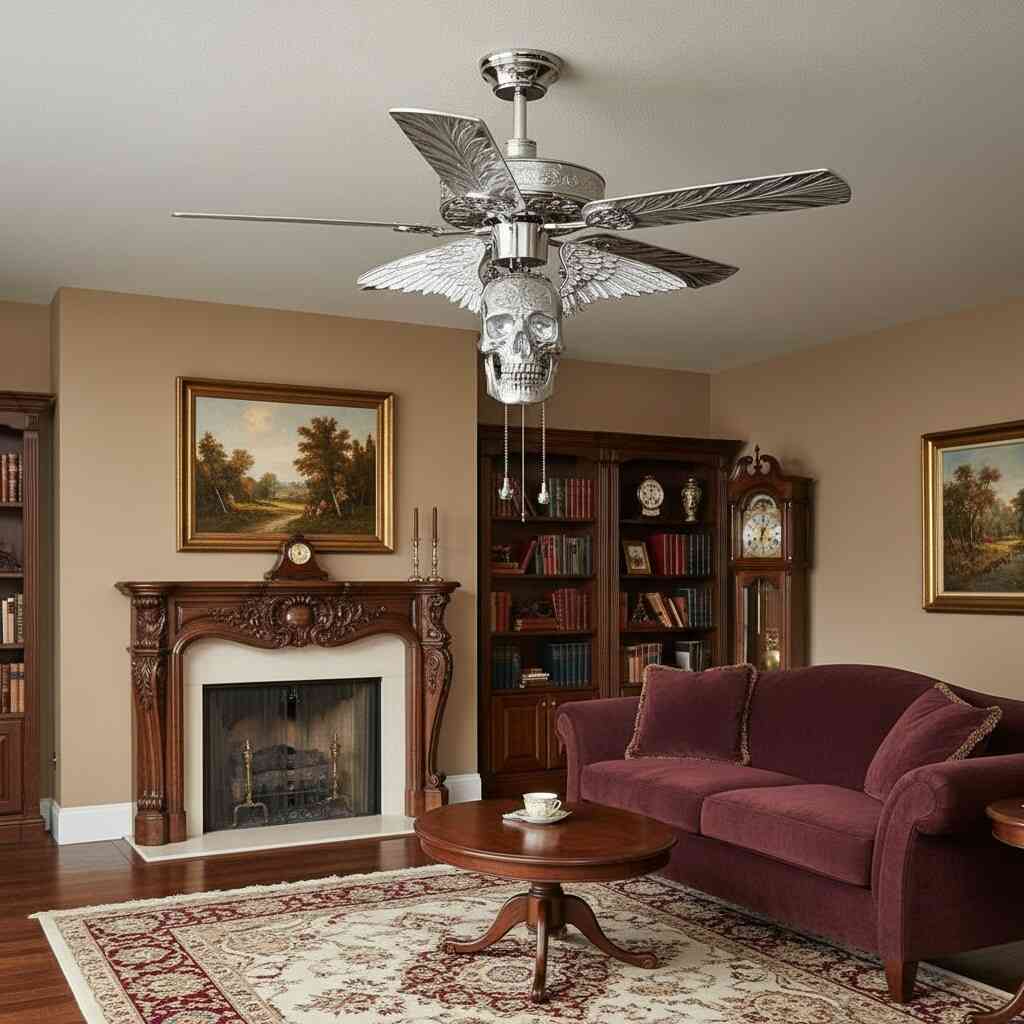
The ceiling occupies a uniquely liminal position in architectural psychology. It is the boundary between interior and structure, the threshold above which lies the unseen infrastructure of beams, wiring, and insulation—what architect Gaston Bachelard called “the realm of the roof,” a space of protection, dreams, and hidden forces. In Gothic cathedrals, vaulted ceilings soar heavenward, directing the gaze upward in devotion. In domestic settings, the ceiling is often ignored—a neutral canvas awaiting recessed lighting or crown molding.
Yet in Gothic interior design, ceilings are reclaimed as active zones of meaning. Exposed rafters, coffered beams, pendant chandeliers with wrought-iron skeletal arms—all serve to disrupt the modernist ideal of the “invisible” ceiling. To install a skull themed ceiling fan is to assert that the overhead plane deserves attention, reverence, even confrontation.
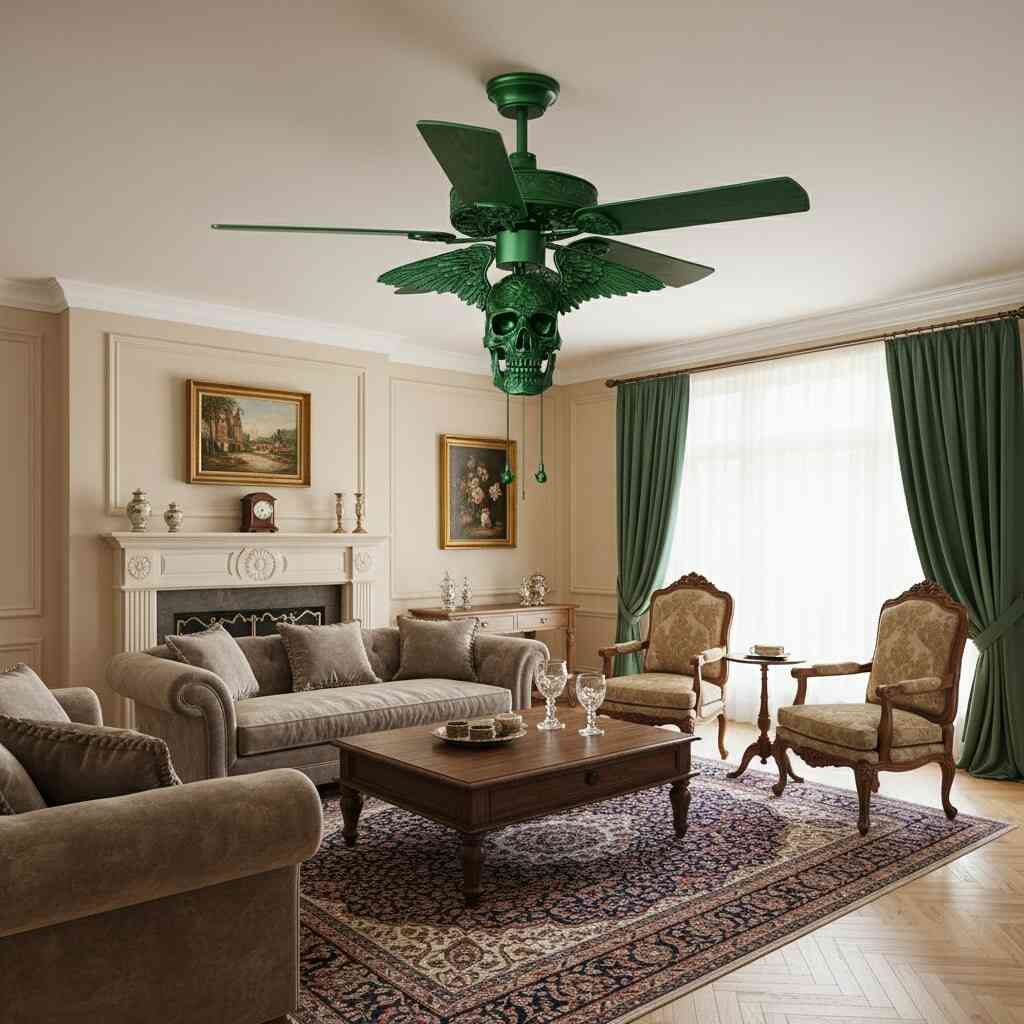
The ceiling fan itself—a device of circulation, breath, and climate regulation—takes on profound metaphorical weight when reimagined through the skull motif. Airflow is life: it cools, refreshes, prevents stagnation. In many esoteric traditions, breath (prana, qi, pneuma) is the animating force of being—the distinction between corpse and person. A skull themed ceiling fan, then, becomes a paradoxical life-giver shaped in the image of death: a mechanical anima, rotating in perpetual motion, exhaling vitality into the room it watches over.
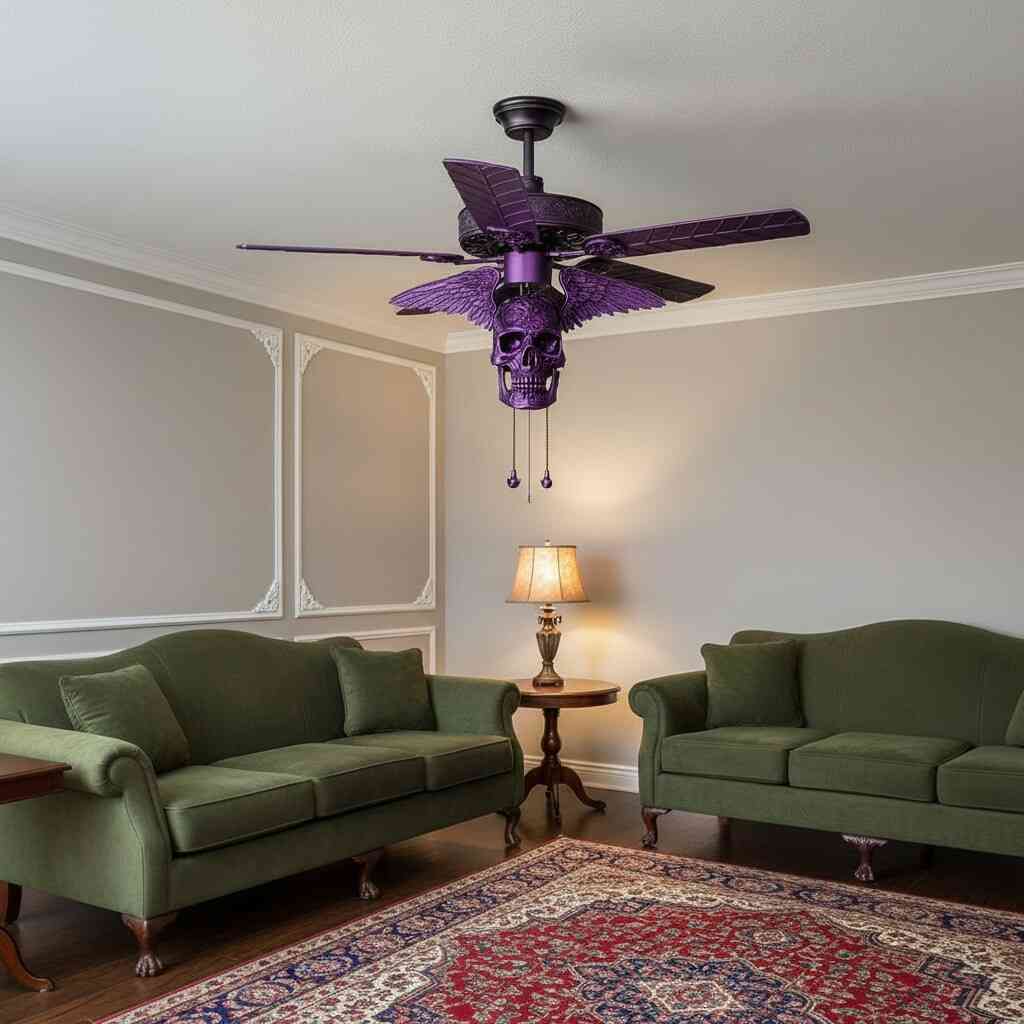
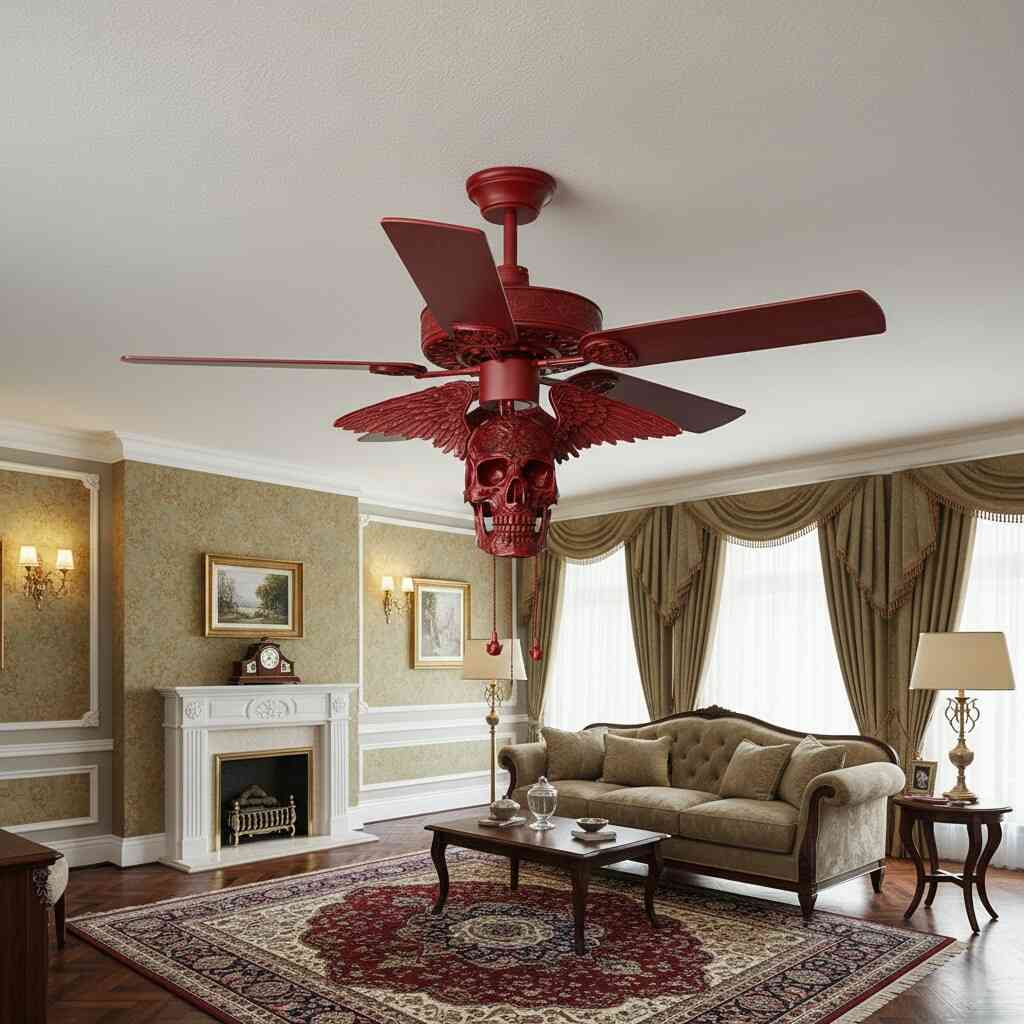
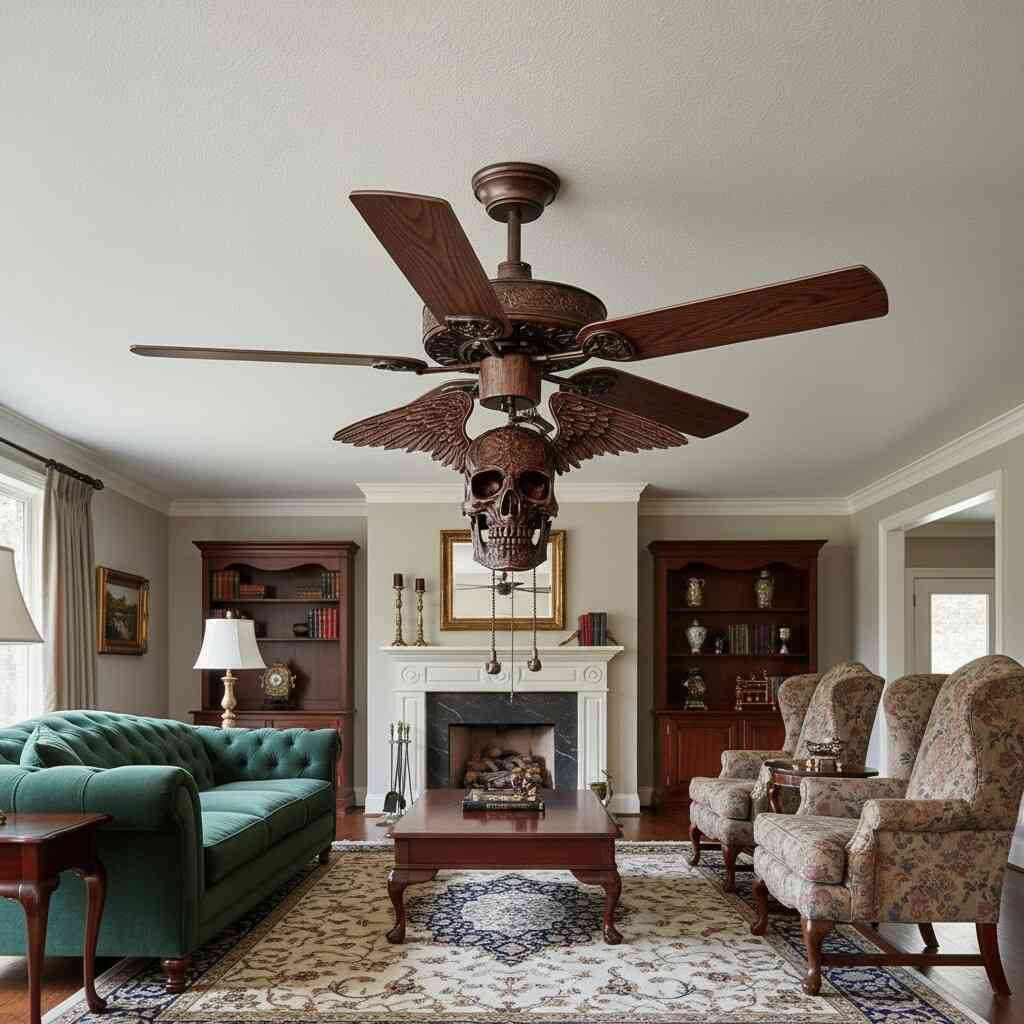
Consider the craftsmanship involved. High-end iterations feature cast-iron or bronze skulls—sometimes stylized, elongated, with exaggerated eye sockets and delicate filigree teeth—forming the motor housing or blade brackets. The blades themselves may curve like rib bones or taper like scapulae, each rotation echoing the cyclical motion of time, seasons, and breath. Light—when integrated—filters through ocular cavities or jaw hinges, casting shifting shadows reminiscent of sundials or chiaroscuro painting.
Spatially, the fan dominates the visual center of the room. Unlike a wall-mounted skull plaque or a coffee table book of anatomical engravings, it cannot be ignored. It moves. It hums. It asserts presence. In a Gothic interior—characterized by deep jewel tones, heavy drapery, antique wood, and layered textures—the skull themed ceiling fan becomes the gravitational center: a totem that unifies the aesthetic language below.
Moreover, its kinetic nature introduces a temporal dimension absent in static decor. A painting of a skull is fixed; a skull themed ceiling fan is performative. It spins—sometimes slowly, meditatively; other times with brisk urgency—inviting occupants to synchronize their inner rhythms with its motion. It is, in effect, a secular prayer wheel—a device for mindfulness, grounded not in dogma but in embodied awareness of impermanence and renewal.
Part III: The Contemporary Gothic Psyche — Interiority, Identity, and the Ethics of Ornament
The rise of the skull themed ceiling fan is not merely an aesthetic trend; it reflects a broader cultural recalibration of how we inhabit space and construct identity.
Gothic interior design, in its contemporary form, has shed its adolescent associations with angst and nihilism. Today’s practitioners are often scholars, artists, archivists—individuals who see beauty in patina, poetry in decay, and dignity in darkness. They reject the sterile minimalism that dominates mainstream interiors not out of contrarianism, but from a conviction that spaces should bear witness: to history, to emotion, to the complexity of human experience.
In such homes, every object tells a story—or invites one. A salvaged church pew becomes a dining bench; a taxidermy raven perches on a bookshelf beside volumes of Poe and Bataille; a mirror framed in blackened iron reflects not just the room, but the self—fragmented, layered, contingent. Into this ecosystem enters the skull themed ceiling fan, not as spectacle, but as participant.
Its presence signals a refusal to compartmentalize life’s dualities. It says: We live among reminders of death—and that is not morbid; it is clarifying. Philosopher Byung-Chul Han, in The Scent of Time, critiques modernity’s “frenetic standstill”—a culture obsessed with productivity, novelty, and distraction, severed from contemplative depth. The skull themed ceiling fan disrupts this. Its slow rotation demands deceleration. Its symbolism prompts reflection. It is ornament with ethos.
Furthermore, it challenges the neoliberal logic of domestic space as a site of optimization and efficiency. The modern smart home—voice-controlled, algorithmically climate-regulated, perpetually “upgrading”—positions the inhabitant as a user, not a dweller. Gothic interiors, by contrast, cultivate dwelling in Heidegger’s sense: a rooted, attuned, poetic habitation. A skull themed ceiling fan insists on the handmade, the symbolic, the irreducibly human. It does not “learn” your preferences; it asks you to meet it halfway—to live deliberately.
This is especially poignant in an era of ecological anxiety and digital saturation. As climate collapse looms and screens mediate more of our perception, the Gothic turn inward—toward texture, shadow, ritual—feels less like escapism and more like resistance. To install a skull themed ceiling fan is to declare that the home should be a sanctuary for the soul, not just the body. It is to acknowledge that beauty can reside in melancholy, that strength can be found in vulnerability, and that remembering death can make life more vivid.
Consider the emotional resonance in personal narratives. A writer installs one above her desk—its rhythmic whir a companion during late-night revisions, its gaze a silent witness to creation and doubt. A couple, grieving a loss, chooses one for their renovated study—not as a memorial per se, but as a quiet affirmation: death is part of the architecture of love. A queer artist paints theirs in iridescent lacquer, transforming the skull from universal symbol into a site of personal reclamation—of identity, survival, flamboyant resilience.
These are not transactions. They are acts of meaning-making.
Conclusion: The Rotating Icon — A New Archetype for Contemplative Living
The skull themed ceiling fan is more than a design object. It is a cultural artifact—one that embodies the shifting relationship between death, beauty, utility, and space in the early 21st century.
Its rise within Gothic interior design marks a maturation of the movement itself: no longer confined to clove cigarettes and Bauhaus records, but expanded into a holistic philosophy of dwelling—one that embraces shadow without succumbing to despair, honors memory without fetishizing the past, and finds grace in the ephemeral.
In spinning above us, the skull themed ceiling fan performs a silent liturgy. Each revolution stirs the air, redistributes light, disturbs dust motes into temporary constellations. It is a machine, yes—but also a mandala, a vanitas, a guardian. It does not frighten. It anchors.
Perhaps this is its most radical function: in a world that teaches us to look down—at phones, at screens, at feet hurrying toward the next obligation—it compels us to look up. To gaze into empty orbits and, in doing so, remember our own breath, our own pulse, our own fleeting, glorious presence in the turning world.
The ceiling, once ignored, becomes a site of communion.
The fan, once utilitarian, becomes an icon.
And the skull—long misunderstood—finally rests not in the grave, but in the home: not as an omen, but as a companion on the quiet, daily work of being alive.
In the end, the skull themed ceiling fan is not about death.
It is about how we choose to live—consciously, beautifully, unflinchingly—beneath its watchful, whirling gaze.