
In a world increasingly governed by haste—where breakfasts are gulped between emails, lunches devoured at desks, and dinners scrolled through on smartphones—the concept of dining as a deliberate, embodied practice has quietly receded. We eat to sustain, but rarely do we eat to be. Yet tucked within certain sanctuaries of design and contemplation lies an extraordinary convergence of architecture, nature, and ritual: the Koi Pond Dining Table.
More than a furnishing, more than a novelty, the Koi Pond Dining Table is a poetic statement—a deliberate architecture of presence. Imagine sitting at a table not of wood or stone alone, but of water: beneath a thick, transparent surface, a living ecosystem pulses gently. Koi, those elegant descendants of the common carp, glide in silent arcs of orange, white, and black, their movements fluid and unhurried, their presence ancient and serene. Above them, diners sip tea, break bread, converse in hushed tones—not separate from nature, but suspended within it. Here, the meal does not merely nourish the body; it becomes a meditation, a communion.
This article explores the layered significance of the Koi Pond Dining Table, not as a product to be acquired, but as a philosophical threshold—one that invites us to reconsider how space, time, and life intersect at the table. Through three reflective movements—The Architecture of Stillness, Rituals Beneath the Surface, and Temporal Harmony in a Flowing World—we delve into the profound quietude this singular design evokes. For in dining over serenity, we do not simply observe tranquility; we inhabit it.
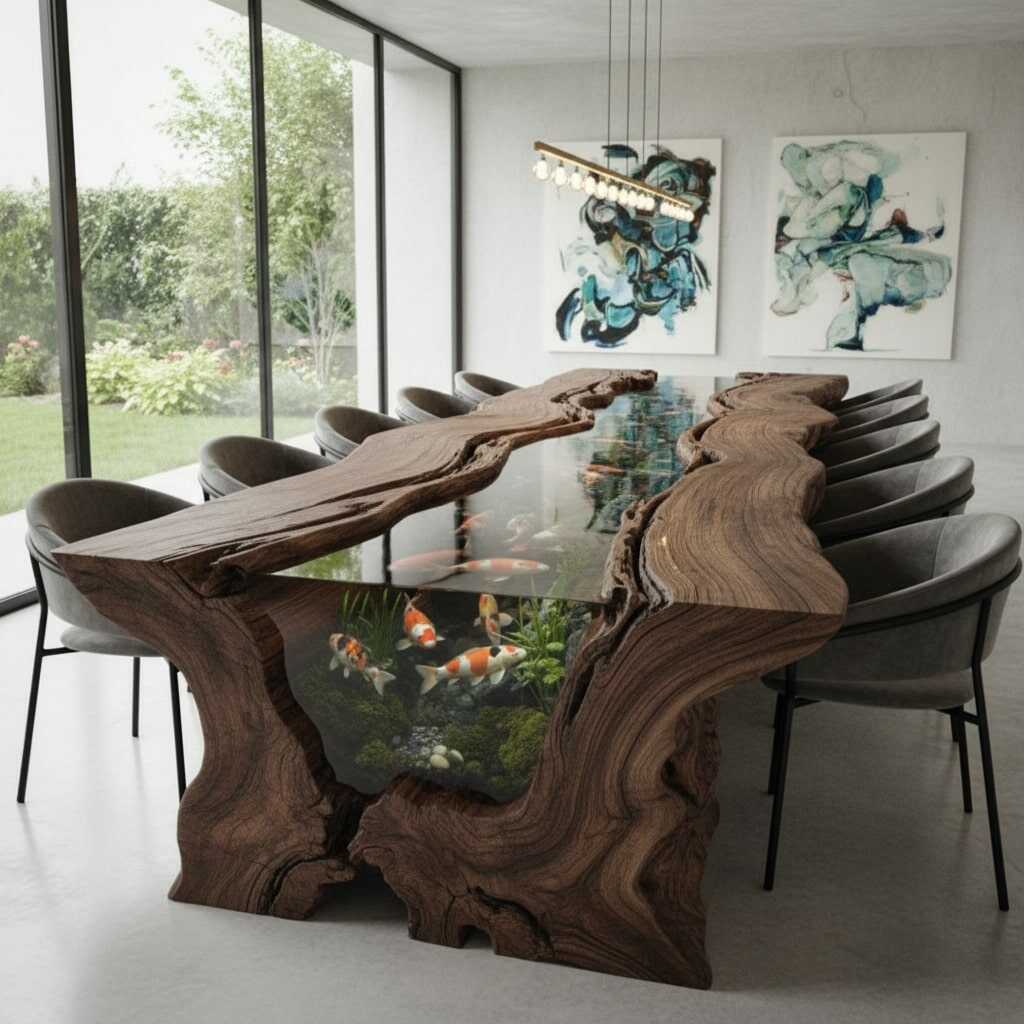
Part I: The Architecture of Stillness – Design as a Threshold Between Worlds
The Koi Pond Dining Table is, at its core, an architectural intervention—a carefully calibrated threshold that blurs boundaries: between interior and exterior, solid and liquid, human and non-human, action and contemplation. Unlike a window looking onto nature or a painting depicting it, the table integrates nature into the very plane of human interaction. It is not ornamental; it is structural—and in that structural honesty lies its power.
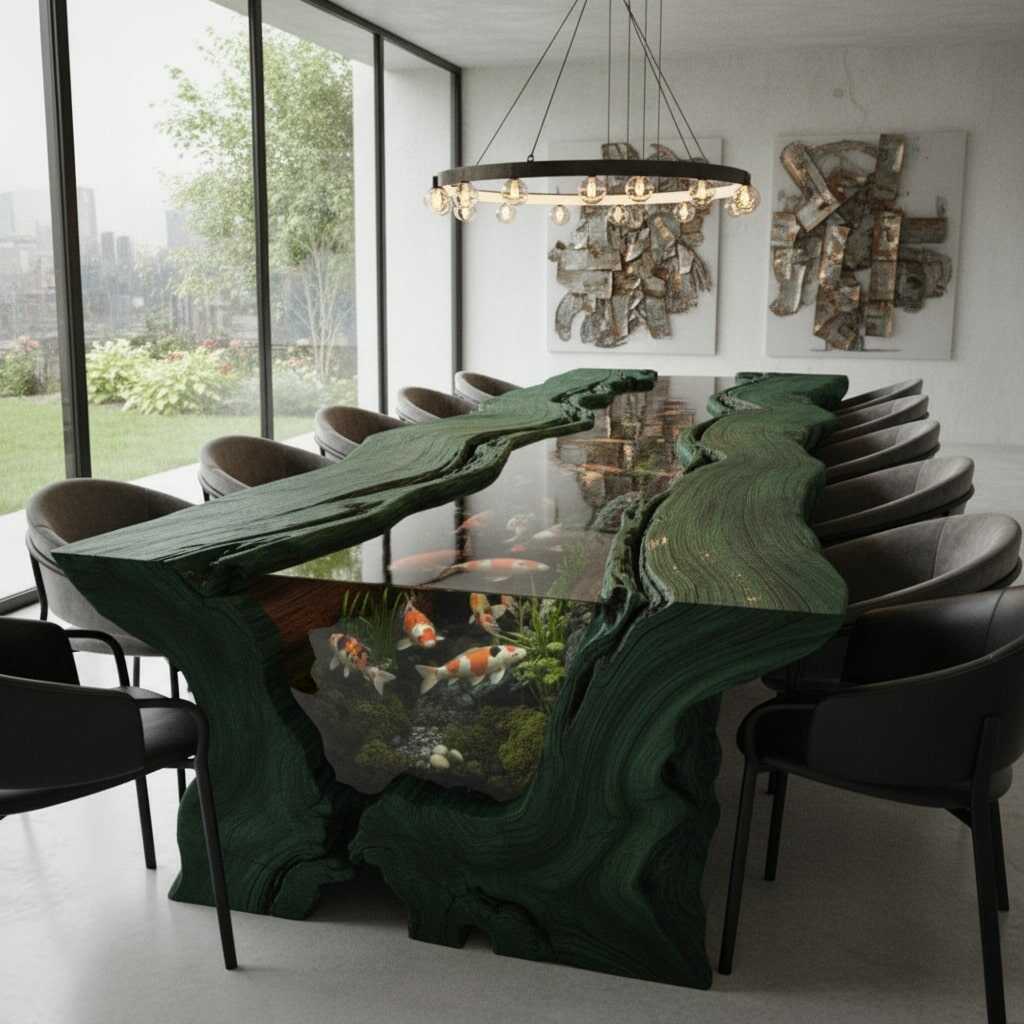
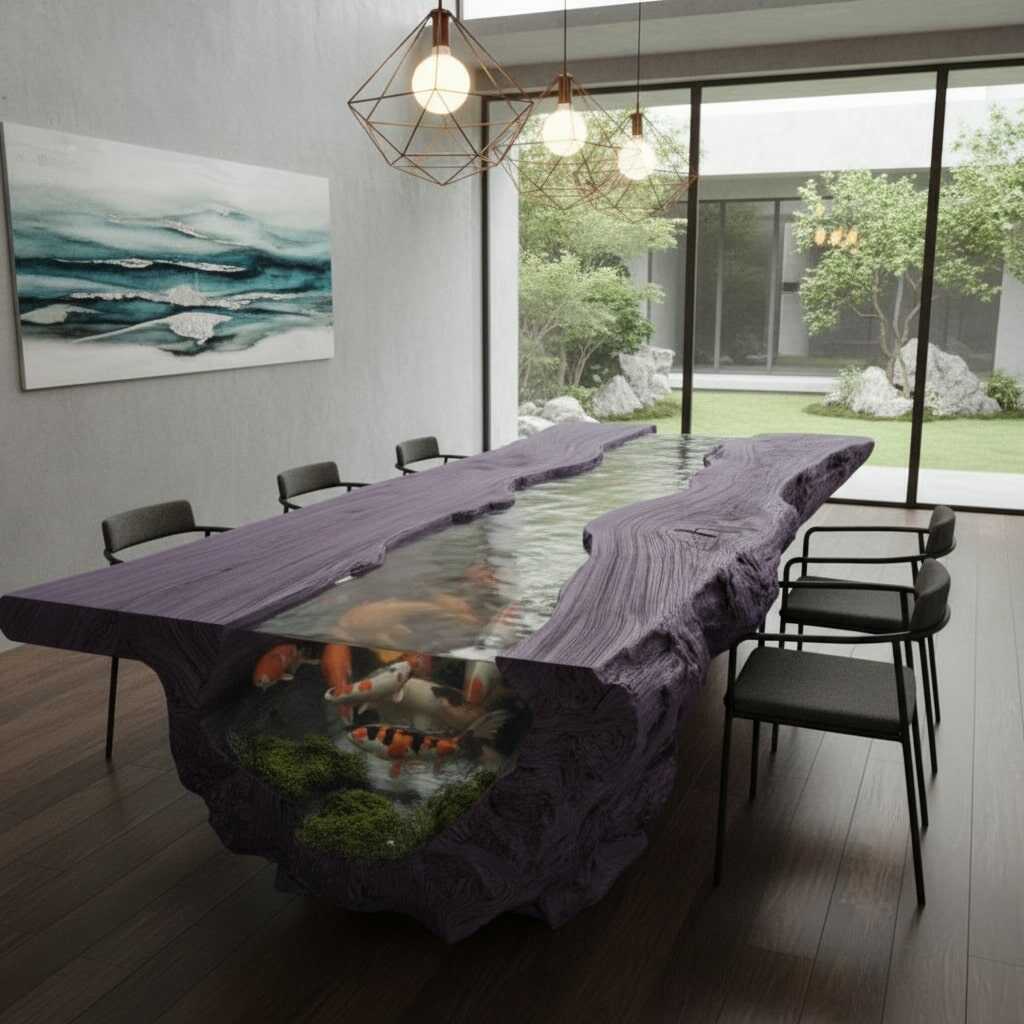
The design typically features a thick, tempered glass or acrylic surface—engineered for clarity, durability, and thermal neutrality—spanning a shallow, custom-built aquatic chamber. This chamber is not an afterthought; it is meticulously conceived as a self-sustaining microcosm. Substrate, filtration, aquatic flora, lighting, and circulation systems are harmonized to support life without imposing upon it. The koi, sensitive to vibration and noise, inhabit a world undisturbed by the diners mere inches above. Their world is quiet, dimly lit from below or the sides, free from harsh shadows or sudden movements. This careful stewardship reveals a central truth: the Koi Pond Dining Table is not about control, but attunement.
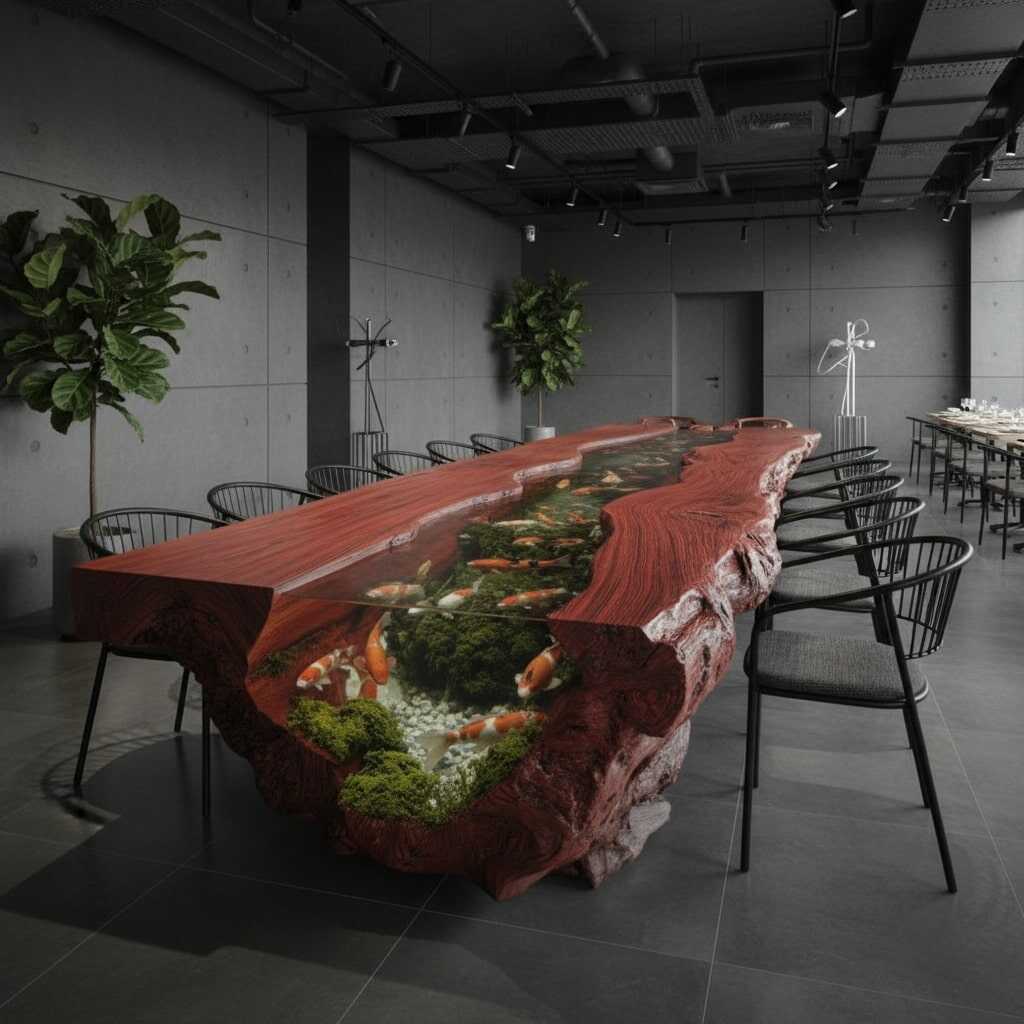
In Japanese design philosophy, ma—the intentional use of negative or ‘in-between’ space—creates rhythm, breath, and meaning. The water beneath the table is such a ma: a living pause. As diners gather, their gazes naturally descend. Conversations slow. Shoulders soften. In the absence of visual clutter—no tablecloth patterns, no centerpieces vying for attention—the mind settles into the rhythmic undulation below. A single koi turning on its side, sunlight glinting off its scales like scattered mica; another hovering motionless, suspended in mid-water, as if in thought. These are not spectacles. They are invitations—to decelerate, to witness, to remember that stillness is not emptiness, but fullness held in equilibrium.
Architecturally, the table reorients the dining experience vertically rather than horizontally. Traditional tables encourage outward engagement: across the surface, toward others. The Koi Pond Dining Table introduces a downward axis—a shared focal point that unites diners not only with each other, but with a third presence: the living water. This triadic relationship fosters a different kind of intimacy—not merely interpersonal, but inter-species, inter-elemental. You are not above nature; you are with it, separated only by a pane of clarity, like a diver observing a reef from inside a submersible.
Crucially, the table resists theatricality. It does not “perform.” There are no jets, no bubbling fountains designed to draw applause. Its power lies in subtlety: the way light refracts at the water’s surface, casting liquid constellations across the underside of ceramic bowls; the faint plink of a koi breaking the surface—rare, but unforgettable—like a punctuation mark in silence. It is architecture as listening, design as receptivity.
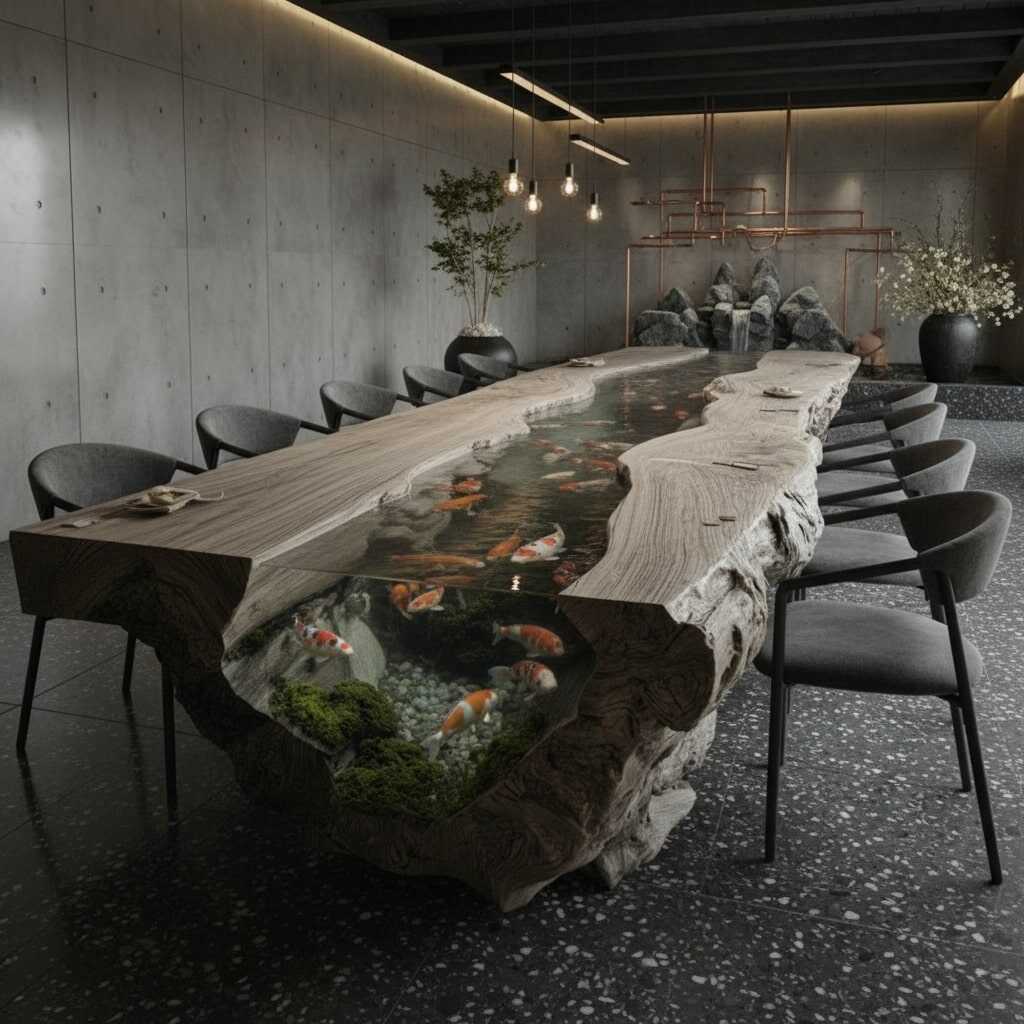
Part II: Rituals Beneath the Surface – Koi as Silent Witnesses to Human Life
To dine above a koi pond is to participate in a ritual both ancient and immediate. Koi, or nishikigoi (“brocaded carp”), carry cultural resonance that deepens the experience. Originating in early 19th-century Japan, where rice farmers bred colorful mutations of black carp in their irrigation ponds, koi ascended from sustenance to symbol. In Japanese tradition, they represent perseverance (for swimming upstream), transformation (through their dramatic color shifts as they mature), and good fortune. But beyond symbolism, they are beings—long-lived, intelligent, capable of recognizing caretakers, even forming individual personalities.
At the Koi Pond Dining Table, these creatures cease to be metaphors. They become participants. Not performers, not props—but co-inhabitants of a shared space, moving through their own cycles of feeding, resting, and social interaction. Their presence introduces an ethics of attention: to dine here is to accept that you are being observed, if not in consciousness, then in effect. Their calm is not staged; it is contingent upon yours. Raise your voice too sharply, slam a glass—subtle vibrations ripple through the water, and the koi retreat, vanishing into the deeper shadows. The table thus becomes a mirror: it reflects not only your image in the glass, but your comportment in the water.
Consider the act of placing a teacup on the surface. As the ceramic meets glass, a faint concentric tremor passes downward. A koi, hovering nearby, flicks its tail—not in alarm, but in acknowledgment, like a nod. In that fleeting response lies a profound reciprocity. You are not merely consuming a meal; you are exchanging presence. The koi do not serve you; they accompany you. Their silence is not absence, but a different grammar of being—one of patience, embodiment, and cyclical time.
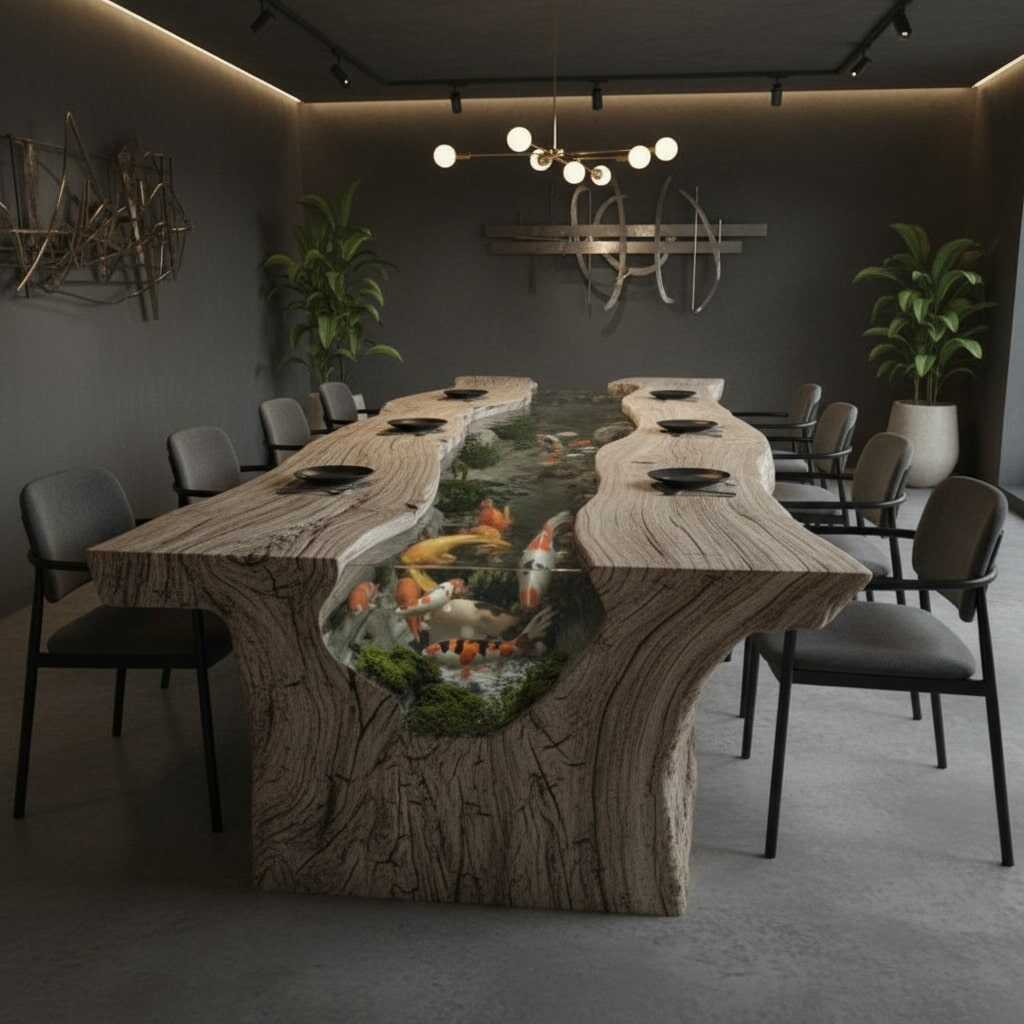
This reconfigures the meal as ceremony. A sake toast, for instance, takes on new resonance as the liquid in your cup echoes the liquid below. The steam rising from miso soup curls upward, while below, a koi exhales a trail of silver bubbles that ascend, vanish at the glass—a silent counterpoint. Seasonal shifts manifest subtly: in autumn, maple leaves may drift from an adjacent garden, settling on the water’s surface like floating brushstrokes; in winter, with ambient temperature carefully regulated, the koi move more slowly, their metabolism attuned to the light. Diners, too, adjust: meals extend longer in summer, shorten in winter—not by clock, but by pulse.
Even the absence of koi speaks. During spawning season, when the pond may be temporarily cleared for brood care, the empty water becomes a different kind of presence: expectant, pregnant with potential. The table then holds not life, but anticipation—a reminder that serenity is not static, but dynamic, ever in process.
This is where the Koi Pond Dining Table transcends décor. It anchors us in embodied temporality—the knowledge that life continues beneath our elbows, indifferent to our agendas, yet profoundly responsive to our respect. In a culture obsessed with productivity, the koi’s unhurried circling is radical. They do not “do.” They are. And in their being, they give us permission to do the same.
Part III: Temporal Harmony in a Flowing World – Slowing the River of Time
Modern life operates on what philosopher Byung-Chul Han terms the burnout society—a regime of hyperactivity, self-exploitation, and digital acceleration. Time is segmented, optimized, monetized. Against this backdrop, the Koi Pond Dining Table enacts a gentle rebellion: it decelerates time, not by stopping it, but by thickening it.
The koi move according to circadian and seasonal rhythms unaltered by human schedules. They do not rush to appointments; they drift with currents both visible and unseen. To watch them is to recalibrate one’s internal chronometer. Studies in environmental psychology suggest that observing aquatic life reduces cortisol levels and heart rate—a physiological echo of the table’s deeper function: it offers chrono-sanctuary.
This is not escapism. It is re-entrainment. The table does not ask you to forget the world beyond its edges—bills, deadlines, global crises—but to hold them in a different light. As your chopsticks hover above a dish of grilled eggplant, your eyes follow a koi as it navigates a stand of dwarf papyrus. In that moment, urgency softens. Perspective shifts. Problems do not vanish, but they lose their stranglehold. The table becomes a temporal tuning fork, resonating at the frequency of natural time: cyclical, patient, non-linear.
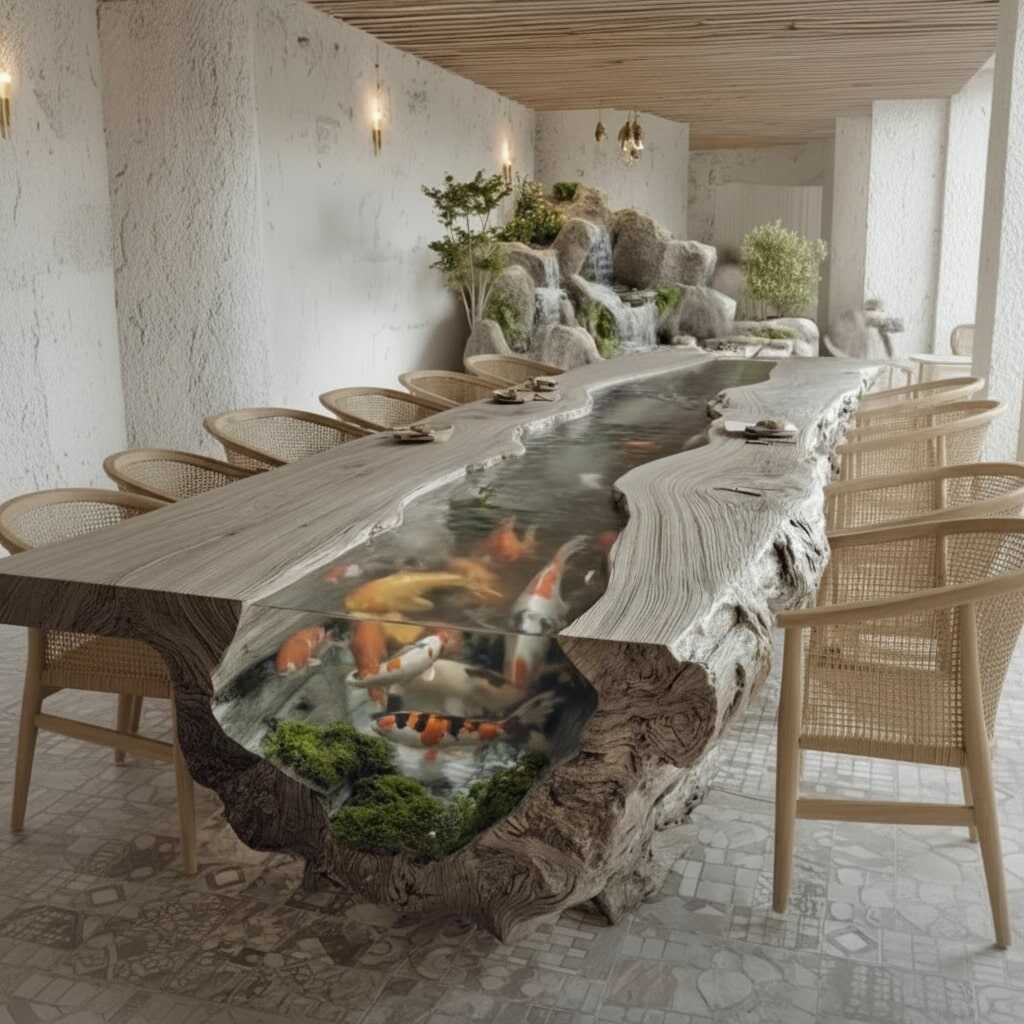
Moreover, the Koi Pond Dining Table fosters intergenerational continuity. Koi live for decades—some surpassing 50, 70, even 100 years. A table installed in a home may witness generations of family meals: a child’s first rice feeding, a wedding toast, a quiet supper for two elders. The same koi may be present across all these moments, growing larger, their colors deepening—silent archivists of memory. In a world of disposability, this endurance is quietly revolutionary.
There is also an ecological humility embedded in the experience. Maintaining the pond requires stewardship: monitoring pH, oxygenation, nitrogen cycles. It is a lesson in interdependence—the realization that serenity is not passive, but cultivated. The clarity of the water depends on balance; the health of the koi depends on consistency. So too, perhaps, does the clarity of human connection. The table teaches that harmony is not default—it is daily practice.
And finally, there is the aesthetics of impermanence. Koi shift position. Light changes with the hour. Algae may bloom in spring, requiring gentle intervention. Nothing is frozen. The serenity offered is not the sterility of a museum diorama, but the vibrant, imperfect peace of a living system—fluctuating, resilient, self-renewing. Like wabi-sabi, it finds beauty in transience: a koi’s scar from a youthful skirmish, the slow browning of a water lily leaf, the way raindrops, if the table resides in a semi-open pavilion, dimple the surface in random constellations.
To dine here is to accept flux—and to find peace within it.
Conclusion: The Table as a Threshold of Belonging
The Koi Pond Dining Table is, ultimately, an invitation—not to consume, but to commune. It asks us to lower our gaze, slow our breath, and acknowledge that we are not the center of every ecosystem, but participants in many. It challenges the Cartesian divide between observer and observed, human and nature, activity and rest. Here, dining becomes an act of cohabitation: with water, with light, with creatures whose language is movement, whose time is depth.
In a culture that often treats nature as backdrop or resource, the table insists on proximity without domination. It does not domesticate the koi; it shares space with them. This ethic of co-presence extends beyond the meal: it seeps into how we listen, how we speak, how we inhabit our days. The serenity beneath the glass is not escapism—it is reorientation. A reminder that stillness is not the absence of sound, but the presence of attention; that beauty does not shout, but shimmers.
Perhaps the deepest enchantment of the Koi Pond Dining Table lies in its refusal to be fully known. No two moments are identical. A koi that darted yesterday may hover today. A shaft of afternoon light may strike the water at such an angle that the entire table becomes a lens, projecting liquid gold onto the ceiling. These micro-epiphanies resist documentation; they must be lived. They ask for presence as prerequisite.
To dine over serenity is to accept that peace is not found in isolation, but in relationship—with the world beneath our hands, with the beings who share our atmosphere, with the quiet pulse of time that flows, like koi in a pond, in graceful, unbroken circles.
In the end, the table is more than furniture.
It is a vow—to slowness, to wonder, to the sacred ordinary.
And when the last dish is cleared, and only the koi remain, gliding in the twilight beneath the empty glasses and folded napkins, they continue their ancient dance—unhurried, unobserved, utterly themselves.
Waiting, as they always have, for the next moment of shared stillness.