
The Call of the Wild — Reimagining the Shower as a Sanctuary
In a world increasingly defined by screens, schedules, and sealed environments, the human spirit yearns—often unconsciously—for reconnection. Not just with people, but with place: with soil, sky, water, and silence. The modern bathroom, once a purely functional space, has quietly evolved into a personal retreat—a sanctuary where the day begins and ends in ritual and reflection. Within this intimate alcove, the shower holds particular significance: a daily baptism, a moment of pause, a sensory reset. What if this daily ritual could do more than cleanse the body? What if it could restore the soul?
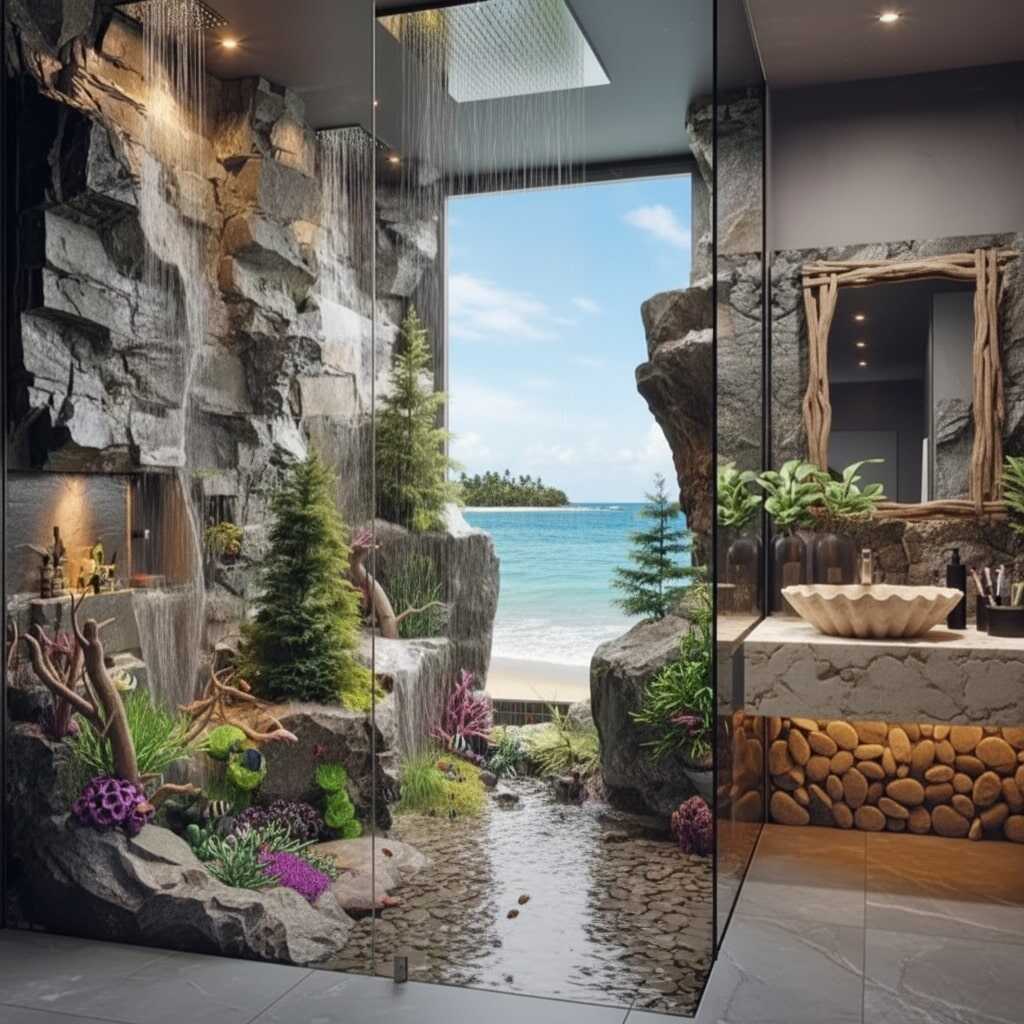
Enter the Nature Scene Themed Shower—an immersive design philosophy that transcends mere aesthetics to evoke the essence of the natural world within the confines of indoor architecture. This is not about slapping leaf-patterned tiles on a wall or hanging a fern in the corner. A true Nature Scene Themed Shower is a holistic re-creation: a multisensory journey that invites forest mist, mountain streams, desert winds, or coastal tides into your daily routine. It is architecture as poetry—where material, light, sound, and scent converge to dissolve the boundaries between inside and out.
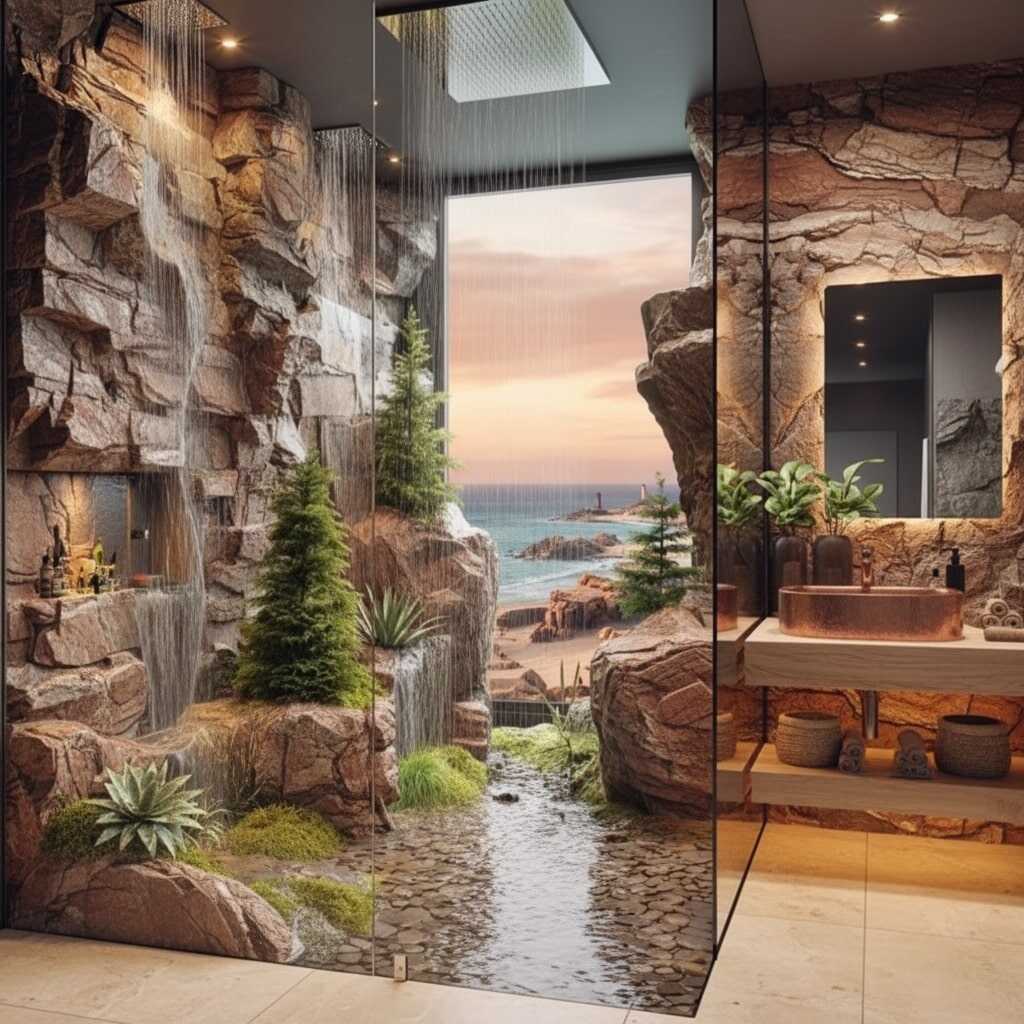
At its core, this concept honors the biophilic principle: the innate human tendency to seek connections with nature and other forms of life. Studies in environmental psychology have repeatedly shown that exposure—even simulated—to natural elements reduces stress, enhances cognitive function, and fosters emotional resilience. A Nature Scene Themed Shower becomes more than decor; it becomes therapy. It transforms a utilitarian act into an experience of reverence—a daily pilgrimage into a microcosm of wilderness, curated not for escapism, but for grounding.
In this article, we explore how to thoughtfully craft such a space—not through gimmicks, but through intention. We’ll delve into three evocative natural archetypes—Forest Canopy, Mountain Stream, and Coastal Dunes—and unpack how each can be interpreted with depth, authenticity, and sensory integrity. Along the way, we’ll consider materiality, acoustics, lighting, and botanical integration—not as isolated design elements, but as threads in a larger tapestry of place-making. The goal is not replication, but resonance: to create a shower that doesn’t just look like nature, but feels like it.
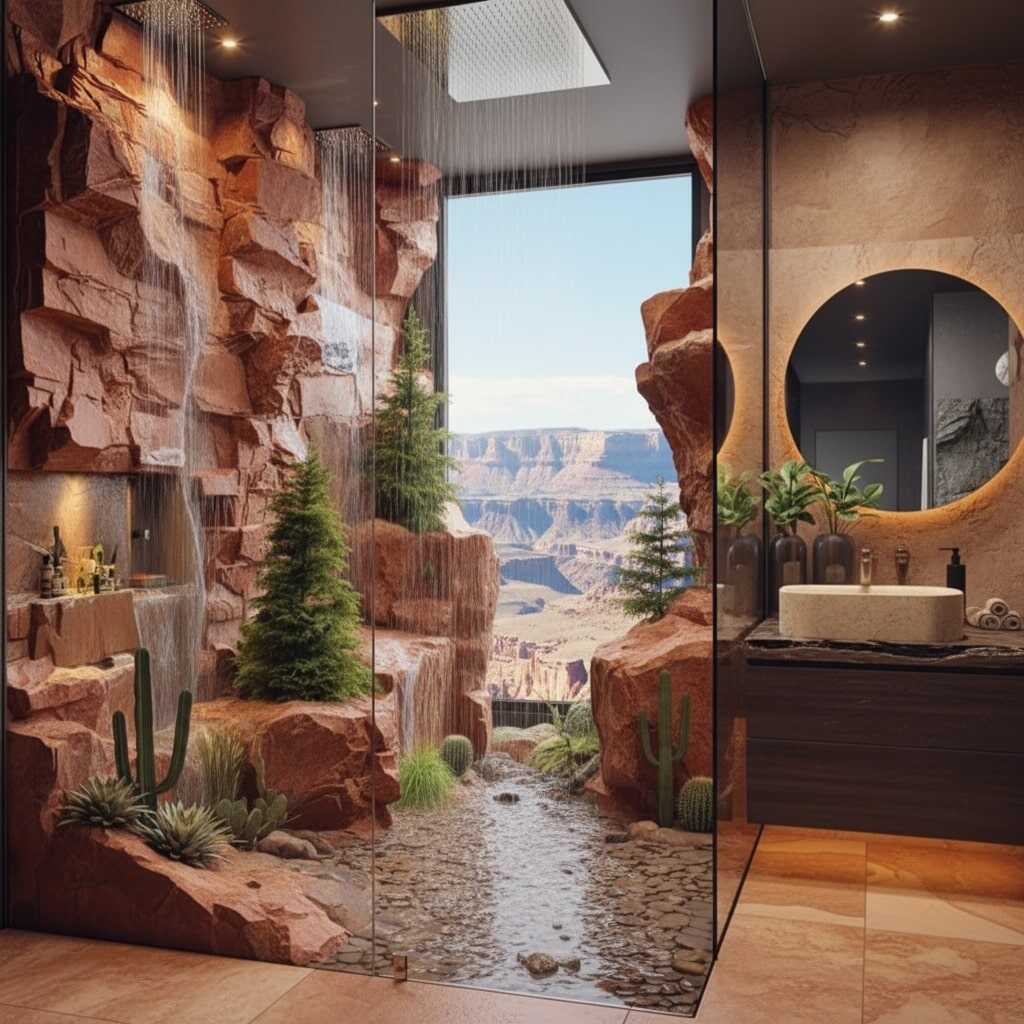
Part I: The Forest Canopy Shower — A Verdant Embrace
Imagine stepping into your shower and feeling, for a moment, as if you’ve ducked beneath the low boughs of an ancient woodland—where dappled light filters through a lattice of leaves, the air hums with green stillness, and water falls not from a faucet, but from the sky itself.
The Forest Canopy Themed Shower draws its power from layered intimacy: tall verticality, textured depth, and a symphony of organic forms. Unlike open, sun-drenched landscapes, the forest invites enclosure—a sense of being held. This theme is ideal for those who find solace in solitude, in the quiet rhythm of growth and decay, in the hush of moss and bark.
Material Palette: Earth, Wood, and Stone in Dialogue
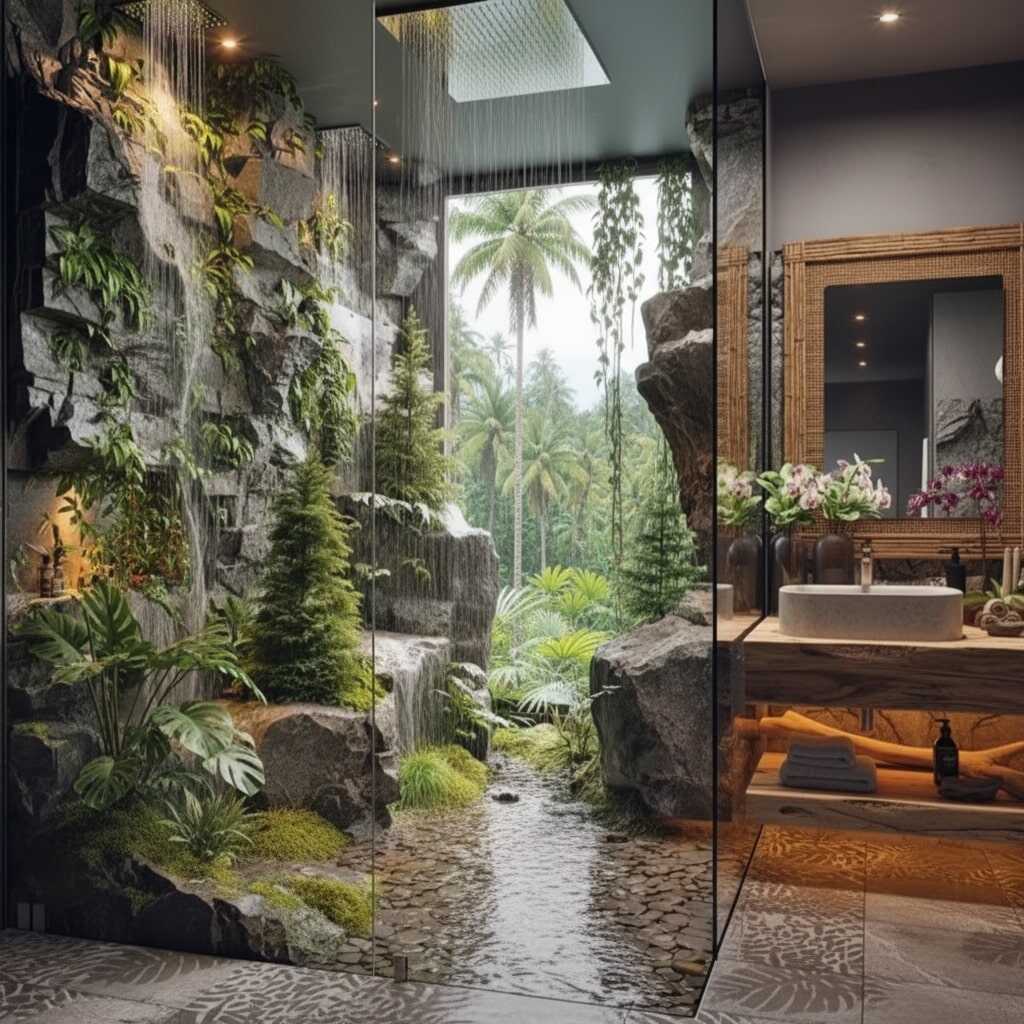
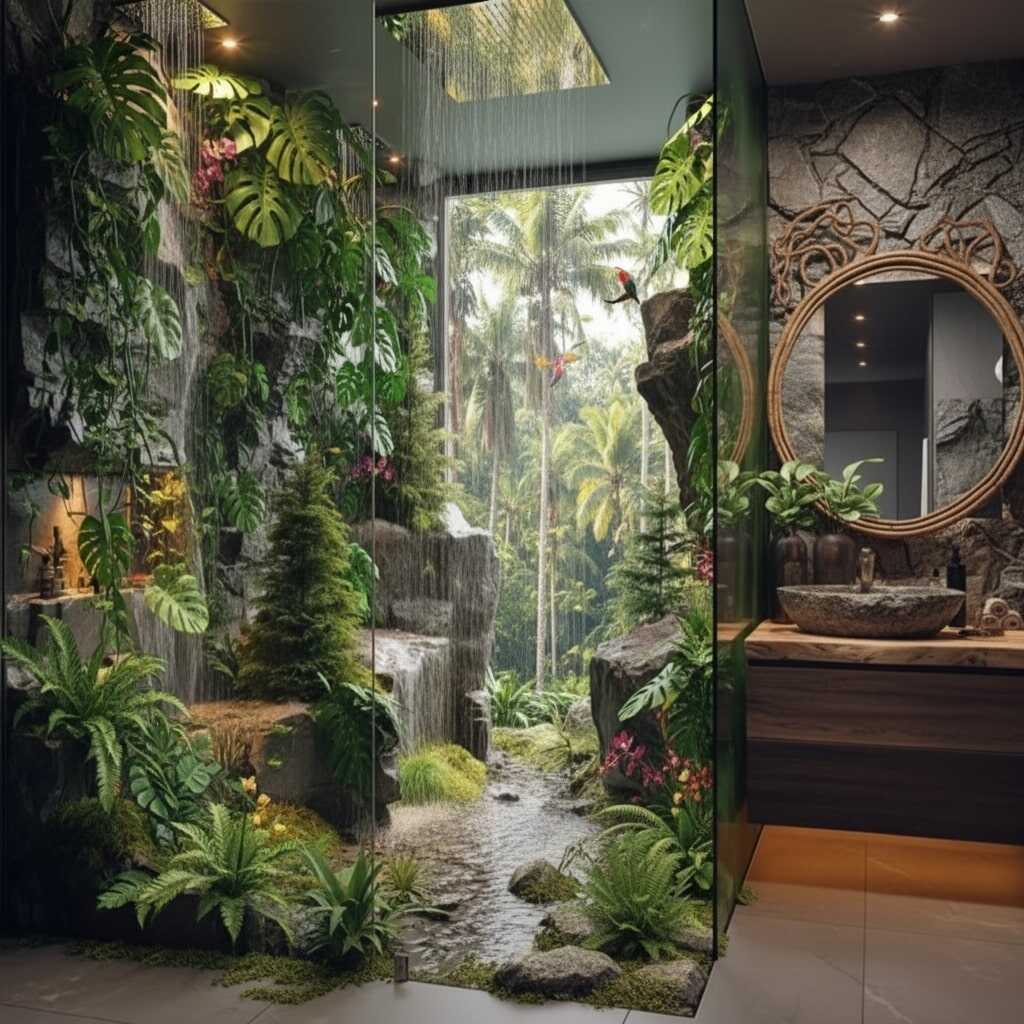
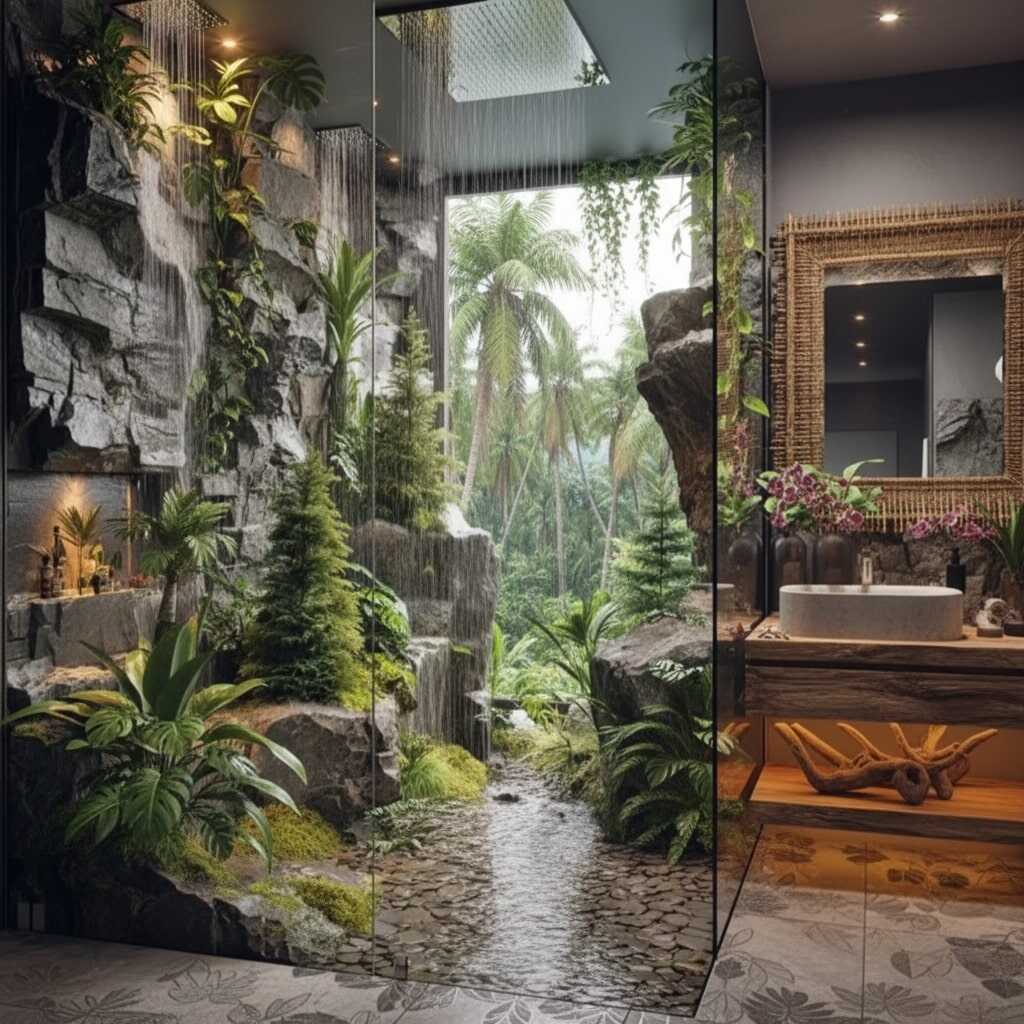
Begin with surfaces that echo the forest floor and its vertical rise. Walls clad in split-face slate or reclaimed cedar planks evoke the rugged texture of tree trunks and exposed roots. Consider integrating a living wall—not as a decorative afterthought, but as a central feature: a vertical garden of ferns (like Polystichum acrostichoides or Adiantum), mosses (Hypnum or Thuidium), and shade-tolerant ivy trained across a porous stone substrate. This living panel breathes, filters humidity, and releases phytoncides—the airborne compounds emitted by trees known to boost immune function and lower cortisol.
The shower floor can be a continuation of the forest path: river stones set in a pebble-mosaic pattern, interspersed with smooth, flat basalt tiles to prevent slipping. The unevenness underfoot—gentle, not jarring—recalls the natural terrain of a woodland trail, engaging proprioception and mindfulness.
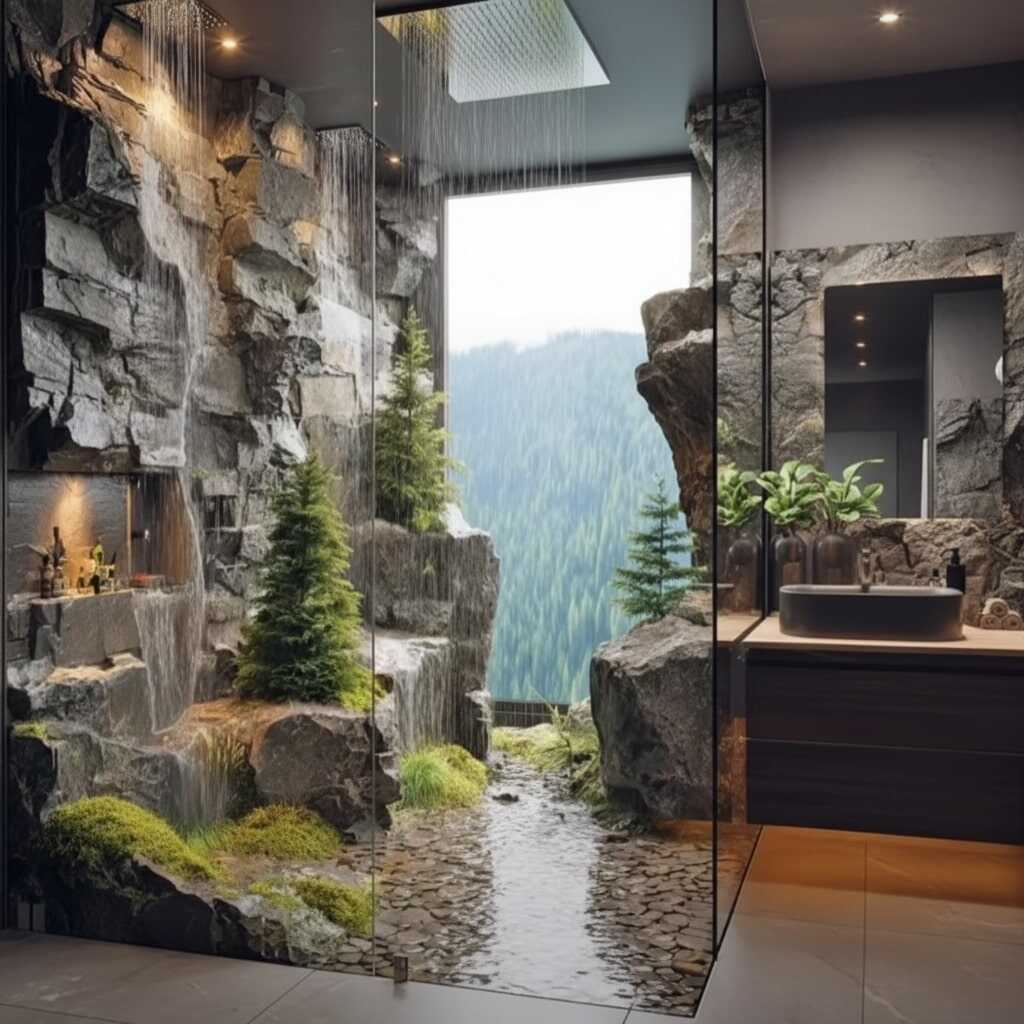
Lighting as Canopy Gaps
Lighting here is indirect and dynamic. Avoid harsh overhead LEDs. Instead, embed warm, low-voltage LED strips behind floating shelves or within coves to mimic the soft glow of sunlight piercing the canopy. Programmable systems can simulate the diurnal arc: pale gold at dawn, bright white at midday, deep amber at dusk. Add fiber-optic “stars” in the ceiling—tiny pinpoints of light that replicate the rare glimpse of sky through dense foliage. In the steam of a hot shower, these lights diffuse into hazy halos, evoking mist rising from damp earth.
Sound and Scent: The Unseen Layers
A truly immersive forest experience engages hearing and smell. Integrate a discreet water feature—a thin sheet of water cascading over a moss-covered basalt slab, or a gentle recirculating brook running along the base of the shower wall. The sound should be soft, persistent, like a distant creek—a white noise that masks urban clamor without demanding attention.
For scent, avoid artificial “pine-scented” sprays. Instead, use a diffuser with essential oil blends of cedarwood atlas, Douglas fir, petitgrain, and vetiver—a complex, grounding aroma that mimics the forest floor after rain. Alternatively, incorporate real botanicals: a small drawer built into the bench, lined with untreated cedar, holding dried pine cones, oakmoss, and birch bark, released subtly by steam.
Furnishings and Details: Functional Botany
A teak or bamboo bench—oiled, not sealed—invites sitting and lingering. Its grain warps slightly with humidity, a reminder of organic life. Hooks carved from driftwood or branches (ethically foraged, sanded smooth) hold towels. Even the drain cover can be customized: cast bronze shaped like a spiral fern frond, or a laser-cut steel screen echoing the fractal pattern of a leaf’s veins.
This is not a theme that shouts. It whispers. It asks you to slow down, to notice the grain in the wood, the variation in stone, the way steam clings to moss like morning fog. In this shower, you do not wash away the day—you wash into presence.
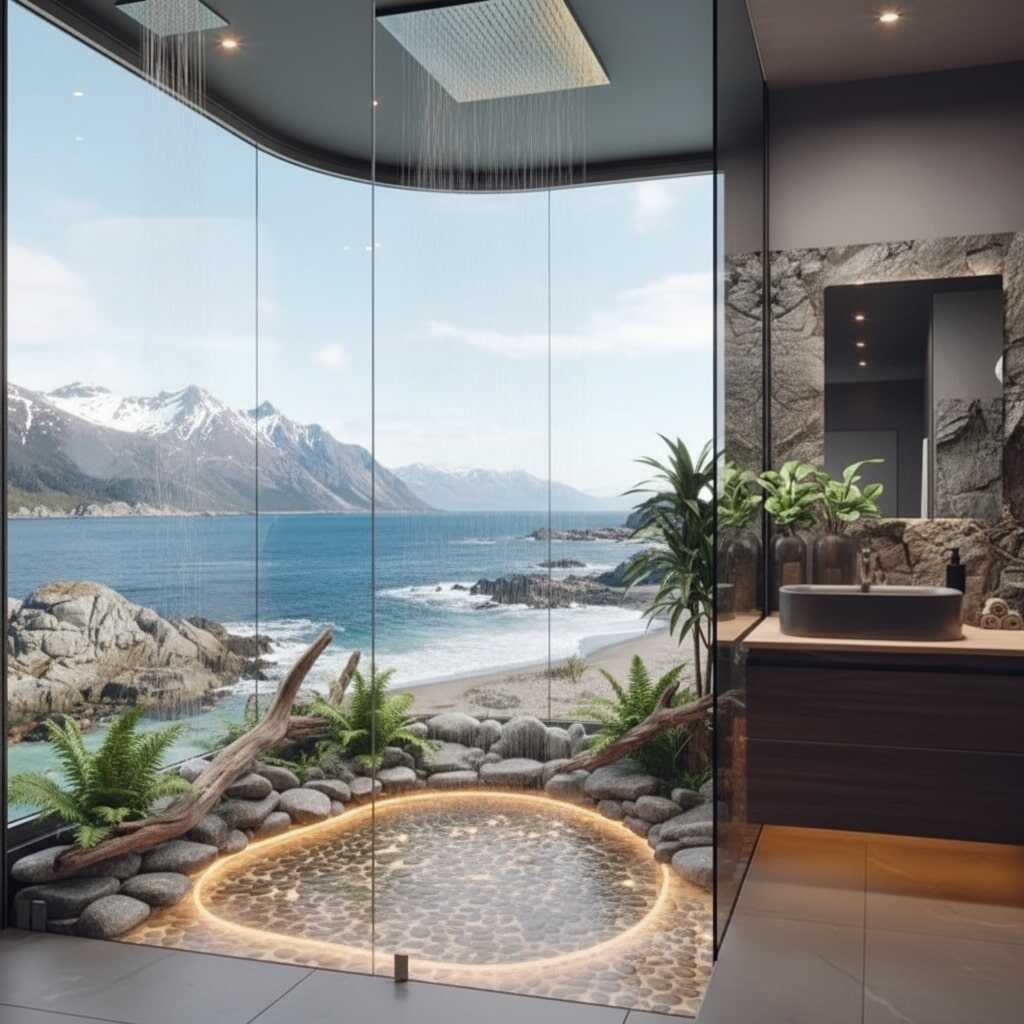
Part II: The Mountain Stream Shower — Clarity in Motion
Where the forest is intimate, the mountain stream is expansive. Here, the Nature Scene Themed Shower channels the raw, purifying energy of alpine waterways—crystal-clear, cold, and ceaselessly moving. This archetype speaks to those who find renewal in clarity, in altitude, in the stark beauty of rock and water stripped bare by wind and time.
Picture granite boulders rounded by centuries of current, shallow pools reflecting the open sky, the sharp scent of pine carried on brisk air. The Mountain Stream Shower is less about enclosure and more about exposure—a sense of standing within the landscape, not sheltered from it.
Materiality: The Language of Geology
Stone is paramount. Use large-format tiles of honed quartzite, flamed granite, or tumbled limestone—materials that reflect the high-altitude palette: greys, silvers, pale blues, and the occasional rust-red iron streak. Avoid grout lines where possible; opt for book-matched slabs or seamless poured concrete with aggregate inclusions (river pebbles, crushed mica) to suggest glacial till.
The shower floor should slope gently—not unnaturally—toward a linear trench drain clad in rusted Corten steel or raw basalt, mimicking the channel of a streambed. Scatter a few larger, smooth river stones within the drain path: not decorative clutter, but functional anchors that break the water’s flow into gentle ripples, recreating the sound and sight of water threading through rocks.
Water as the Central Character
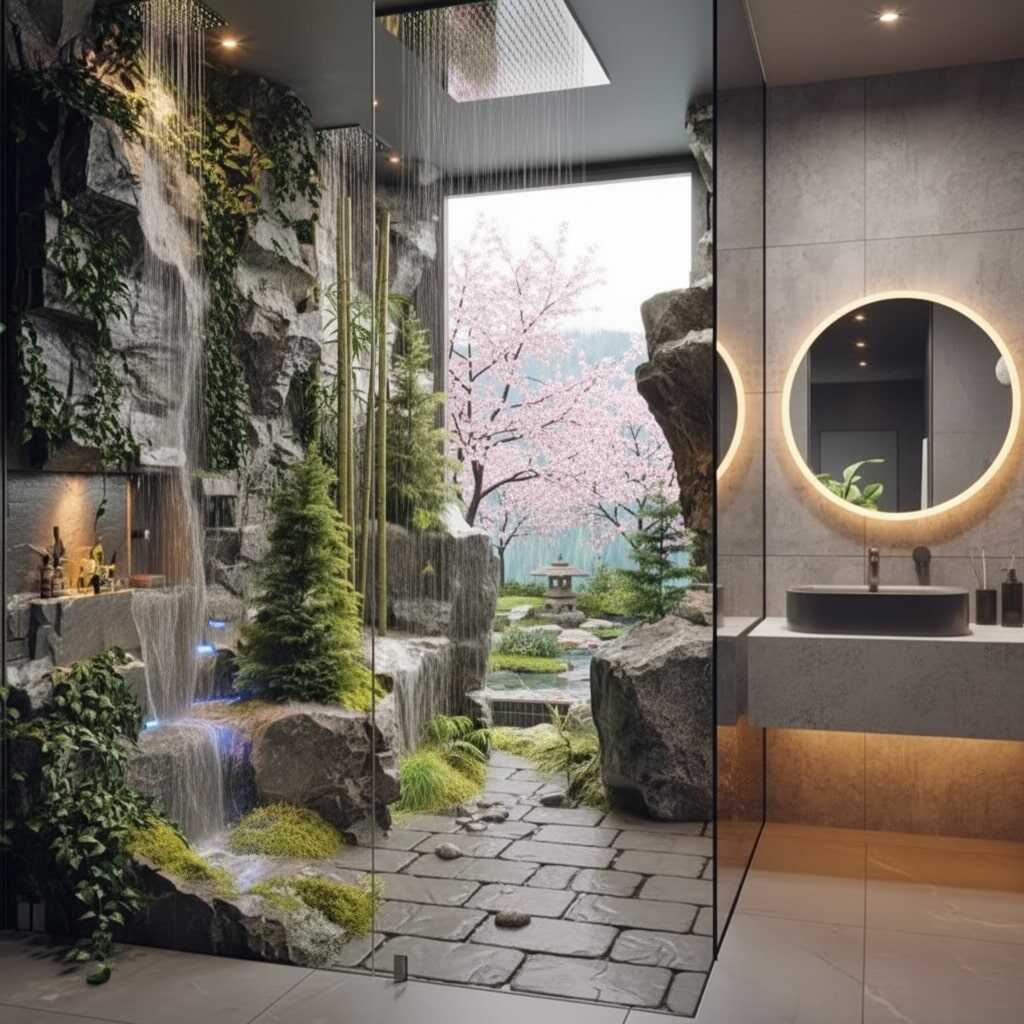
In this theme, the showerhead is not a fixture—it’s a feature. Replace standard heads with a rain canopy: a wide, shallow ceiling-mounted panel that releases water in a broad, even sheet—not a torrent, but a steady, enveloping pour, like summer rain on an open mountainside. Pair it with a handheld sprayer mounted on a forged iron arm resembling a twisted branch, allowing users to direct flow like a hiker cupping water from a stream.
For advanced immersion, consider a thermo-chromatic valve system: at cooler settings (not cold—just cooler than body temp), the water carries a subtle blue LED glow, evoking glacial melt. As temperature rises, the light shifts to soft white—like sun on snowmelt.
Spatial Flow and Openness
Unlike the forest, this shower benefits from visual continuity. Use frameless, low-iron glass walls—or better yet, no glass at all, relying instead on strategic sloping and drainage. The goal is to preserve sightlines: to see the stone floor extend beyond the wet zone into a dry area of brushed concrete and raw timber, blurring the threshold between “shower” and “landscape.”
Ceiling height should feel generous, even vaulted if possible. Paint or finish it in matte white or pale grey to suggest open sky. A single skylight, even a small tubular one, transforms the experience—suddenly, you’re showering under actual clouds, real sunlight, the passage of time made visible.
Botanical Accents: The Alpine Edge
Alpine flora is sparse but potent. A single, sculptural Juniperus communis in a shallow stone trough beside the shower bench. A cluster of Sedum or Sempervivum (hens-and-chicks) tucked into a crevice of the stone wall—succulents that thrive on minimal water and high light, symbolizing resilience.
For scent, diffuse silver fir, eucalyptus globulus, and black spruce—bright, clean, slightly camphorous notes that mimic high-altitude air. Add a hint of ozonic or petrichor molecules (the scent of rain on dry stone) for authenticity.
This shower does not coddle. It invigorates. It reminds you of your smallness in the face of geologic time, and in that humility, offers a strange kind of freedom.
Part III: The Coastal Dunes Shower — Where Land Meets Sea
Finally, we arrive at the liminal zone—the edge. The Coastal Dunes Themed Shower captures the transitional magic of shoreline ecosystems: windswept grasses, sun-bleached driftwood, the saline tang of sea air, and the rhythmic pulse of tides.
This theme is for those who find peace in flux—the constant negotiation between stability and surrender, between solid ground and fluid horizon.
Texture and Tone: The Palette of Erosion
Think in layers: the deep indigo of ocean depths, the frothy white of breaking waves, the warm beige of sun-drenched sand, the weathered grey of driftwood. Walls can be finished in Venetian plaster tinted with natural earth pigments—ochre, umber, bone white—troweled to suggest wind-rippled dunes. Hand-troweling creates subtle ridges that catch light like sand at low tide.
Incorporate driftwood not as ornament, but as structure: a bench carved from a single salvaged log, sanded smooth by centuries of surf. Use sea-smoothed stones—not polished, but naturally tumbled—as border accents or embedded in the floor. Consider a backsplash of hand-formed ceramic tiles glazed in celadon, seafoam, and deep cobalt, with irregular edges mimicking wave-worn glass.
Water Movement: The Language of Tides
Here, water should feel dynamic—not just falling, but moving. A dual-head system: an overhead rain panel for immersion, plus a side-mounted wave sprayer—a linear bar with staggered nozzles that pulse in sequence, creating a horizontal wave-like motion across the body. Program it for gentle ebb-and-flow timing: 10 seconds on, 5 seconds off—like waves lapping the shore.
The drain can be designed as a tidal pool: a shallow, circular basin lined with black river stones, where water collects momentarily before receding—a visual and auditory echo of the sea’s rhythm.
Light and Air: The Coastal Atmosphere
Maximize natural light. If possible, position the shower to face east—to greet the sunrise over an imagined horizon. Use sheer, woven reed shades or linen curtains on nearby windows: not for privacy, but to diffuse light into a golden haze, like sea mist at dawn.
For artificial light, employ adjustable CCT (correlated color temperature) fixtures: cool daylight (5000K) in the morning for alertness, warm amber (2700K) in the evening for calm. Add a salt lamp on a nearby shelf—not for “negative ions,” but for its soft, organic glow, like a lighthouse in twilight.
Sensory Anchors: Salt, Wind, and Grass
Scent is critical. Use a marine-based diffuser blend: sea fennel, salty amber, sage, and a touch of calone (a synthetic molecule that replicates the fresh, ozonic smell of the sea). Place a shallow dish of unrefined sea salt and dried sea lavender on a windowsill; steam releases their minerals and fragrance naturally.
Sound can be subtle: a hidden speaker playing a loop of distant gulls, wind through marram grass, and the low, rhythmic crash of surf—recorded on a real coastline, preferably at low tide, when the sound is more textured, less monotonous.
Botanically, lean into coastal natives: Carex grasses in a planter outside the shower (visible through glass), Limonium (sea lavender), or Armeria maritima (thrift). These are tough, salt-tolerant, and symbolize endurance.
This shower doesn’t just clean—it recalibrates. It reminds you that you, too, are a meeting place: of breath and body, thought and feeling, land and water.
Conclusion: Beyond Decoration — The Shower as Threshold
A Nature Scene Themed Shower is not an exercise in interior design. It is an act of re-enchantment.
In a culture that prizes efficiency, we have forgotten that some things cannot—and should not—be rushed. Bathing, at its origin, was sacred: Roman thermae, Japanese onsen, Finnish saunas—all were spaces of community, reflection, and renewal. The modern shower, stripped of ritual, risks becoming just another task. But what if we reclaimed it? What if, for five minutes a day, we stepped not into a stall, but into a forest, a mountain, a dune—and emerged not just clean, but changed?
The power of the Nature Scene Themed Shower lies in its refusal to be passive. It does not sit quietly in the background. It engages. It asks you to feel the stone underfoot, to listen to the water’s cadence, to breathe in scent that carries memory. It disrupts autopilot. In that disruption lies presence.
Critics may call it indulgent. But consider: what is more essential than feeling connected—to your body, to the earth, to the quiet pulse of life that continues, undeterred, beyond concrete and glass? We do not need to go to nature to be reminded of it. With intention, nature can come to us—not as a replica, but as a resonance.
Designing such a space requires patience, observation, and humility. Visit real forests. Sit by real streams. Walk barefoot on real dunes. Notice how light falls, how water moves, how wind sounds different through pine than through grass. Let those impressions guide your choices—not trends, not catalogs, but lived experience.
In the end, the Nature Scene Themed Shower is less about bringing the outdoors in, and more about remembering that we were never truly separate. The shower becomes a threshold—not a barrier—between worlds. And every time we cross it, we have the chance to return, not just rinsed, but rooted.