
In the quiet interstices of daily life—between the hum of obligations and the flicker of digital distractions—there exists a profound yearning for sanctuary. A space where time slows, the mind untangles, and the soul reorients itself to stillness. The modern bathroom, once a purely functional chamber, has undergone a renaissance, transforming into a personal temple of wellness and aesthetic contemplation. At the heart of this evolution rises a singular archetype: the Crystal Inspired Bathtub. More than a vessel for water, this design philosophy draws deeply from the metaphysical resonance, geometric purity, and luminous elegance of natural crystals. It is not mere mimicry of form, but an architectural homage—an alchemy of material, light, and intention that seeks to channel the serenity and transformative energy long associated with crystalline structures.
Crystals have, for millennia, captivated human imagination—not just for their beauty, but for their perceived ability to hold, amplify, and harmonize energy. From the precise symmetry of a quartz point to the fluid inclusions of amethyst geodes, nature’s crystalline architectures embody principles of balance, clarity, and inner light. The Crystal Inspired Bathtub interprets these principles through design language: sharp yet softened facets, translucent or reflective surfaces, asymmetrical contours that defy convention, and a play of light that sculpts space like a prism refracting dawn. This is design as meditation—where bathing becomes ritual, and the tub itself becomes a catalyst for restoration.
This article explores how Crystal Inspired Bathtub designs transcend utility to become conduits of tranquility and testaments to refined artistry. We will delve into the philosophical underpinnings rooted in crystallography and sacred geometry, examine how these ideals manifest in form and materiality, and finally, reflect on the experiential transformation these bathtubs evoke—a true elevation of both serenity and style.
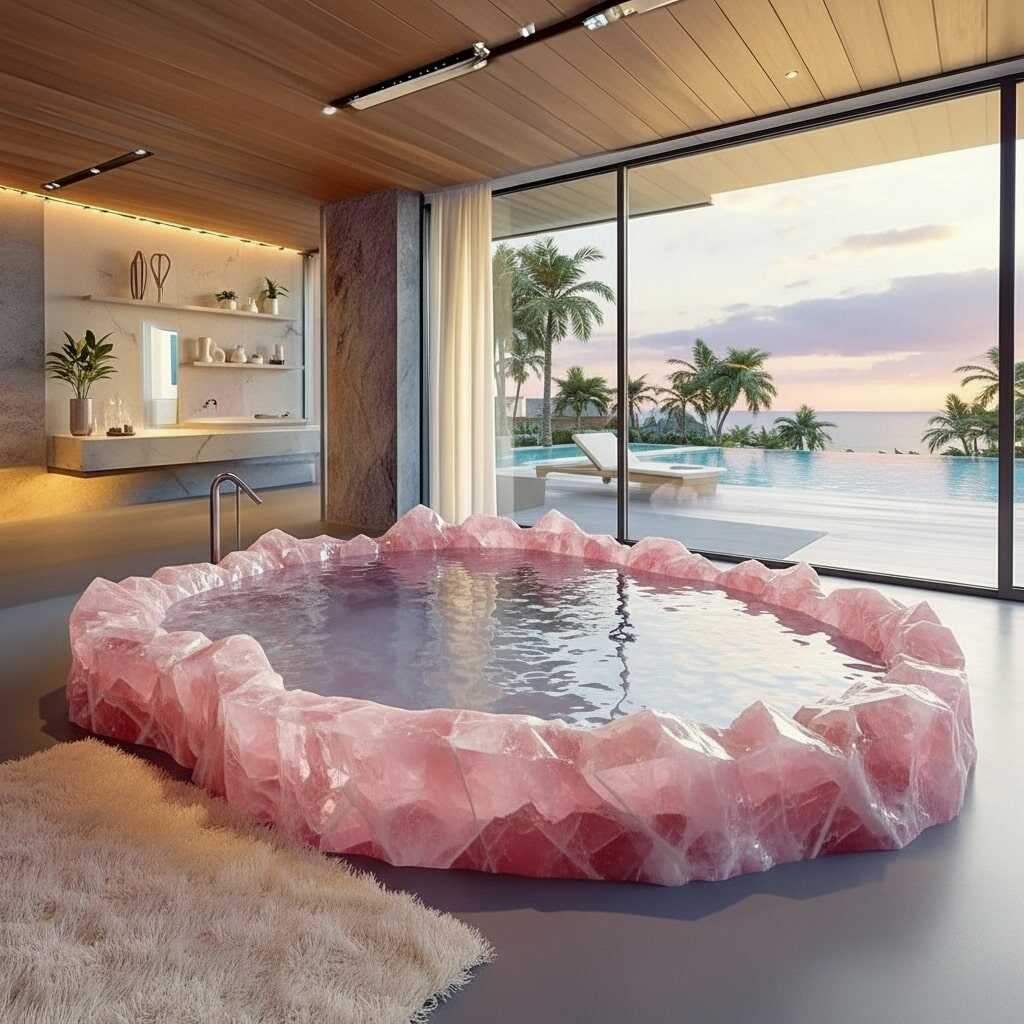
I. The Philosophy of Form: Sacred Geometry and the Language of Crystals
Before stone becomes sculpture, and water meets surface, there is intention. The Crystal Inspired Bathtub begins not with ergonomics alone, but with a reverence for the mathematical poetry inherent in crystalline structures. Crystals are nature’s master architects—their growth governed by immutable laws of symmetry, lattice formation, and energetic equilibrium. A single quartz crystal, for instance, follows a hexagonal system, its elongated prism crowned by pyramidal terminations—a form that speaks of upward aspiration and grounded stability simultaneously.
Designers drawing from this wellspring do not simply replicate a geode’s jagged rim or a diamond’s cut. Rather, they abstract the essence: the tension between angular precision and organic fluidity; the harmony of opposing facets converging toward a center; the illusion of weightlessness despite substantial mass. This is where sacred geometry enters the discourse—the belief that certain proportions and shapes (the golden ratio, the Flower of Life, the Platonic solids) resonate with fundamental frequencies of the cosmos and, by extension, the human psyche.
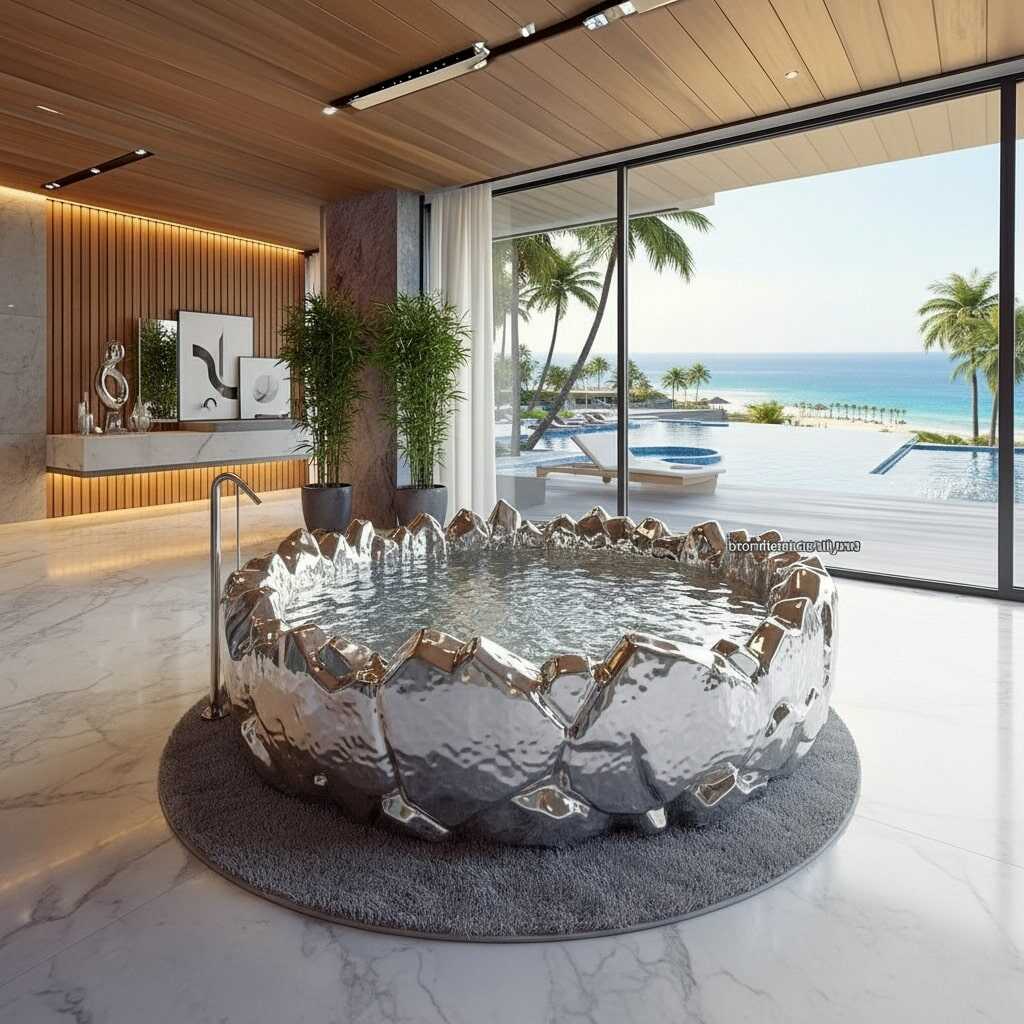
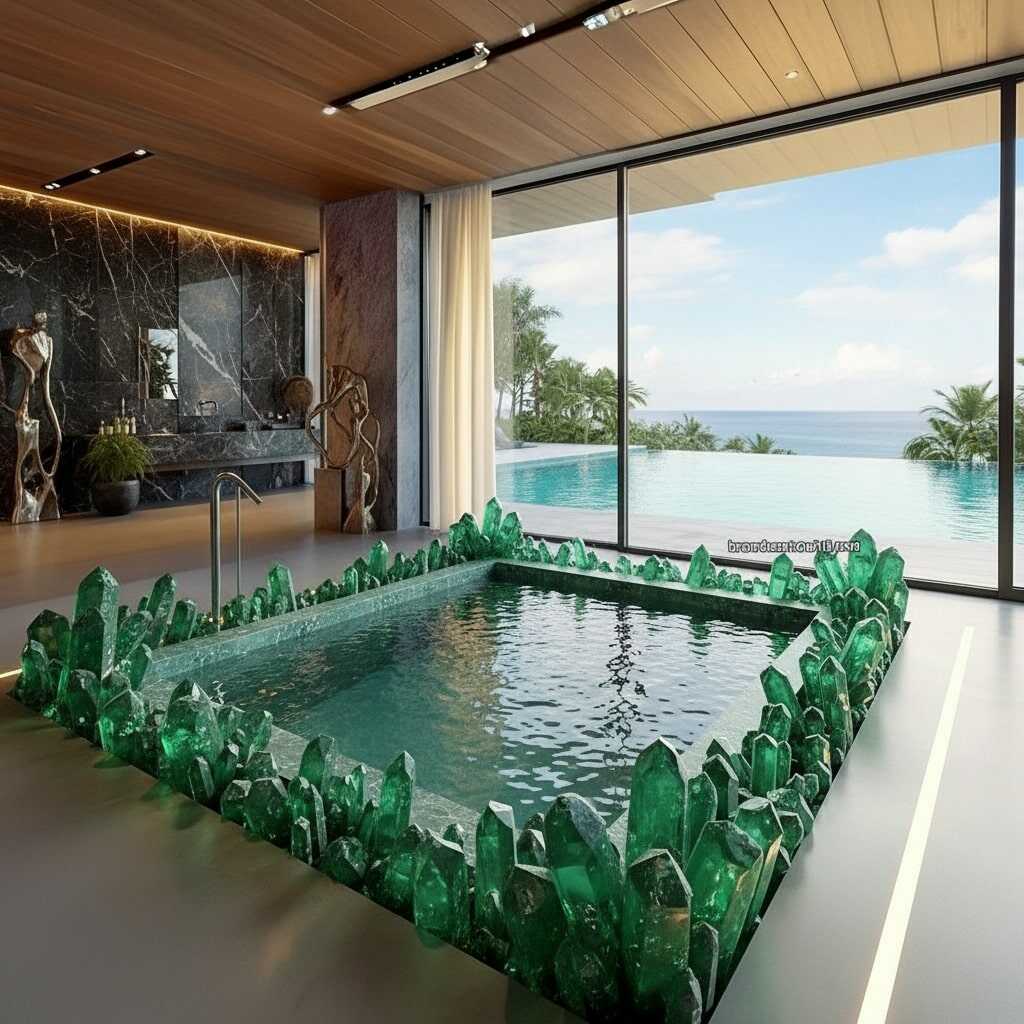
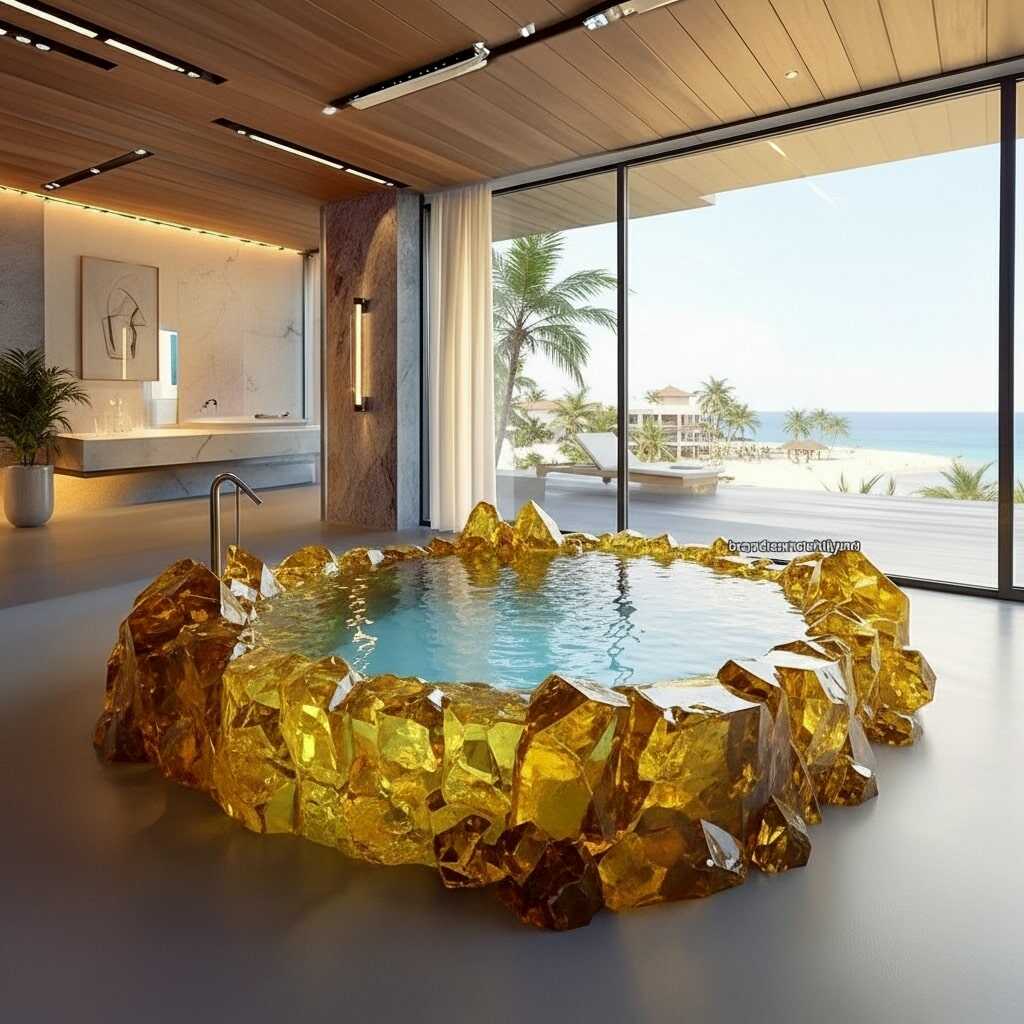
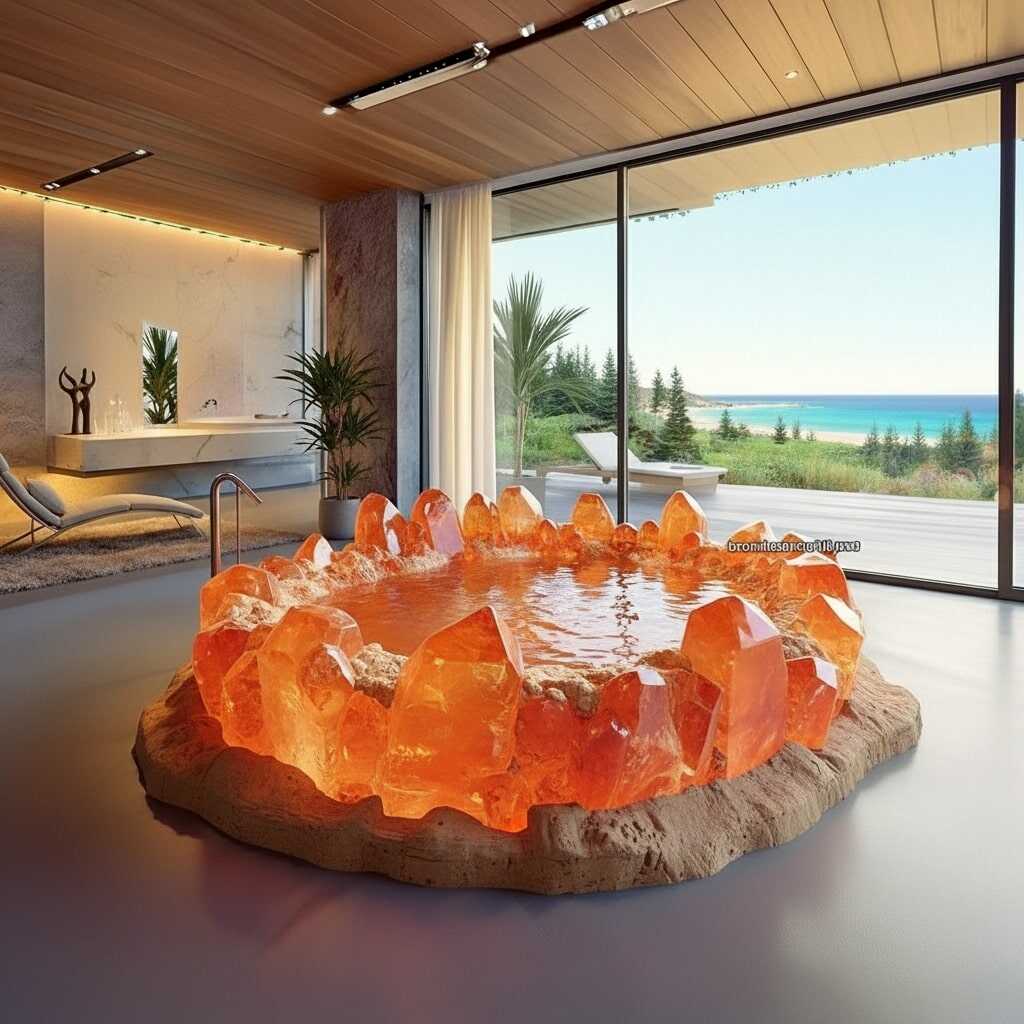
Consider a bathtub shaped like a faceted beryl prismatic column—six clean planes tapering gently inward, softened just enough for comfort, yet retaining the architectural rigor of its mineral muse. Or imagine a freestanding tub modeled after a raw citrine cluster: asymmetrical, with undulating planes that catch and scatter light like sunlight through amber glass. Even the placement matters—centered within a room, it becomes an altar; aligned with a window, it harnesses natural light to create dynamic shadow-play throughout the day, echoing the way raw crystals interact with their environment.
This philosophical grounding ensures that each Crystal Inspired Bathtub is not arbitrary novelty, but a deliberate evocation of order emerging from chaos—the same process by which a crystal nucleates and grows in deep earth. In a world saturated with chaotic stimuli, such geometry offers subconscious reassurance: this space is coherent. This space is safe.
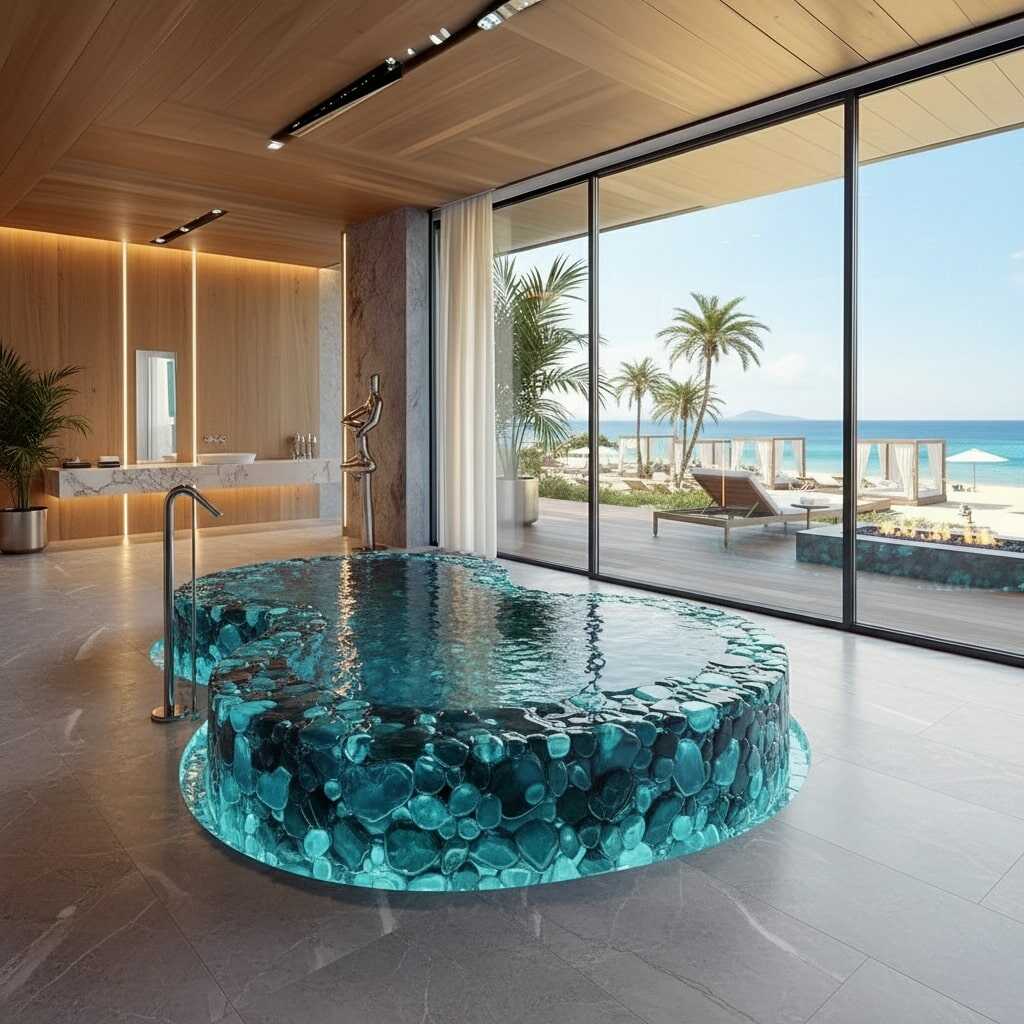
II. Material Alchemy: Translating Earth’s Treasures into Tactile Experience
If philosophy provides the blueprint, materiality breathes life into the Crystal Inspired Bathtub. Here, innovation converges with tradition, as artisans and manufacturers explore substances that echo the optical and textural qualities of gemstones—without literal imitation. The goal is not to create a plastic replica of amethyst, but to evoke its presence: its coolness, its depth, its interior luminosity.
Translucency and Light Transmission
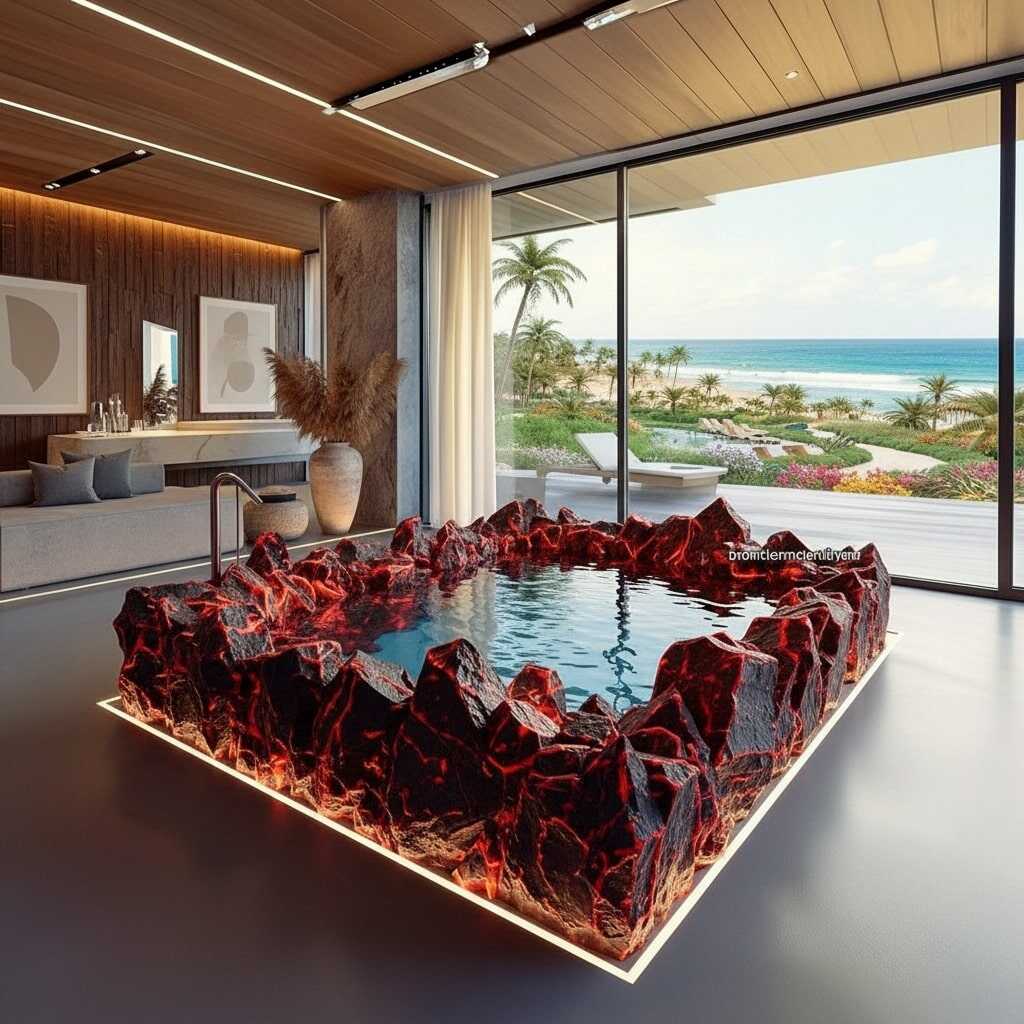
One of the most arresting qualities of crystals is their ability to transmit, refract, and diffuse light. This is powerfully harnessed through the use of solid surface composites infused with mineral aggregates—materials like translucent resin-ceramic hybrids or engineered quartzites that allow ambient light to penetrate the tub’s shell. At dusk, with subtle LED backlighting (often integrated beneath the rim or within a recessed base), the tub glows softly from within, like a cluster of selenite rods held up to candlelight. The water itself becomes part of the composition—rippling light patterns dancing across walls and ceiling, turning the entire bathroom into a kinetic light installation.
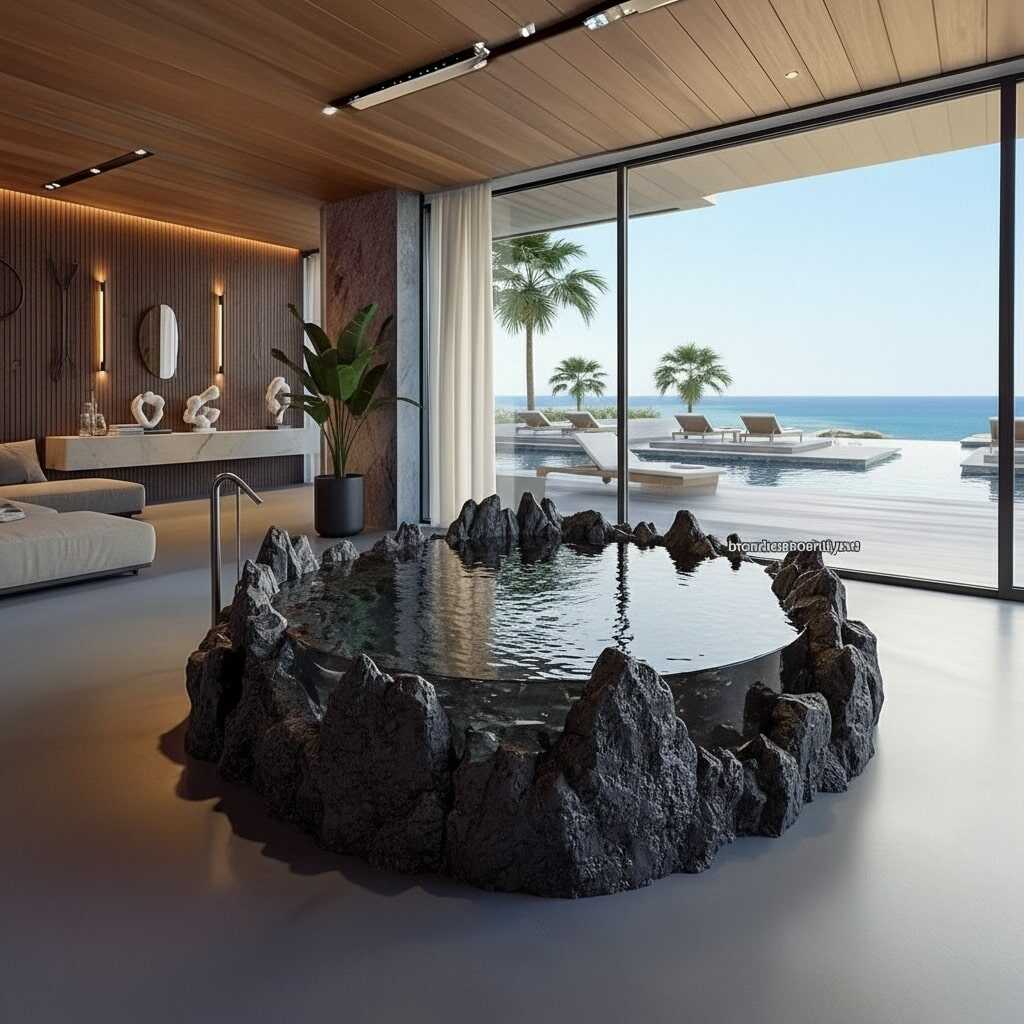
Surface Texture and Tactility
While gemstones are often polished to high sheen, many Crystal Inspired Bathtub designs celebrate the raw, unpolished state—the matrix in which crystals form. Textured finishes emulate the granular feel of drusy quartz or the striated ridges of tourmaline. Matte-finished stone composites with micro-etching replicate the velvety surface of raw celestite; brushed metal inlays—copper, brushed gold, or oxidized silver—trace the ‘veins’ where different minerals meet in a geode. These textures are not merely visual; they engage the sense of touch. Running a hand along the tub’s rim becomes a grounding exercise—cool, varied, alive with subtle topography.
Color as Emotional Resonance
Color in crystals is rarely arbitrary; it arises from trace elements and structural quirks, and carries symbolic weight. A Crystal Inspired Bathtub embraces this chromatic language thoughtfully. Soft, opalescent whites and pale lavenders channel the calming frequencies of howlite and lepidolite—ideal for spaces dedicated to rest and nervous system regulation. Deep, velvety blues and indigos, achieved through pigmented concrete or ceramic glazes, recall lapis lazuli and azurite, evoking depth, intuition, and inner vision. Even clear or ice-like finishes—achieved with optical-grade acrylic or layered glass—invoke the purity of rock crystal, encouraging mental clarity and energetic cleansing.
Crucially, these colors are not flat. They shift with light and perspective: a tub that appears dove-gray at noon may blush rose-gold at sunset, just as a piece of fluorite reveals hidden hues when rotated in the hand. This dynamism ensures the bathing experience remains ever-fresh, ever-responsive to the rhythms of nature.
III. Sculptural Presence: The Bathtub as Centerpiece and Contemplative Object
A Crystal Inspired Bathtub refuses to be furniture. It is a sculpture first—functional second. Its design commands spatial dialogue, altering how one moves through, perceives, and inhabits the bathroom. Freestanding, often asymmetrical, it invites circumambulation; one must walk around it to appreciate its full form, much like approaching a piece of monumental art.
Asymmetry and Dynamic Balance
Unlike the bilateral symmetry of traditional oval or rectangular tubs, many crystal-inspired forms embrace dynamic asymmetry—a concept borrowed from mineral formations where growth is influenced by environmental pressures. A tub might widen dramatically on one end, tapering to a delicate point on the other, suggesting the slow accretion of calcite in a cavern. Or it may feature an off-center drain, positioned like a flaw in a diamond—imperfection as intentional design. This asymmetry creates visual intrigue and psychological interest: the mind is gently challenged, then soothed, as it seeks and finds equilibrium in the unconventional.
Integration with Environment
The Crystal Inspired Bathtub does not exist in isolation. It is conceived as part of a greater ecosystem of serenity. Designers often collaborate with architects to position the tub in relation to natural elements: beneath a skylight to catch celestial light, adjacent to a living wall of ferns (echoing the moist environments where many crystals form), or nestled within a stone alcove that mimics a geode’s cavity. Flooring may extend seamlessly beneath the tub in large-format tiles that resemble polished basalt or slate; walls might be finished in textured plaster resembling raw crystal matrix.
Even the overflow and faucet fittings are curated as extensions of the theme—minimalist spouts that emerge like mineral extrusions from the tub’s surface, or deck-mounted fixtures with faceted handles that catch the light like cut gemstones. Every detail conspires to dissolve the boundary between object and environment, reinforcing the sense that one is not merely bathing in a tub, but within a crystalline microcosm.
The Ritual of Immersion: A Sensory Recalibration
Ultimately, the power of the Crystal Inspired Bathtub reveals itself in use. Lowering oneself into its contours is an act of surrender—a physical yielding to geometry that has been shaped, however abstractly, by natural law. The water’s warmth contrasts with the cool solidity of the material, creating a grounding thermal duality. As light filters through or reflects off the faceted surfaces, it casts moving geometries on the skin and walls, engaging the visual field in gentle, non-intrusive patterns.
Sound, too, is modulated: water pouring into a deep, narrow basin resonates differently than in a shallow oval—deeper, more resonant, like water dripping in a cave. The absence of harsh edges promotes full-body support, allowing muscles to release without strain. In this confluence of sensory inputs—tactile, thermal, visual, auditory—the mind begins to quiet. The sharp, anxious edges of thought soften, much like raw crystal erodes into smooth river stones over time. One enters a state akin to what neuroscientists call the default mode network activation—where self-referential thought diminishes, and creativity, introspection, and emotional processing flourish.
This is the true elevation: not of the body alone, but of consciousness. The Crystal Inspired Bathtub becomes a portal—not to escape reality, but to return to it with greater clarity, calm, and connection.
Conclusion: A Vessel of Quiet Transformation
The Crystal Inspired Bathtub is more than a trend. It is a quiet revolution in domestic design—one that acknowledges the deep human need for meaning, beauty, and resonance in our most intimate spaces. It bridges the ancient and the contemporary: the slow, patient artistry of geological time meeting the precision of modern fabrication; the metaphysical traditions of crystal healing meeting evidence-based wellness science.
In choosing such a bathtub, one does not merely select a fixture. One invites a philosophy into the home—a belief in the restorative power of form, light, and intentional stillness. It is an acknowledgment that self-care is sacred, and that the environments we inhabit shape not just our bodies, but our inner landscapes.
As we move further into an age of acceleration and fragmentation, spaces that foster coherence become radical acts of preservation. The Crystal Inspired Bathtub stands as a testament to that ideal: a sanctuary carved not from haste, but from contemplation; not from uniformity, but from the exquisite irregularity of natural wonder. It reminds us that serenity is not the absence of stimulus, but the presence of harmony—and that style, at its highest expression, is not adornment, but alignment.
To bathe in such a vessel is to participate, however briefly, in the slow, luminous work of crystallization—to allow turbulence to settle, impurities to fall away, and clarity to emerge, facet by facet, from within.
In the heart of the home, a quiet geode opens. And within it, the self remembers how to shine.