
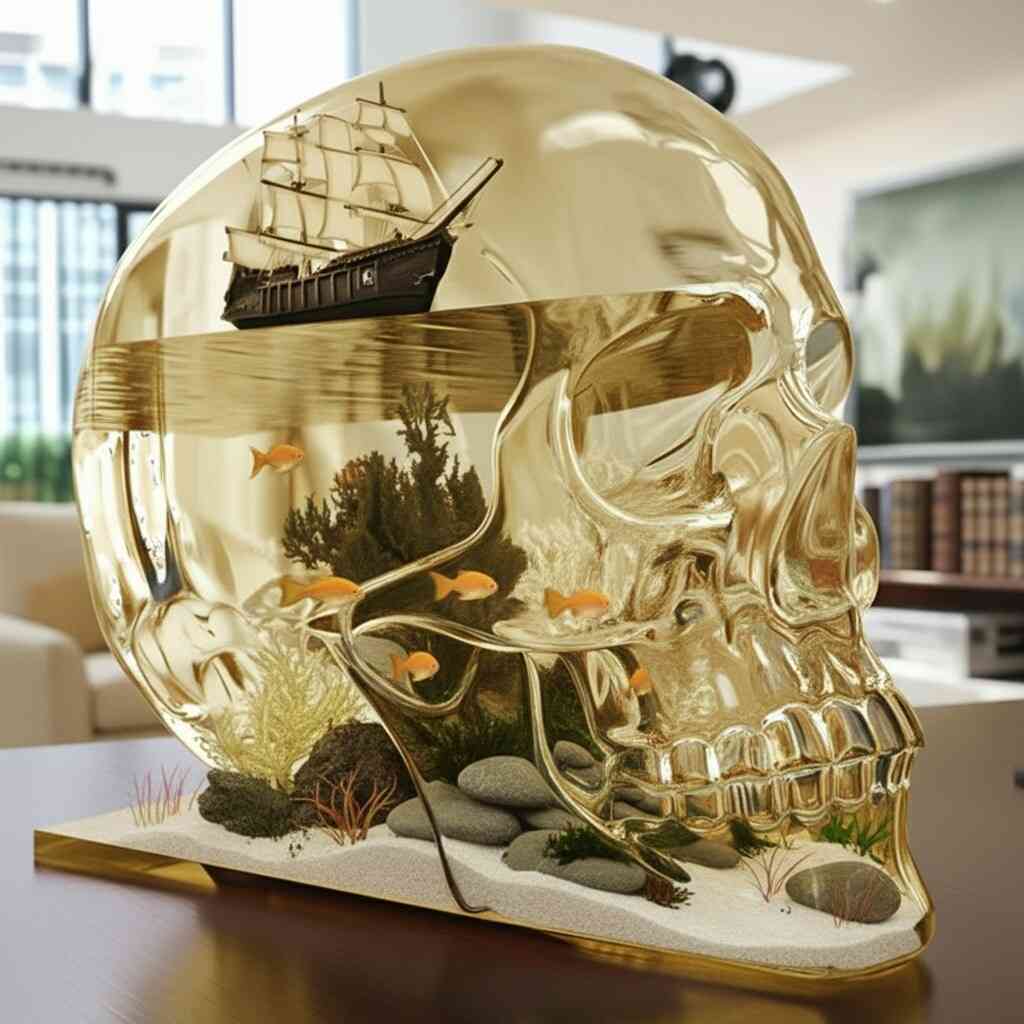
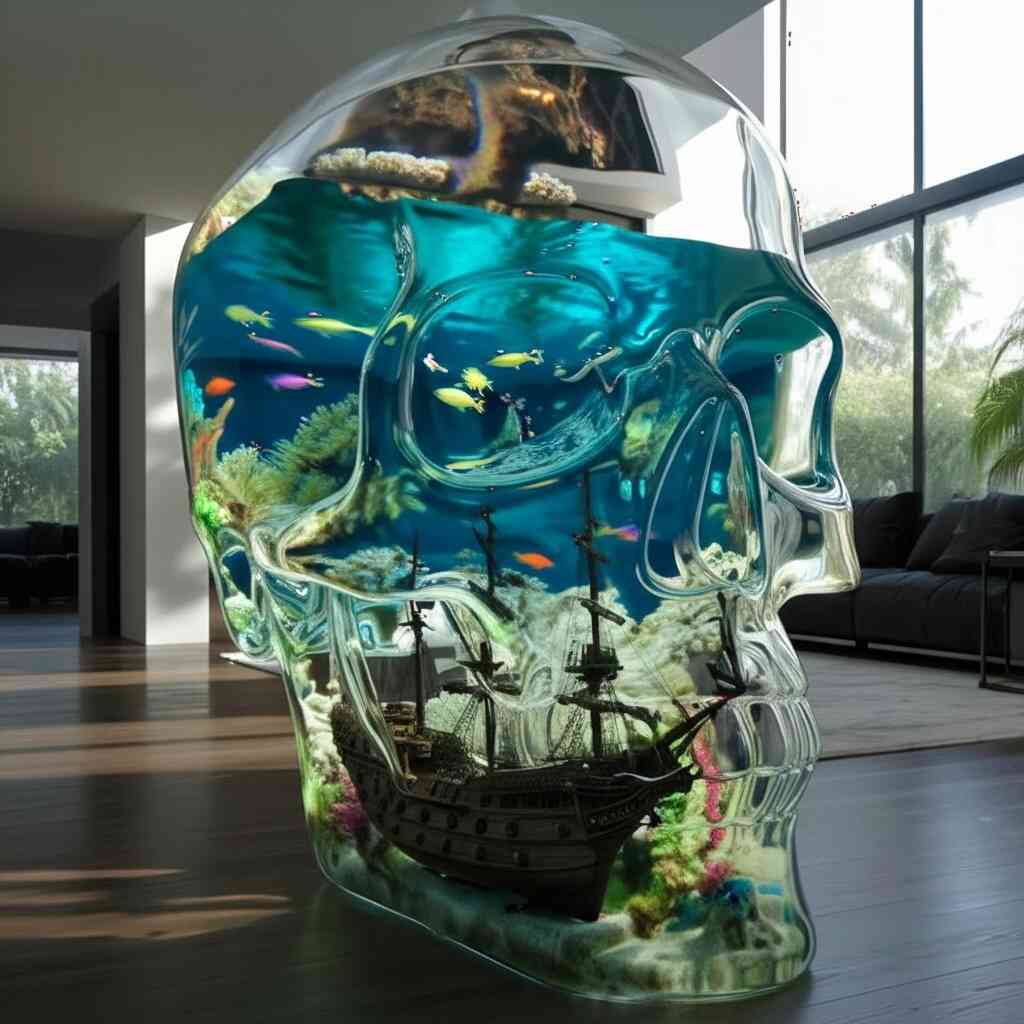
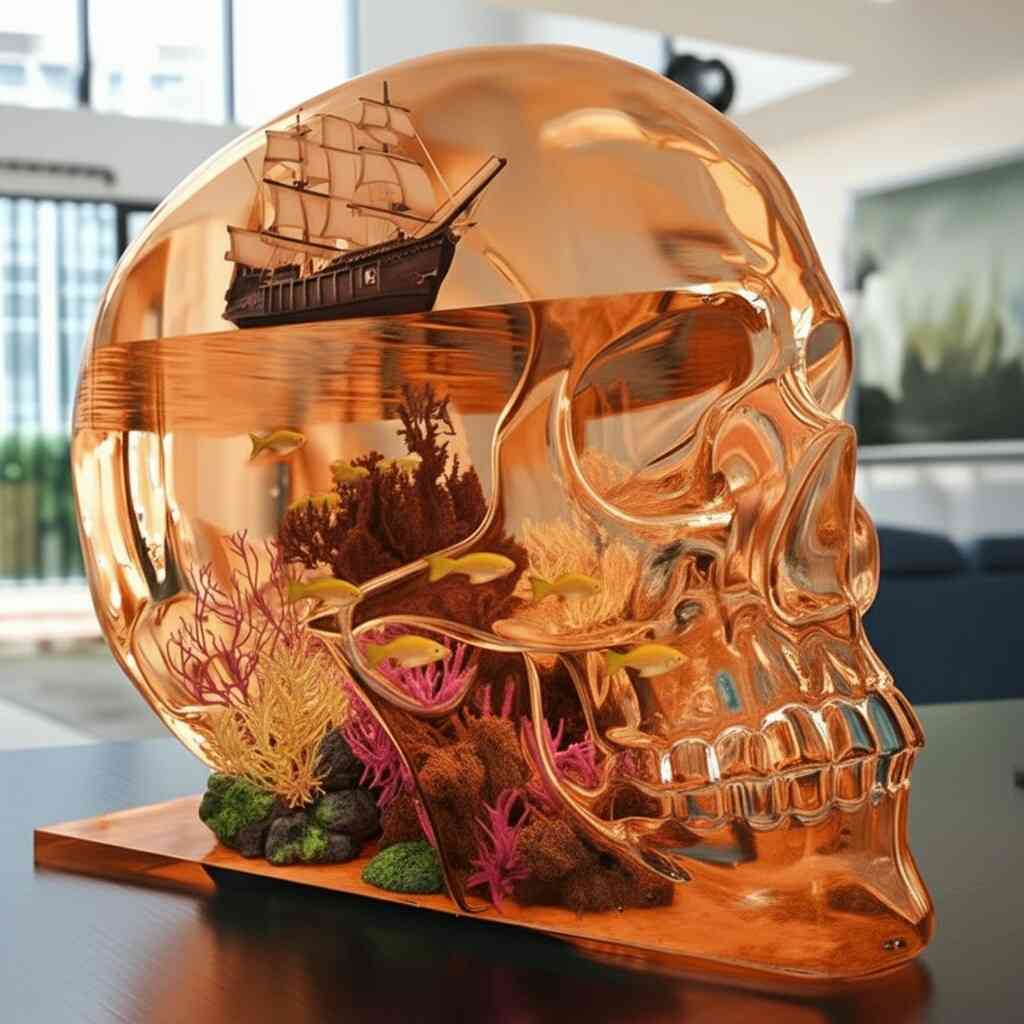
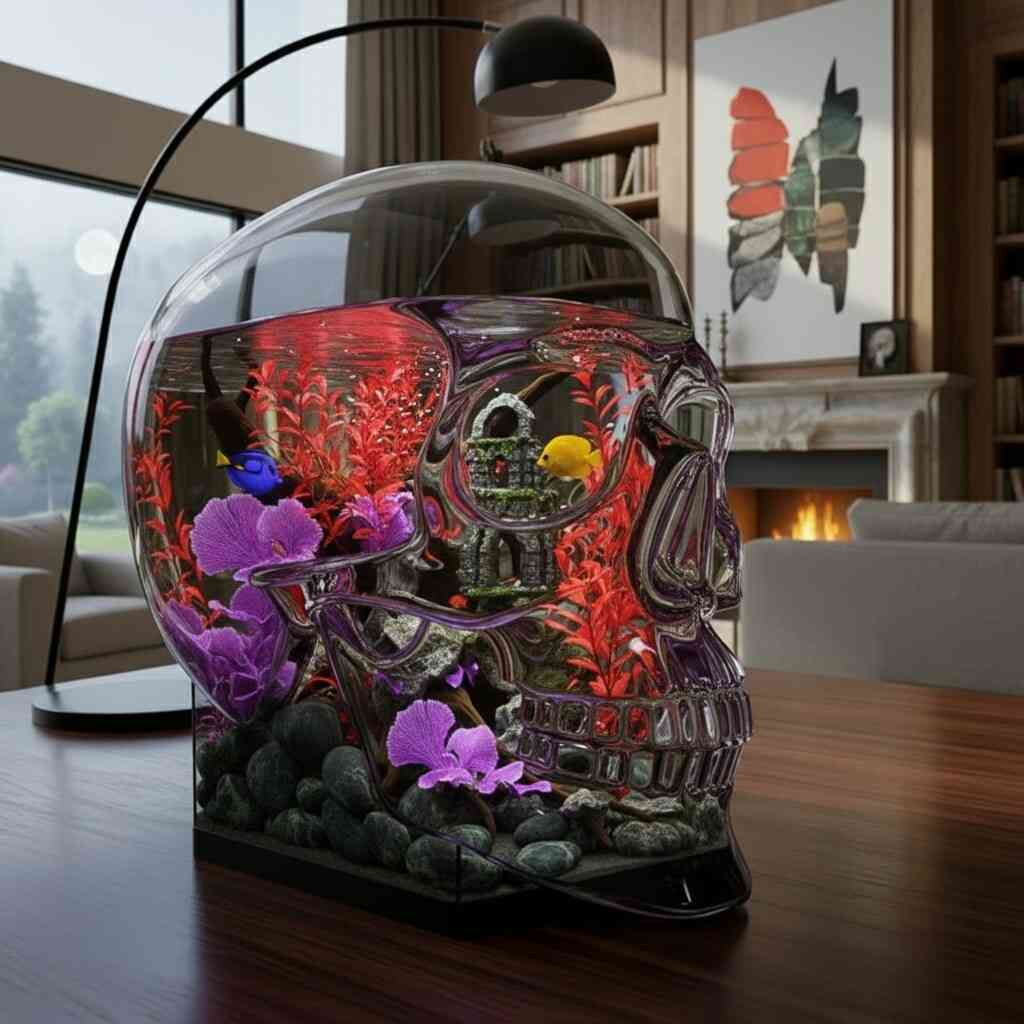
In the quiet hum of a dimly lit room, light refracts through rippling water, casting flickering shadows on walls adorned with antique tapestries and weathered books. At the center stands not a conventional glass rectangle stocked with coral and clownfish—but a vessel of profound duality: a Skull Themed Aquarium. Its structure mimics the contours of a human cranium, hollowed and repurposed not as a relic of fear, but as a cradle of life. Algae drifts like spectral smoke through orbital sockets; schools of tetras swirl where thoughts once coursed; bettas flare their fins in silent oration against the vault of the cranial dome.
The Skull Themed Aquarium is more than an eccentric decoration or a provocative conversation piece. It is a deliberate synthesis of seemingly oppositional forces—decay and vitality, transience and endurance, shadow and luminescence. Rooted in centuries of gothic tradition—where memento mori served not as morbid fixation but as a call to live meaningfully—the skull here undergoes metamorphosis. No longer a stark warning of death, it becomes a stage upon which life reasserts itself, continuously, fluidly, irrevocably.
This article delves into the philosophical and aesthetic underpinnings of the Skull Themed Aquarium, unpacking how it functions as a liminal object: neither wholly art nor wholly habitat, neither purely symbolic nor purely functional. Through three interconnected explorations—The Symbolic Resonance of the Skull in Aquatic Contexts, Design as Ritual: Crafting a Living Reliquary, and Ethical Symbiosis: Life Within the Void—we shall illuminate how this singular concept transcends novelty to become a contemplative medium, a visual koan suspended in water.
I. The Symbolic Resonance of the Skull in Aquatic Contexts
The human skull occupies a unique space in global iconography. Universally recognizable, it transcends language and era—appearing in Neolithic burial rites, Renaissance vanitas paintings, Aztec cosmology, pirate flags, and punk album covers alike. Yet its meaning is rarely fixed. In Western gothic traditions, the skull (caput mortuum, the “dead head”) operates as memento mori: a reminder that “you too shall die.” But this is not nihilism—it is an invitation. By confronting finitude, one is urged to cherish presence, to seek beauty not despite impermanence, but because of it.
Place that symbol beneath water, and its semiotics shift in fascinating ways.
Water, as a primordial element, represents birth, purification, renewal, and the unconscious. In myth, it is the medium of creation (Nun in Egyptian cosmogony, Tiamat in Babylonian), the threshold between worlds (Styx, Lethe), and the embodiment of emotional depth. To submerge the skull in water is to initiate a symbolic baptism—washing away the dust of finality and allowing the bone to become porous, receptive, generative.
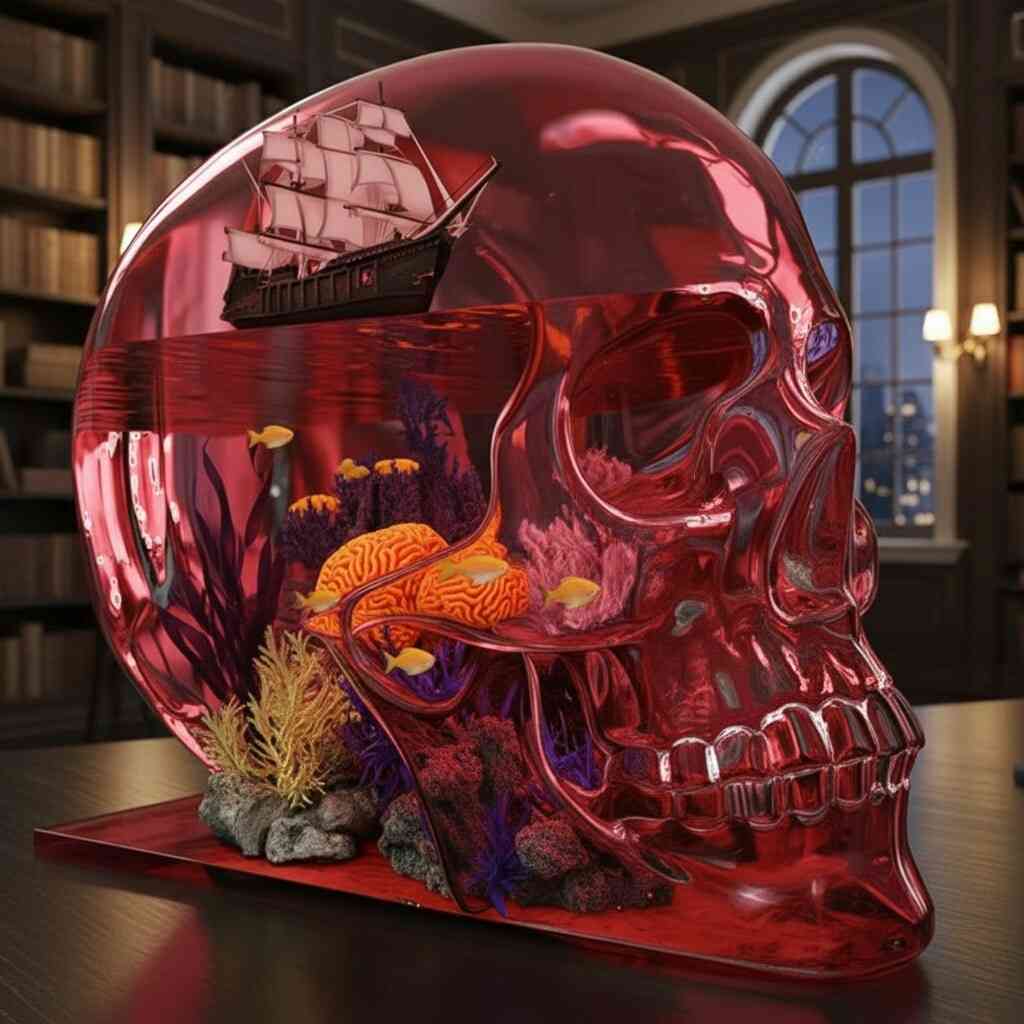
Consider the visual poetry: a cardinal tetra darts through the zygomatic arch, its red stripe like a pulse momentarily reignited. A plecostomus grazes on biofilm along the mandible, performing the slow, essential work of decomposition—turning death into nourishment. Bubbles rise from a hidden airstone, effervescing like breath returning. The skull, once inert and absolute, begins to breathe again—not with lungs, but with the rhythms of an ecosystem.
This resonance is amplified by gothic aesthetics’ long-standing dance with paradox. Gothic cathedrals soared toward heaven with skeletal stone tracery—literal ossuaries of light. Romantic poets like Coleridge and Poe found sublime beauty in ruins, graveyards, and moonlit decay—not out of despair, but awe at time’s layered testimony. The Skull Themed Aquarium inherits this tradition: it does not deny death, but situates life within its embrace. As the 17th-century vanitas painters placed wilting flowers beside hourglasses and skulls, so too does the aquarium juxtapose fragile, fleeting fish with the enduring bone—creating a tableau where mortality and vitality coexist in silent dialogue.
Even the materials contribute to this dialogue. Cast-resin skulls, hand-sculpted with anatomical fidelity, evoke medical specimens and reliquaries. Weathered ceramic or aged bronze variants recall archaeological finds—artifacts pulled from silt and time. Each choice adds layers of narrative: Is this a saint’s relic? A pirate’s trophy? A forgotten scholar’s memento? The ambiguity invites projection, reflection, and, ultimately, personal meaning-making.
Thus, the Skull Themed Aquarium becomes a living vanitas—not static, but dynamic. Its message evolves hourly: as fish grow, plants spread, algae bloom and recede, the composition never repeats. It teaches that meaning is not fixed in bone, but flows—like water—through time.
II. Design as Ritual: Crafting a Living Reliquary
Designing a Skull Themed Aquarium is not merely technical; it is an act of ritual world-building. Every decision—from scale and orientation to substrate and lighting—serves a dual purpose: biological functionality and symbolic coherence.
Form and Function in Dialogue
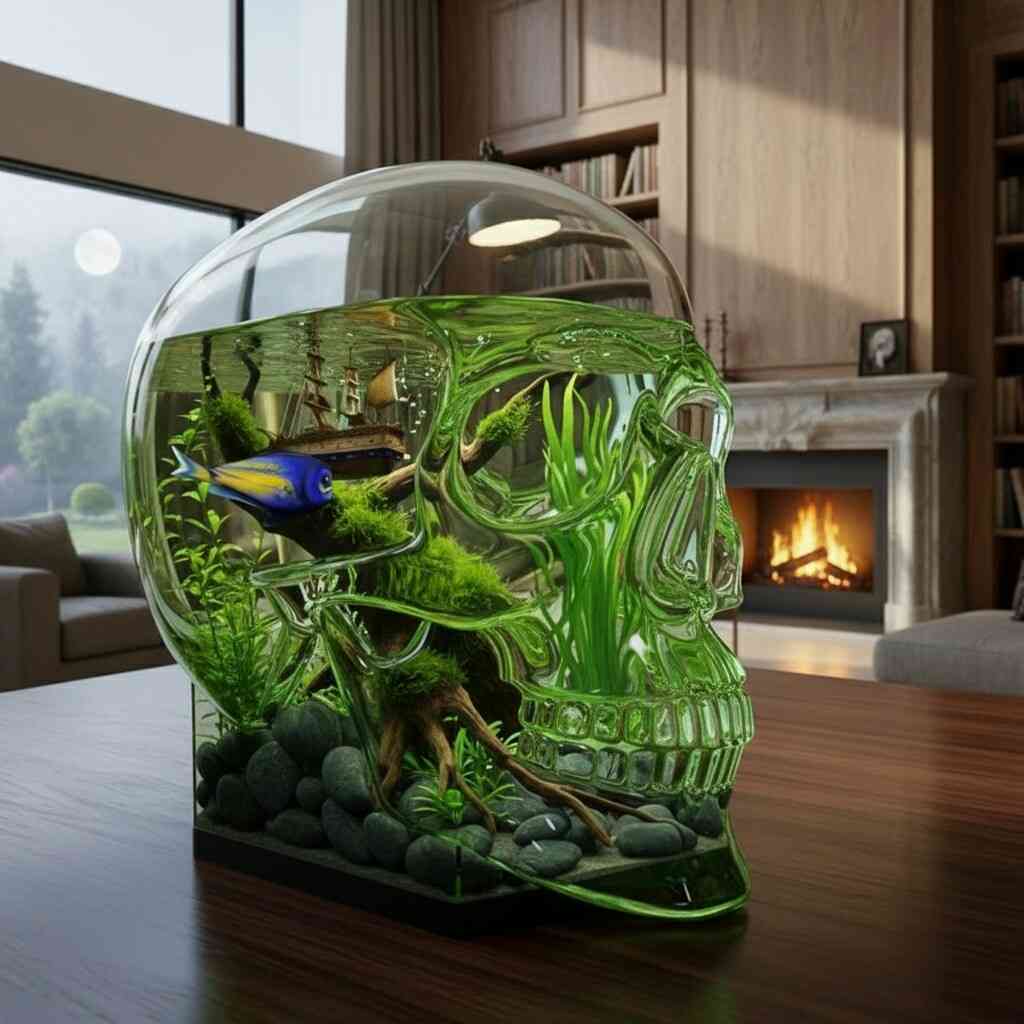
Unlike traditional aquariums, where the tank is a neutral container, the skull itself is the architecture. Its form dictates flow, territory, and refuge. The cranial cavity offers a sheltered central domain—ideal for shy species like kuhli loaches or dwarf corydoras. The nasal aperture and foramen magnum become current channels, guiding water circulation in ways that mimic natural riverbeds or cave systems. Orbital sockets, often fitted with discreet LED spotlights, transform into luminous eyes—watchful, serene, alive with color-shifting hues at dusk.
The challenge lies in respecting both anatomy and ecology. A poorly designed skull might have sharp interior ridges that injure fish, or occluded passages that trap detritus. True craftsmanship involves hydrodynamic testing: ensuring gentle flow, eliminating dead zones, and reinforcing structural integrity without compromising aesthetic authenticity. Silicone seams are hidden along natural fissures—the coronal suture, the lambdoid—so that the skull appears monolithic, a single artifact reclaimed by nature.
Materiality as Narrative
Materials carry weight. A matte-white resin skull evokes medical sterility, clinical observation—perhaps echoing Enlightenment-era anatomical theaters where dissection was both science and spectacle. In contrast, a skull cast in blackened iron or oxidized copper speaks of antiquity, of tombs and forgotten catacombs. Mosses cling more readily to porous terracotta versions, allowing aquascapers to cultivate beard algae or java fern along the temporal lines—literally “growing” hair and beard onto the cranium over time.
Some designers integrate subtle gothic motifs beyond the skull: wrought-iron stands resembling cathedral buttresses, backdrops of stained-glass patterns projected via LED, or base plinths carved with Latin phrases—“Sic transit gloria mundi” (Thus passes the glory of the world), “Et in arcadia ego” (Even in Arcadia, I am)—reminders whispered beneath the surface.
Light as Alchemy
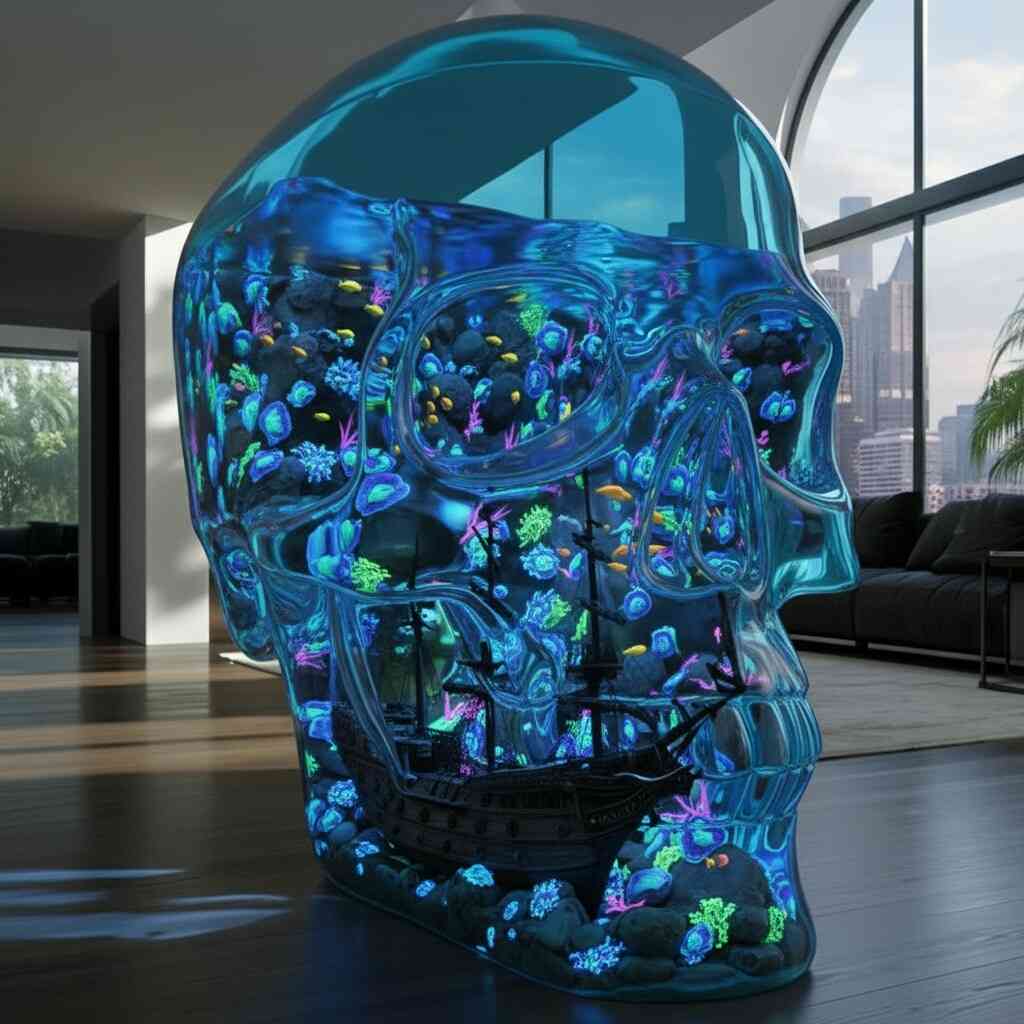
Lighting in a Skull Themed Aquarium functions as both sustainer and storyteller. Cool white LEDs promote plant growth but can feel sterile; warmer tones (2700K–3500K) cast the water in amber, evoking candlelight in a chapel, firelight in a crypt. Moonlight-mode LEDs simulate nocturnal luminescence—under which cardinalfish emerge, glowing faintly, like stars in a bone-constellated sky.
Strategic spotlighting within the orbits can create the illusion of sentience: a gentle glow that seems to follow the viewer, not mechanically, but with the slow, patient regard of something ancient and knowing. This is not anthropomorphism—it is atmospherics as philosophy. The light does not illuminate the skull; it animates it.
Aquascaping the Interior World
The interior landscape is where biology and symbolism merge most intimately. Unlike reef tanks that mimic external ecosystems, the Skull Themed Aquarium constructs an internal one—a biome within a body.
- The Brain Cavity may be planted with fine-leafed species like Hemianthus callitrichoides (“HC”), forming a dense green “cerebrum” that pulses with microfauna: copepods, ostracods, tiny worlds within worlds.
- The Sinuses—narrow, elevated chambers—host epiphytes: anubias, bucephalandra, or mosses attached to miniature bone-textured hardscape, suggesting neural pathways overgrown with memory.
- The Mandible rests slightly ajar in many designs, allowing trailing plants like Ceratopteris (water sprite) to cascade downward like a beard of living thought.
Even detritus is recontextualized. A layer of fine black sand in the cranial base doesn’t signal neglect—it becomes “thought sediment,” the accumulated residue of contemplation. Shrimp sift through it, cleaning, recycling—nature’s librarians, preserving the archive.
This level of intentionality makes the creation process itself a meditative act. Building a Skull Themed Aquarium is akin to composing a sonnet: strict form, rich metaphor, emotional precision. It demands patience, respect for both life and symbol—and above all, the understanding that the skull is not a cage, but a sanctuary.
III. Ethical Symbiosis: Life Within the Void
The most profound dimension of the Skull Themed Aquarium lies not in its appearance, but in its ethics. To place living beings within a symbol of death invites scrutiny: Is this exploitation? Aestheticization of suffering? A macabre folly?
The answer hinges on stewardship—and here, the Skull Themed Aquarium reveals its deepest philosophical alignment: with symbiosis, not spectacle.
Animals as Co-Authorities
In responsible practice, fish are not props but participants. Species selection is guided by behavioral harmony and environmental suitability—not visual shock value. A betta may inhabit the skull solo, its labyrinth organ allowing it to thrive in stiller waters, its flowing fins echoing ceremonial vestments. A community of ember tetras, chili rasboras, and otocinclus creates a gentle, self-regulating microcosm—each species fulfilling ecological roles as they would in blackwater streams of Southeast Asia.
Crucially, no creature is forced into unnatural postures. The skull’s interior is modified to remove sharp edges; all openings are wide enough for unimpeded passage; water parameters (pH, hardness, temperature) match the inhabitants’ native ranges. The design serves them first; the symbolism emerges second.
Indeed, many aquarists report that fish in skull tanks exhibit reduced stress behaviors. The enclosed cranial space offers psychological security—a “cave” instinctively recognized as shelter. Shy species become bolder; territorial disputes lessen. The skull, paradoxically, becomes a womb.
Death as Cycle, Not Endpoint
The Skull Themed Aquarium does not deny mortality—it integrates it. When a fish dies (as all living things must), its body is not removed as failure, but composted respectfully—perhaps placed under a potted ivy nearby, completing the nutrient loop. Algae blooms are not “problems” but indicators: of light imbalance, of excess nutrients, of seasonal shifts. They are trimmed, not eradicated—allowed to exist in balance.
This mirrors gothic ecology’s deeper truth: decay is generative. Fallen leaves become humus; fallen stars become nebulae. The skull, in this light, is not an end, but a threshold—a porous membrane between states. Water flows in and out; oxygen dissolves; fish breathe, excrete, feed, spawn. Life persists through the form of death, not in opposition to it.
The Viewer’s Transformation
Finally, the Skull Themed Aquarium asks something of its observer. To sit before it for ten minutes is to experience a subtle recalibration. The initial unease—the uncanny valley of bone and gill—gives way to fascination, then reverence. One notices how the fish ignore the skull entirely. To them, it is not a symbol; it is simply home. Their world is water, current, food, companionship. The human projection of meaning is ours alone.
This realization is humbling. It dissolves anthropocentrism. The skull does not contain life as a trophy; it hosts it as a guest. And in that hospitality—silent, ancient, generous—lies a model for coexistence.
Conclusion: The Skull That Dreams in Water
The Skull Themed Aquarium is, ultimately, a paradox made manifest: a monument to impermanence that thrives on continuity; a symbol of silence that teems with life; a vessel of void that overflows with color, motion, and breath.
It does not glorify death, nor does it flee from it. Instead, it offers a third path—one long walked by mystics, poets, and ecologists alike: integration. To live fully is not to forget we die, but to let that knowledge deepen our attention—to the iridescence of a danio’s scale, the delicate unfurling of a cryptocoryne leaf, the slow, deliberate glide of a shrimp along an ancient suture line.
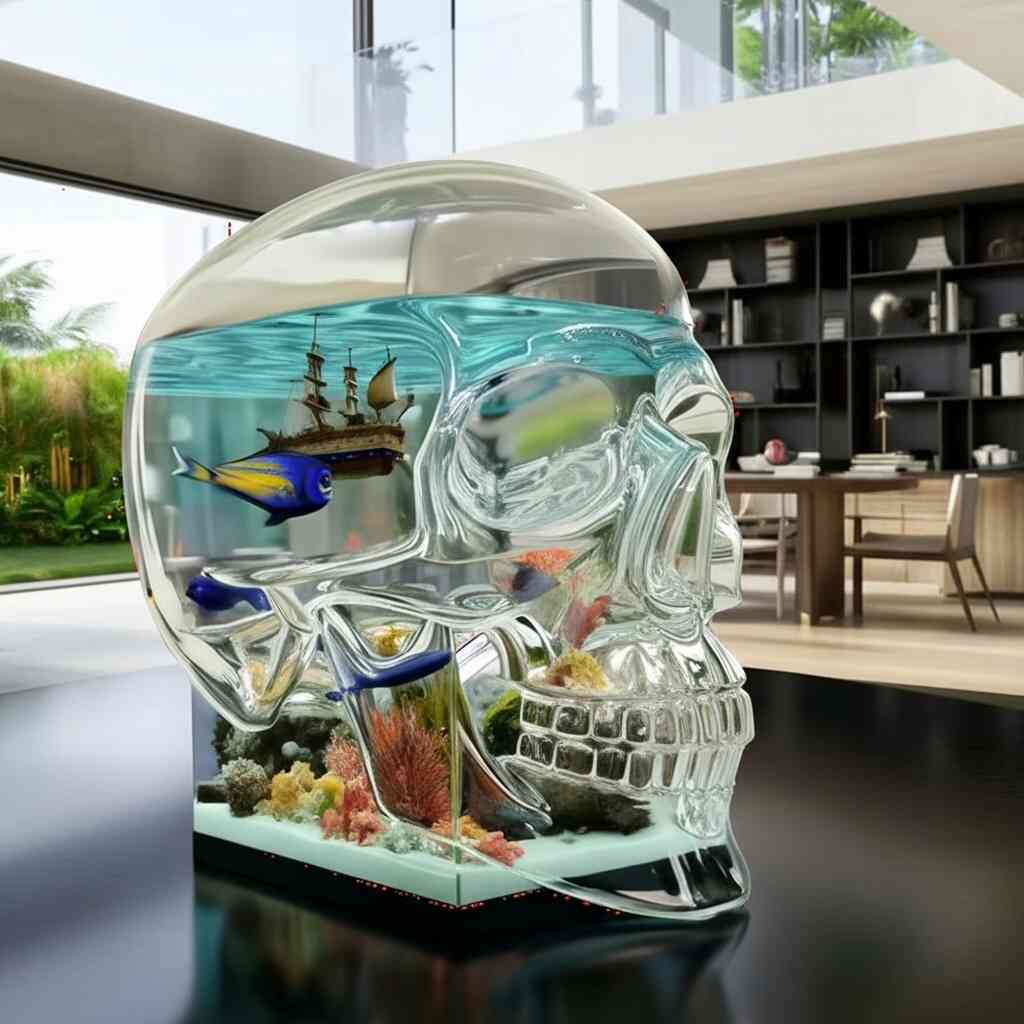
In an age of digital distraction and ecological estrangement, the Skull Themed Aquarium stands as a quiet counterpoint: a focal point for mindfulness, a lesson in interdependence, a testament to beauty born of contrast. It asks us to see the sacred not only in bloom, but in bone; not only in light, but in the shadows it casts; not only in life, but in the forms it leaves behind—and within which, miraculously, it begins again.
For in the end, every skull was once a cradle. And every cradle, in time, becomes a vessel—not of endings, but of return.
The water flows. The gills pulse. The light shifts.
And the skull, submerged, dreams on.