
In an age of increasing environmental awareness and a collective yearning for connection with nature, architecture is quietly undergoing a poetic metamorphosis. No longer confined to stark minimalism or industrial bravado, contemporary design is reaching into the forest—and not merely for inspiration or raw materials, but for dialogue. Among the most evocative manifestations of this shift is the emergence of Tree Trunk Doorways: architectural passages that integrate the living or preserved form of a tree trunk into the very threshold of a home. These are not decorative motifs or stylized replicas; they are literal portals—functional, structural, and deeply symbolic—where the boundary between inside and out dissolves into something far more tender and profound.
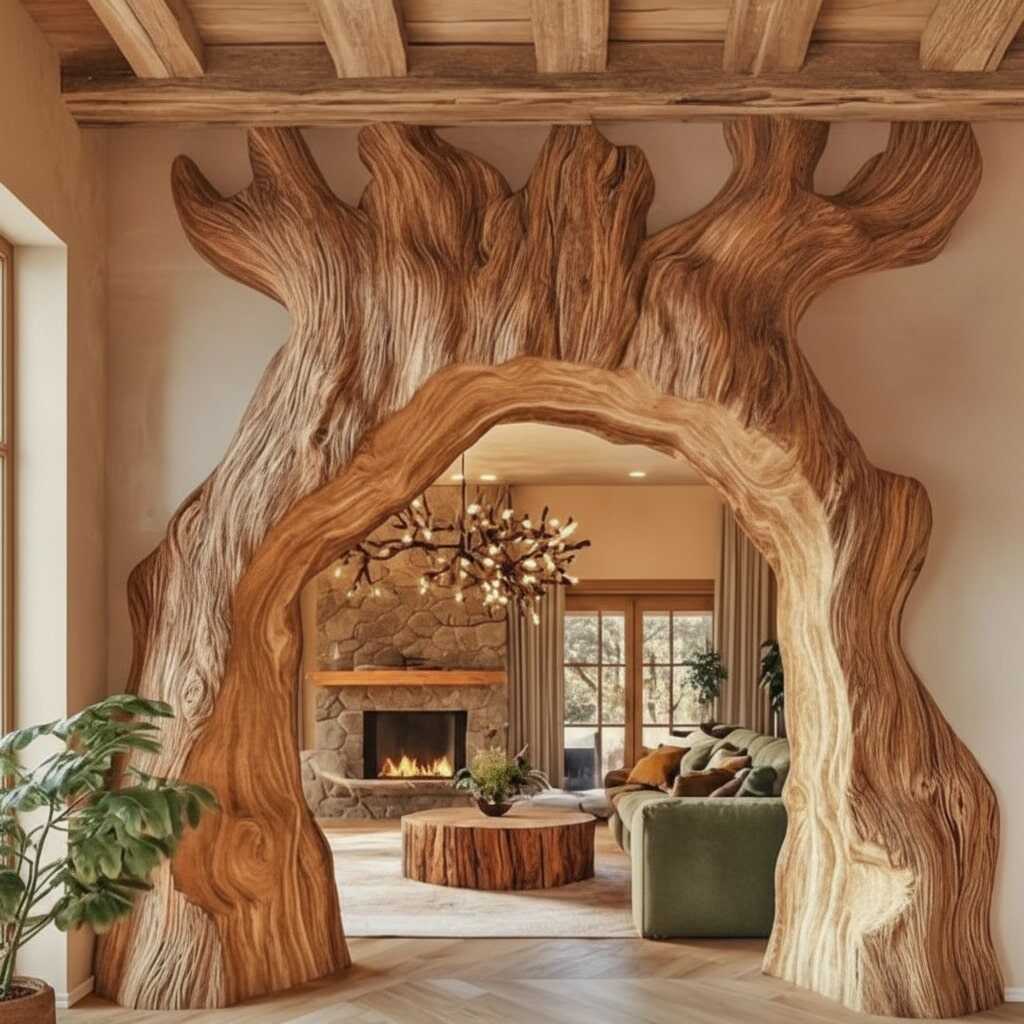
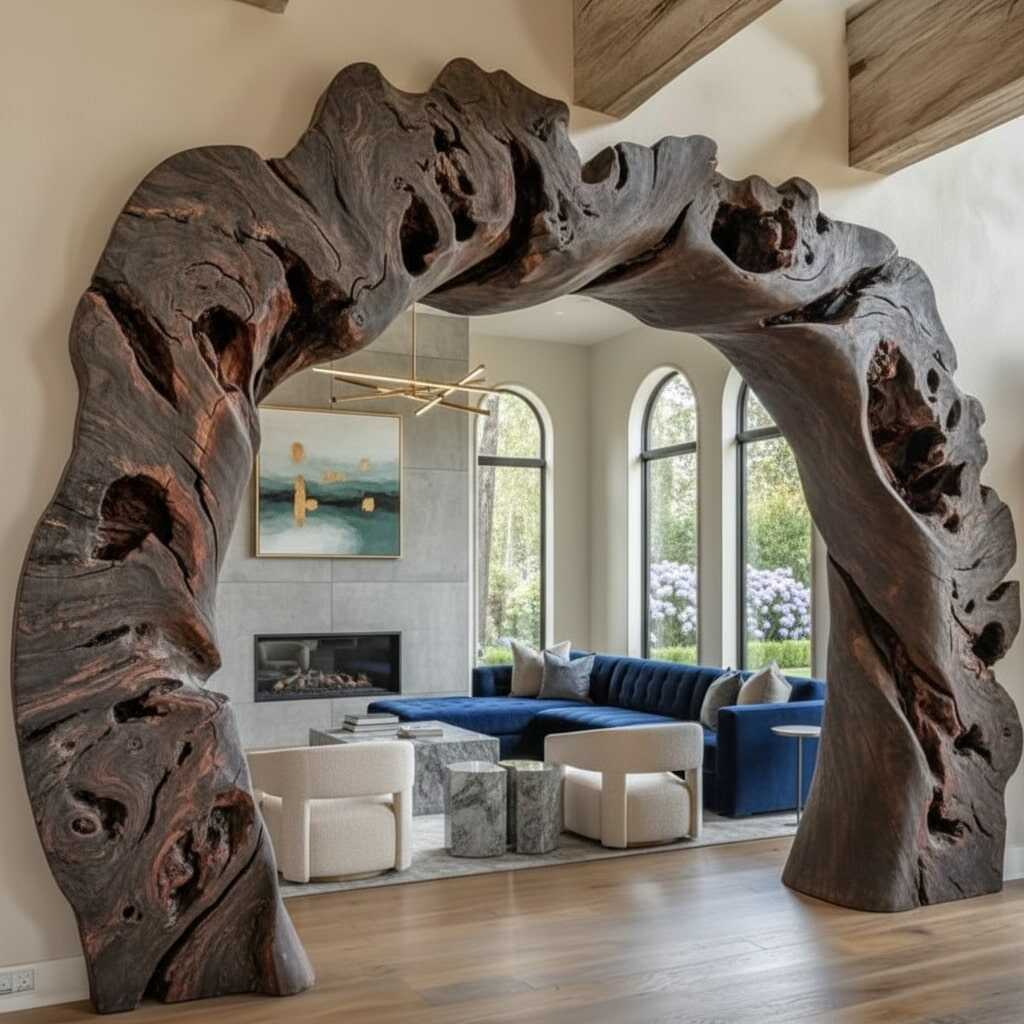
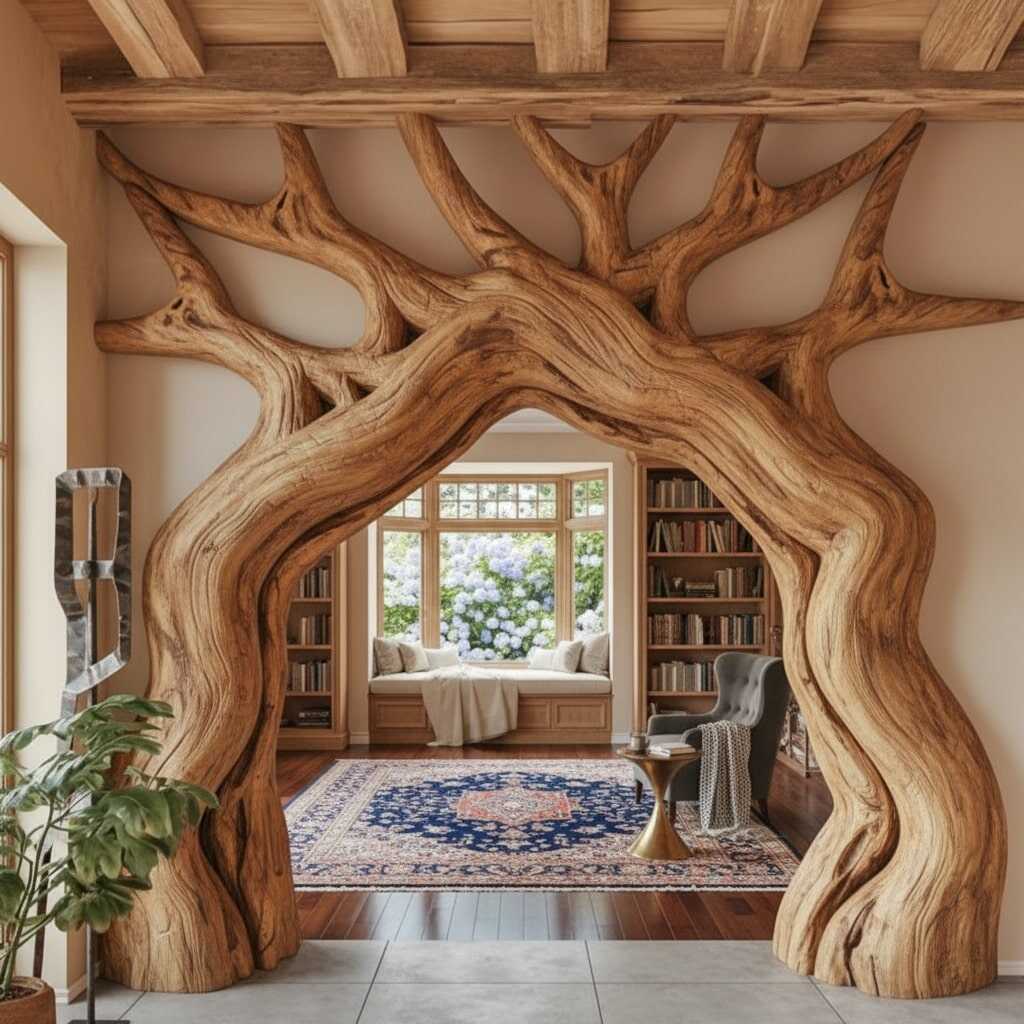
A Tree Trunk Doorway is exactly what its name suggests: a functional entryway built around, within, or through the natural form of a tree trunk. In some cases, a living tree grows unimpeded through the center of a home, its trunk forming the core of a passageway; in others, a reclaimed, centuries-old trunk becomes the frame—its bark still intact, its grain undisturbed—welcoming residents and guests with the quiet dignity of time itself. These doorways resist standardization. Each one is singular: shaped by the tree’s life, its bends, scars, rings, and roots—narratives etched in cellulose and cambium.
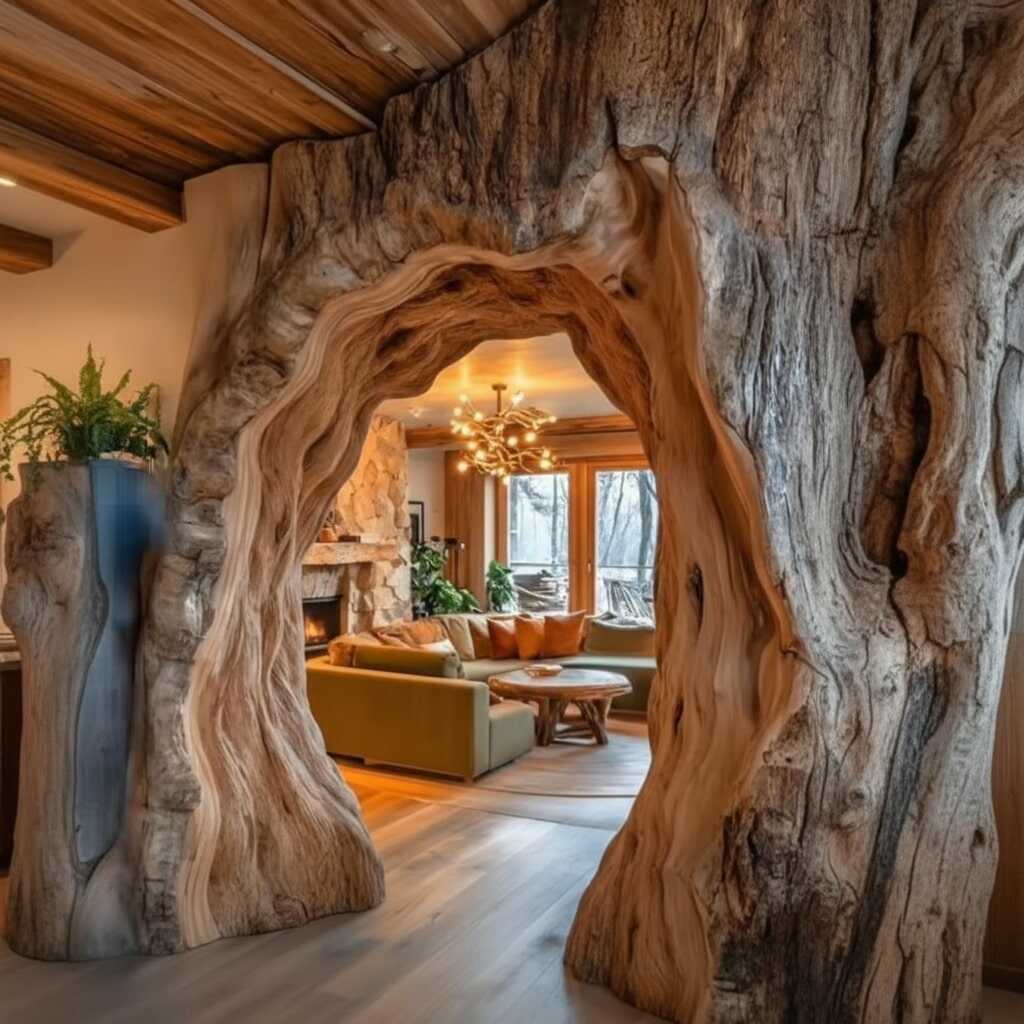
The charm of Tree Trunk Doorways lies not only in their visual poetry but in their philosophical resonance. At a time when sustainability is often reduced to metrics—R-values, carbon footprints, LEED scores—such features remind us that eco-friendly design is, at its heart, relational. It is about reciprocity: not just taking less from the earth, but giving space to it. A Tree Trunk Doorway does not merely conserve resources—it reconfigures human habitation around the rhythms and rights of the nonhuman world. It is a physical manifesto: a home that does not dominate the landscape, but invites the landscape in.
This article explores the multifaceted allure of Tree Trunk Doorways in eco-friendly homes—not as novelties or luxury flourishes, but as profound acts of ecological and aesthetic reorientation. Through three lenses—material continuity and reverence, threshold as transformation, and temporal dialogue across generations—we will delve into what makes these doorways so uniquely compelling, and why they may represent more than just a trend in sustainable architecture, but a quiet revolution in how we understand dwelling itself.
Part I: Material Continuity and Reverence—Honoring the Integrity of the Tree
One of the most striking aspects of Tree Trunk Doorways is how they challenge conventional notions of material processing. In mainstream construction, wood is typically reduced to uniform planks, beams, or veneers—stripped of its original form, scent, and story. A tree becomes lumber, a commodity. But in a Tree Trunk Doorway, the tree remains unmistakably a tree. Its bark, weathered and textured, forms part of the tactile threshold. Knots, cracks, and burls are not flaws to be sanded away but signatures of resilience—features that are preserved, even highlighted.
This preservation is more than aesthetic; it is ethical. It reflects a philosophy of material continuity—the idea that a substance retains its identity and dignity throughout its journey from forest to structure. A Tree Trunk Doorway acknowledges that a tree’s life does not end when it is felled or enclosed; rather, its role evolves. In homes where the tree is still living, this evolution is literal: the trunk continues to photosynthesize, draw water, and respond to seasonal light. The doorway becomes a symbiotic interface—where human warmth meets arboreal breath.
Consider the case of a home built around a mature oak in the Pacific Northwest. Rather than clearing the land, the architects designed the central corridor to curve around the trunk, embedding the doorway into the tree’s natural taper. The door itself is inset within the bark-lined aperture; to enter, one must step through the circumference of the living oak. Rainwater is funneled along copper gutters that echo the tree’s own vascular patterns, feeding a root zone protected beneath a permeable stone courtyard. Here, the Tree Trunk Doorway is not an imposition but an accommodation—an act of cohabitation. The home does not consume the tree; it shelters beside it.
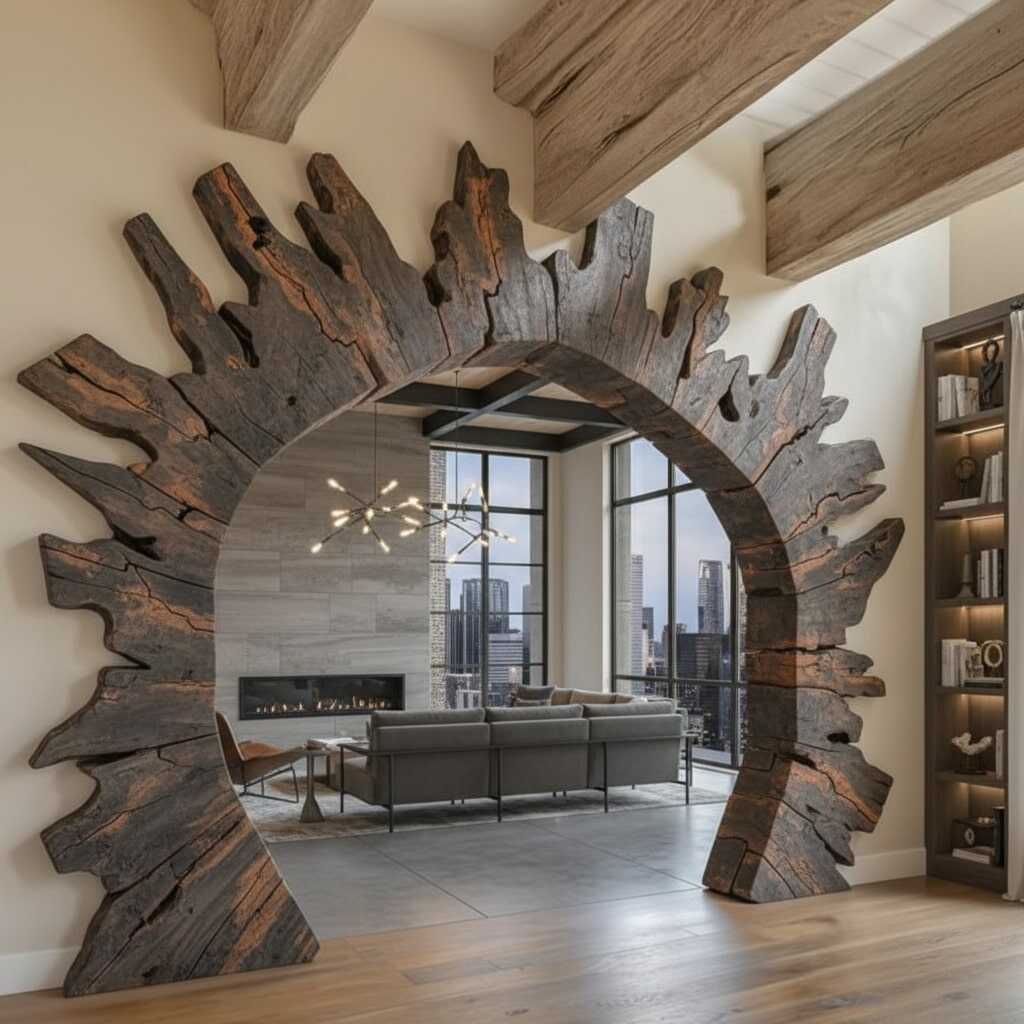
This reverence extends to reclaimed trunks as well. Some eco-conscious builders source storm-fallen giants or trees removed for pathogen containment—not from commercial timber operations, but from municipal arborist programs or forest stewardship initiatives. These trunks, often massive and centuries old, are carefully craned into place, their root flares grounding the foundation, their crowns (even if lopped) evoking the memory of canopy. The doorway carved into such a trunk is a kind of memorial—not mournful, but celebratory. Touching the bark upon entry becomes a ritual, a tactile reminder that shelter is borrowed, not owned.
Crucially, this approach demands humility. Working with an irregular, organic form requires bespoke joinery, adaptive engineering, and deep collaboration between architects, structural biologists, and craftspeople. There are no off-the-shelf hinges or pre-cut jambs. Every bolt must accommodate grain direction; every sealant must allow for subtle movement in response to humidity and temperature. The labor intensifies, but so does the meaning. The resulting Tree Trunk Doorway resists mass production—not as an elitist gesture, but as an affirmation that some things should not be replicated. Each one is site-specific, story-bound, irreplaceable.
In this way, Tree Trunk Doorways embody a core tenet of deep ecology: that intrinsic value resides not in utility, but in existence itself. The tree is not used—it is witnessed.
Part II: Threshold as Transformation—Crossing into a New Mode of Being
In architectural theory, the threshold is never merely functional. It is liminal space—charged with symbolism, transition, and psychological resonance. Think of the genkan in Japanese homes, where one removes shoes to leave the outer world behind; or the portico in classical villas, marking the passage from public to private life. A Tree Trunk Doorway deepens this liminality, layering it with ecological and spiritual dimensions.
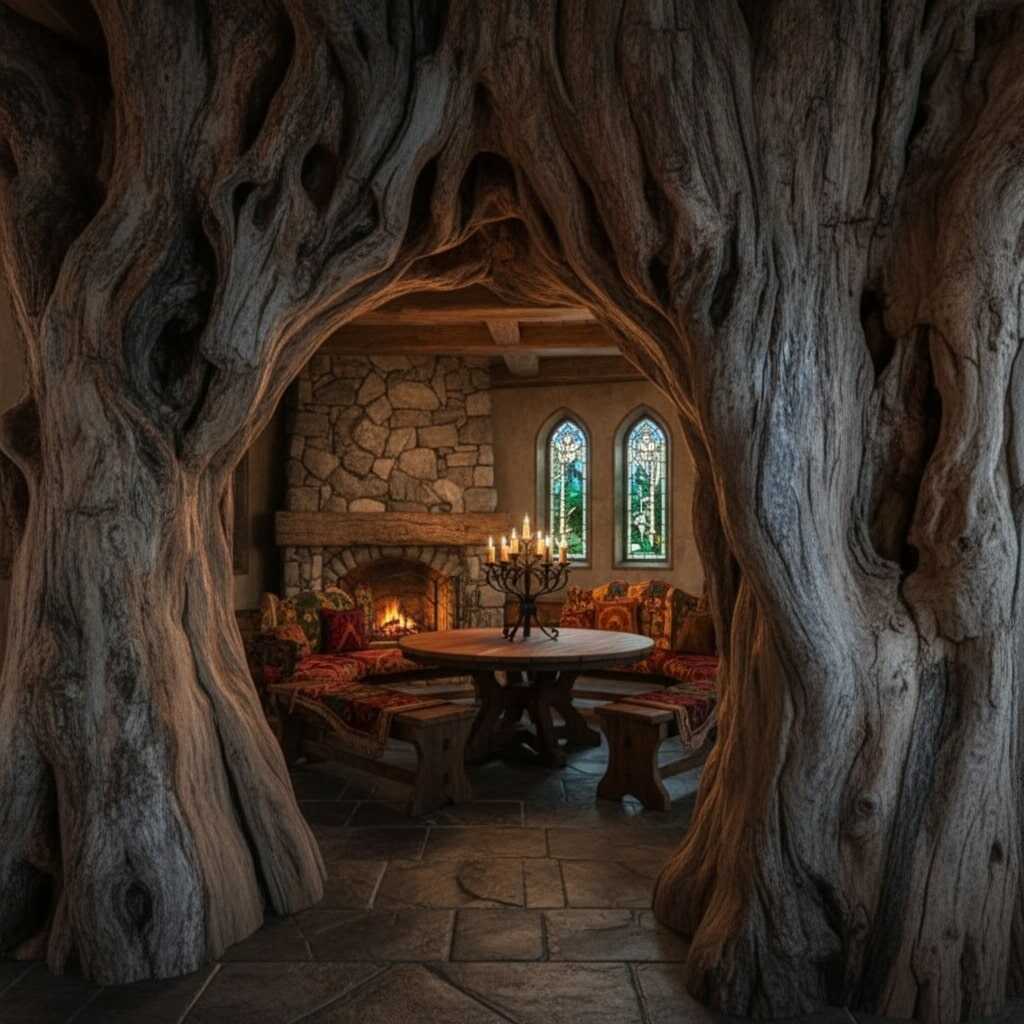
To pass through a Tree Trunk Doorway is to enact a small but potent ritual of reorientation. One does not simply open a door; one enters the body of the forest. The trunk’s circumference forms a natural frame—sometimes tight enough to require a slight turn of the shoulder, an almost ceremonial gesture of yielding. Light filters differently here: dappled if the tree is leafed, or sharp and linear if the trunk is bare in winter. The scent shifts too—damp moss in the rainy season, sun-warmed resin in summer, the faint tang of decaying leaves in autumn. These sensory nuances recalibrate the nervous system, slowing the pace of entry, inviting mindfulness.
This transformative power stems from the doorway’s refusal to separate nature from culture. Most eco-homes emphasize views of nature—large windows framing forests or meadows—while still maintaining an intact, sealed envelope. The Tree Trunk Doorway, by contrast, breaches the envelope intentionally. It allows microclimates to mingle: birdsong enters unfiltered; breezes carry pollen and spores inside; insects may alight on the inner bark. Rather than defending against the outside, the home negotiates with it. This is not passive design; it is active hospitality.
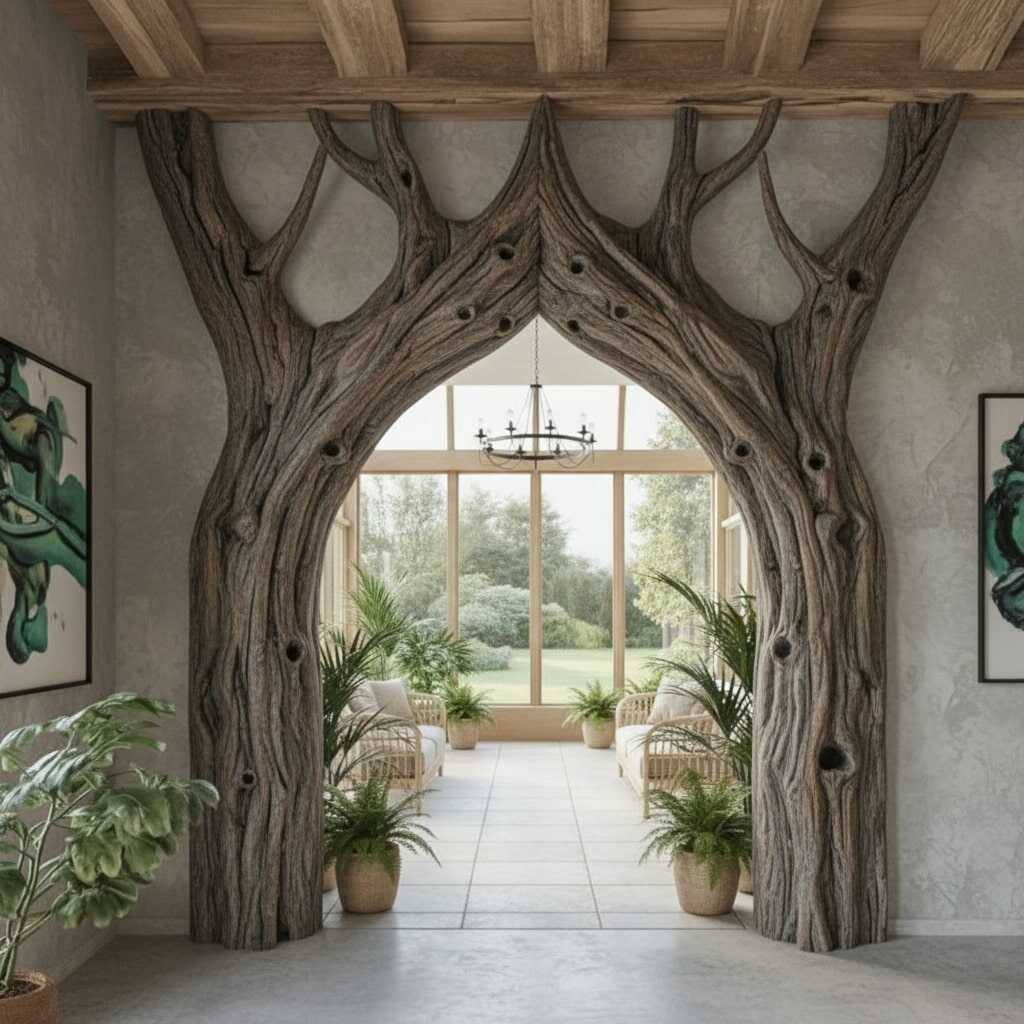
Moreover, the Tree Trunk Doorway subverts the colonial logic of domestic space—where nature is curated, controlled, and kept at bay. Here, nature is granted agency. A living trunk may lean slightly over decades, requiring adaptive hinges. Fungal networks may extend from root to subfloor, subtly influencing indoor air microbiology (studies suggest such connections can enhance immune resilience). Even decay is not hidden: a bracket fungus fruiting on the lower trunk becomes part of the home’s evolving narrative—a sign not of neglect, but of acceptance.
For children especially, these doorways become sites of wonder and learning. A crack in the bark may house a family of beetles; lichen patterns become impromptu lessons in symbiosis. The doorway is not static décor—it is a living textbook, a companion. In this way, Tree Trunk Doorways serve as pedagogical thresholds, teaching that homes are not islands but nodes in a larger, breathing network.
Architects who work with such features speak of “designing with permission”—asking not how can we make this tree fit our plan? but how can our plan serve the tree’s presence? This inversion is radical. It shifts architecture from mastery to stewardship. And every time a resident crosses that threshold, they enact that shift anew.
Part III: Temporal Dialogue—Conversations Across Centuries
Perhaps the most profound dimension of Tree Trunk Doorways lies in their engagement with time. Trees grow slowly. A mature trunk may have begun its life before the invention of electricity, before the signing of foundational human rights charters, before entire nations existed. Its rings hold climate data, fire scars, drought memories—archives written in lignin and cellulose.
When such a trunk becomes a doorway, it brings this deep time into daily human rhythms. Breakfast is made under the gaze of a being that weathered the Little Ice Age. A child’s first steps echo in a space witnessed by centuries of owls, deer, and falling stars. The Tree Trunk Doorway becomes a chronotope—a fusion of place and time—where the present is constantly measured against the long arc of ecological history.
This temporal dialogue reshapes inhabitants’ relationship to legacy. Unlike steel or concrete—materials that project an illusion of permanence—wood ages visibly. A Tree Trunk Doorway will change: bark may slough in patches; new growth may emerge from dormant buds; color will mellow from russet to silver-gray. These changes are not signs of deterioration but of continuity. Residents learn to read the tree’s moods, its responses to drought or abundant rain. They become attuned to cycles larger than quarterly calendars or election cycles.
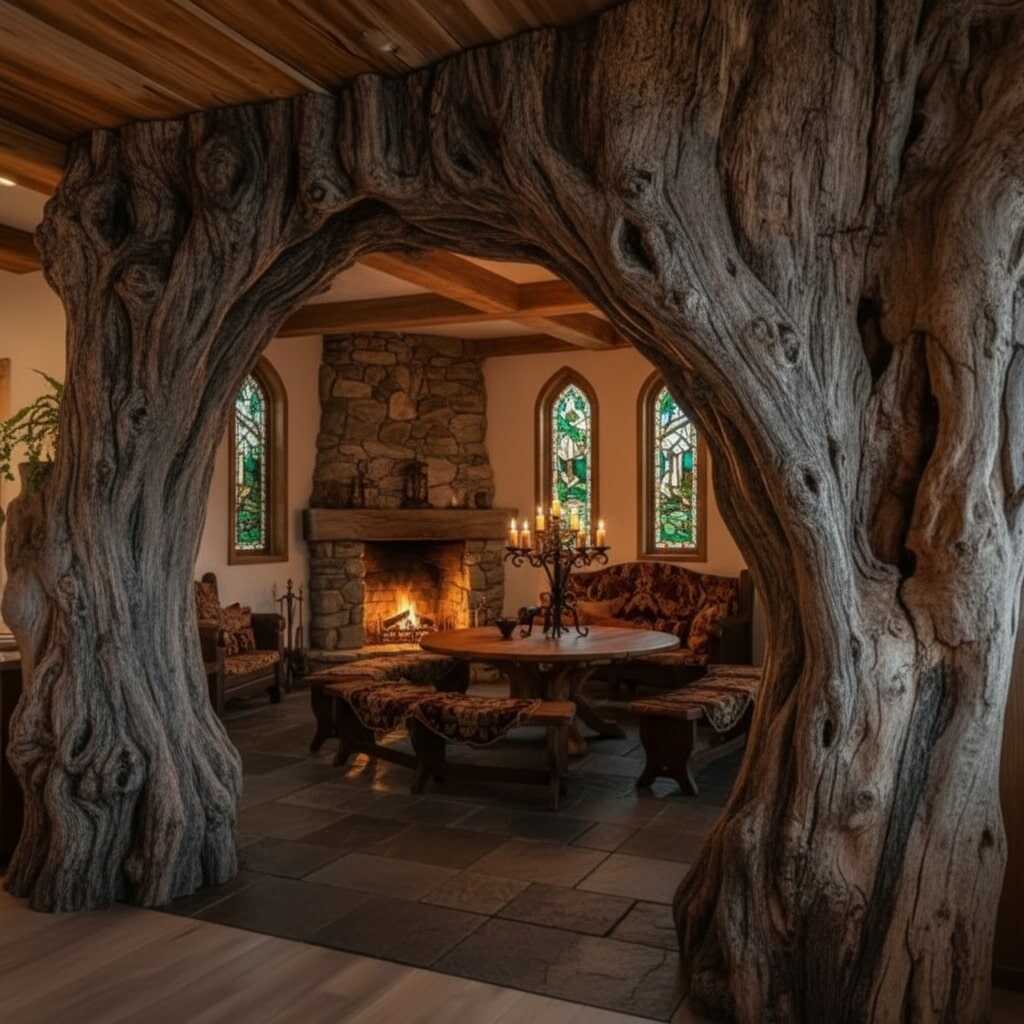
In homes with living trunks, this attunement becomes responsibility. Pruning is done not for aesthetics but for structural health; irrigation mimics natural patterns; pests are managed through polyculture, not pesticides. The home becomes a node in a forest’s extended metabolism. And when, inevitably, the tree reaches the end of its life, the response is not demolition but evolution. Some architects design modular interiors so that, when the trunk finally hollows or leans beyond safe limits, the doorway can be respectfully enclosed—its form memorialized in a plaster cast, its wood repurposed for shelving or a meditation bench.
Even then, the dialogue continues. Seeds from the tree may be planted in the garden—the next generation already growing, its saplings watched with affection by those who once passed through their ancestor’s doorway.
This multi-generational perspective challenges the disposability embedded in modern construction. A Tree Trunk Doorway is not designed for a 30-year mortgage cycle; it is conceived in decades, even centuries. It asks: What will this threshold mean to those who come after us? How will they speak to the tree? In a world racing toward obsolescence, such questions feel revolutionary.
Conclusion: Thresholds of Belonging
The charm of Tree Trunk Doorways cannot be reduced to aesthetics, though they are undeniably beautiful—gnarled and graceful, humble and monumental. Nor lies it solely in their ecological credentials, though their low-impact ethos is undeniable. Rather, their true allure resides in their ability to reframe the very act of dwelling.
To live with a Tree Trunk Doorway is to inhabit a different ontology—one in which humans are not sovereign tenants of the earth, but participants in a shared, ancient story. Each crossing of the threshold becomes a reaffirmation of that participation: a small bow to the more-than-human world, an acknowledgment that shelter is not conquest, but coexistence.
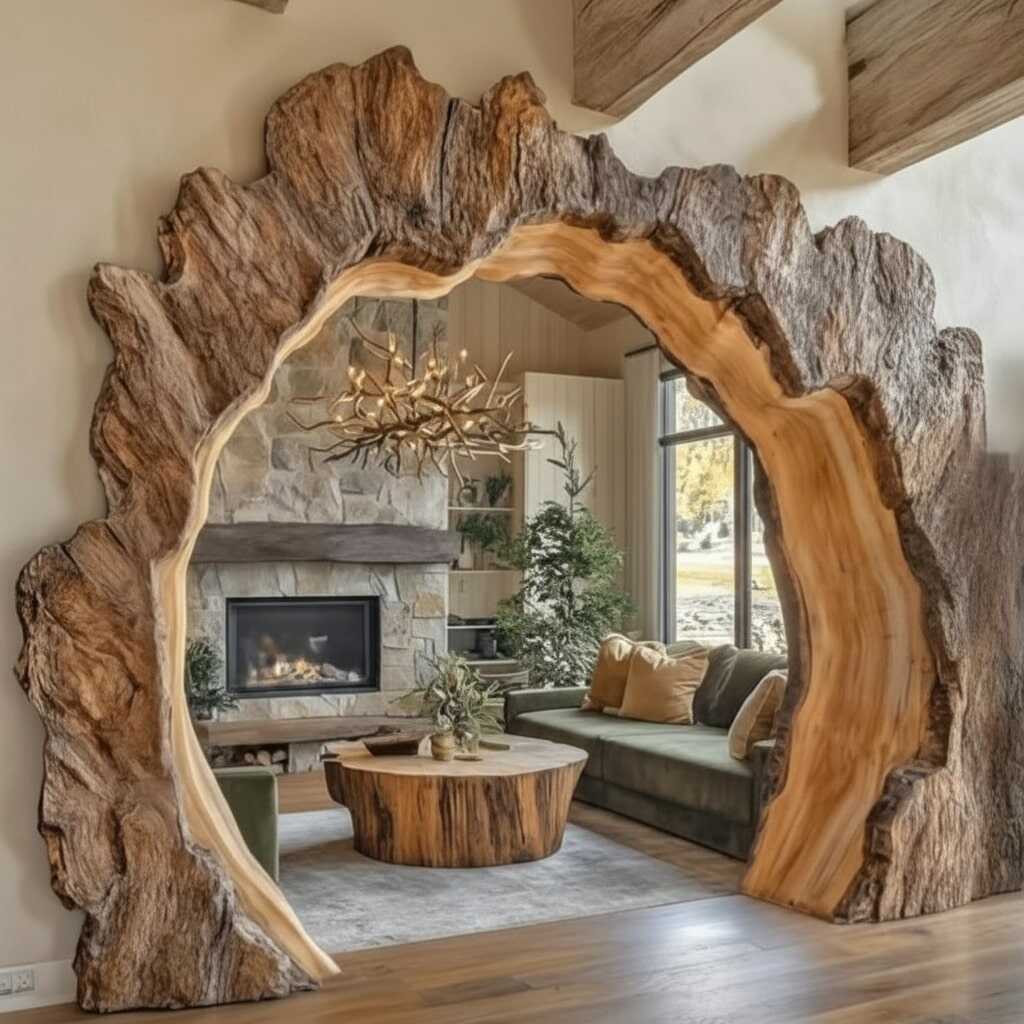
These doorways do not shout. They do not seek to impress with scale or technology. They stand quietly, like elders—offering passage, bearing witness, holding memory. In their presence, we remember what many indigenous cosmologies have long affirmed: that trees are persons—teachers, kin, ancestors. Architecture, when it listens, can become a form of kinship.
As climate uncertainty deepens and urban alienation intensifies, the Tree Trunk Doorway offers more than shelter. It offers orientation. It reminds us that to build a home is not merely to enclose space, but to enter into relationship—with soil, with species, with time itself.
In the end, the most sustainable structure may not be the one that uses the least energy, but the one that fosters the deepest belonging. And sometimes, all it takes is a single doorway—woven from bark and light, patience and reverence—to step into that truth.